
An SEO content network is a strategically interconnected architecture of web pages in which each page strengthens the ranking potential of every other page through entity relationships and internal linking. Content networks compound organic visibility because Google evaluates topical authority across connected pages rather than isolated documents.
Five components define an effective network: a pillar page, cluster pages, entity bridges, strategic internal links, and a measurement framework.
Building one requires mapping your central entity and connecting every page through descriptive anchor text that reinforces topical authority signals. Sites that sustain content network publishing for 12 or more months achieve 40% higher organic traffic than comparable single-page strategies.
What Is an SEO Content Network?
An SEO content network is a structured system of interconnected web pages organized around a central topic, where each page targets a specific query and links to related pages to build cumulative topical authority.
This is NOT a content delivery network (CDN) that speeds up page loading. It is NOT a content distribution platform that syndicates articles across third-party sites. The confusion between these terms causes Google to show mixed results for this query. So let me be clear about what a content network does.
Most websites publish content randomly. A blog post here. A service page is there. No strategic connection between them. Each page competes for rankings on its own. An SEO content network flips this approach by connecting every page through shared entities and internal links so Google sees the site as an authority on the entire topic.
You may already know this concept by other names. Topic clusters. Pillar content strategy. Hub and spoke architecture. Content hubs. These all describe versions of the same principle. The core idea is interconnection.
Google processes over 8 billion entities through its Knowledge Graph. It evaluates websites the same way: as networks of connected meaning. When Google crawls a page and follows internal links to 12 related pages covering specific subtopics, the signal is unmistakable. This site understands the subject deeply.
How Content Networks Compound Organic Visibility
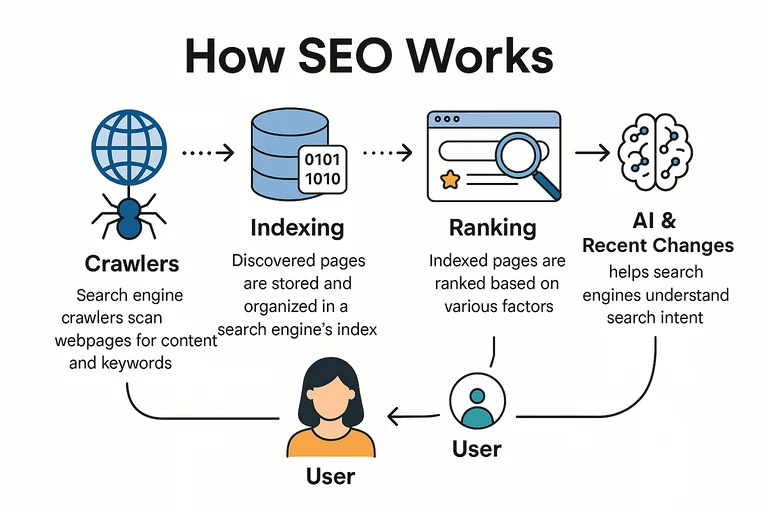
Content networks compound organic visibility because Google distributes ranking signals through internal links, so the entire cluster rises together rather than each page competing alone.
Authority Consolidation
When a pillar page links to 15 cluster pages and each cluster page links back, Google sees a clear topical hierarchy. SEMrush data shows websites using topic clusters achieve 38% higher organic traffic than traditional site structures. Sites sustaining this architecture for 12 or more months see the gap widen to 40%.
A single page targeting a competitive keyword will struggle against a competitor who has published 15 interconnected articles covering every angle of the same topic. Google’s language models recognize when a site genuinely covers a domain versus targeting a narrow keyword.
Passage Level Retrieval and AI Citation
Google indexes passages independently. Each H2 section in a content network page can compete for featured snippets and AI Overview inclusion on its own. When multiple pages in a network earn these placements, the compounding effect multiplies.
In my work building content architectures for clients across recovery services, legal, and ecommerce verticals, I consistently see the same pattern. Connected pages outperform isolated pages by a factor that grows over time. I have built client networks where 7 published pages resulted in 4 appearing in AI Overviews within 60 days. That compounding does not happen with scattered publishing.
AI systems like ChatGPT, Perplexity, and Gemini prefer citing pages that exist within structured content ecosystems. The surrounding pages provide contextual validation that isolated articles cannot offer.
5 Components of an Effective Content Network
Five components define an effective SEO content network. Remove any one of them, and the compounding effect weakens.
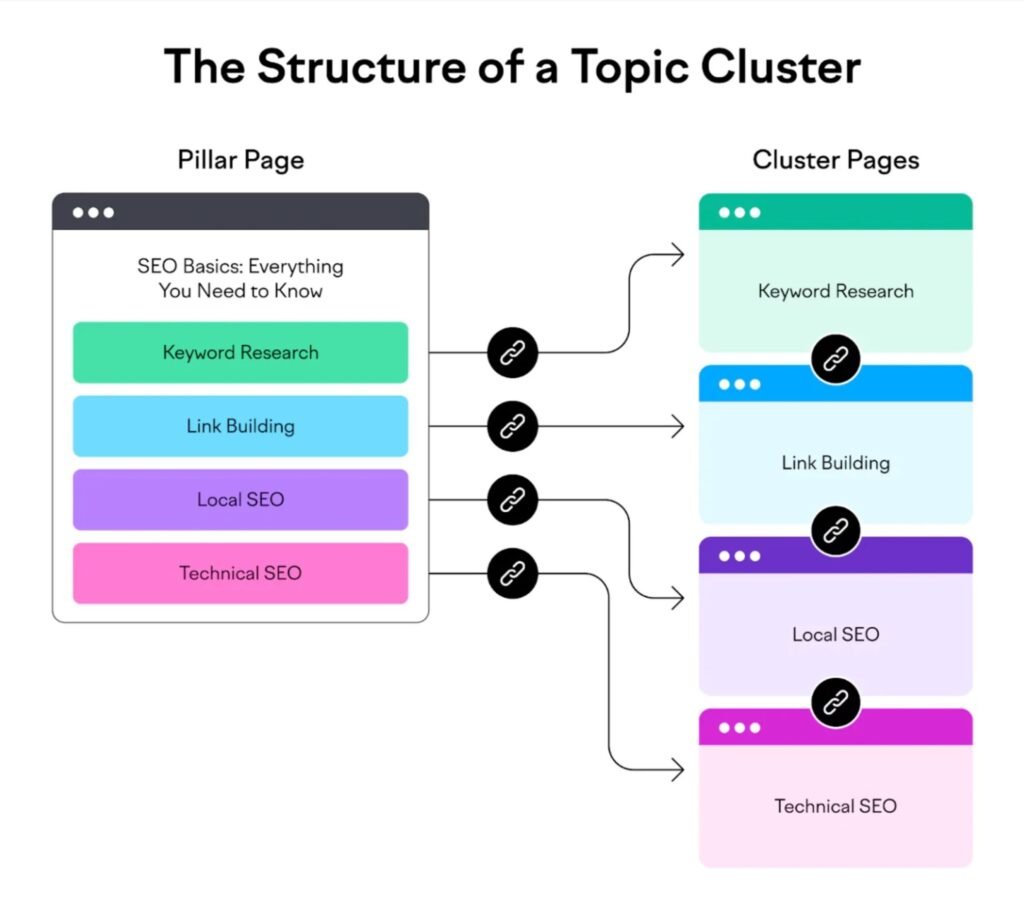
1. Pillar Page (The Hub)
A comprehensive overview of the core topic. Typically 2000 to 3000 words. Targets the broadest query in your cluster. Every cluster page links back to it, and it links out to every cluster page. The first 400 words should represent the entire document context if Google only processes the beginning.
2. Cluster Pages (The Spokes)
Each targets a specific long tail query within the topic. Typically 1200 to 2500 words. All cluster pages must maintain the same predicate as the pillar. If your pillar covers “semantic SEO,” then your clusters should address “how semantic SEO improves rankings” and “semantic SEO for local businesses.” NOT “what is keyword density.” That jumps to a different predicate and dilutes your context.
3. Entity Bridges
Pages that connect two related content networks on your site. These exist in the supplementary sections (roughly 20% of each page) and contain dual entity focus. The bottom sections mention both the current page topic AND a related page topic. This creates natural pathways between clusters.
4. Strategic Internal Links
Descriptive anchor text that includes the target page entity. Never “click here” or “read more.” Varied anchors across multiple links to the same destination. Links are placed within body content rather than navigation or footer.
Bidirectional linking: cluster pages link to the pillar AND the pillar links to clusters.
5. Measurement Framework
Track at the cluster level. Not individual pages. Combined organic traffic across all pages in the network. Number of AI Overview appearances. Ranking positions for both head terms and long tail queries. Internal link coverage with zero orphan pages.
How to Build an SEO Content Network in 6 Steps
Building an SEO content network starts with understanding your central entity and mapping real query paths before writing a single word.
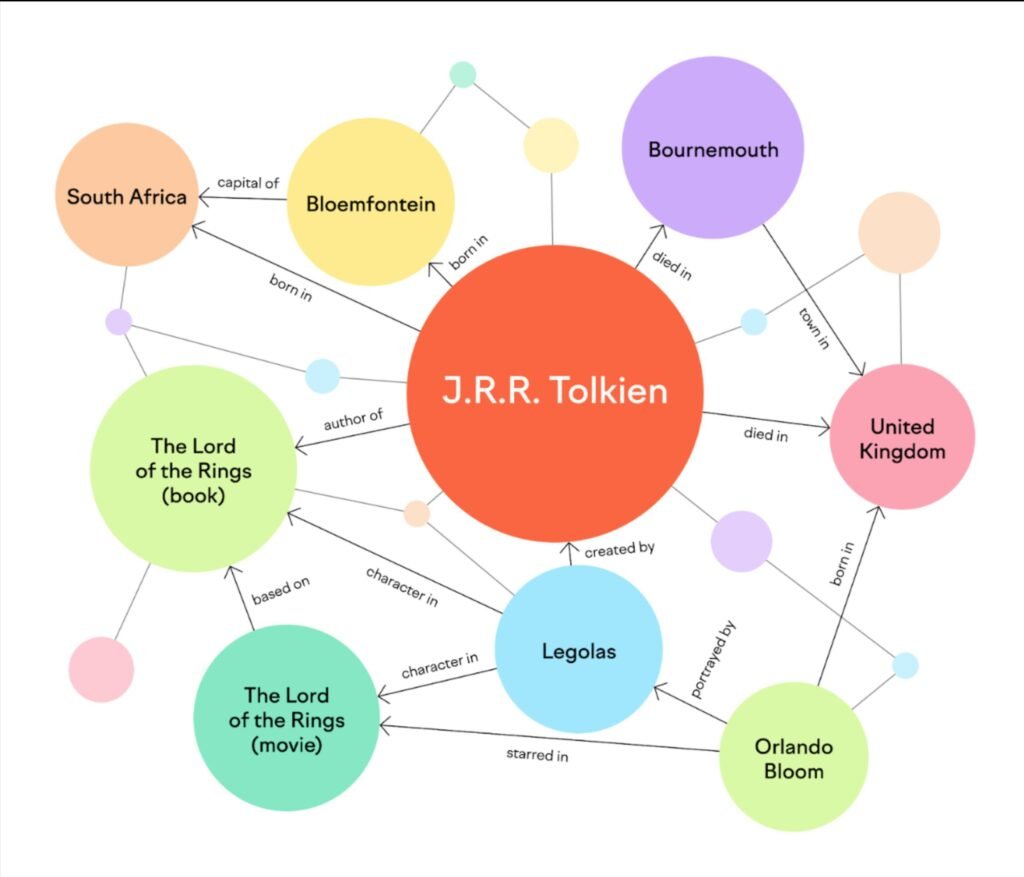
Step 1: Define Your Central Entity.
Identify the ONE topic your network will establish authority around. For a recovery services client in Texas, I mapped the central entity as “sober living” and every page reinforced that entity from a different angle: structured accountability, post-rehab transition, men’s recovery housing. Use the 3 box test: Is the attribute Prominent (defines the entity), Popular (people search it), and Relevant (fits your audience)?
Step 2: Map Your Query Paths.
Research what users search for BEFORE your target query. Identify the target query itself. Map what users search AFTER. Mine People Also Ask and Related Searches for cluster opportunities. This creates a content map based on actual user journeys.
Step 3: Design Your Pillar Page.
Write a comprehensive overview covering the full breadth of the topic. Include an extractive summary under H1 by collecting the first sentence from each H2 section. This technique ensures your page survives truncation.
Step 4: Create Cluster Pages Following the Same Predicate.
Each cluster page targets one specific micro query. All maintain the same predicate as the pillar. Apply the 80/20 rule: 80% focused on the main topic and 20% bridging to related content.
Step 5: Connect Everything Through Internal Linking.
Every cluster page links back to the pillar using the pillar keyword as anchor text. The pillar links out to every cluster page. Place your first internal link within the first 150 words. Use 10 or more anchor text variations across the network.
Step 6: Measure at the Network Level.
Stop evaluating individual page performance in isolation. Track combined organic traffic across the entire cluster. Monitor AI Overview appearances for all pages. Audit internal link coverage monthly. Expect the first signs of progress within 8 to 12 weeks, with compounding results visible at 6 to 12 months.
I structure every client content network around a central entity mapped to real query paths. This is the exact methodology I apply through my semantic SEO consulting practice.
Why Isolated Content Publishing Fails
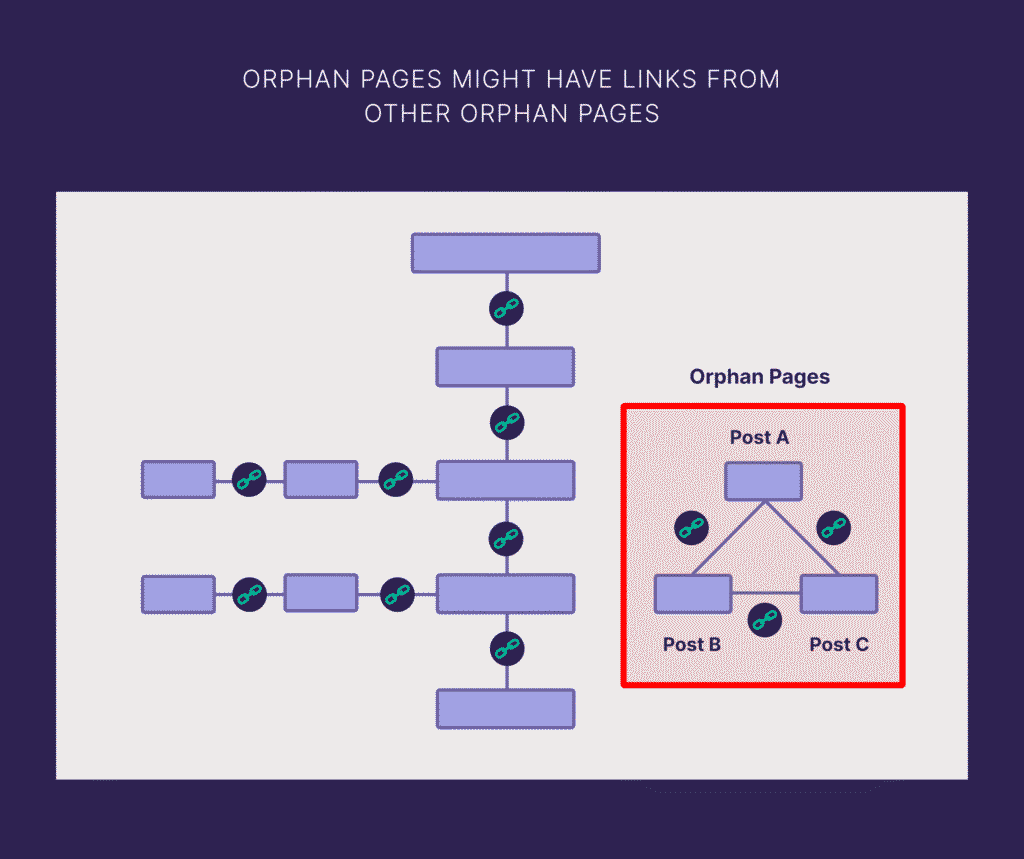
Isolated content publishing fails because Google evaluates topical depth across connected pages. Standalone articles without internal links signal shallow expertise.
Ahrefs data shows 90.63% of pages receive zero organic traffic from Google. Most of these are orphan pages with no internal linking and no topical cluster. Content cannibalization compounds the problem. When multiple isolated pages target similar keywords without a clear hierarchy, they compete against each other instead of reinforcing a single authoritative source.
The solution is not publishing more content. The solution is connecting what you already have into a network where every page makes the others stronger.
From Content Networks to Semantic Content Networks
A semantic content network advances the basic cluster model by connecting pages through entity relationships and meaning-based architecture rather than simple topic similarity.
The progression moves through stages. Isolated pages become topic clusters. Topic clusters become content networks. Content networks evolve into semantic content networks. Each stage adds a deeper layer of interconnection.
Semantic content networks incorporate Entity Attribute Value structures, extractive summaries, same-predicate architecture, and passage-level optimization that basic clusters miss. This is where compounding visibility truly accelerates because AI systems retrieve and cite specific passages from a semantically structured network with higher confidence than from loosely grouped clusters.
Key Takeaways
SEO content networks transform scattered publishing into a strategic architecture where every page compounds the visibility of every other page. Five components drive network performance. Compounding visibility requires the same predicate across all main sections. AI systems cite content network pages at higher rates because structured ecosystems provide contextual validation.
Start building your content network with the semantic content network strategy guide or explore how semantic SEO transforms content architecture for both Google and AI search systems.
Frequently Asked Questions About SEO Content Networks
About the Author: Usman Ishaq
Usman Ishaq is a semantic SEO strategist and topical content consultant specializing in entity-based optimization, content network architecture, and Generative Engine Optimization (GEO). As the founder of Digital Vikingz, Usman Ishaq builds interconnected content systems that rank in Google, earn citations from AI platforms (ChatGPT, Perplexity, Gemini), and convert readers into clients.
His methodology follows the Koray Tugberk GUBUR framework, applying a proprietary Semantic Content System that combines Entity Attribute Value structures with extractive summary optimization and AI visibility strategies. Usman Ishaq works across recovery services, ecommerce, legal, HVAC, and SaaS verticals through direct client partnerships and agency collaborations.
Hire Usman Ishaq for semantic SEO consulting on Upwork.
Connect: LinkedIn | YouTube | Facebook | Gravatar | usmanishaq.com
Share: