
No, every keyword does not need its own page, because one page answers one need and many keywords name the same need. A page decision is the step of semantic SEO that gives each search one place on a website: a page, a section or a sentence. A search earns its own page when the search passes the five checks of the page test. Twelve searches for one plumbing service produce four pages, so the page count of a website follows from the searches. Extra pages cost a website visibility and upkeep, and consolidation starts with the pages that already overlap.
Does every keyword need its own page?
No, every keyword does not need its own page. One page answers one need, and many keywords name the same need in different words. A keyword is a search: the words a customer types into Google. A query is the same thing. SEO practitioners agree that pages with the same need compete with each other. A keyword needs its own page when the need behind the keyword differs from every existing page. A keyword list of thousands of entries from keyword research does not call for thousands of pages. A long-tail keyword is a longer, more specific search. A closely related variation shares the need of an existing page. Every other keyword earns a section of a page or one sentence. Semantic SEO calls each such choice a page decision.
What is a page decision in semantic SEO?
A page decision is the choice of where a website answers one search: on its own page, in a section of a page or in one sentence. Semantic SEO is the practice of organising a website around entities, their attributes and the relationships between them, so that search engines and AI systems read what each page means. A page decision is the step of semantic SEO that turns a list of searches into a list of pages. A page decision has four parts: the search, the test, the verdict and the owning page. A page decision reads each search as an entity and an attribute. The entity is the thing the search is about. The attribute is the aspect of that thing. The search "how much does it cost to repipe a house" has the entity repiping and the attribute cost. The Semantic SEO Architecture service is the project that makes the page decisions for a whole website before a page is written. The topical map, the page plan from the Semantic SEO Architecture service, records a page, section or sentence verdict per search, with the reason.
What are the three verdicts of a page decision?
The three verdicts of a page decision are a page, a section and a sentence. The three verdicts of a page decision are defined below:
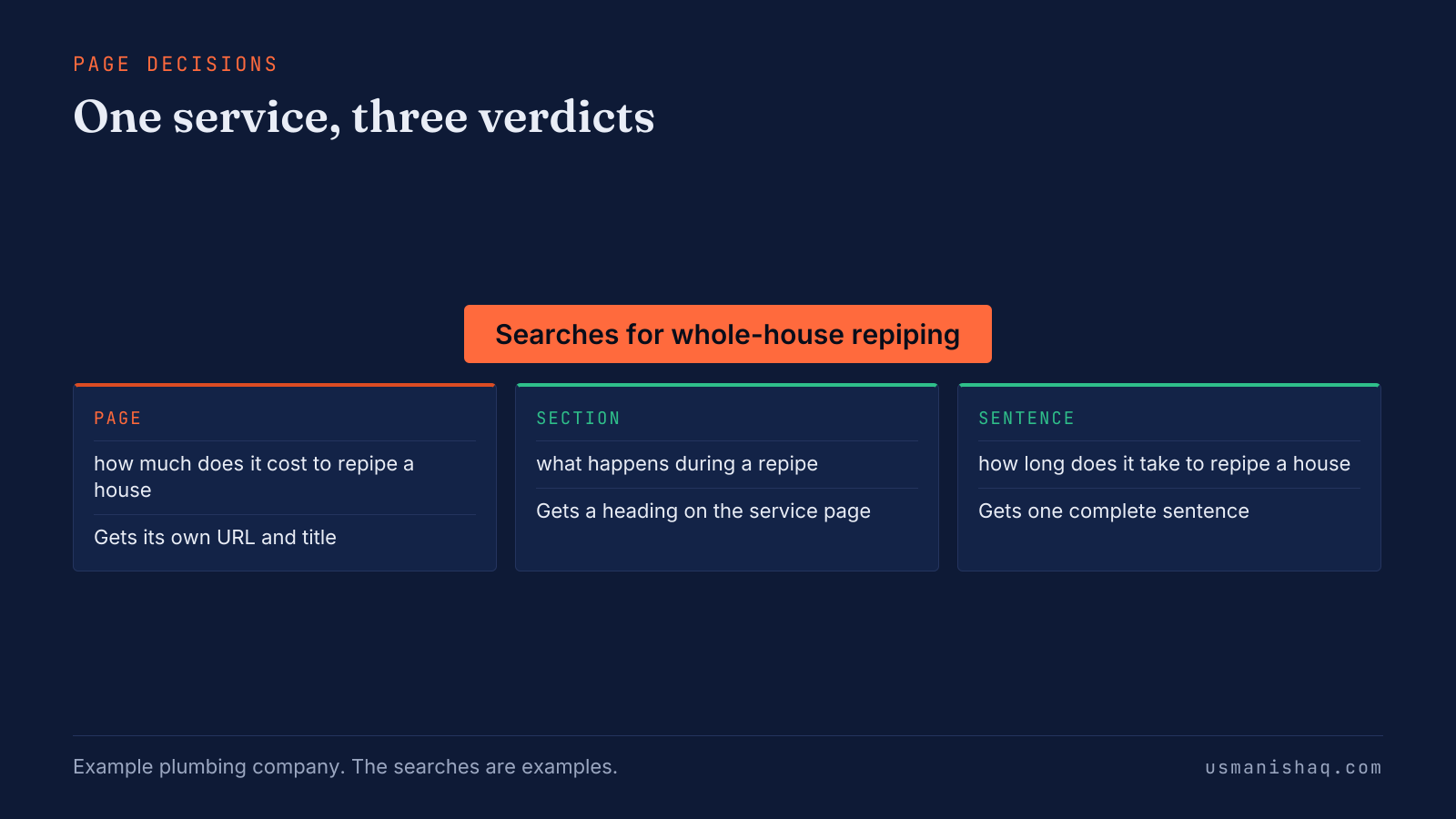
- Page: A page is one URL with its own title and its own main search. A search earns a page when the search passes the page test. The search "how much does it cost to repipe a house" earns a standalone page.
- Section: A section is a headed part of a page that answers one related search with a few paragraphs, a list or a table. A search earns a section when the search shares the need of an existing page and the answer needs its own heading. The search "what happens during a repipe" earns a section of the repiping service page.
- Sentence: A sentence is one complete statement of one fact inside a section. A search earns a sentence when one fact answers the search in full. The search "how long does it take to repipe a house" earns a sentence.
The figure below shows one repiping search for each verdict and the space each search gets.
Google Search Central's "A guide to Google Search ranking systems" describes a passage ranking system. The system identifies individual sections of a page to judge the page's relevance to a search. A section therefore counts toward the relevance of the whole page. Semantic SEO gives the third verdict to a search that earns only a sentence.
When does a search earn only a sentence?
A search earns only a sentence when one fact answers the search in full and a page for the same need already exists. The sentence should name the entity, the attribute and the value, so the sentence stands alone when lifted from the page. The sentence sits in the section where the reader meets the question. A page built around one fact has no second thing to say and becomes a thin page. The search "do you need a permit to repipe a house" earns one sentence in the process section of the repiping service page. The sentence states one yes-or-no fact about the permit. A sentence verdict states a fact and is not a keyword added to a page without an answer. Semantic SEO settles the other two verdicts of a page decision with the page test.
How do you decide whether a search earns its own page?
A search earns its own page when the search passes the five checks of the page test: no existing page, a new entity or attribute, a different job, different Google results and an outline that stands alone. The page test runs on real searches: customer questions from calls, Google Search Console and Google's typing suggestions. The five steps of the page test are listed below:
- Look for an existing page that answers the search, counting reworded searches as one. Pass: no page answers the search. Fail: the existing page takes the search as a section or a sentence.
- Name the entity and the attribute of the search. Pass: the entity or the attribute is new to the website. Fail: the pair already has a page.
- Ask whether the job differs. Pass: the search points to a different job, price, proof or next step. Fail: all four match an existing page. Proof is the reviews, photos and licences of the business.
- Compare the Google results for the new search and for the closest existing page's search, reading both first pages. Pass: most results differ. Fail: the same results answer both searches.
- Outline the new page and name the parent page, a service or subject the business sells. Pass: the outline repeats no existing page, and the parent page links to the new page. Fail: the outline repeats an existing page, or no page links to the new page.
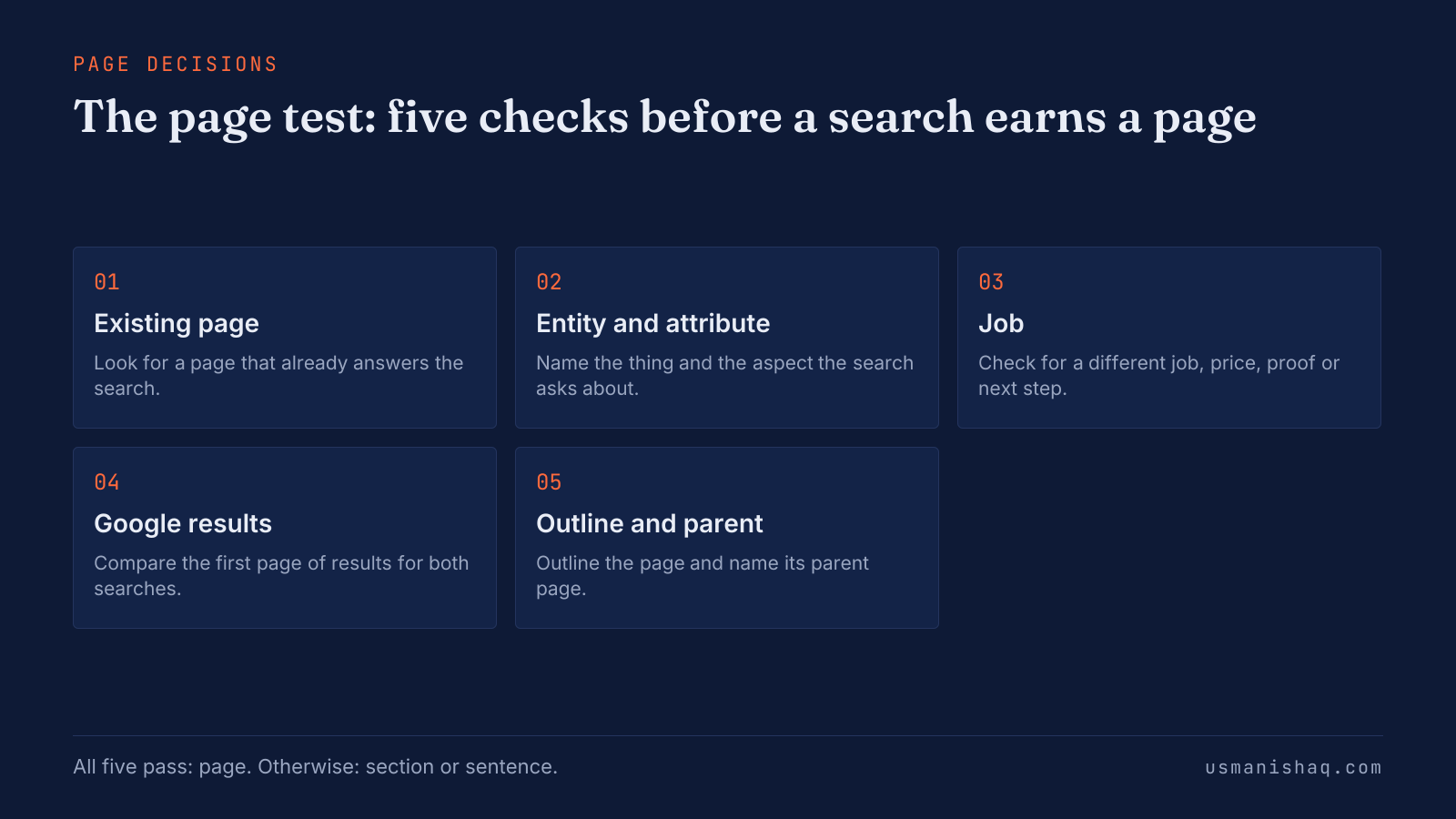
The figure shows the five checks in order. A search that passes all five checks earns a page. A search that fails a check and still needs its own heading earns a section. A search that one fact answers earns a sentence. A keyword deserves its own page only after the five checks pass. A search with a split result should start as a section. An online shop runs the same page test on category and filter pages. Semantic SEO runs the same page decision on every service.
Does every service need its own page?
No, every service does not need its own page, and a service earns a page when the job, the price, the proof or the next step differs from the other services. Owners ask about all services on one page or separate service pages. Google's ranking systems are designed to work on the page level, according to "A guide to Google Search ranking systems" on Google Search Central. A different job should therefore have a page that can rank for the job. An example plumbing company gives drain cleaning and whole-house repiping a page each: the jobs, prices and proof differ. Kitchen and bathroom drain cleaning share the job, the price list and the booking step, so both are sections of the drain cleaning page. One services page should list every service in a sentence or two and link to the individual service pages. Semantic SEO makes the same page decision for each search about one service.
How is one service sorted into pages, sections and sentences?
One service is sorted into pages, sections and sentences by running the page test on every search customers make for the service. The decision table uses whole-house repiping, a service of the example plumbing company, with example searches. The table below sorts twelve searches for whole-house repiping into a page, a section or a sentence, with the reason for each verdict.
| Search | Entity and attribute | Verdict | Where the answer lives | Reason |
|---|---|---|---|---|
| whole house repipe | repiping, the service | Page | Repiping service page | No other page answers the search. The job, the price, the proof and the booking step are its own |
| how much does it cost to repipe a house | repiping, cost | Page | Repipe cost page | A new attribute with its own answer: price ranges by home size and pipe material |
| pex vs copper repipe | repiping, pipe material | Page | PEX and copper comparison page | A different next step. The reader is choosing a material, not booking a job |
| signs you need to repipe | repiping, warning signs | Page | Signs page | A different next step. The owner has not decided on the job yet |
| what happens during a repipe | repiping, process | Section | Repiping service page | Same job and same next step as the service page. The answer is a list of steps |
| partial repipe or whole house repipe | repiping, scope | Section | Repiping service page | Same job and same quote. The answer is a short comparison |
| how to prepare your home for a repipe | repiping, preparation | Section | Repiping service page | Same customer at the same stage. The answer is a short checklist |
| repipe financing | repiping, payment | Section | Repipe cost page | Same need as the cost page. The answer is a short list of options |
| how long does it take to repipe a house | repiping, duration | Sentence | Process section of the service page | One fact: a time range |
| do you need a permit to repipe a house | repiping, permit | Sentence | Process section of the service page | One yes-or-no fact |
| repipe cost per square foot | repiping, cost in a second unit | Sentence | Repipe cost page | The same price stated in another unit |
| how long does pex pipe last | PEX pipe, lifespan | Sentence | PEX and copper comparison page | One value in the comparison table |
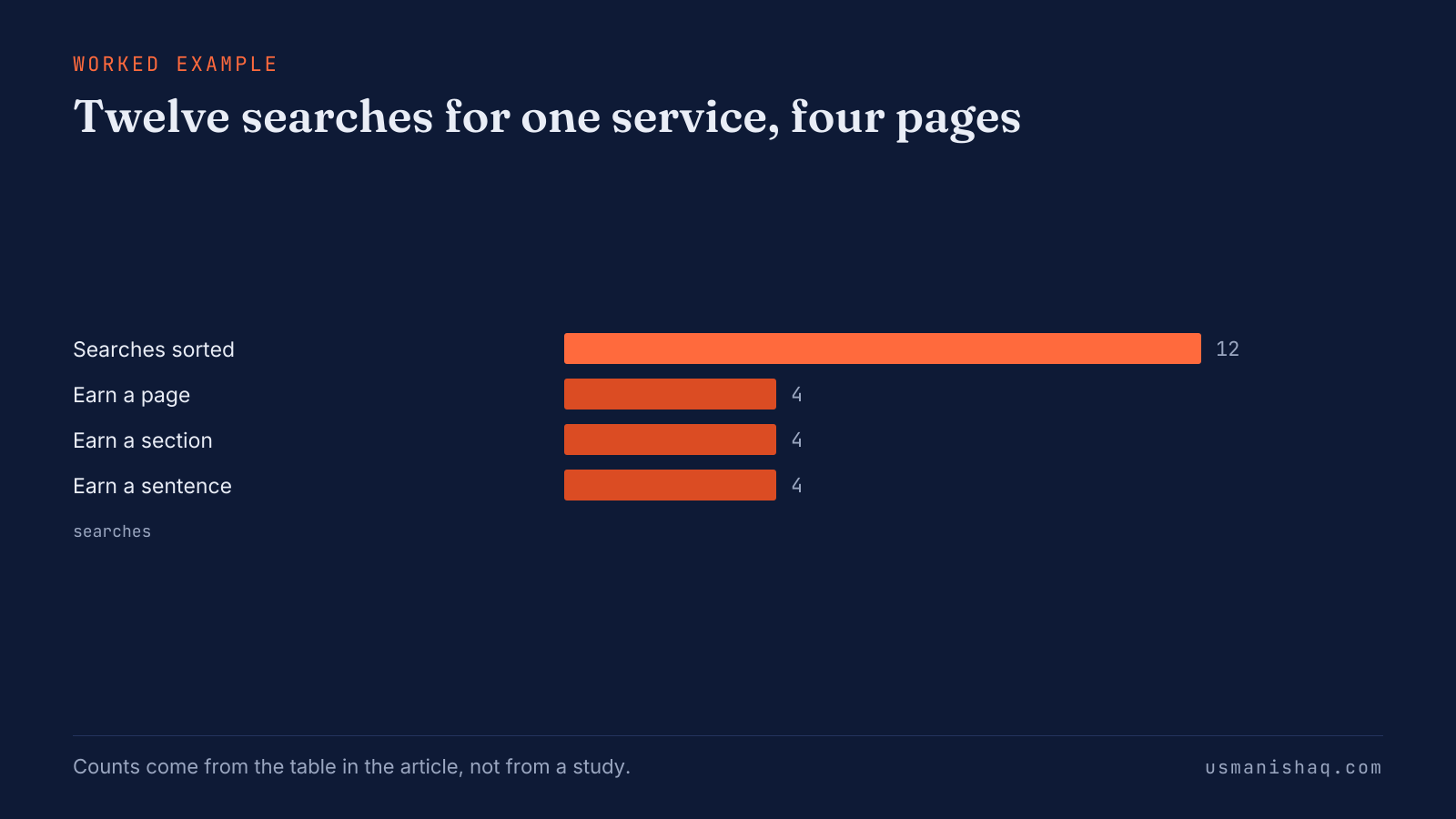
Twelve searches produce four pages, four sections and four sentences. I record the reason beside each verdict in the topical map, so the next person who plans a page reads why a search was not given one. The same page decisions on every service set the page count in semantic SEO.
How many pages does a business website need?
A business website needs one page for every search that passes the page test, so the page count follows from the business and no fixed number applies. Twelve searches for one service produced four pages in the table above. The figure below counts the same twelve searches by verdict: four pages, four sections and four sentences.
Three sources supply the pages: services that are different jobs, questions that pass the page test and the towns the business serves. A home page, an about page and a contact page are pages no search decides. Web design studios commonly advise 5 to 10 pages for a small service business. The range is a starting convention of studios and not a rule from Google. No Google document read for the guide sets a page count. Semantic SEO reaches the page count through page decisions, one search at a time. A page added without a passed page test is an extra page.
What do extra pages cost a website?
Extra pages cost a website visibility and upkeep: Google groups very similar pages and shows one, generally lists one site twice at most in top results, and treats pages made only to rank as spam. An extra page is a second page for a need the website already answers. Owners say "too many pages", and SEO practitioners say content bloat. A "repipe cost" page beside a "cost to repipe a house" page is one such pair. The costs of extra pages are listed below, each with the Google document that describes the system:
- Grouping: "What is canonicalization" on Google Search Central says Google clusters pages with the same or very similar main content. One page becomes the canonical, the representative page, and the duplicates are crawled less often. The scope is duplicate or very similar main content.
- One result: "A guide to Google Search ranking systems" describes deduplication systems that show only the most relevant results where matching pages are very similar. The scope is very similar pages.
- Two listings: the site diversity system in the same guide generally shows no more than two listings from one site in top results. More can appear where the systems judge that especially relevant. A third page for one need generally adds no third listing.
- Spam policy: Google Search Central's "Spam policies for Google web search" defines doorway abuse and scaled content abuse. Doorway abuse covers pages created to rank for specific, similar searches that lead users to intermediate, less useful pages. One listed example is substantially similar pages closer to search results than to a browseable hierarchy. Scaled content abuse covers many pages generated mainly to manipulate rankings, not to help users. Violating websites may rank lower or not appear. A useful page for each different job is outside both definitions.
- Upkeep: each page carries prices, photos, proof and links that the owner keeps current.
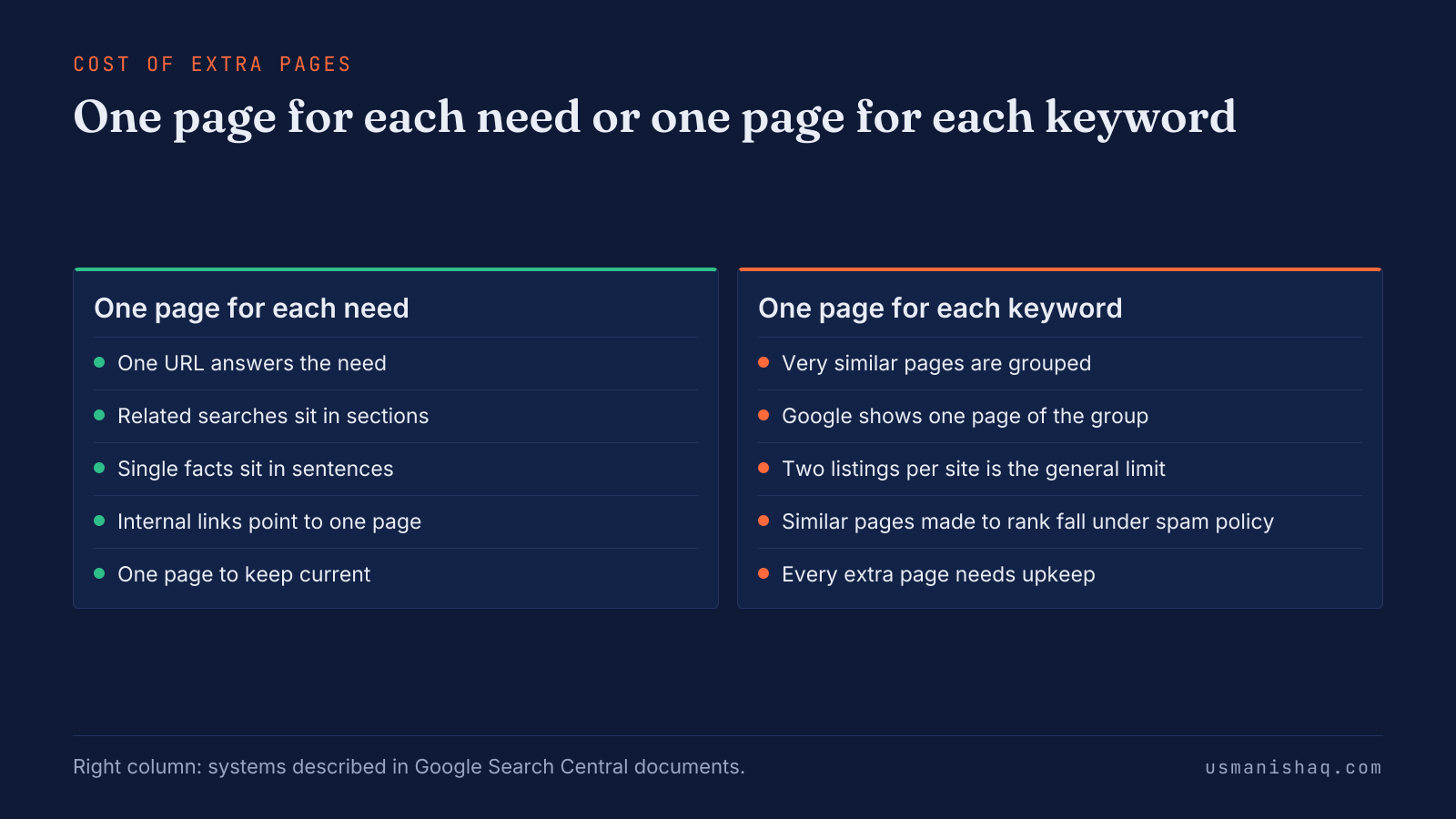
The figure compares one page per need with one page per keyword. Two pages compete with each other when both answer the same need. A page decision in semantic SEO avoids each cost, with or without copied text.
Can too many pages hurt SEO when no content is copied?
Yes, too many pages can hurt SEO without copied content, when two or more pages are very similar in what the pages answer. One view heard on owner forums holds that a large page count does no harm when nothing is copied. Google's wording goes beyond exact copies. "What is canonicalization" speaks of main content that is the same or very similar. "Spam policies for Google web search" speaks of substantially similar pages. Pages carry none of the costs when each page answers a different need, at any page count. The number of pages is not the cause. The overlap is the cause. A page decision in semantic SEO repairs pages that already overlap.
Which page do you keep when two pages overlap?
The page to keep should be the page with the most complete answer and the most impressions, clicks and links for the search, and the other page is merged into the kept page and redirected. Owners call the problem "pages that say the same thing". Keyword cannibalization is the name SEO practitioners give to two or more pages of one website that compete for the same search. Search Console shows the sign: one search with two pages of the website, or a shown page that keeps changing. The Semantic Content Audit is the review that finds every such pair across a whole website. The steps to consolidate two overlapping pages are listed below:
- Choose the page to keep.
- Merge the strongest content of the other page into the kept page as sections and sentences.
- Redirect the other URL to the kept page.
- Point every internal link at the kept page.
The issue map from a Semantic Content Audit records a page decision for every page in question. The document How to specify a canonical URL with rel="canonical" and other methods calls a redirect a strong canonical signal. The same document lists consolidating signals as a reason to name a canonical and asks for links to the canonical URL. The document What is canonicalization states that Google picks the most complete and useful page as canonical, and a stated preference is a hint. Both Google Search Central documents speak of duplicate or very similar pages. Semantic SEO meets the same question on service area pages.
How does a page decision apply to service area pages?
A page decision applies to service area pages with one added requirement: each town page carries the services, questions, proof and links of that town. A service area page, or town page, is a page for the work a business does in one town. Google's Spam policies for Google web search lists pages for regions or cities that funnel users to one page as doorway abuse. Such pages are less useful than the destination. The test for service area pages is a decision of its own. Every town page and every service page is one row of the same semantic SEO plan.
How does a topical map record page decisions?
A topical map records page decisions as rows: every search has one owning page, section or sentence. A topical map is the plan of every entity, attribute and question a website must cover, with one owning page, section or sentence for each. A recorded verdict stops overlap from returning with each new page. The structure of a semantic content cluster follows from the page decisions: one main page for the entity, one page for each attribute that passes the page test, and sections and sentences for the rest. The verdicts together form the semantic content architecture of the website. A topical map for a business website holds one row for each search. The guide to the topical map for a business website explains the rows inside the semantic SEO framework.
Where does the page decision come from?
The page decision comes from the semantic SEO framework of Koray Tuğberk Gübür, which names the test Query Deserves a Page. The framework of Koray Tuğberk Gübür applies the same test to the heading and the sentence. The topical map above is a concept of the same framework. The test is a planning method of the framework and not a confirmed Google mechanism. Google's A guide to Google Search ranking systems gives the name "query deserves freshness" to systems that show fresher content where expected. The freshness systems are a different thing. The phrase "query deserves diversity" appears in none of the Google documents read. The same guide describes a site diversity system.
Questions about page decisions
Page decisions in semantic SEO raise five further questions from owners and marketers: keywords per page, one-page websites, page count, blog posts and the moment a section becomes a page.
How many keywords should one page target?
One page should target one main search, and the related searches that share the need become the sections and sentences of that page. The rule of one keyword per page holds for the main search only: every page needs one main search, and not every search needs a page.
Can a one-page website work for a small business?
A one-page website can work for a small business with one service in one area. A business with several different jobs should give each job that passes the page test its own page, because one page holds one main search.
Do more pages help a website rank?
No, more pages do not help a website rank by number alone. Google's Creating helpful, reliable, people-first content treats lots of content on many different topics, produced in hope of search performance, as a warning sign.
Should a customer question get a blog post or an FAQ answer?
A customer question should get a blog post when the question passes the page test, and an FAQ answer when one or two sentences answer the question in full. A question between the two earns a section on the page of the service the question is about.
When should a section become its own page?
A section should become its own page when Search Console shows the page earning impressions for the section's search and the section has outgrown one heading. The new page passes the five checks of the page test before the section is moved.
Page decisions: the short answer
Not every keyword needs its own page: a page decision gives each search a page, a section or a sentence. The page test decides the verdict, and the topical map records the verdict. Understanding page decisions in semantic SEO comes first, and building the decisions into a website happens in the topical map.