
A semantic content audit checks six things: competing pages, missing topics, competitor gaps, citable answers, page layout and consistent wording. The audit delivers a written issue map of the site and a 45-minute review call on the findings. Each audit runs in five stages: access, crawl and read, live results checks, the issue map and the review call.
The audit is for owners and marketing leads whose site has ten or more indexable pages and a decision ahead. Every audit is priced as one flat fee, quoted in writing before any access to the site is granted.
A semantic content audit reads pages by meaning and coverage, a content audit sorts pages by performance, and a technical SEO audit checks crawling.
What is a semantic content audit?
A semantic content audit is a review of website pages by meaning, topic coverage and entity relationships, with each fix ranked by cost.
The audit reads what each page means and which search each page answers, not how often a keyword appears. "Semantic audit" and "semantic SEO audit" name the same review. A person reads the pages, with a site crawl and Google Search Console data as evidence.
A content audit sorts pages into keep, update, merge, redirect or remove; a semantic content audit adds which page should answer which search.
Owners usually arrive with competing pages, or rankings that barely moved after a report. Semantic SEO work starts from a semantic content audit, because new pages built on an unread site repeat the old faults. Six checks do the reading.
What does a semantic content audit check?
A semantic content audit checks six things: competing pages, missing topics, competitor gaps, citable answers, page layout and consistent wording.
Each check has one failure and one usual fix, explained in the sections below. The six checks, the problem each one finds and the usual fix are given in the table below:
| Check | What the owner sees | Usual fix |
|---|---|---|
| Competing pages | Two pages answer the same search | Merge, or give each page its own search |
| Missing topics | A service or town with no page | A new page or section |
| Competitor gaps | Questions every top result answers | Additions in order of demand |
| Citable answers | AI answers name competitors | One-sentence answers and a named author |
| Page layout | The answer sits below banners | A template change |
| Consistent wording | One service, several verbs | A wording list, then a rewrite |
The checks run on every indexable page, and I read the core pages in full. Each check tests one part of semantic SEO on the pages the site already has. Pages that compete come first.
Which pages compete for the same search?
The pages that compete for the same search are two or more pages of one site that target the same service or question.
Picture a plumbing company based in Springfield with a "drain cleaning" page and a "blocked drains" page. Both pages answer "drain cleaning springfield".
Owners describe the problem as pages competing. Practitioners call the problem cannibalization. The method term is semantic dilution: one search split across several URLs.
Search Console shows the sign: one search with two pages of the website, or a shown page that keeps changing. Google's "guide to Google Search ranking systems" says deduplication systems show "only the most relevant results" when pages are very similar.
The semantic content audit records a page decision for each pair. The rules behind a page decision for each search also cover searches with no page.
Which topics have no page on the site?
The topics with no page are the services, towns and customer questions the business covers that no page or section answers.
The Springfield plumber installs water heaters, yet "water heater installation" appears only in a list on the home page. Franklin, the company's second town, doesn't have a page at all.
Entity coverage, the method term, means every service, place and question the business covers has a page or a section with the answer.
The fix is a new page or a new section, decided topic by topic. The semantic content audit finds the gaps by setting the services and towns the business names against the pages that exist. Competitors point to a second kind of gap.
Which topics do competitors cover that the site does not?
The topics competitors cover and the site does not are the questions every top result answers for a core search.
The semantic content audit runs each core search and compares the site with three competitors. Every top result for "repiping springfield" explains pipe materials. The plumber's site never names one.
Competitive entity gaps is the method term for questions like that one. The fix is a set of additions, made in the order of search demand. AI answers expose a different gap.
Which pages give answers an AI system can cite?
The pages that give answers an AI system can cite state each answer in one plain sentence, under its heading, with a named source.
The semantic content audit marks three failures: two claims in one sentence, a page with no named author and a claim with no evidence.
The test is a set of prompts for the core questions. I record which answers name the site and which name competitors.
AI citation readiness is the method term for the check. GEO, AEO and LLM SEO name the same work. The usual fix is a round of sentence rewrites and an author block near the top of the page.
Which pages push the main content below other blocks?
The pages that push the main content down put a banner, slider, share bar or date stamp between the H1 and the answer.
The semantic content audit checks that the opening 400 characters below the H1 name the service, state the answer and show the page's job. Centerpiece and block order is the method term for the main component and the order of blocks around the main component.
A Google patent, "document segmentation based on visual gaps", describes splitting a page into blocks by white space. Patents describe systems Google has invented, and no patent is a confirmed ranking factor.
The usual fix is a change to the page template, trialled on a small set of pages before the rest of the site. Wording is the last check.
Which services are described with different words on different pages?
The services described with different words are services that one page names with one verb and another page with a different verb.
One page of the plumbing site "installs" water heaters, another "fits" water heaters, and a third "sets them up". Owners call the goal staying consistent across pages.
Predicate consistency is the method term for the check. A predicate is the verb that ties the business to a service. Mixed verbs can blur which page answers which search.
The usual fix after a semantic content audit is one wording list for the site, then a rewrite pass. All six checks end up as written findings.
What do you receive from a semantic content audit?
A semantic content audit delivers a written issue map of the site and a 45-minute review call on the findings.
The issue map is a document that lists every finding with the page, the check the page fails, the evidence and the fix. The same document records a page decision for every page in question.
Every finding carries evidence: the crawl entry, the recorded search results or the quoted sentence from the page. The figure below shows one finding as written, using the plumbing example.
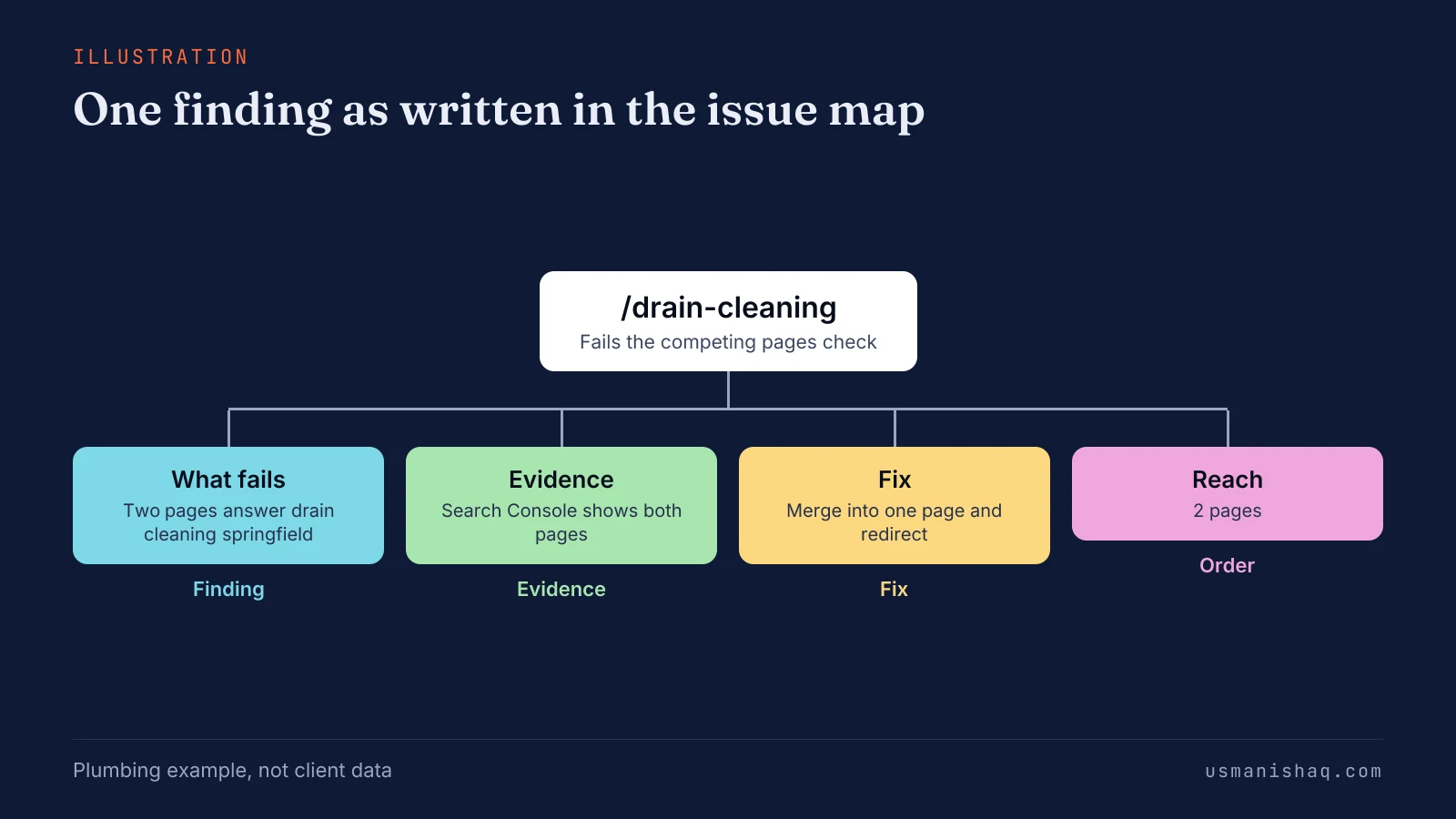
A common fear is a long report that leaves the owner asking what to do first. The document answers that fear with an order of work.
None of the findings depends on hiring the same consultant for the fixes. The issue map is the first document of any semantic SEO plan for the site. The findings follow a set order.
How are the findings ordered?
The findings are ordered by reach first, so a fix that corrects a whole page template ranks above a fix to one paragraph.
Reach is the number of pages one fix corrects. The larger problem comes first when two fixes cost about the same. The top of the issue map lists the fixes to start with.
A template fix for every service page outranks a rewrite of the Franklin paragraph. Ordering is stage four of a semantic content audit run.
How does a semantic content audit run?
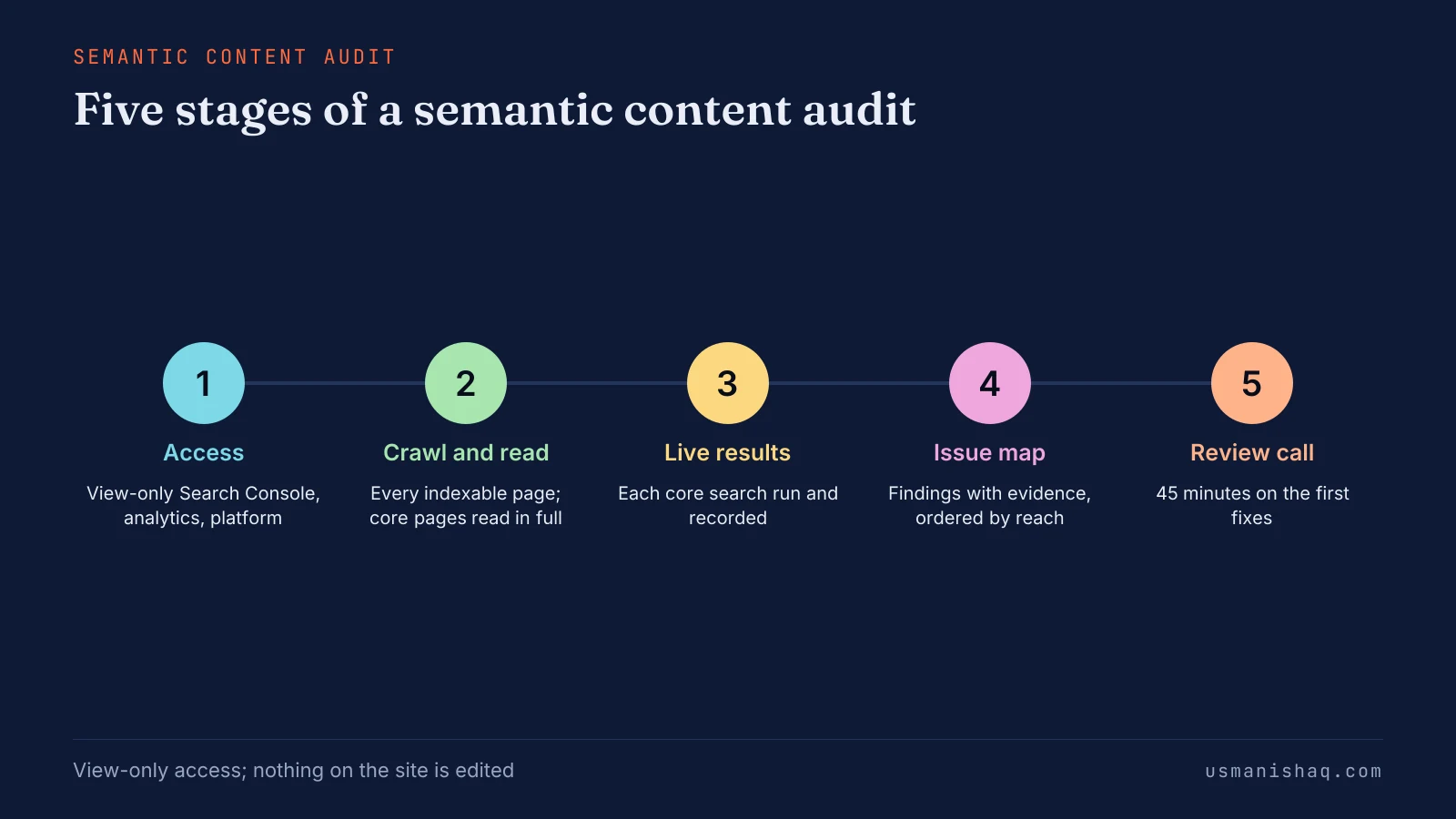
A semantic content audit runs in five stages: access, crawl and read, live results checks, the issue map and the review call.
The five stages of a semantic content audit are listed below:
- Access: view-only audit logins for Search Console, analytics and the website platform, plus one contact for business facts.
- Crawl and read: a crawler covers every indexable page, and I read the core pages in full.
- Live results checks: I run each core search and note which page types fill the top results.
- Issue map: every finding is written up with evidence and sorted by reach.
- Review call: 45 minutes on the issue map, the first fixes and the path that follows.
Search Console is Google's free report on how a site appears in Google Search. The audit edits nothing on the site. Each stage reads the site in the order semantic SEO plans a site: by search, by page and by meaning.
The figure below lays the five stages out in order.
The five stages need a site of ten or more indexable pages, which settles who the audit is for.
Who is a semantic content audit for?
A semantic content audit is for owners and marketing leads whose site has ten or more indexable pages and a decision ahead.
The situations where a semantic content audit fits are listed below:
- Rankings that stalled or dropped after a core update and never recovered.
- A redesign, restructure or migration that needs a list of what stays and what goes.
- A blog or content library that grew without a plan.
- AI answers that name competitors for the main service and leave the business out.
- A provider being chosen, or an earlier audit that changed nothing.
One of the five is reason enough.
A typical fit is a plumbing or HVAC company that serves several towns, with service and town pages written by different people. The audit does not fit a site under ten indexable pages with no content history, where the 30-minute call is the better start.
The audit is also an independent written read of semantic SEO work another provider delivered. Which situation applies does not change how the audit is priced.
How is a semantic content audit priced?
A semantic content audit is priced as one flat fee, quoted in writing before any access to the site is granted.
The fee covers the issue map and the 45-minute review call. Two things set the fee: the number of indexable pages and the language versions in scope. The Springfield plumber's English-only site is priced on the page count alone.
The fee includes no hourly billing, no retainer and no fixes. I write the exact scope into the quote after the 30-minute call.
The fee buys a diagnosis of the site's semantic SEO, not a promise of rankings. The decision ahead of the owner sets what the audit is worth.
Is a semantic content audit worth paying for?
A semantic content audit is worth paying for when a rebuild, a migration or a retainer decision costs more than the audit fee.
A free tool report lists crawl errors and scores. A semantic content audit decides which page should answer which search. The figure below sets the two scopes side by side.
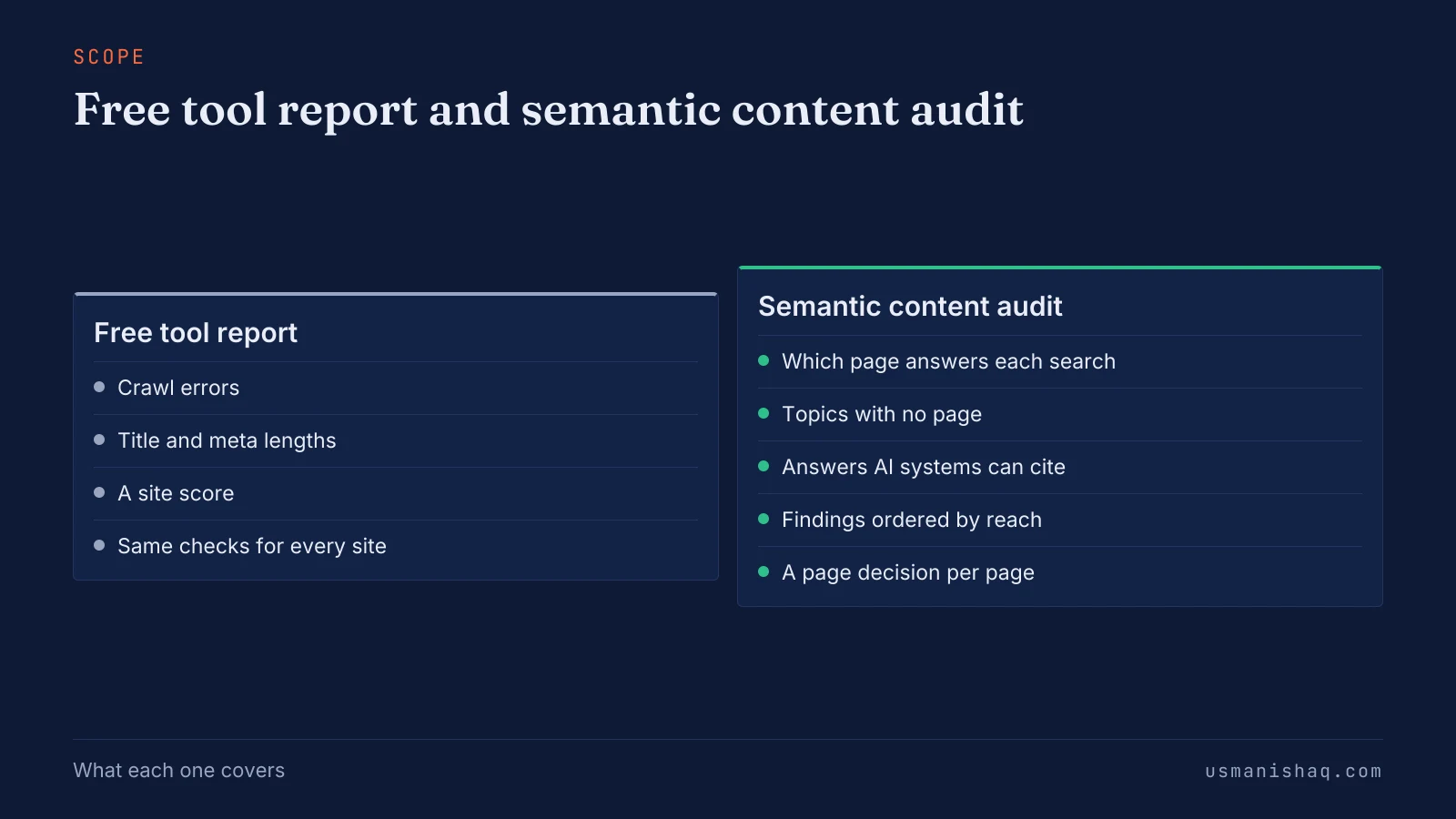
Some owners suspect a paid audit is only a sales step toward a retainer. The issue map doesn't need a further hire to be useful.
The audit is not worth paying for on a site under ten indexable pages. The audit is the smallest test of whether a site needs semantic SEO work at all. Two other audits often get confused with the semantic one: a content audit and a technical SEO audit.
How does a semantic content audit differ from a content audit and a technical SEO audit?
A semantic content audit reads pages by meaning and coverage, a content audit sorts pages by performance, and a technical SEO audit checks crawling.
The three audit types, the question each answers and what each delivers are compared in the table below:
| Audit type | Question it answers | What it reviews | What it delivers |
|---|---|---|---|
| Semantic content audit | Which page should answer which search? | Meaning, coverage, wording, layout | An issue map with a page decision per page |
| Content audit | Which pages to keep, update, merge, redirect or remove? | Traffic, quality, age | One action per URL |
| Technical SEO audit | Can search engines crawl and index the site? | Server, speed, crawl, rendering | A list of technical faults |
The three audits are complementary. Many sites need more than one. A plumbing site with slow pages and competing drain pages needs a technical SEO audit and a semantic content audit.
The semantic content audit touches rendering and crawling only where either one hides the main content or blocks indexing. A full technical SEO audit is a separate scope. Semantic SEO needs all three, in the order the findings set.
Owners now ask about a fourth option: ChatGPT.
Can ChatGPT do an SEO audit?
ChatGPT can do part of an SEO audit on pages a person supplies, and holds no Search Console data or site crawl by default.
A chat model given page text can spot two claims in one sentence, missing headings and unclear answers.
A semantic content audit adds Search Console data and a crawl of every indexable page. The audit also adds live results for each core search and a person's page decision. The citable answers check puts AI to work through a prompt set that records cited sources.
The full order of the checks is described in how a semantic content audit runs. Three Google documents sit behind the checks.
Which Google documents describe what the checks look for?
Three Google documents describe what the checks look for: a patent on page segmentation, the spam policies and the ranking systems guide.
Two of the documents are Google Search Central pages, and the third is a patent assigned to Google LLC. The three documents and the check each one informs are listed below:
- Document segmentation based on visual gaps (US 7,676,745 B2): a document's block hierarchy, found from visual white space; the page layout check reads the order of blocks under the H1 on the same principle.
- Spam policies for Google web search: misleading functionality, sites that "trick users into thinking they would be able to access some content or services"; the page layout check marks any button, form or widget that offers a service the page does not deliver.
- A guide to Google Search ranking systems: deduplication systems show "only the most relevant results" among very similar pages; the competing pages check finds pairs of near-identical pages on the site.
Semantic SEO work on the site follows the three documents, so every page meets the standard each document sets. A few practical questions about the semantic content audit remain.
What else do owners ask about the Semantic Content Audit?
Owners ask two more questions about the Semantic Content Audit: frequency and next steps.
How often should a site run a semantic content audit?
A site should run a semantic content audit at least once a year, and more often when the site publishes new pages every month.
What happens after the audit?
The audit leads to one of three paths: in-house fixes, Semantic SEO Architecture with the issue map as phase one, or no further work. The third path applies when the issue map finds no need for semantic SEO work on the site.
How do you start a semantic content audit?
A semantic content audit starts with a 30-minute call with the site open, followed by a written quote for the flat fee. The scope of the audit is agreed on that call.
The audit shows how search engines understand the site, so the next semantic SEO work is built on findings.