
A semantic SEO architecture project delivers seven documents, led by a topical map and a 12-month publishing roadmap. The project runs in six stages, from two working sessions with the business to a recorded handoff workshop.
Each project is for a business about to build, rebuild or expand a website that needs the page plan first. Every project is priced as one fixed scope, quoted in writing after a 30-minute call and before any work starts.
A per-topic topical map service prices and lists topics, while a semantic SEO architecture project decides which page, section or sentence owns each search.
What is semantic SEO architecture?
Semantic SEO architecture is the plan of a website's pages around a business's entities, attributes and searches, with one owning page per search.
The plan starts from what the business sells and what customers search, rather than isolated keyword pages. An entity is a thing the business sells or serves, such as a service or a town. Owners call the plan the site structure, or the list of pages a business needs.
Searches for semantic content architecture, semantic SEO structure and semantic SEO infrastructure ask for the same plan. Semantic SEO architecture means a website plan, not the semantic layer of a data warehouse.
Semantic SEO Architecture is the fixed-scope project that produces a topical map and a twelve-month publishing roadmap. Semantic SEO organises a website around entities, their attributes and their relationships, so search engines and AI systems read what each page means. The plan arrives as seven documents.
What does a semantic SEO architecture project deliver?
A semantic SEO architecture project delivers seven documents, led by a topical map and a 12-month publishing roadmap.
All seven come with every project, each written as plain instructions for its user.
The seven documents, what each one decides and who uses it are given in the table below:
| Document | What it decides | Who uses it |
|---|---|---|
| Business description | What the business sells, to whom and where, with one name per service | Everyone who writes or builds |
| Wording list | The one word the site uses for each thing, and the words it never uses | Writers and editors |
| Topical map | The page, section or sentence that owns every search, with the reason | The owner, writers and the developer |
| Fact sheet per service | The details each page must state, and the values to collect before writing | Writers and a subject-matter contact |
| Internal link plan | Which page links to which, with what anchor | Editors and the developer |
| 12-month publishing roadmap | The order each page goes live in, with a checkpoint per page | The project owner |
| Technical specification | Schema per page type, identity details, rendering rules and the URL scheme | The developer |
The fact sheet is what the method calls an entity-attribute matrix: the details each service or town must state. The brief format arrives with three worked example briefs. A recorded handoff workshop closes the project.
Buyers searching for a topical map service get the map as document three. Each document fixes one part of the semantic SEO plan before a writer or developer starts. One row shows how the decisions read.
What does one row of the topical map show?
One row of the project's topical map names a search, its owning page, section or sentence, and the reason for that decision.
A topical map for a business website is the plan of every entity, attribute and question the website must cover, with one owning page, section or sentence for each.
A Springfield plumber's topical map gives the search "how much does it cost to repipe a house" its own page, /repiping/cost/. The repipe cost page links to the whole-house repiping page. The figure below shows that row.
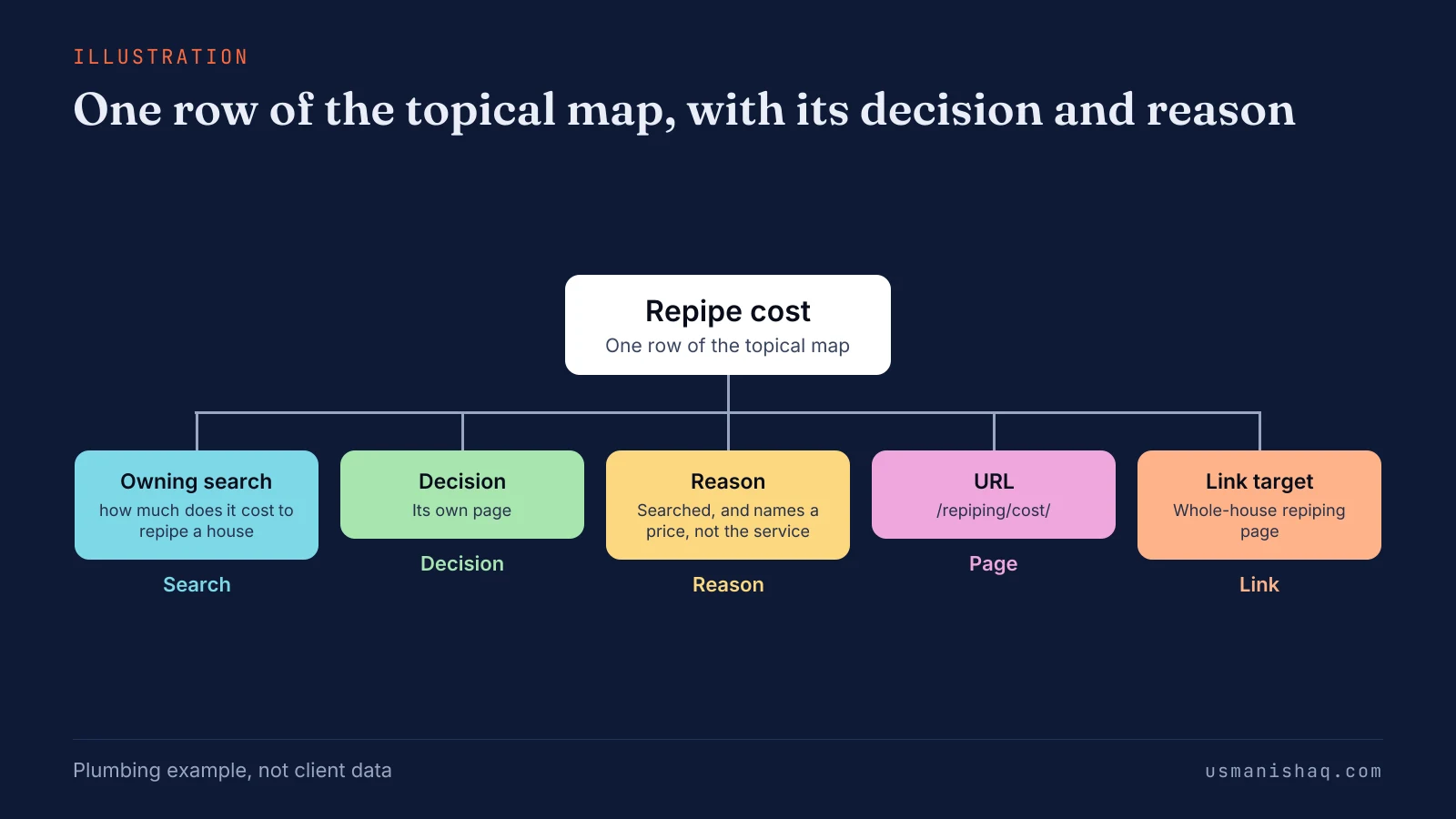
The same map makes the question "what happens on repipe day" a section of the repiping page for one town. Each decision records its reason as demand, entity difference, similarity and pattern.
I record each reason in a semantic SEO architecture project, so the business can overrule any decision. The roadmap keeps each overrule for the 90-day review. The guide on how a topical map for a business website is built runs from the first search to the roadmap.
What does the 12-month publishing roadmap set?
The 12-month publishing roadmap sets the order in which planned pages go live, with core pages before the outer pages that link to them.
Two keys set the order: what each page depends on, and which pages can earn the first clicks.
The plumbing roadmap opens with the whole-house repiping and repipe cost pages. The Springfield and Franklin town pages follow, then the PEX vs copper and signs-you-need-a-repipe question pages. The figure below shows that order.
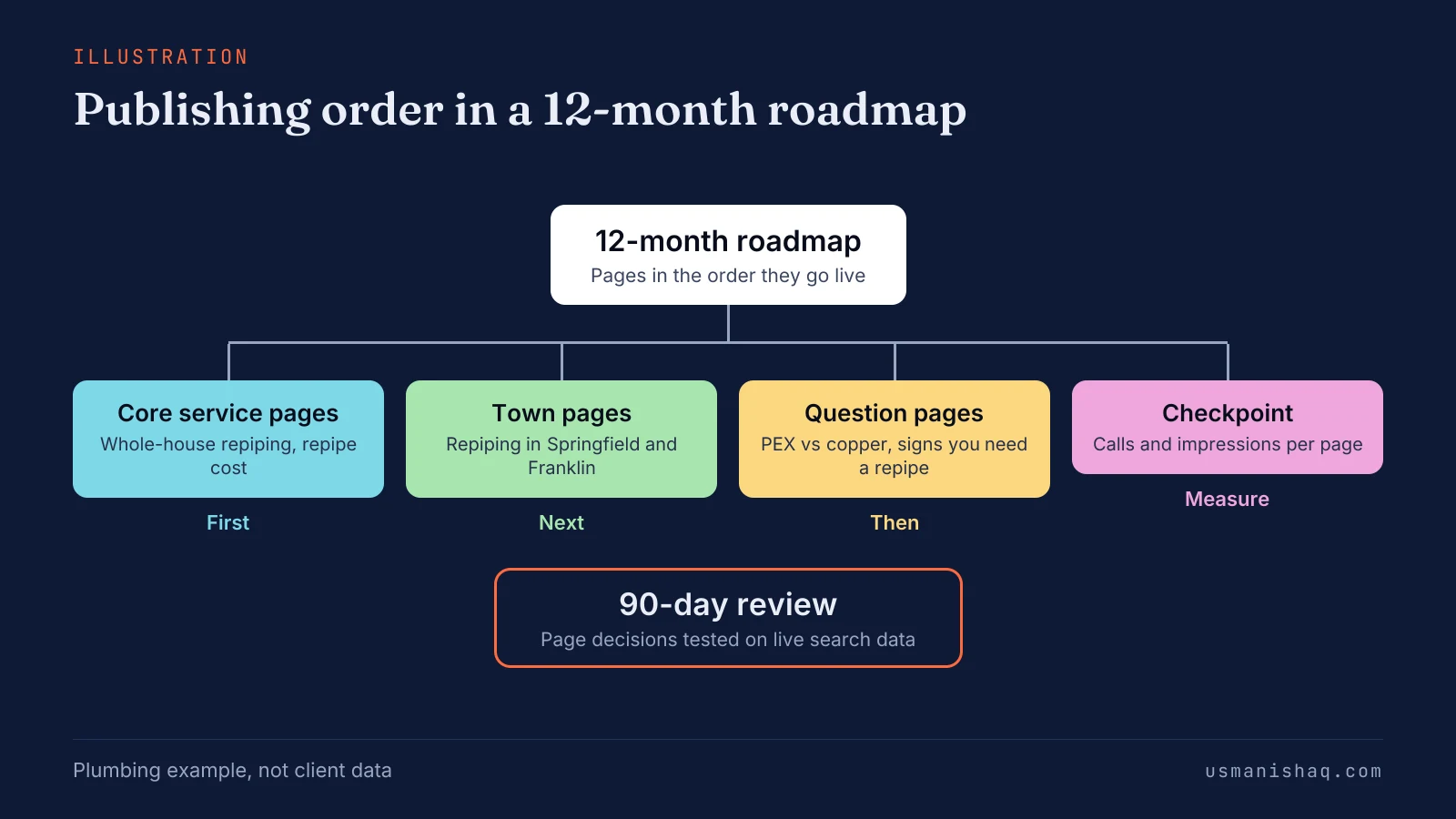
Each page carries a checkpoint, read in calls, quote requests and booked jobs beside impressions in Google Search Console. The 90-day review tests the page decisions against live search data.
A roadmap in a semantic SEO architecture project orders the pages of the map, not monthly tasks. The roadmap turns the semantic SEO plan into a publishing pace the team can hold.
Six stages produce the map and the roadmap.
How does a semantic SEO architecture project run?
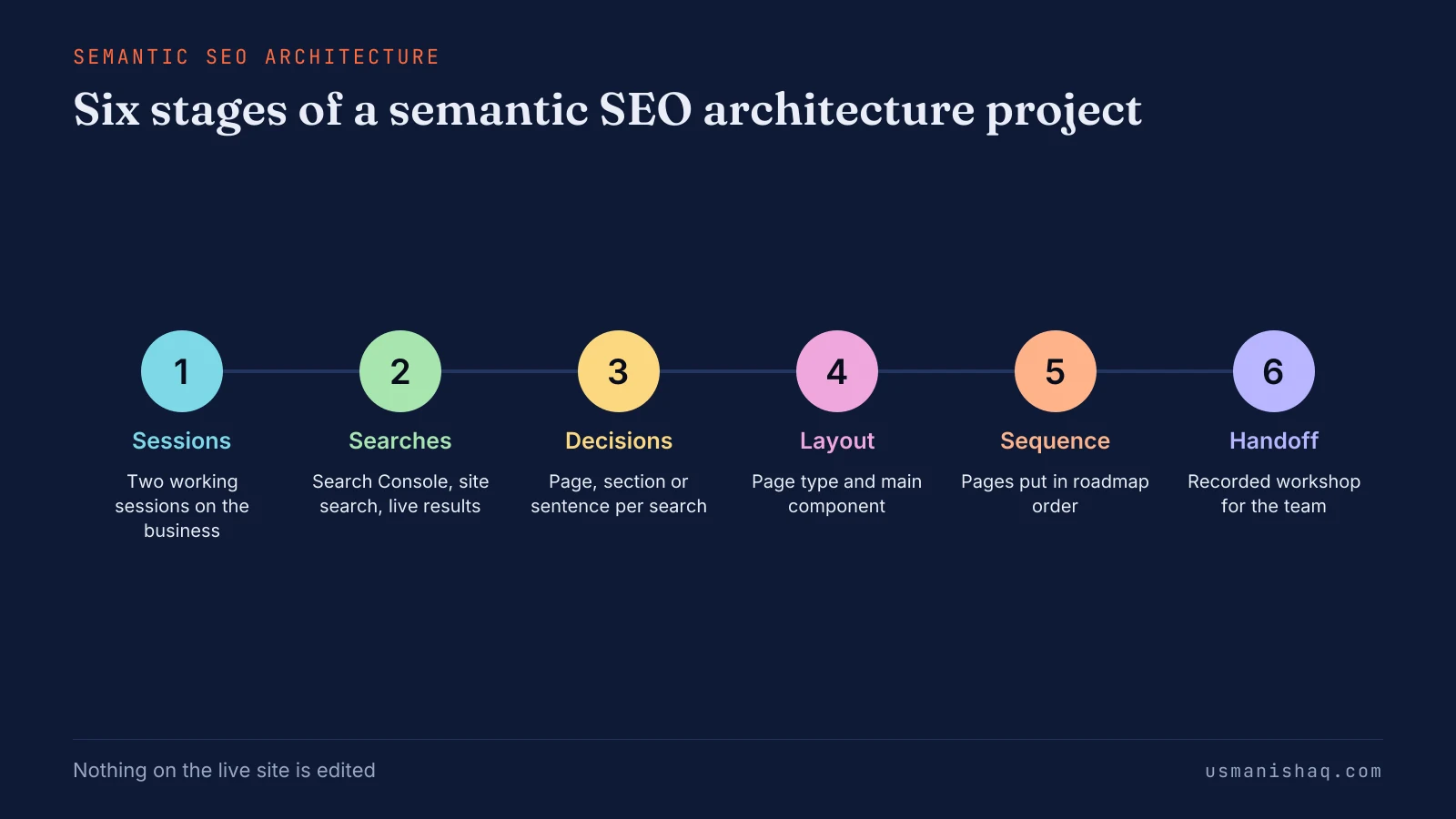
A semantic SEO architecture project runs in six stages, from two working sessions with the business to a recorded handoff workshop.
The six stages of a semantic SEO architecture project are listed below:
- Working sessions: two sessions with the owner or founder fix the business description and the first wording list.
- Search collection: I gather searches from Search Console, the site's search logs, the live results and the rewordings an AI system gives.
- Page decisions: every search gets its own page, section or sentence, with the reason recorded.
- Page layout: each planned page is assigned a page type and a main component, such as a price card on a cost page.
- Sequencing: the pages are put in roadmap order.
- Handoff workshop: a recorded session walks the team through every document.
The project edits nothing on the live site. Each stage settles one semantic SEO decision before the next stage starts. The figure below lays the six stages out in order.
Several stages depend on what the business supplies.
What does the business supply during the project?
The business supplies read access to Google Search Console and analytics, two working sessions with the owner and one contact for service facts.
The inputs the business supplies during a semantic SEO architecture project are listed below:
- Read access: Google Search Console and analytics, plus the site's search logs where the logs exist. Search Console is Google's free report on how a site appears in Google Search.
- Owner time: the founder or owner joins the two working sessions.
- A subject-matter contact: one person who supplies fact-sheet values, such as prices, materials and service areas.
- A developer review: the developer reads the technical specification at handoff.
No login with edit rights is needed, because nothing on the site changes. Writers need no semantic SEO training, because each document reads as plain instructions. The workshop recording stays with the team.
The project fits trade businesses, service firms and founders who still have a website to plan.
Who is a semantic SEO architecture project for?
A semantic SEO architecture project is for a business about to build, rebuild or expand a website that needs the page plan first.
The situations where a semantic SEO architecture project fits are listed below:
- A trade or service business adding a town or service, such as the Springfield plumber expanding to Franklin.
- A new website or a rebuild that needs the list of pages before design starts.
- A site stuck on page two or three after years of posts written without a plan.
- A founder or marketing lead with a writer and no plan, including teams whose AI drafts come out generic.
- A site that lost traffic after a core update because its own pages compete for the same searches.
An ecommerce site fits the same way, with a keep, merge or new decision for each category page. Agencies that need the documents under their own brand use White-Label Semantic SEO.
Semantic SEO works from the plan outward, so the project comes before the pages in each case. Live pages raise one more question: the audit.
Does a site need a semantic content audit before the project?
A site with ten or more indexable pages needs a semantic content audit before the project, and the audit's issue map becomes phase one.
The Semantic Content Audit records what the existing pages answer, so the map keeps what works rather than starting from nothing. A new site, or a site under ten indexable pages with no content history, starts with the working sessions instead. Such a site has little to audit.
A business that already paid for a topical map elsewhere does not start over. The audit checks the existing map, and whatever passes stays. The semantic SEO architecture project is then priced on its own fixed scope.
How is a semantic SEO architecture project priced?
A semantic SEO architecture project is priced as one fixed scope, quoted in writing after a 30-minute call and before any work starts.
Three things set the price: the size of the site, the number of searches in scope and the number of languages. A Springfield plumber who adds Franklin brings a second town's searches into scope, so the quote covers more page decisions. One map and one set of page decisions serve every language, with a native editor for each language's wording list.
The price covers the seven documents, the worked briefs and the handoff workshop. The price excludes page copy, the website build and any monthly retainer.
The project is priced per website rather than per topic, because the number of search decisions follows the site. The fee buys the semantic SEO plan for one website, not a promise of rankings.
Owners then ask if a plan alone is enough.
Is a fixed-scope semantic SEO architecture project enough on its own?
A fixed-scope project is enough to plan the website, and the pages in the roadmap still need a team to write and build them.
Three paths follow the handoff. The business's own team can work from the documents. Semantic Content Production writes and publishes the pages in roadmap order.
Website Development builds the site the technical specification describes. The documents arrive without a monthly contract. No retainer is needed to receive or use any of the seven.
A semantic SEO architecture plan that nobody writes from brings no calls. The plan meets its 90-day review once pages are live. The usual comparison is with a per-topic product.
How does a semantic SEO architecture project differ from a per-topic topical map service?
A per-topic topical map service prices and lists topics, while a semantic SEO architecture project decides which page, section or sentence owns each search.
Buyers who search for a topical map service usually meet per-topic products first.
The two ways of buying a topical map are compared in the table below:
| Point | Per-topic topical map service | Semantic SEO Architecture project |
|---|---|---|
| Price basis | A price per topic | One fixed scope per website, quoted in writing |
| Main output | A spreadsheet of topics with intent and priority | A page, section or sentence decision for every search, with its reason |
| Order | A publishing order | A 12-month roadmap with a checkpoint per page |
| Briefs | Often sold as an add-on | The brief format and three worked briefs |
A per-topic list suits a team that has decided its pages. The project fits a business that still needs those decisions.
Buyers weighing a list also ask how to tell a hand-built SEO topical map from an AI-generated one. A hand-built map is planned from the facts of one business by a person.
Both products use the words of semantic SEO, and the documents show the difference. The first difference sits in the source context.
Why does the project start from the source context of the business?
A semantic SEO architecture project starts from the business's source context, because source context sets which services, towns and questions enter the topical map.
Source context is why a website exists and how the business earns. The central entity is the one thing the whole website is about. The business description of a semantic SEO architecture project fixes the central entity.
A plumbing company that does not install boilers keeps boiler pages outside the map. Source context, the central entity and the topical map come from the semantic SEO framework of Koray Tuğberk Gübür. The framework is a method of work, not a statement by Google.
The guide to source context in semantic SEO shows how source context sets the central entity, and the Google documents follow.
Which Google documents inform the project?
Three Google documents inform a semantic SEO architecture project: the SEO Starter Guide, a patent on entity metrics and a patent on answer passages.
Patents describe systems Google has invented, and no patent is a confirmed ranking factor.
The three documents and the project document each one informs are listed below:
- SEO Starter Guide (Google Search Central): the guide says a logical organisation "can help search engines and users understand how your pages relate to the rest of your site". The topical map and the internal link plan set that organisation.
- Ranking search results based on entity metrics (US 10,235,423 B2, Google LLC): the abstract describes weights for result metrics "based in part on the type of entity included in the search". The business description names the site's entities.
- Context scoring adjustments for answer passages (US 9,959,315 B1, Google LLC): the abstract describes a heading vector, the path from the root heading to the heading above a passage. The brief format sets each heading path.
The same guide adds that search engines will likely understand pages as they stand, so the plan promises clarity, not rankings. Semantic SEO work on the site follows the three documents and claims no more than they state.
Owners still ask a few practical questions about semantic SEO architecture.
What else do owners ask about Semantic SEO Architecture?
Owners ask three more questions about Semantic SEO Architecture: time to rank, link building and silo structures.
How long does a new website take to rank after a semantic SEO architecture project?
No fixed time applies after a semantic SEO architecture project, because each page starts to rank only after the page is published and indexed. The publishing pace the team holds sets when each page goes live.
Does a semantic SEO architecture project include link building?
A semantic SEO architecture project includes no link building, and the internal link plan covers links between the site's own pages only.
Is a semantic SEO architecture the same as a silo structure?
A semantic SEO architecture is not a silo structure, because the architecture gives each search one owning page instead of closed page categories. A silo groups related pages under one category page, while semantic SEO links each outer page to the core page the outer page supports.
How do you start a semantic SEO architecture project?
A semantic SEO architecture project starts with a 30-minute call with the site open, followed by a written quote for the fixed scope. The scope of the project is agreed on that call.
The project shows how search engines will understand the site, so each page is built in the order the roadmap sets.