
Source context in semantic SEO is the purpose of a website and the way the website earns money: who the business is, what the business sells, to whom and where. Source context sets what the whole website is about, which semantic SEO calls the central entity. A plumbing company with five lines of work has one source context and one central entity: plumbing. Source context gives an installer and a retailer of the same product two different topical maps. A business owner who understands source context decides one website or two before a topical map is built.
What is source context in semantic SEO?
Source context in semantic SEO is the purpose of a website and the way the website earns money: who the business is, what the business sells, to whom and where.
Source context decides which topics a website covers and in what order. Why does source context come first? Every later decision of the semantic SEO method reads from the source context. Source context states facts owners know: what the business does, who the business serves, where the business works and how the business makes money. Source context is a planning decision. The owner makes the decision once and reviews the decision when the business changes. The parts of source context put the owner's facts in a fixed order.
What are the parts of source context?
Source context has five parts for a trade or service business: the identity, the work sold, the buyer, the area served and the way money arrives.
The first definition of source context names the purpose of a source. The way the business earns is the part the method adds for a business website. A trade or service business adds identity and area, because the business works under one name in named towns. The five parts of source context for a trade or service business are listed below:
- Identity: the business name and the kind of business.
- Work sold: the lines of work of the business, named by the verbs of the trade, such as install, repair, replace and inspect.
- Buyer: the people who pay the business, such as homeowners, landlords or restaurant owners.
- Area served: the towns or the region where the business works.
- Earning: how the business is paid, and the action a visitor takes on an earning page: a call, a quote request or a booking.
The source context statement joins the five parts in the written form below.
[Business name] is a [kind of business]. [Business name] [verbs of the work] [what is sold] for [buyer] in [area served]. Money arrives through [how the business is paid], and every page that earns ends in [a call, a quote request or a booking].
The statement shows what the whole website is about.
How does source context set the central entity of a website?
Source context sets the central entity of a website by showing the one thing every line of work, every buyer and every earning page has in common.
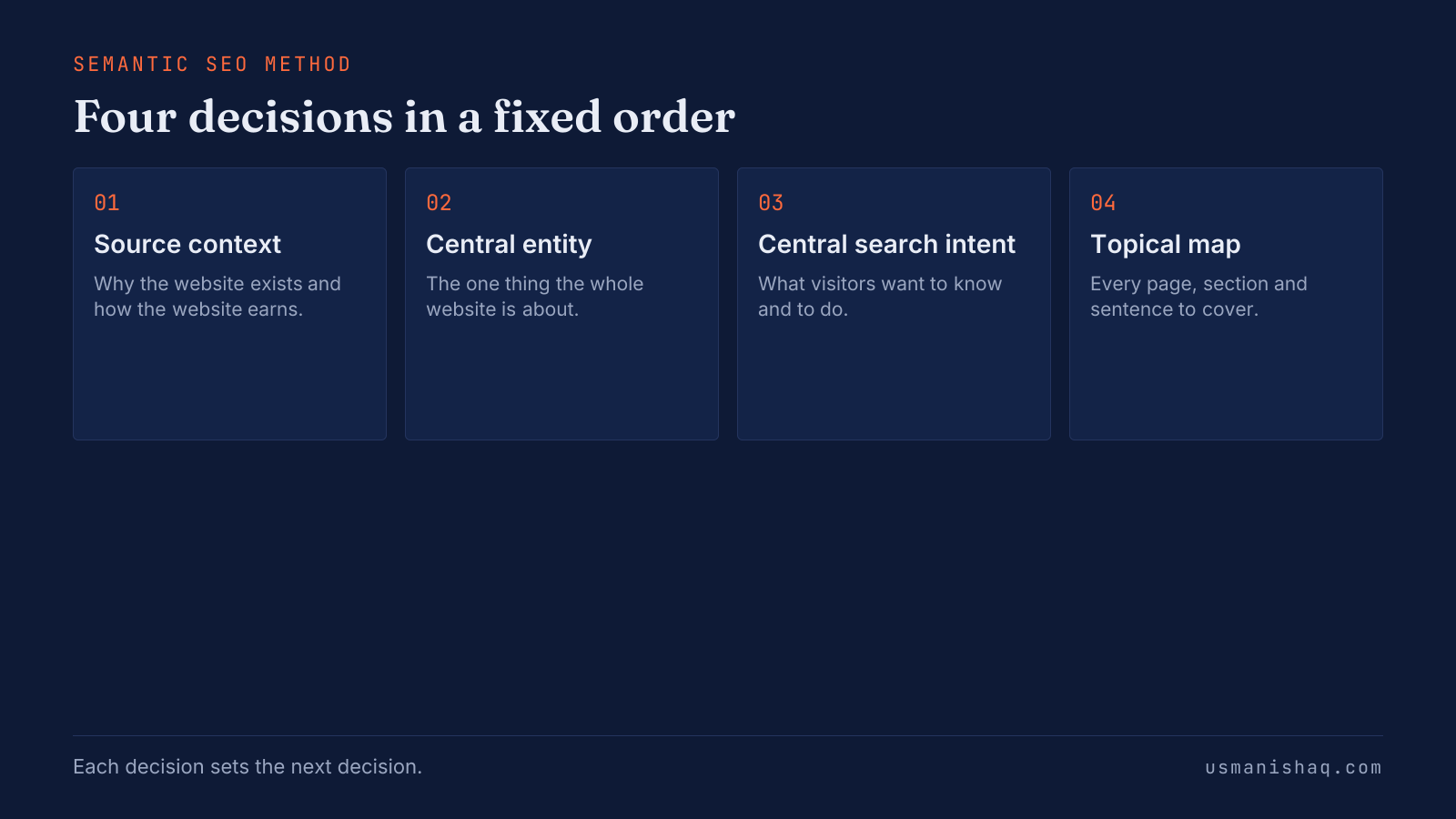
The central entity of a website is the one thing the whole website is about. Every page relates back to the central entity. An entity is a distinct thing a search engine can name, such as a business, a service or a town. Source context answers why the website exists. The central entity answers what the website is about. Which is decided first, source context or central entity? Source context is decided first, and the central entity is decided second. The central entity described here is the one an owner decides for a whole website. The main entity of a single document is a separate, narrower use of the term. The topical map is built on both decisions. The source context, the central entity and the topical map form the architecture of a website. The fixed-scope work that sets all three for a business is a Semantic SEO Architecture project. The figure below shows the four decisions in their fixed order, from source context to the topical map.
Central search intent is the third decision.
What is central search intent?
Central search intent is what visitors want from the whole website, written as two verbs: one for what visitors want to know and one for what visitors want to do.
The central entity names what the website is about, and central search intent names what visitors want from the website. The two verbs come from the source context, which names the work sold and the action that earns. The two verbs of usmanishaq.com are understand and build. The second verb of a trade or service business is what the owner wants visitors to do: call, book or ask for a quote. The three decisions are set below for one example business, a plumbing company.
What do source context and central entity look like for a plumbing company?
A plumbing company with five lines of work has one source context and one central entity: plumbing.
The plumbing company is an example business. The company began with one service and now sells five lines of work. The five lines are drain cleaning, leak repair, water heater repair and installation, whole-house repiping and bathroom remodeling. The source context statement of the company reads as follows.
The business is a plumbing company. The company repairs, replaces and installs home plumbing, from drains and water heaters to whole-house repiping, for homeowners in five towns of one county. Money arrives through booked jobs, and every service page ends in a call or a quote request.
Four of the five lines of work are plumbing work. The fifth line, bathroom remodeling, touches plumbing in one part. The one thing the whole website is about is therefore plumbing. The company name is the source of the website, not the subject. The five towns qualify the subject. Bathroom remodeling covers one line of work only. The central search intent has two verbs: visitors want to understand a plumbing problem and its cost, and visitors want to book a plumber. The website leaves out remodeling design guides, appliance reviews and repair guides for work the company does not sell.
The table lists the source context, the central entity and the central search intent of the example plumbing company.
| Decision | Example plumbing company |
|---|---|
| Identity | a plumbing company |
| Work sold | repair, replacement and installation of home plumbing |
| Buyer | homeowners |
| Area served | five towns of one county |
| Earning | booked jobs; a call or a quote request |
| Central entity | plumbing |
| Central search intent | understand a plumbing problem and its cost; book a plumber |
Every row comes from facts the owner already knows.
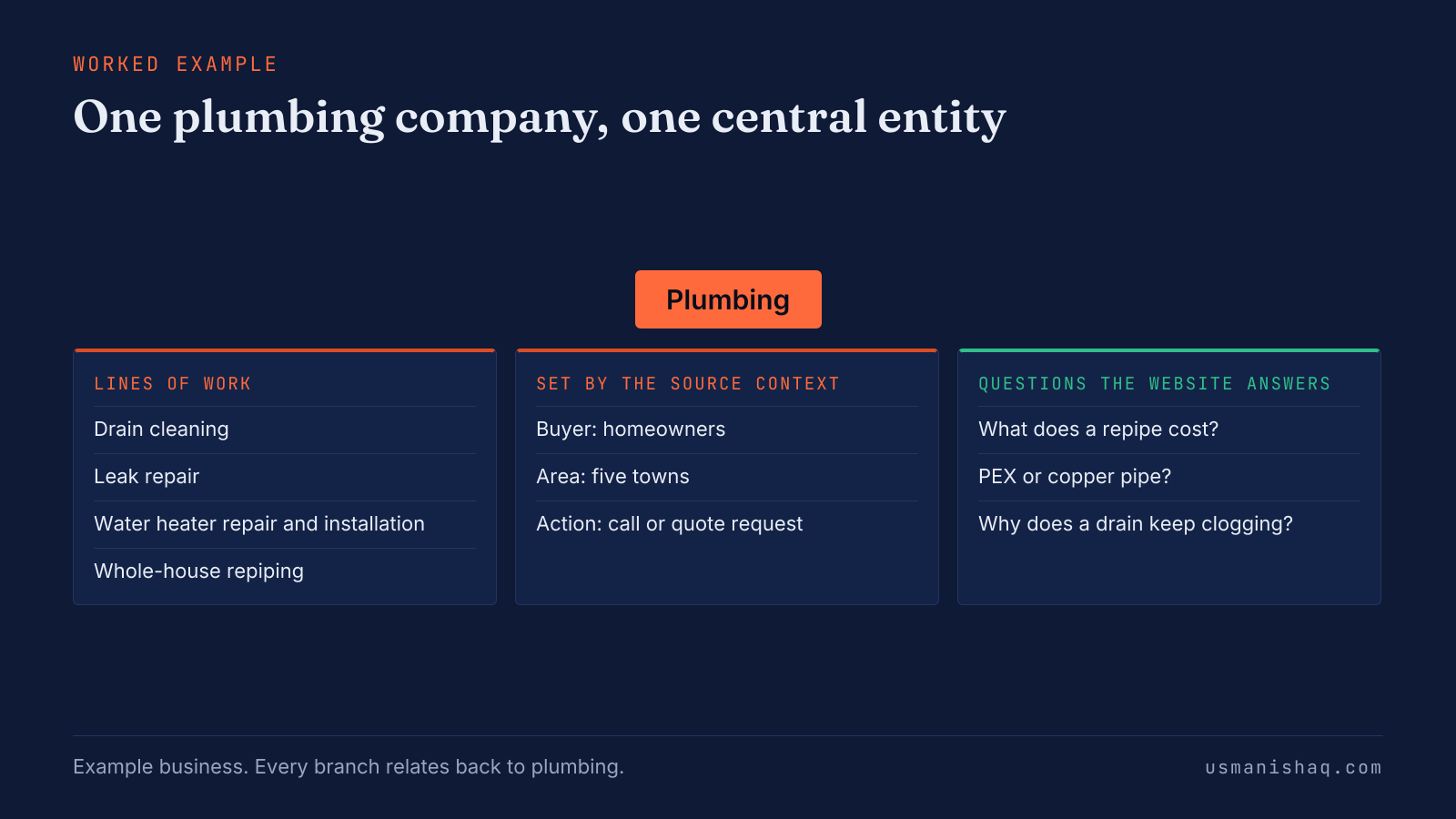
The figure places plumbing at the root, with the four plumbing lines of work, the source context facts and three customer questions as branches. A second example, an installer and a retailer of one product, shows two source contexts on one subject.
How does source context give an installer and a retailer two different topical maps?
Source context gives an installer and a retailer of the same product two different topical maps, because each business earns from a different action.
The two example businesses are a company that installs and repairs water heaters in its towns and a store that sells water heaters online. Both websites are about water heaters. Every part of the source context differs between the two businesses.
The table compares the source context and the first pages of the topical map for a water heater installer and a water heater retailer.
| Part | Water heater installer | Water heater retailer |
|---|---|---|
| Work sold | installation, repair and replacement | the units, shipped to the buyer |
| Buyer | a homeowner with a failing or old water heater | a homeowner or contractor choosing a unit |
| Area served | the towns the crew drives to | every address the store ships to |
| Earning | booked jobs | online orders |
| Action on a page that earns | a call or a quote request | an order |
| Verbs of the website | install, repair, replace | compare, buy, ship |
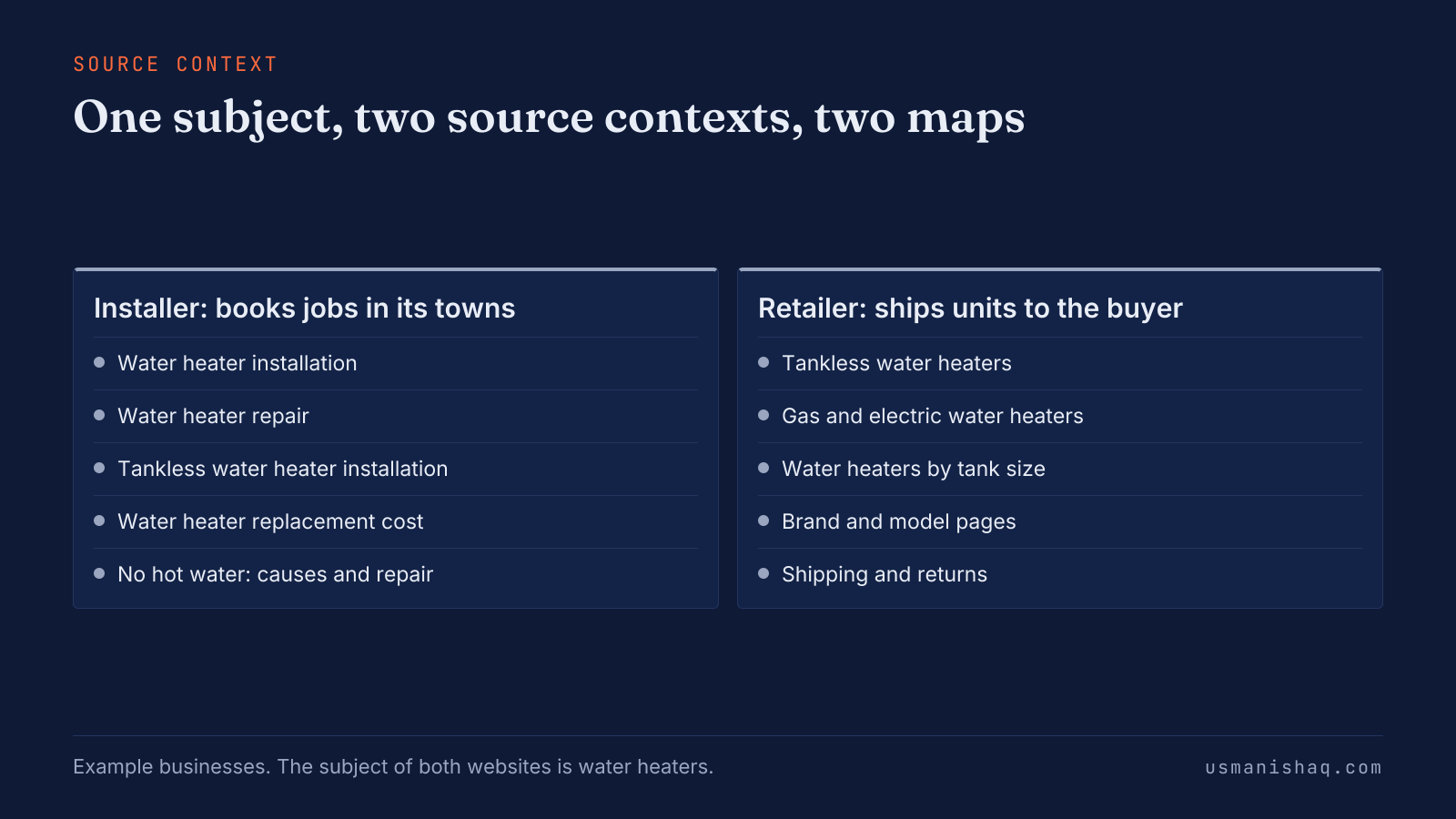
| First pages of the map | water heater installation; water heater repair; tankless water heater installation; water heater replacement cost; no hot water: causes and repair | tankless water heaters; gas and electric water heaters; water heaters by tank size; brand and model pages with price and warranty; shipping and returns |
| Left off the map | brand-by-brand buying guides; shipping pages | town pages; repair call-outs |
The subject is the same in both columns, and no page title is. Two websites with one subject and two source contexts need two different topical maps. The figure sets the first five pages of each topical map side by side.
Four tests check each source context statement and each central entity.
How do you test a source context statement and a central entity?
A source context statement passes two tests, and a central entity passes two more.
The four tests for a source context statement and a central entity are listed below:
- Swap the business: put another kind of business into the source context statement. A specific statement turns false.
- Trace the earning: follow each verb of the source context statement to a page that ends in the earning action. A verb with no such page marks a gap.
- Check every page: confirm that each planned page names the central entity or one of its services. A page that does neither is off the subject.
- Reject the stand-ins: confirm that the central entity is not the business name, not a town, not a list of services and not the result the owner wants.
Can a website owner test the central entity alone? Tests 3 and 4 run on the central entity alone. I ran the four tests on my own website, usmanishaq.com, and the source context statement reads as follows.
Usman Ishaq plans topical maps, audits site content and directs the production of semantic content, schema and websites for owners of trade and service businesses in the United States, the United Kingdom, Canada, Australia, the United Arab Emirates and Germany. Money arrives through a flat-fee audit, fixed-scope projects and monthly production. Every monetising page ends in a booked 30-minute call.
Swapping in a software publisher or a directory makes the statement false. Each verb (plan, audit, write, build) leads to one service page that ends in a booked call. The central entity of usmanishaq.com is semantic SEO. I rejected two candidates: topical authority, the result and not the thing bought, and the name Usman Ishaq, the source and not the subject. The common faults are a statement that fits any business, a verb with no earning page and a stand-in named as the central entity. The same tests show when one business holds more than one source context.
How many source contexts can one website have?
One website has one source context, and one source context sets one central entity.
A business with several services keeps one website while the services share a buyer and a kind of work. The worry belongs to the owner whose business grew from "one clear service" into "five or six different things". A different buyer and a different kind of work mark a second source context, and a second source context needs a second website. The choice between two websites or one follows a test with two questions.
Should a business with two different services create two websites or one?
A business with two different services needs one website when both services share a buyer and a kind of work, and two websites when both differ.
The test has two questions: who buys, and what kind of work is sold.
The table applies the two questions to four lines of work a plumbing company adds.
| New line of work | Same buyer | Same kind of work | Verdict |
|---|---|---|---|
| Tankless water heater installation | yes | yes | one website; the line gets its own service pages |
| Plumbing for restaurants and landlords | no | yes | one website; a separate section for that buyer |
| Bathroom remodeling | yes | no | one website keeps one page on the plumbing part of a remodel; a full remodeling business needs its own website |
| An online store for plumbing parts | no | no | a second website with its own source context |
The verdict follows the source context: a line that makes the statement false needs its own statement. I applied the same test to usmanishaq.com: website development stays, limited to websites built for semantic SEO, because the buyer is the same. White-label work for agencies has one page of its own because the buyer differs, and the agency Digital Vikingz has its own website. A second website is a second bill and a second thing to maintain, so the test should run before the build. The figure sorts a new line of work by the two questions.
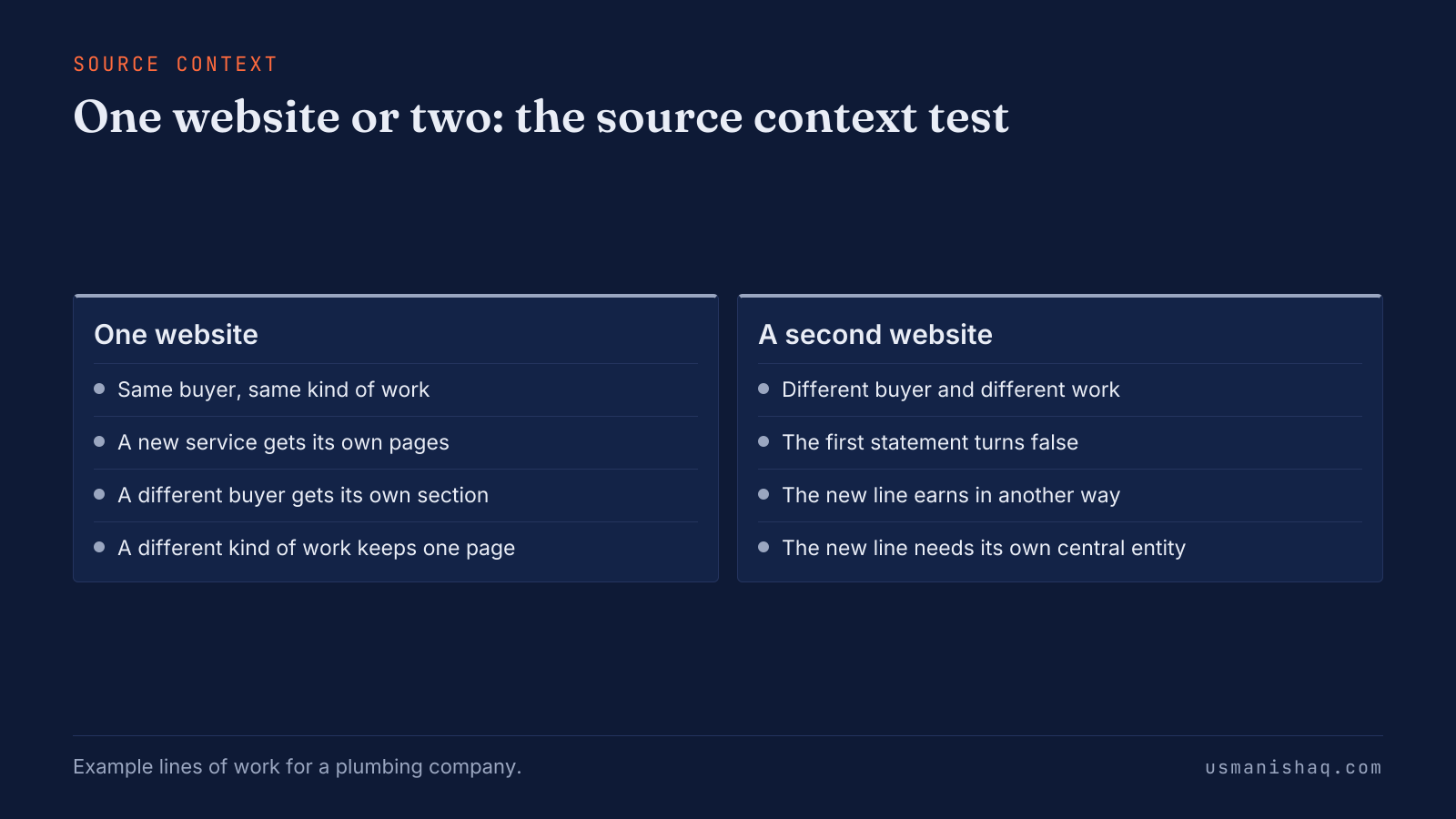
One question remains: list many services or keep the website focused.
Is it better to list many services or keep a website focused?
Listing many services is better than cutting services, provided every listed service relates to one central entity.
Source context does not remove what the business sells, and a focused website does not require leaving a service off. Focus means one central entity, with the services ordered by how the business earns. How many services are too many? No number of services is too many. The limit is a service with a different buyer and a different kind of work. A service past the limit leaves the list, and the remaining services enter the topical map inside one border.
How does source context set the border of a topical map?
Source context sets the border of a topical map by deciding which topics the business earns from and which topics belong to another kind of business.
The topical border is the line where a topical map stops: topics past the line belong to another kind of business. A topical map is the plan of every entity, attribute and question a website must cover, with one owning page, section or sentence for each. Keeping the website focused is the topical border in plain words. A water heater installer leaves brand buying guides outside the border, because the installer earns from booked jobs. The source context and the central entity are the first two decisions of a topical map for a business website. The full build, from the two decisions to the page list, is explained in the guide to a topical map for a business website. The border leaves one decision inside the map: which query earns a page.
How do source context and the central entity decide which query earns a page?
A query earns a page on a business website only when the query relates to the central entity and to the way the business earns.
The central entity gives the first condition, and the source context gives the second. The query "water heater replacement cost" earns a page on the website of the water heater installer. A comparison of water heater brands does not earn a page on the same website. Page decisions settle which query earns a page, a section or a sentence. The tests for which query earns a page, a section or a sentence have their own guide. Source context stays the first decision behind every page.
Where do the terms source context and central entity come from?
Source context and central entity are planning terms from one semantic SEO framework, and neither term comes from Google's Search documentation.
The framework is the work of Koray Tuğberk Gübür of Holistic SEO, whose case study on initial ranking and re-ranking defines source context. The case study was published on 29 November 2021 and updated on 28 October 2023. The case study states: "Source Context is the purpose of the source with its identity." The same case study adds that two sources with different source contexts do not treat the same topic in the same way. Both terms describe decisions a website owner makes. Neither is presented here as a Google ranking factor. The word niche names a different thing from source context.
How is source context different from a niche?
Source context differs from a niche in scope: a niche names a subject area, and source context states how one business earns inside that subject area.
A niche is shared by every business in the subject area, and a source context belongs to one business. The water heater installer and the water heater retailer share one niche and hold two source contexts. The advice to "niche down" narrows the subject area and does not write the source context statement. A business in a narrow niche still has to state who buys and how money arrives. A business with several services stays inside one source context when the services share a buyer and a kind of work. Each case, a narrow niche or several services, ends in one source context statement.
Questions about source context and the central entity
Business owners ask six further questions about source context and the central entity of a website.
Does Google know what my website is about?
Google does not tell a website owner what Google concludes a website is about, and the query list in Google Search Console is the closest public reading.
The Performance report lists the queries a website appeared for, and a list that names the services of the business matches the central entity. An owner reads a query list about other subjects as a sign that the website and the source context do not match.
Can source context change?
Source context changes when the business changes the work sold, the buyer or the way money arrives.
The source context statement is rewritten first, and the topical map is reviewed after.
Does every page need to state the source context?
No page needs to state the source context, because source context is a planning decision and not a line of text on a page.
Every page relates back to the central entity, and the central entity follows from the source context.
Does the town belong in the central entity?
The towns a business serves belong in the source context statement, and the service stays the central entity.
A plumbing company in five towns is about plumbing, not about the five towns.
Does source context mean citing good sources?
Source context does not mean the sources a page cites: source context is the purpose of the whole website and the way the website earns money.
Citing sources is a writing practice for a single page. Source context in semantic SEO describes the business behind the website, not the references on a page.
Is the central entity the same as a keyword?
The central entity is not a keyword: a keyword is one search phrase, and the central entity is the one thing every page of the website relates back to.
Source context sets one central entity, and one website answers search phrases about the central entity.
What should a business owner decide before a topical map is planned?
A business owner should write the source context statement and name the central entity before a topical map is planned.
The source context statement records the purpose of the website and how the website earns, in the five-part written form. The central entity names the one thing the whole website is about. An owner who understands both decisions can build the website on both. Usman Ishaq, a semantic SEO strategist and consultant, writes both decisions down before a topical map is planned for a trade or service business.