
The pages a business website needs are decided by a topical map for the website: the plan of every service, town and customer question to cover, with one owning page, section or sentence for each. Semantic SEO keeps the map as rows: each row holds one service, town or customer question with its owning search, intent, decision and URL. A plumbing company's map for one service, repiping, lists six pages across two towns. The map is built in five steps: describe the business, collect the searches, decide each owner, set each page type and order the pages. A finished map passes five checks before any page is written.
What is a topical map for a business website?
A topical map for a business website is the plan of every entity, attribute and question the website must cover, with one owning page, section or sentence for each. An entity is a thing the business sells or serves, such as a service or a town. An attribute is a detail of that thing, such as a price, a material or a time. The plan gives every search one owner, so no two pages of the website answer the same search. Trade and service owners ask the same thing in other words: which pages a website needs, one page or many, a page per town. Topical mapping is the semantic SEO work of building that plan. Each service, town and customer question takes one row of the map, and every row contains the same parts.
What does a topical map for a business website contain?
A topical map for a business website contains one row for each service, town and customer question, and each row holds seven parts. The parts that each row of a topical map for a business website contains are listed below:
- Entity: the service, town or thing the row covers.
- Attributes: the details to state about the entity, such as price, material and time.
- Owning search: the one search the row answers. No two rows share one.
- Intent: what the searcher wants. An informational intent is to learn, a commercial intent is to compare or to price, and a transactional intent is to book.
- Decision: the page, section or sentence that owns the search of the row.
- URL: the address of the page, for every row with a page decision.
- Link target: the page the row links to.
A topical map is kept as a spreadsheet, with a diagram as a second view. The semantic SEO method calls each row a node. The rows of a map fall into two sections.
What are the core section and the outer section of a topical map?
The core section of a topical map is the set of pages that sell a service, and the outer section is the set of pages that answer customer questions and link to the core. A plumbing company's core section for repiping holds the service page, whole-house repiping, and the price page, repipe cost. Two town pages complete the core section: repiping in Springfield and repiping in Franklin. The outer section holds two question pages: PEX vs copper repipe and signs you need a repipe. Every outer page links to a core page. An outer page with no core page to link to leaves the map. The core section is planned first, since every outer page needs a core page to link to. The figure below sorts the six pages of the example into the two sections.
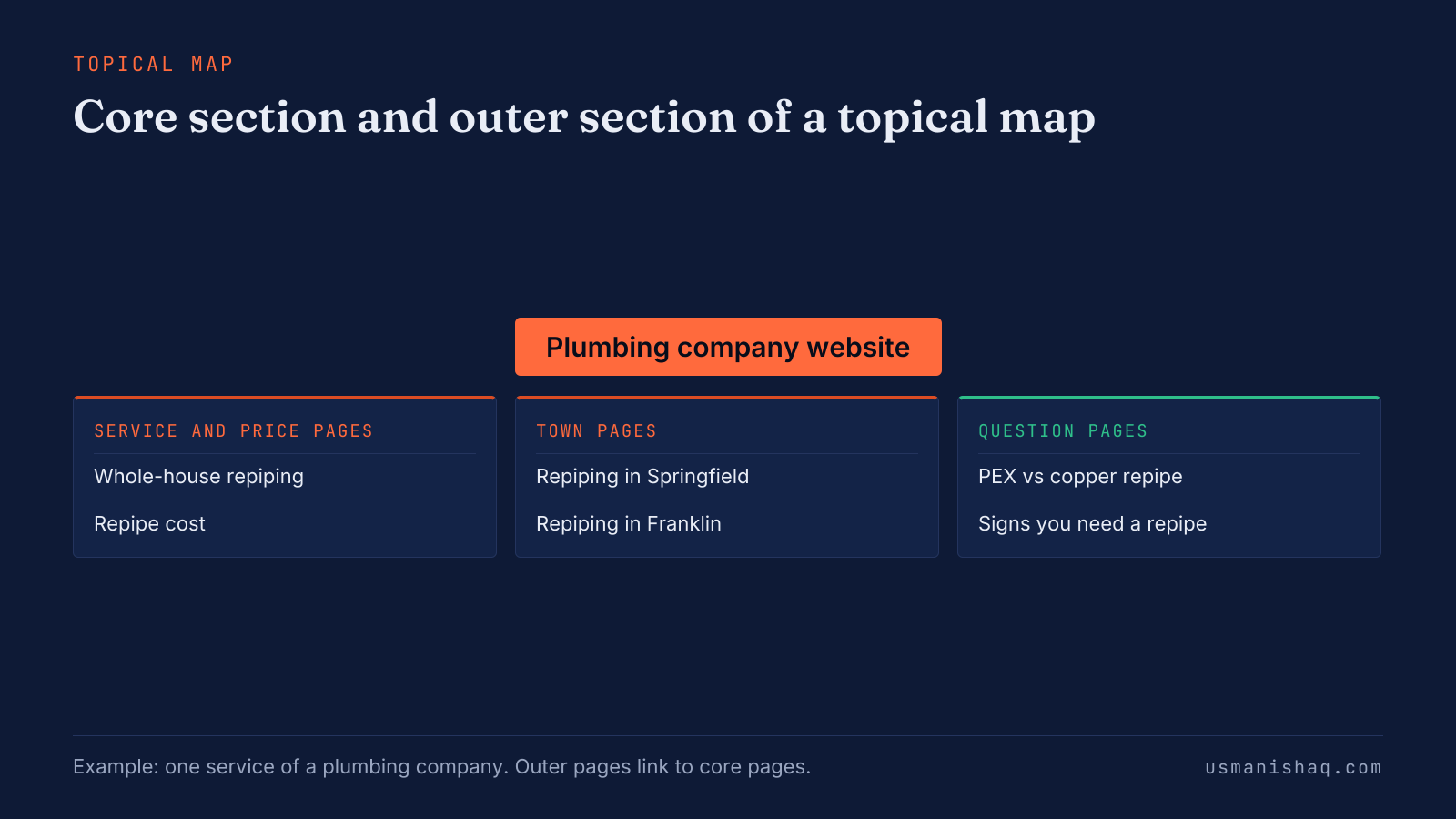
A finished topical map shows both sections as one list of pages.
What is an example of a topical map for a business website?
An example of a topical map for a business website is the page list of a plumbing company: six pages for one service, repiping, in two towns. Each row of the example names the page, the section of the map, the search that owns the page, the intent and the URL.
| Page | Section | Owning search | Intent | URL |
|---|---|---|---|---|
| Whole-house repiping | Core | whole house repipe | Commercial | /repiping/ |
| PEX vs copper repipe | Outer | pex vs copper repipe | Informational | /repiping/pex-vs-copper/ |
| Repipe cost | Core | how much does it cost to repipe a house | Commercial | /repiping/cost/ |
| Signs you need a repipe | Outer | signs you need to repipe | Informational | /repiping/signs/ |
| Repiping in Springfield | Core | repiping springfield | Transactional | /springfield/repiping/ |
| Repiping in Franklin | Core | repiping franklin | Transactional | /franklin/repiping/ |
The six rows give repiping one service page, one price page, two question pages and two town pages. The same five columns work as a topical map template for any trade: replace the service, the towns and the questions. The URL of each page follows its row: a service folder such as /repiping/ for service pages and a town folder such as /springfield/repiping/ for town pages. The figure below shows the same six rows as a working sheet in semantic SEO: page, owning search, intent, decision and URL.
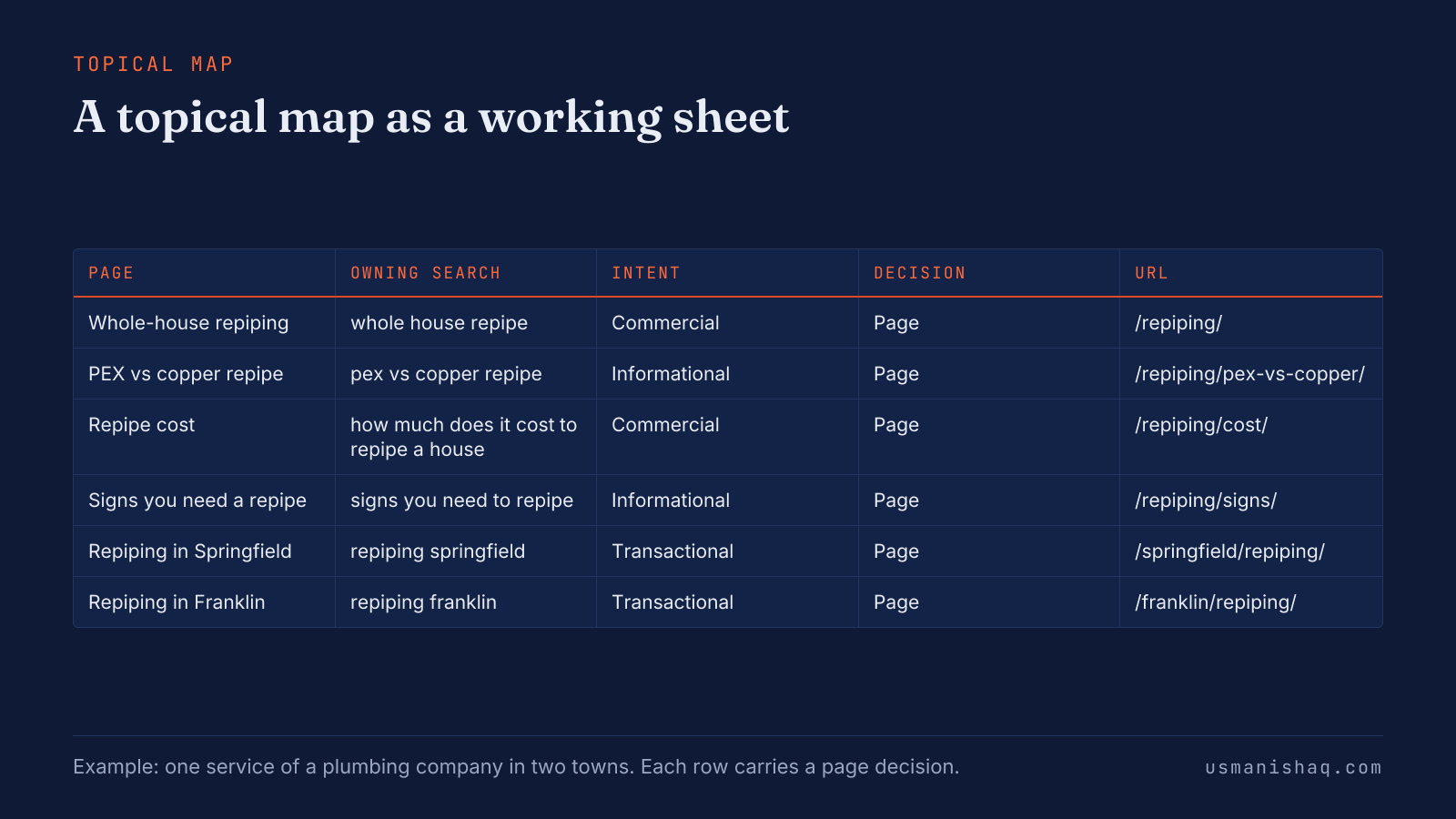
The plumbing rows are a worked example, not a client result. The page list is the output of the five steps that build a topical map.
How is a topical map for a business website built?
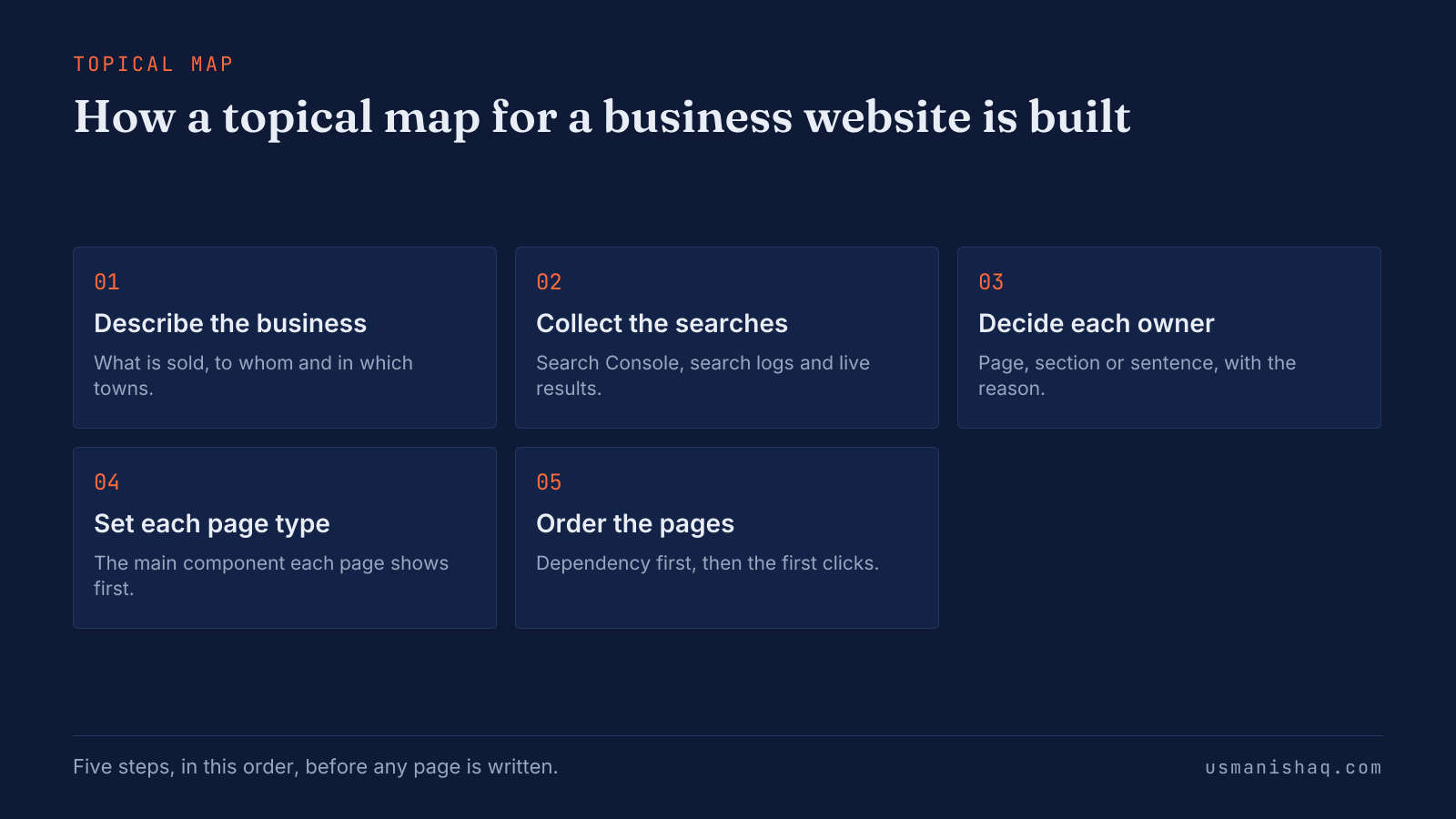
A topical map for a business website is built in five steps: describe the business, collect the searches, decide the owner of each search, set each page type and order the pages. The steps that build a topical map for a business website are listed below:
- Describe the business in one sentence: what the business sells, to whom and in which towns. Fix one name for each service in the business description.
- Collect the searches from Google Search Console, the site's search logs and the live results for each candidate search. Add the rewordings an AI system gives for each search.
- Decide the owner of each search: a page, a section or a sentence, with the reason recorded.
- Set the page type and the main component of each page, such as a price card on a cost page.
- Order the pages by dependency and by which pages earn the first clicks. The publishing order places a core page before the outer pages that link to the core page.
The figure below shows the five steps in order.
Semantic SEO Architecture is the fixed-scope project that produces a topical map and a twelve-month publishing roadmap. The documents the project delivers are listed under Semantic SEO Architecture. Step three, the decision, follows one rule.
How does a topical map decide what earns a page, a section or a sentence?
A topical map decides between three owners for each search: a page, a section of a page or a sentence. A search earns a page when customers type the search and the search names a different service, town or thing from every other page. The search also shows different results in Google from the searches other pages own. The search "how much does it cost to repipe a house" earns the repipe cost page. A narrower question about the same thing becomes a section of a page. The question "what happens on repipe day" is a section of the repiping page for one town. A single fact becomes a sentence. The freeze tolerance of PEX pipe is one sentence on the PEX vs copper page. Each page decision, the recorded choice for one search, carries its reason in the topical map: demand, entity difference, similarity and pattern. The full tests for which query earns a page fill a separate guide. Towns are the page decision that owners ask about most.
How does a topical map handle a business that serves more than one town?
A topical map handles a business that serves more than one town by giving each town its own page, and each town page holds its own services, questions, proof and links. A page that lists every town is one URL with one title, so no town has a page of its own. The example rows "Repiping in Springfield" and "Repiping in Franklin" are two town pages: a page for each service area. Google's spam policies for web search name pages targeted at specific cities that funnel users to one page as an example of doorway abuse. A topical map does not multiply every service by every town into a grid. A page for one service in one town, such as repiping in Springfield, enters the map when customers search for that service in that town. The figure below compares one page that lists every town with one page for each town.
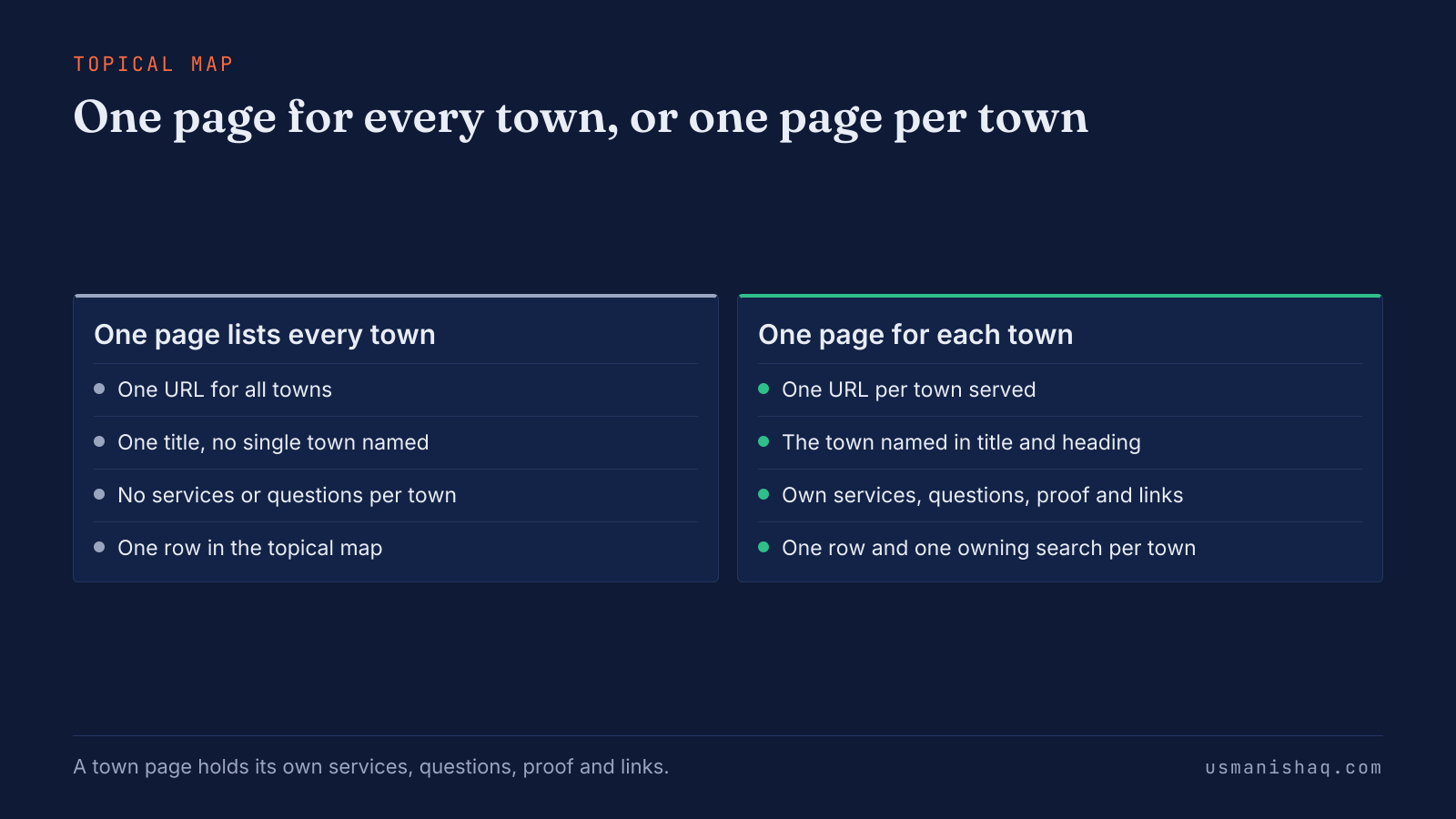
The full structure of a multi-town website belongs to semantic SEO for trade and service businesses. Every row of the map, town rows included, passes the same checks.
Which checks does a topical map pass before pages are written?
A topical map passes five checks before pages are written: one owner, no overlap, a core link, town content and a decision for every existing URL. The checks that a topical map for a business website passes before pages are written are listed below:
- One owner: every search in the map has one owning page, section or sentence. A search with no owner is a gap.
- No overlap: no two rows share an owning search. Two pages on one search compete with each other.
- Core link: every outer row names the core page that the row links to. An outer page with no core page is a loose page.
- Town content: every town row lists services, questions and proof of its own. A town row with nothing of its own is a copy.
- Existing URLs: every URL of the current website has a row or a decision. An existing URL with neither stays live and unplanned.
A topical map that passes the five checks still depends on the semantic SEO decisions before the map and the pages built after.
What comes before and after a topical map in semantic SEO?
The source context and the central entity come before a topical map in semantic SEO, and content briefs, the written pages and internal links come after. The source context is why a website exists and how the business earns. The central entity is the one thing the whole website is about. Source context, content briefs and the core and outer sections of a topical map come from the semantic SEO framework of Koray Tuğberk Gübür. The framework is a method of work, not a statement by Google. Source context is the first step.
How does source context shape a topical map?
Source context shapes a topical map by setting which services, towns and questions enter the map and where the map stops. A plumbing company that does not install boilers, as one illustration, keeps boiler pages outside the border of the map. The decision is explained under source context in semantic SEO, with the central entity that source context sets.
How do page decisions apply to pages a website already has?
Page decisions apply to existing pages in the same way: every existing URL gets a row in the topical map or a decision to merge or remove. A page that matches a row is kept. Two pages that compete for one search get a merge or a removal, with a redirect. The tests behind each decision are set out under which query earns a page.
How does a topical map become a semantic content network?
A topical map becomes a semantic content network when its pages are built from one template per entity type and linked in sequence. An entity type is a kind of page subject, such as a service or a town. The map is the plan, and the network is the published result. The parts and order are covered under how a semantic content network is built.
How do internal links connect the pages of a topical map?
Internal links connect the pages of a topical map in one direction first: every outer page links to a core page. Internal linking architecture decides which page links to which, with what anchor and from which section. Google's SEO Starter Guide says a logical organisation of a site can make the relation between its pages clearer to search engines and users. The same guide adds that search engines will likely understand pages as they stand, so the topical map promises clarity, not rankings.
What does a topical map change for a trade or service business?
A topical map changes what a trade or service business builds and measures: each service and each town gets a page that is measured on its own. The measure is calls, quote requests and booked jobs from each page, read beside clicks and impressions in Search Console. The map brings no calls until its pages are built. The site structure, the page order and the measure in calls are set out under semantic SEO for trade and service businesses.
How does a topical map differ from a topic cluster, a keyword map and a sitemap?
A topical map differs from a topic cluster, a keyword map and a sitemap in what each document decides: the topical map sets which page, section or sentence owns each search across the whole website. The table below compares the four documents by what each one lists and what each one decides.
| Document | What it lists | What it decides |
|---|---|---|
| Topical map | every entity, attribute and question of the business | which page, section or sentence owns each search, and which page links to which |
| Topic cluster | one main page and the supporting pages that link to it | how one group of pages is linked |
| Keyword map | keywords grouped into topics and assigned to pages | which page targets which keywords |
| Sitemap | the pages and files of a live website | nothing: the file reports pages that exist |
Documentation from Google Search Central defines a sitemap as a file of information about a site's pages, files and their relationships. A keyword map, the output of keyword mapping, and a topic cluster are not second names for a topical map. A topical map in semantic SEO holds every cluster of the website and starts from the business, not a keyword list.
Questions about a topical map for a business website
The ten questions below cover who needs a topical map for a business website, how many pages the map sets, who builds the map and when the map changes.
Does a small local business need a topical map?
A small local business needs a topical map when the business sells more than one service or serves more than one town. A business with one service in one town needs a few rows: the service, the town and the customer questions.
Should every service have its own page?
A service earns its own page when the job, the price, the proof or the next step differs from the other services. A topical map places services that share all four on one shared page, as sections.
Is a one-page website enough for a trade business?
A one-page website is enough for a trade business with one service in one town. One page holds one URL, one title and one main topic, so every further service and town in the topical map shares them.
Does a topical map mean a business needs a blog?
A topical map does not require a blog. The outer section holds the questions customers search, and each question page links to a service page or a town page.
How many pages does a business website need?
A business website needs one page for every search that passes the page test, so no fixed number applies. The plumbing example above holds six pages for one service in two towns.
Does every trade need a different topical map?
Every trade needs a different topical map, since the services, the towns and the customer questions differ. A topical map for a plumbing company website lists service pages, town pages and question pages for plumbing work.
Can a business owner build a topical map without an SEO provider?
A business owner can build a topical map with a spreadsheet, Search Console data and the five steps above. The page decisions take the most judgement, since each one needs the live search results for that search.
Can a topical map generator build the map?
A topical map generator can build a list of topics, and the page decisions still need the facts of the business. A tool does not know which services the business sells, which towns the business serves or which pages the website has.
Does a topical map change after the website launches?
A topical map changes at review points after launch. The 90-day review set by Semantic SEO Architecture tests the page decisions against live search data and adds the new searches customers use.
What is a topical authority map?
A topical authority map is a second name for a topical map. Topical authority is the term SEO practitioners use for the coverage of a subject that the map plans.
What does a topical map decide for a business website?
A topical map decides which pages a business website needs, which page, section or sentence owns each search and in which order the pages are built. An owner who understands the map should build in its order: business description, searches, owners, page types and publishing order. Usman Ishaq is a semantic SEO strategist and consultant, and the founder of Digital Vikingz. Usman Ishaq plans topical maps for trade and service businesses.