
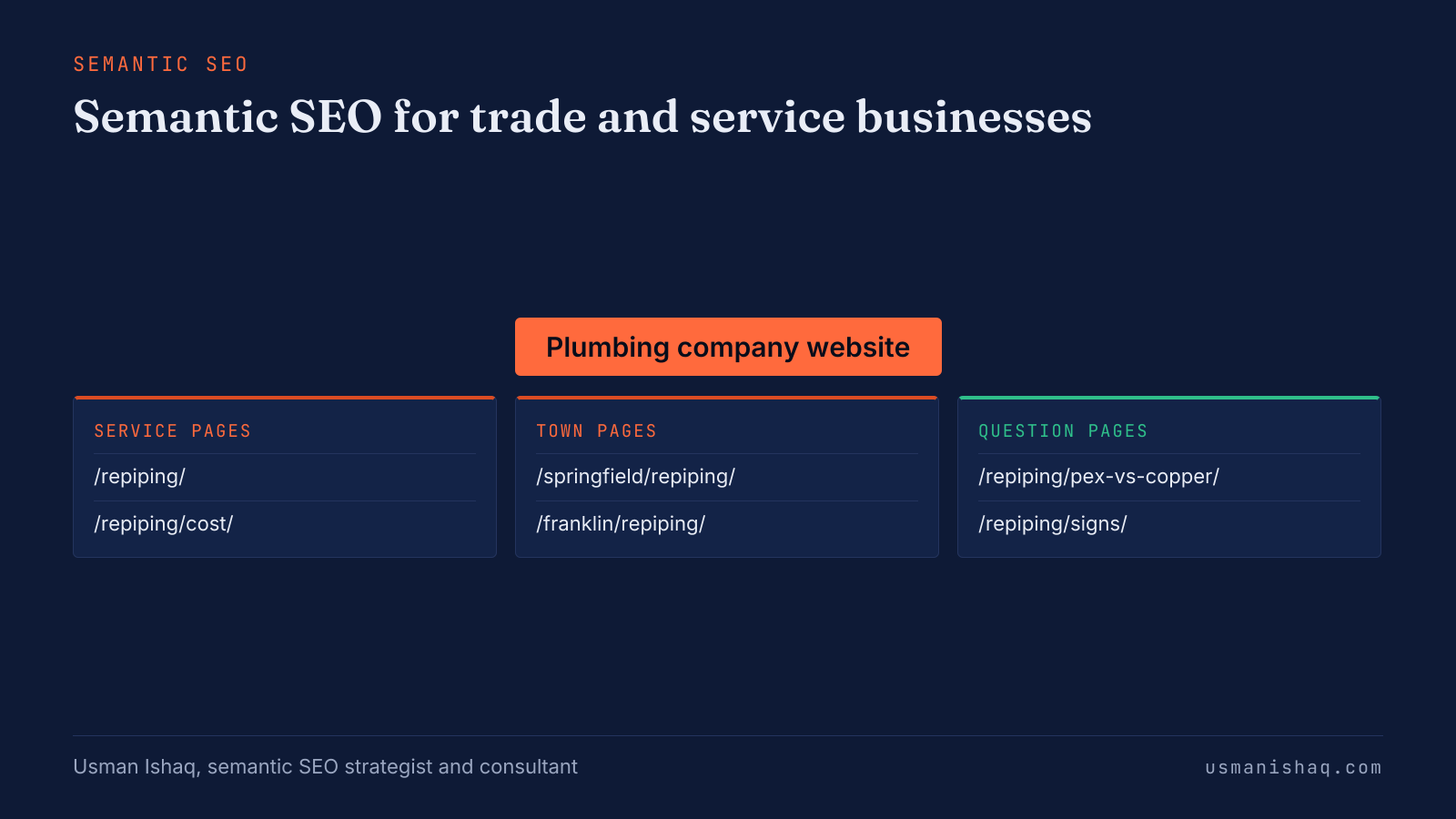
Semantic SEO for a trade or service business is the practice of organising the website around the business, its services and its towns, so that search engines and AI systems understand what the business does and where. One page that lists every town can rank for one town at most, because a page has one title, one H1 and one main subject. Semantic SEO gives a trade or service business a site structure in which each service and each town has one owning page. A semantic SEO strategy for a service business is built in seven steps, from the source context to the measure in calls. Semantic SEO for a service business is measured in calls, quote requests and booked jobs, with rankings and clicks underneath as the cause.
What is semantic SEO for a trade or service business?
Semantic SEO for a trade or service business is the practice of organising the website around the business, its services and its towns, so that search engines and AI systems understand what the business does and where.
Each of those things is an entity: a distinct thing a search engine identifies, with its own attributes and its own links to the others. Semantic SEO in that form serves local service businesses such as plumbing, roofing and HVAC companies that work in several towns and cities. The owner of such a business wants to show up in each town the business serves. Semantic SEO organises the site around things and the links between them, not around single keywords. Local semantic SEO is a second name for the same practice. Semantic SEO organised in that way brings a local service business four benefits.
What are the benefits of semantic SEO for a local service business?
Semantic SEO gives a local service business four benefits: one owner for each search, a page for each town that earns one, facts that match the Google Business Profile and growth without a rebuild.
The four benefits of semantic SEO for a local service business are listed below:
- One owner for each search: each service and each town of the service business has one page, so no two pages compete.
- A page for each town that earns one: the page can rank for searches that name the town.
- Matching facts: the website and the Google Business Profile state the same name, services and service areas for the service business.
- Growth without a rebuild: a new service or a new town adds one page to the semantic SEO plan.
The first benefit is missing on a site that relies on one page that lists every town.
Why does one page that lists every town rank for one town?
One page that lists every town can rank for one town at most, because a page has one title, one H1 and one main subject.
A page that lists sixteen towns gives a search engine one page to match against sixteen different town searches. The page can rank for one place. The other fifteen towns have no page on the service business website. The site structure is one reason why a website ranks in one town. Map results add a second limit: the Google Business Profile is one listing, measured from one base. Semantic SEO names what one page owns.
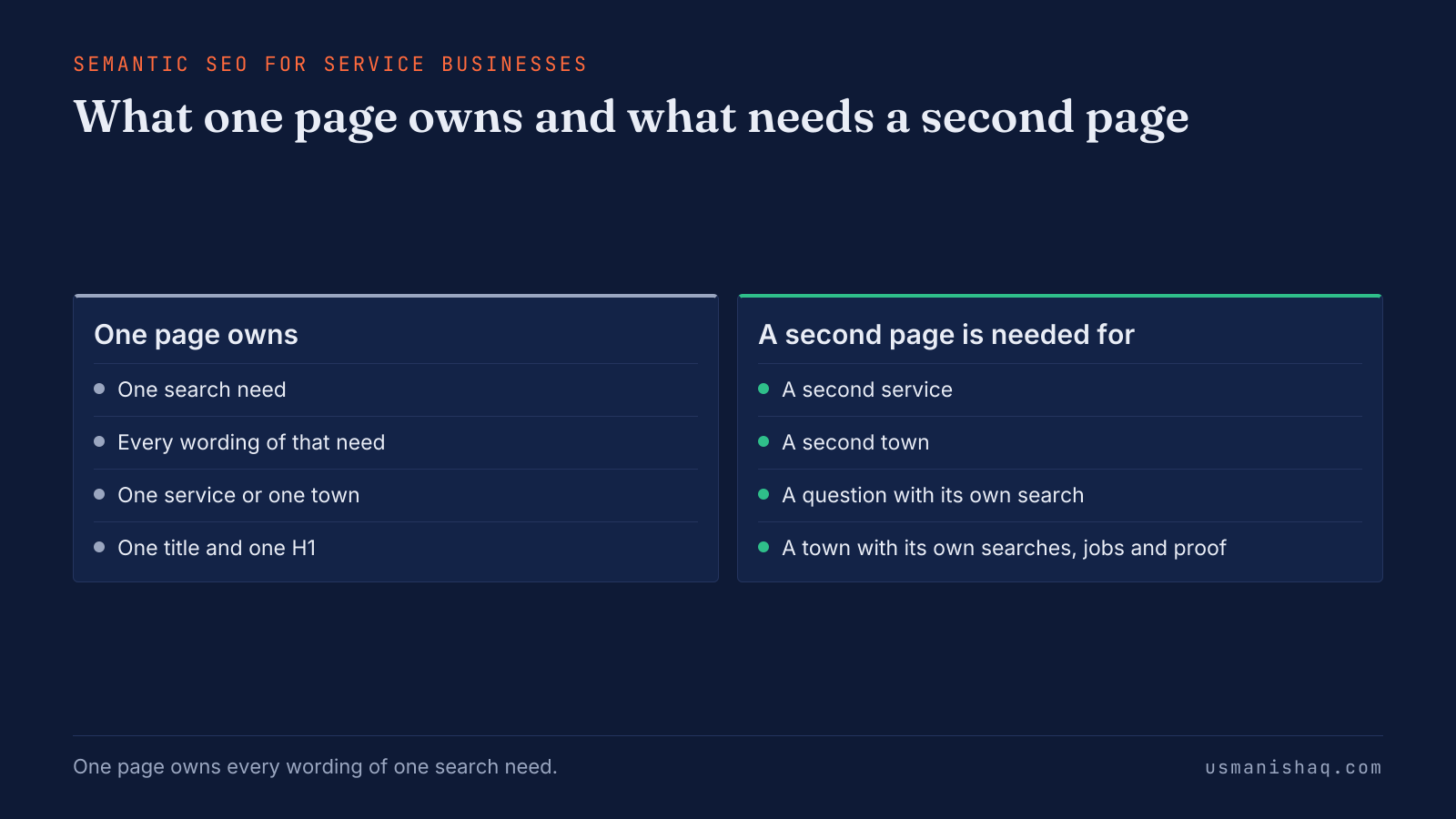
Can one page rank for every wording of one search? One page owns every wording of one search need. The searches "whole house repipe", "repipe a house" and "whole-home repiping" share the page /repiping/. A second town is a second entity with its own searches. The searches "repiping springfield" and "repiping franklin" each need a page. The figure below sets what one page owns beside what needs a second page.
Google's own documents set the rules on the profile side.
Which Google documents set the rules for a business that serves several towns?
Four Google documents set the rules for a business that serves several towns: three Google Business Profile Help pages and the spam policies for Google web search.
The Google Business Profile, the Google listing of the business, appears in the local results on Google Maps and Search. The values are stated as of November 2026. The four Google documents and the rule each one sets are listed below:
- The Help page "Tips to improve your local ranking on Google" names three factors for local results: "relevance", "distance" and "prominence". Distance is how far the business is from the person searching.
- The Help page "Manage your service areas for service-area & hybrid businesses" gives a service-area business "one profile for the whole area". A profile holds "up to 20 service areas", set by city or postal code, never as a radius. The area stays within "about 2 hours of driving time" of the base.
- The Help page "Guidelines for representing your business on Google" allows one profile for a business that travels to its customers. One profile for each location applies only where each location has its own staff. Larger areas "may be appropriate" for some businesses.
- The "Spam policies for Google web search", section "Doorway abuse", name pages for cities that "funnel users to one page" and "substantially similar pages".
One profile with 20 service areas holds no separate entry for each service in each town. The website holds that detail, one page at a time. Semantic SEO plans those pages as a site structure.
What site structure does semantic SEO give a trade or service business?
Semantic SEO gives a trade or service business a site structure in which each service and each town has one owning page.
An owning page is the one page on the site that answers one search need. A town page is a page about the business or one service in one town served. A topical map is the plan of every entity, attribute and question a website must cover, with one owning page, section or sentence for each. The table below is an example of semantic SEO for a plumbing company: six pages, each with one owning search and one URL.
| Page | Type | Owning search | URL |
|---|---|---|---|
| Whole-house repiping | Service page | whole house repipe | /repiping/ |
| Repipe cost | Service page | how much does it cost to repipe a house | /repiping/cost/ |
| PEX vs copper repipe | Question page | pex vs copper repipe | /repiping/pex-vs-copper/ |
| Signs you need a repipe | Question page | signs you need to repipe | /repiping/signs/ |
| Repiping in Springfield | Town page | repiping springfield | /springfield/repiping/ |
| Repiping in Franklin | Town page | repiping franklin | /franklin/repiping/ |
No two pages chase the same search. Planning such a structure is the work called semantic SEO architecture. The fixed-scope project that produces the topical map and a 12-month roadmap for one business is described on the Semantic SEO Architecture page. Each town page links to its service page, and each service page links to its town pages. The structure adds a town page only when a town earns its own page.
When does a town earn its own page?
A town earns its own page when the town has its own searches, its own jobs and its own proof.
Owners often call such pages service area pages. Searches are Google Search Console queries or search suggestions that name the service with the town. Jobs are booked jobs in that town in the records of the business. Proof is reviews, photos or finished work from that town. The service area list is the one page that lists every town served. A town that fails the test stays a section or a mention on the service area list. Semantic SEO applies the same test to every town. The same test separates a town page from a doorway page.
Where is the line between a town page and a doorway page?
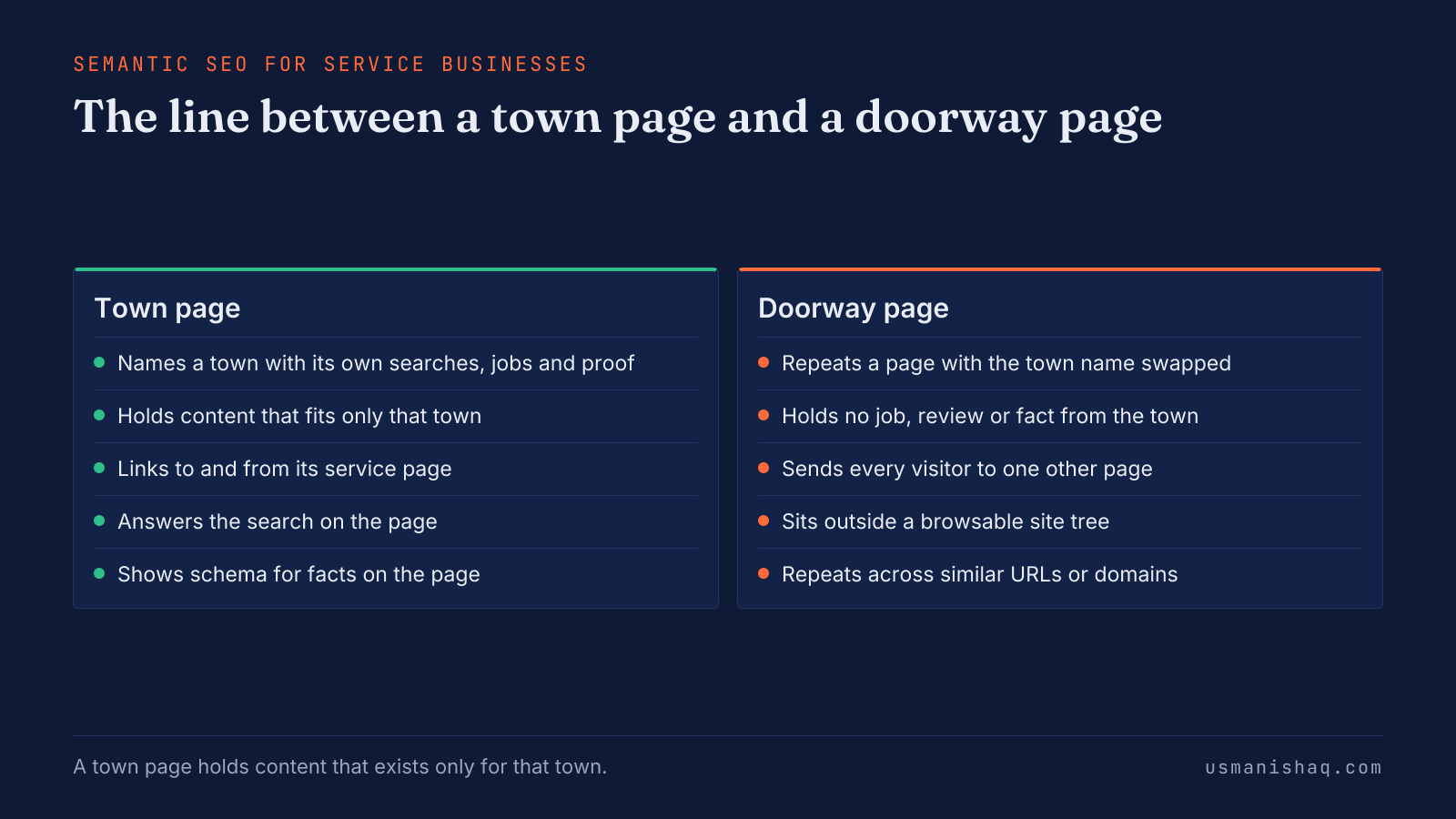
The line between a town page and a doorway page is content that exists only for that town.
Google's "Spam policies for Google web search" define doorway abuse as pages created to rank for specific, similar searches. Two examples in the policy fit a site that covers several towns. The examples are pages for cities that "funnel users to one page", and "substantially similar pages". Owners fear that a page for each town is spam. Google's policy names the pattern, not the page type. An owner tests a town page by removing the town name: a page that still fits any other town is a doorway candidate. Semantic SEO plans a town page around jobs, reviews and questions that exist only for that town, never around copied text. The figure below sets a town page beside a doorway page.
The structure is built in a fixed order.
In what order is a semantic SEO strategy built for a service business?
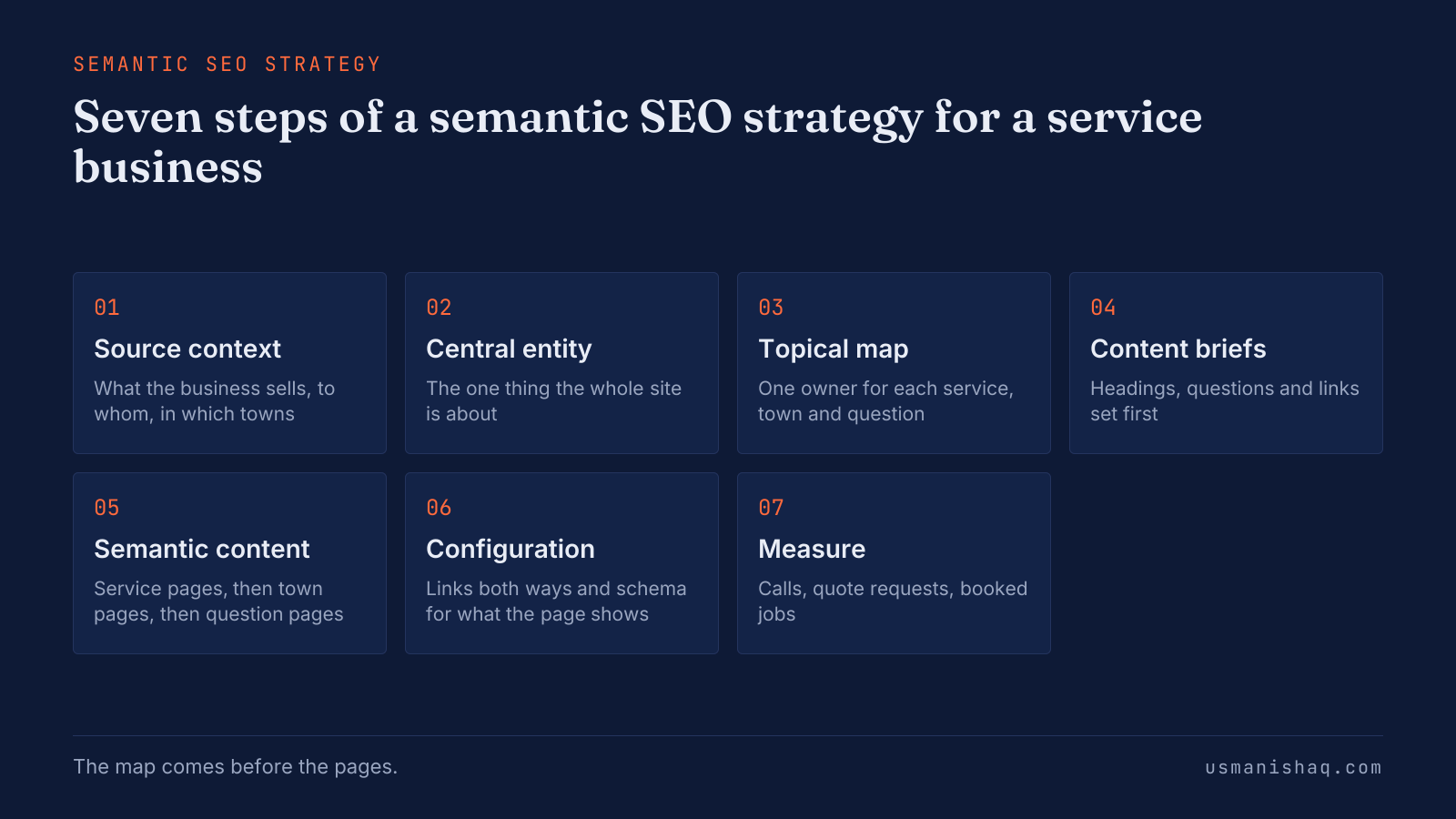
A semantic SEO strategy for a service business is built in seven steps, from the source context to the measure in calls.
The seven steps to build semantic SEO into a service business website are listed below:
- State the source context. The source context is what the business sells, to whom and in which towns.
- Name the central entity. The central entity is the one thing the whole site is about, such as "plumbing".
- Plan the topical map. Every service, town and question gets one owning page, section or sentence.
- Write the content briefs. A content brief sets the headings, the questions and the links of a page before a word is written.
- Write the semantic content in the order the map sets: service pages first, town pages next, question pages last. Service pages and town pages form the core section. Question pages form the outer section.
- Configure the site. Each town page links to its service page and back. Schema, the structured data of a page, states only what the page shows: Plumber, Service and areaServed for the town.
- Measure the result in calls, quote requests and booked jobs.
The figure below shows the seven steps of the semantic SEO strategy in order, with the map before the pages.
Source context, central entity and topical map are terms from the framework of Koray Tuğberk Gübür. The seventh step states how the result is measured in calls.
How is semantic SEO for a service business measured in calls?
Semantic SEO for a service business is measured in calls, quote requests and booked jobs, with rankings and clicks underneath as the cause.
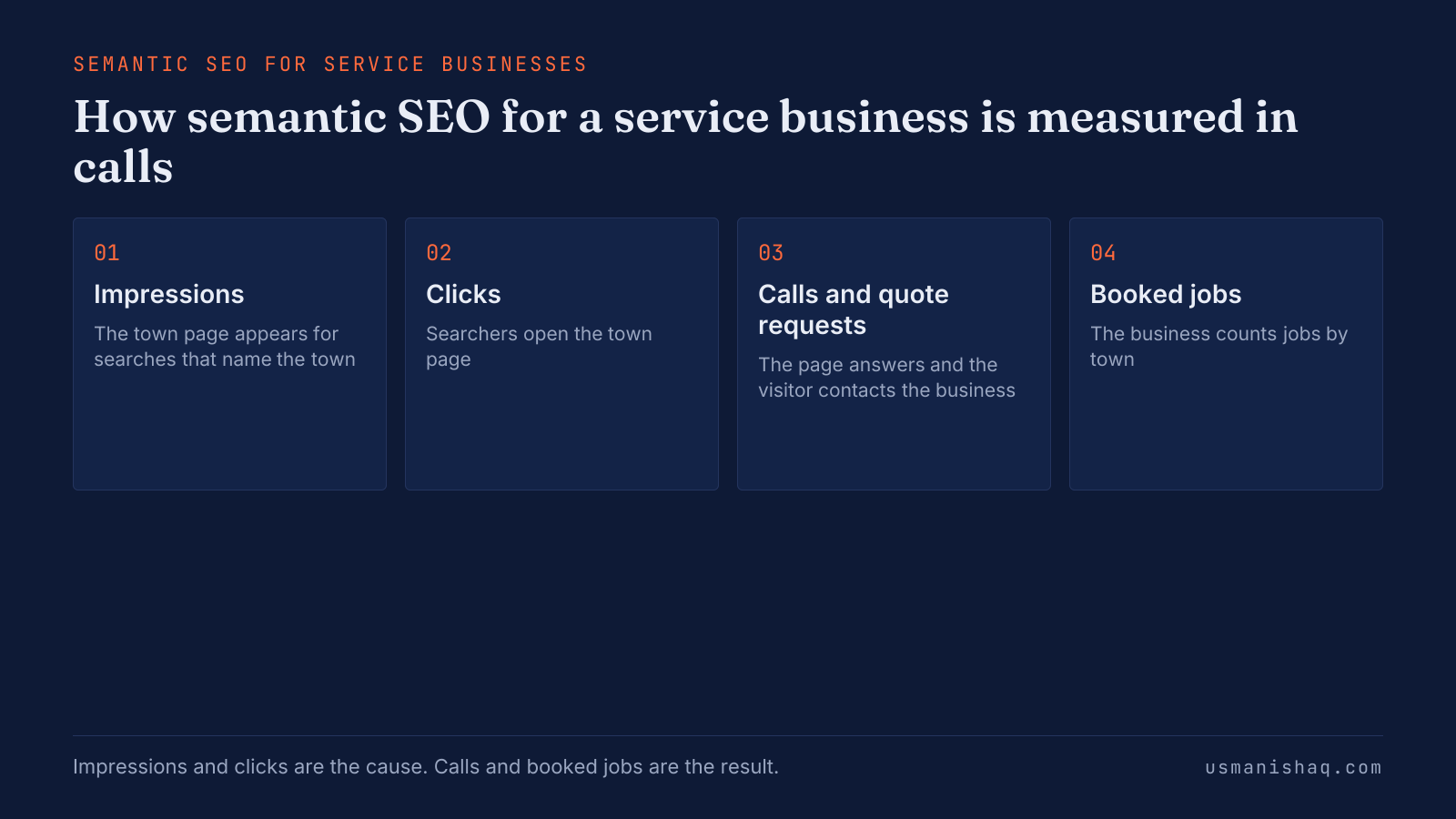
Google Search Console shows the impressions and clicks of each town page. Impressions show that the town page appears for searches that name the town. Clicks show that searchers open the page. The business counts the calls, quote requests and booked jobs that follow, town by town. We state in each report which towns moved and which towns did not. A town page with impressions and no calls needs a better answer on the page, not more pages. The figure below follows the chain from an impression of a town page to a booked job.
Five mistakes in the site structure break that chain.
Which mistakes break semantic SEO on a service business website?
Five mistakes break semantic SEO on a service business website: one page for every town, copied town pages, a page for each wording, unlinked pages and facts the pages do not show.
The five mistakes that break semantic SEO on a service business website are listed below:
- One page for every town: the service area list is the only town content, so one town at most has an owner. The fix is a page for each town that earns one.
- Copied town pages: the text repeats with the town name swapped, which matches Google's doorway examples. The fix is content only for that town.
- A page for each wording: two pages answer one search need and compete. The fix is one page that owns every wording.
- Unlinked pages: a town page with no link from its service page is an orphan. The fix is a link in both directions.
- Facts the pages do not show: schema or the Google Business Profile states a service or a town that no page covers. The fix is a Google Business Profile and website match on every fact.
A topical map settles all five before a page is written.
How does a topical map set the pages of a service business website?
A topical map sets the pages of a service business website by giving every service, town and question one owning page, section or sentence.
The six rows in the table above are an excerpt of such a topical map. The framework behind the topical map is the work of Koray Tuğberk Gübür. The topical map comes before the pages. The map decides which towns and services earn a page, so no page is written first and placed later. A topical map for a plumbing company website lists the service pages, town pages and question pages of that one trade. Semantic SEO for a service business starts from the plan, not from the pages. The plan for every service in every town is built as described in the guide to the topical map for a business website.
Does every service need a page in every town?
No, a service needs a page in a town only when the service has its own searches, jobs and proof in that town.
"Repiping in Springfield" is a page because people search for repiping with that town name. A service with no searches in a town stays a section on a page that exists. Semantic SEO treats each service by town case as a page decision. A page decision settles which query earns a page, which earns a section and which earns a sentence. The same test, held with a worked example in the guide on which query earns a page, applies to other kinds of service business.
How does the structure change for other kinds of service business?
The semantic SEO structure of a service business changes with the number of staffed offices and with the area the business serves.
A business with several staffed offices adds one office page for each office. A service business that works online has no area served by town, so the town pages drop out. The first change applies to a business with several offices.
Does a business with several offices need a different structure from a service-area business?
Yes, a business with several staffed offices needs one page and one Google Business Profile for each office, and a service-area business keeps one profile and adds town pages.
Google's "Guidelines for representing your business on Google" allow one profile for each location that has its own staff and its own service area. A service-area business, one that travels to its customers, gets one profile. Semantic SEO keeps one rule for both: one website, with one owning search for each office page and each town page. A virtual office is not a staffed office. The structure changes again for a service business that works online.
Does semantic SEO apply to a service business that works online?
Yes, semantic SEO applies to a service business that works online, and the structure keeps one owning page for each service without town pages.
A tax and accounting firm that serves clients online gives bookkeeping, payroll and tax returns one owning page each. The seven steps stay the same for a business that works online. Only the town pages drop out. The same structure separates semantic SEO from the SEO a service business paid for before.
How is semantic SEO different from the SEO a service business paid for before?
Semantic SEO starts with the structure of the site, and a standard SEO package adds posts, links and a monthly report on top of the same site.
Semantic SEO plans by entity with one owning page, and a standard SEO package plans by keyword list. Semantic SEO reports calls and booked jobs, and a standard package reports rankings. Local SEO work on reviews and the Google Business Profile stays, because "Tips to improve your local ranking on Google" counts reviews under prominence. Semantic SEO sets the service business pages those signals point to. A standard SEO package is also called traditional SEO. The guide on semantic SEO vs traditional SEO compares both by attribute, ahead of the questions owners ask.
Questions owners ask about semantic SEO for trade and service businesses
Owners ask the ten questions below about semantic SEO for trade and service businesses.
Does adding a town to the service area make the Google Business Profile rank there?
Adding a town to the service area does not guarantee that the Google Business Profile appears for searches in that town. Google's "Manage your service areas for service-area & hybrid businesses" says the setting shows customers where the business works.
Can a business rank in a town where it has no office?
A town page can rank in the website results for a town where the business has no office. The map results weigh the distance between the business and the searcher, according to "Tips to improve your local ranking on Google".
Does a virtual office in the next town earn a second Google Business Profile?
No, Google's "Guidelines for representing your business on Google" make a virtual office ineligible unless staff work there during business hours. Semantic SEO for a service-area business keeps one profile and adds town pages.
Do separate websites for each town rank better than one website?
No, Google's doorway abuse examples include several domain names aimed at cities that "funnel users to one page". The examples sit in the "Doorway abuse" section of "Spam policies for Google web search".
How many town pages does a service business need?
A service business needs one town page for each town that has its own searches, jobs and proof, and no fixed number applies. Semantic SEO decides each town page by that test, one town at a time.
How long does a new town page take to bring calls?
A new town page takes a few months to bring calls in most cases. The time depends on the competition, the current site and the proof the business can show.
Does the Google Business Profile have to match the website?
Yes, a Google Business Profile and a website must match on name, services, service areas and hours. Google's "Guidelines for representing your business on Google" ask for the business name as used consistently on the storefront and the website.
Is a town page the same as a city page or a service area page?
Yes, town page, city page and service area page are three names for a page about the business or one service in one place served. A semantic SEO plan keeps one of the three names, so each page type has one label.
Does a service business that serves one town need semantic SEO?
Yes, a service business that serves one town still gives each service one owning page, and no town pages are needed. Semantic SEO for a one-town business plans the service pages and the question pages.
Does semantic SEO make a local business easier for AI answers to cite?
Clear entities and consistent facts across the website, the Google Business Profile and other listings can make a business easier for AI answers to cite. Semantic SEO builds both: one owning page for each entity and the same facts on every page.
Semantic SEO for trade and service businesses and the next step
Semantic SEO for trade and service businesses gives each service and each town one owning page. Search engines and AI systems then understand what the business does and where. An owner builds semantic SEO into the site in the seven steps, map before pages.