
The work runs in six steps, from a 30-minute scope call to a day-90 re-run. AI search visibility work for an online test-prep platform drew 17.9K citations in Microsoft Copilot and partners over six months. Results are measured in three layers: AI assistant visits, influenced demand and the share of answers naming the business.
An AI search visibility consultant is for trade and service businesses first, then online brands whose buyers ask AI assistants. The work is priced as one fixed scope, quoted in writing after a 30-minute call and before any work starts. The right AI search visibility consultant shows dated AI answers with their sources, fixes facts before pages and promises no placement.
What does an AI search visibility consultant do?
An AI search visibility consultant gets a business found and recommended by ChatGPT, Gemini, Perplexity, Google AI Overviews and AI Mode.
The consultant fixes what those systems read: the business's own pages, its profiles and listings, and the third-party pages they cite. AI visibility consultant and AI search consultant name the same role.
Owners ask how to show up in ChatGPT and get recommended, or why a competitor gets named instead.
A mention is an answer that names the business. A citation is an answer that links to a source or credits one. I run the diagnosis and the fixes myself, from the first buyer question to the report.
Google treats work for its AI features as SEO, so the same pages serve search results and AI answers. Semantic SEO organises a website around entities, their attributes and their relationships. Search engines and AI systems then read what each page means.
Buyers meet the same role under several other labels.
Is an AI search visibility consultant the same as a GEO consultant?
Yes, GEO, AI SEO and LLM SEO consultants do the same work as an AI search visibility consultant.
GEO, AEO and LLM SEO name the same work. GEO stands for generative engine optimization, and AEO stands for answer engine optimization. A search for a geo consultant alone also returns geotechnical and immigration firms.
A different label does not mean a different method. The label changes the name on the proposal, while the buyer questions, sources and fixes stay the same. The real difference between sellers sits in what the work covers.
What does AI search visibility work cover?
AI search visibility work covers seven deliverables, from a dated prompt-set baseline to profile fixes, source-gap mentions and a measurement report.
Each deliverable fixes one thing an AI answer reads about the business.
The seven deliverables, what each one fixes and what the owner receives are set out in the table below.
| Deliverable | What it fixes | What the owner receives |
|---|---|---|
| Prompt-set baseline | Not knowing which buyer questions name the business | A dated record of answers from ChatGPT, Gemini, Perplexity, AI Overviews and AI Mode |
| Source map | Not knowing which sites the answers trust | The cited directories, review sites, forums and competitor pages for each question |
| Answer passages | Service and town pages whose sections lean on the rest of the page | Sections that each answer one buyer question on their own |
| Profile and listing match | Different names, hours, services or areas across profiles | One set of facts on Google Business Profile, Bing Places, Apple Business Connect, Businesses in ChatGPT, LinkedIn and trade directories |
| Mentions on cited sources | Lists and directories that name competitors but not the business | A source-gap list worked in order, with no paid links |
| Crawler access and schema | AI crawler blocks and markup that disagrees with the page | Crawler rules checked, and business and service markup that matches the visible facts |
| Measurement report | No record of change | The three-layer report described below |
Google AI Mode splits one buyer question into several searches, which Google calls query fan-out. Each service page therefore answers the follow-up questions of query fan-out as well as the main one. Bing Places is Microsoft's free business listing for Bing search and Bing Maps, and no official source says ChatGPT reads it.
The sample tracker below flags four of six profiles: three disagree on name, hours or towns, and one is unclaimed.
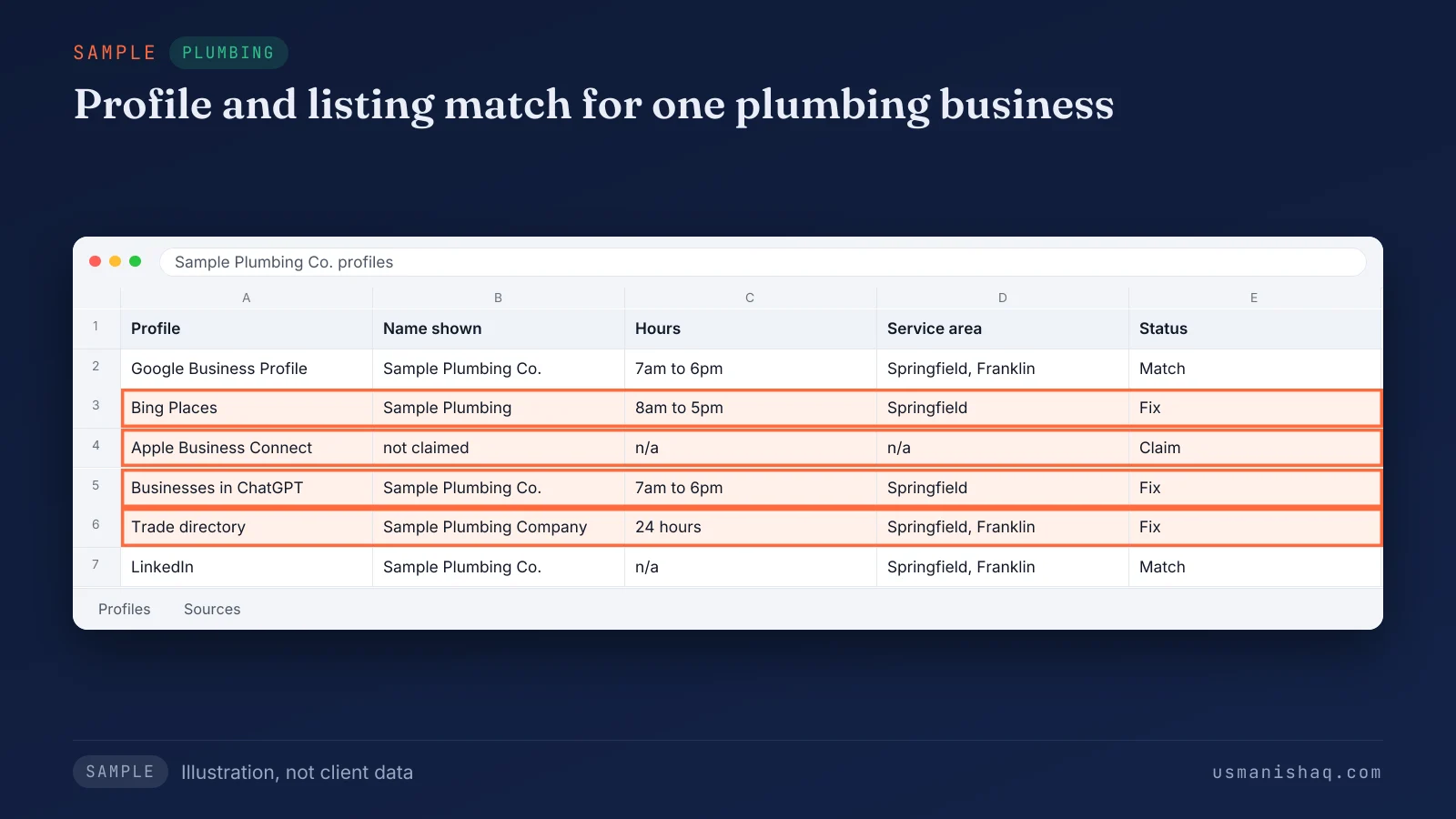
A mention of the business on a list an answer already cites counts, even without a link. Semantic SEO keeps the facts identical on every page and profile, so each AI system reads one business.
Which deliverable comes first depends on the gaps in each AI engine.
Does AI search visibility work change for each AI engine?
Yes, AI search visibility work changes by engine, because ChatGPT, Gemini, Perplexity and Google AI Mode draw on different sources.
The gap pattern across engines shows which fix comes first, in my reading.
The four gap patterns I read in a baseline, and the fix each one points to, are listed below.
- Missing only in AI Overviews and AI Mode: usually ranking gaps on query fan-out searches, fixed on pages and the topical map.
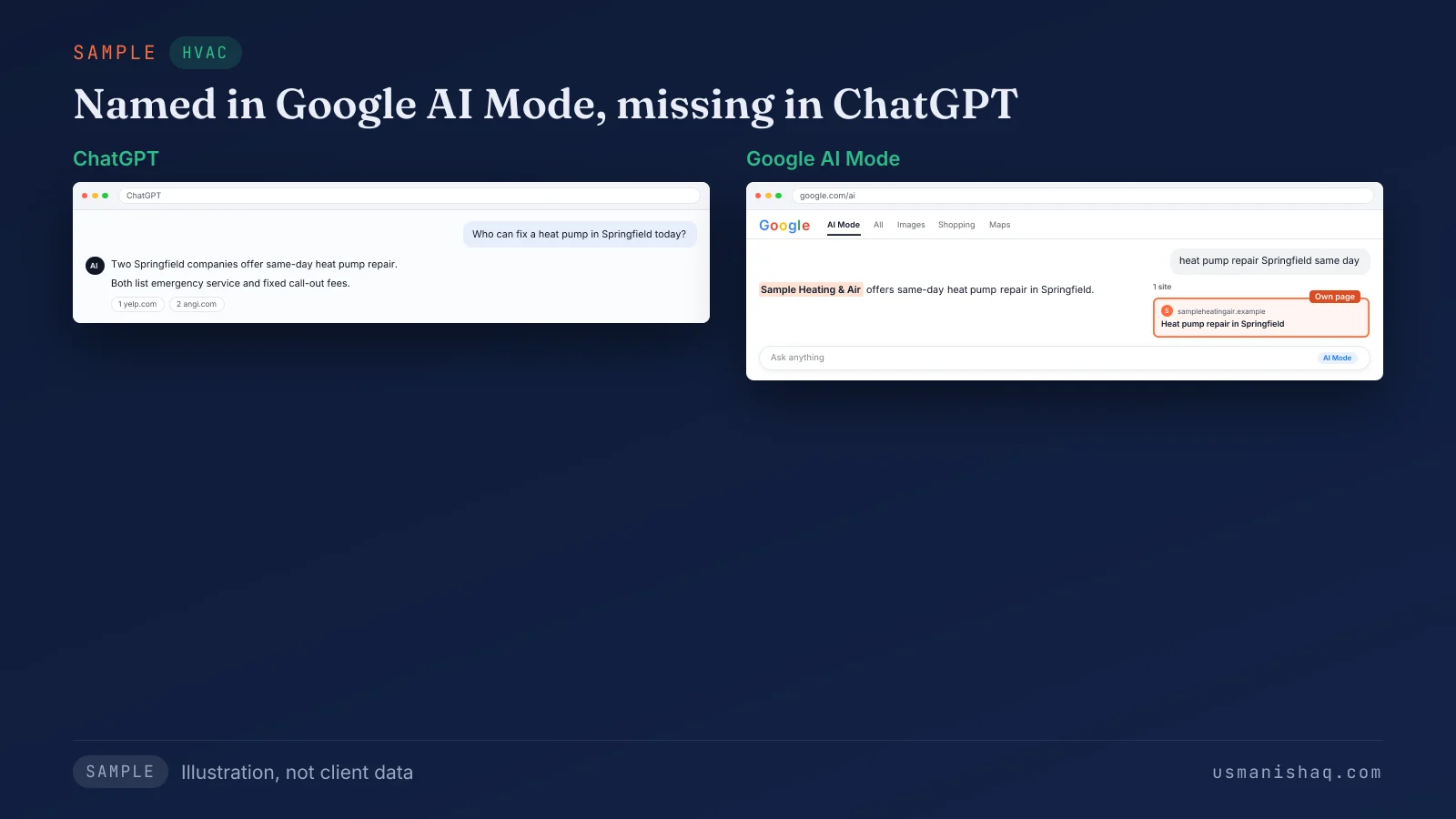
- Missing only in ChatGPT: usually thin entity presence, fixed through profiles, listings and brand mentions.
- Missing only in Perplexity: usually a freshness gap, fixed with recent pages and the directories and forums Perplexity cites.
- Missing on one topic in every engine: a content gap, fixed with a new page that owns the question.
Every engine is read on the same day, so the gaps compare. No engine goes first, because all four are read together.
The sample below shows the second pattern: Google AI Mode names Sample Heating & Air, and ChatGPT names two directory-listed rivals.
The same-day reading belongs to the baseline, the second of six steps.
How does work with an AI search visibility consultant run?
Work with an AI search visibility consultant runs in six steps, from a 30-minute scope call to a day-90 re-run.
The six steps of AI search visibility work are listed below.
- Scope call: a 30-minute call sets the buyer questions, engines and competitors, and a written fixed scope follows.
- Baseline: I ask 20 to 50 buyer questions in the buyers' own words, with several dated runs in each engine. Google Search Console and Bing Webmaster Tools are read the same week.
- Source and fact map: every cited source, every profile and every wrong fact is listed with the true value.
- Fixes in order: facts at their sources first, then listings and mentions, then pages and passages.
- Re-run: the same questions, engines and competitors are asked again at day 90.
- Report and next round: the three-layer report sets the next fix list.
The business sees every answer behind every number. Each step settles one semantic SEO fact before the next step builds on it.
The baseline and the fixes depend on what the business supplies.
What does the business supply during AI search visibility work?
The business supplies read access to its reports, manager access to its profiles, one fact checker and three competitor names.
The inputs a business supplies for AI search visibility work are listed below.
- Report access: read access to Google Search Console, Bing Webmaster Tools and GA4.
- Profile access: manager access to Google Business Profile, Bing Places and the other profiles, while the owner keeps ownership.
- Website access: edit access for the page fixes, or a developer who applies them.
- A fact checker: one person who confirms hours, service areas, services and licences.
- Competitor names: the three businesses buyers compare against.
No password or owner-level access is needed for the reports. Read access also lets the owner check every figure the work has produced.
What has AI search visibility work produced?
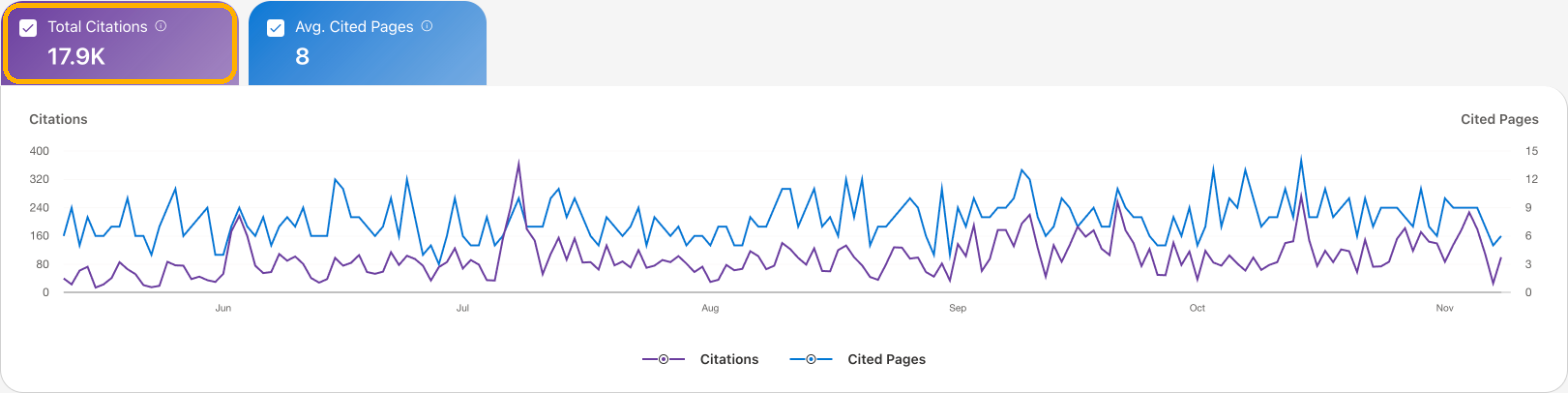
AI search visibility work for an online test-prep platform drew 17.9K citations in Microsoft Copilot and partners over six months.
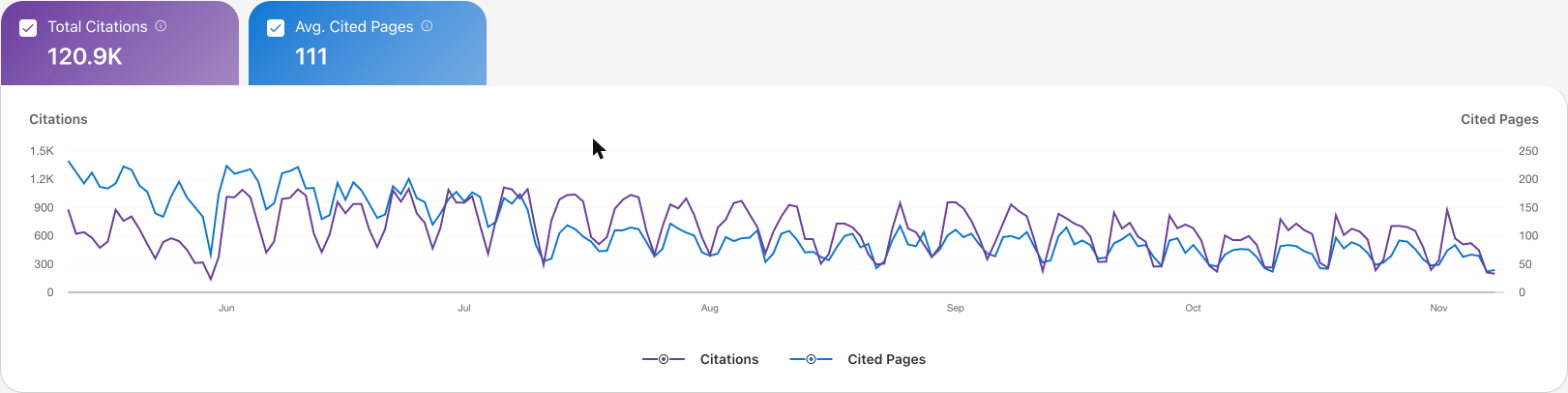
The count comes from the AI Performance report in Bing Webmaster Tools, read on 11 November 2026. Daily citations stood at about 40 in late May 2026. The daily count reached 120 to 200 by October and November 2026.
The report below shows 17.9K citations in total, with the daily line rising from late spring to autumn.
I wrote single-topic guides from the search results, competitor pages and current AI answers between December 2025 and November 2026. The most cited pages were single-topic guides, and the longest guide drew far fewer citations. The test prep SEO case study records the same pattern guide by guide.
One Google-Extended block had stopped Gemini quoting the site, and I removed the block in October 2026. Guides from a 2025 blog program for an international calling app drew about 43.2K citations in six months, a year after publication.
Bing's report covers Microsoft Copilot and partners only, and no comparable count exists for ChatGPT, Gemini or Perplexity. The full test prep SEO case study shows the work in order, what did not move and how each figure was measured.
How are AI search visibility results measured?
AI search visibility results are measured in three layers: AI assistant visits, influenced demand and the share of answers naming the business.
Each layer undercounts in its own way, so the three are read together.
The three layers, what each counts, where each is read and why each is a floor are set out below.
| Layer | What it counts | Where it is read | Why it undercounts |
|---|---|---|---|
| Direct | Visits from AI assistants, and buyers who say an AI assistant sent them | A GA4 segment for chatgpt.com, perplexity.ai, gemini.google.com, claude.ai and copilot.microsoft.com; a "How did you hear about us?" answer naming ChatGPT or another assistant | Many answers send no click, and some visits arrive with no referrer |
| Influenced | Searches for the business name, direct visits and booked calls after the fixes | Search Console filtered by the brand name; GA4; the call log | Other work moves these numbers too |
| Future moat | The share of answers that name the business, how often it is cited and how it is described | The re-run prompt set; Search Console's generative AI report; Bing Webmaster Tools AI Performance | Each report covers one engine family |
Search Console's generative AI report counts impressions in Google AI Overviews and AI Mode by page, country, device and date. The report shows no answer text, prompt or click. Bing Webmaster Tools AI Performance adds the citation count for Microsoft Copilot and partners.
Tracking tools call the moat layer AI share of voice. The trend is read by group of buyer questions over six months, not page by page in one month.
A single month's number reads as noise until the same questions run again. Which layer matters most depends on who the work is for.
Who is an AI search visibility consultant for?
An AI search visibility consultant is for trade and service businesses first, then online brands whose buyers ask AI assistants.
The businesses an AI search visibility consultant fits are listed below.
- Trade and service businesses: a plumber or HVAC firm across several towns, whose buyers ask ChatGPT or Google AI Mode for one. Google AI Mode now shows booking links through job software such as Jobber and Housecall Pro in the US.
- Clinics and professional firms: fields where an AI answer names only a few providers.
- Online businesses: software, apps and stores that want to get recommended in "best" answers.
- Businesses with wrong facts: any business whose AI answers state wrong hours, areas or services.
- Ranking but unnamed businesses: a business that ranks in Google and is still missing from AI answers.
The work does not fit a new website with no pages for an answer to cite yet.
Does a new website need AI search visibility work first?
No, a new website does not need AI search visibility work first, because AI answers can cite only pages that exist.
A new site starts with Semantic SEO Architecture, which plans the pages before any are built.
Some work can start on day one. Profiles such as Google Business Profile and Businesses in ChatGPT can be claimed before the site is finished. What the business already has decides how the work is priced.
How is AI search visibility work priced?
AI search visibility work is priced as one fixed scope, quoted in writing after a 30-minute call and before any work starts.
Four things set the price: locations and services, buyer questions and engines, profiles and listings, and pages that need new passages. A plumber serving Springfield and Franklin brings two towns' questions into scope, not one.
The price covers the baseline, the source map, the fixes in scope, the day-90 re-run and the report. The price excludes new pages and articles, the website build, paid ads in ChatGPT or Google, link buying and review generation. Monthly re-runs after the first round are quoted separately.
The scope follows the business, because the work is the list of facts and sources to fix. The fee buys semantic SEO work on named facts and sources, not a promise of answers. No scope, however large, includes a guarantee.
Can an AI search visibility consultant guarantee a ChatGPT recommendation?
No, an AI search visibility consultant has no way to guarantee a ChatGPT recommendation, because AI systems choose their own sources.
The same holds for Gemini, Perplexity and Google's AI features.
The work can promise three things: the dated record, the fixes in the scope and the day-90 re-run on the same questions. A seller who promises a named spot in ChatGPT is selling the promise, not the work. A promise of placement is the first warning sign when owners choose a consultant.
How do you choose an AI search visibility consultant?
The right AI search visibility consultant shows dated AI answers with their sources, fixes facts before pages and promises no placement.
The five checks to make before hiring an AI search visibility consultant are listed below.
- Dated answers: the proposal shows real answers with dates, not a score.
- Named sources: the consultant names the sites the answers cite for your questions. A sound proposal also lists the brand mentions competitors hold on those sites.
- A fix order: facts at their sources first, with who fixes each item.
- A measurement method: the three layers, each with its limit stated.
- No guarantee and no early access demand: no promised spot, and no owner-level login before a written scope.
A first AI visibility audit is the cheapest way to see the five checks in practice. The guide to what an AI visibility audit should hand over lists the documents a sound first audit delivers. Owners often weigh a consultant against a tracking tool and an agency.
How does an AI search visibility consultant compare with a GEO tool and an agency?
A GEO tool records AI answers, an agency runs many people at once, and an AI search visibility consultant diagnoses and fixes.
The three ways to buy AI search visibility work are compared in the table below.
| Point | GEO tracking tool | AI search visibility consultant | Agency |
|---|---|---|---|
| What it does | Tracks answers and share of voice on a prompt set | Reads the answers, maps the sources and makes the fixes | Runs writing, development and outreach in parallel |
| Who fixes the sources | The business | The consultant, with the business's developer | The agency team |
| Fits | A team that already knows what to fix | An owner who wants the diagnosis and the fixes from one person | A business with many pages and several work streams |
A GEO (generative engine optimization) tool earns its fee once someone on the team can act on what the tool shows. A tool flags a missing citation, and the reason often sits in a passage that does not answer on its own.
Passage independence means each section answers one question without leaning on the rest of the page. The guide on passage independence for service pages shows why a cited competitor's passage beat the business. The third option, an agency, fits a different kind of fix list.
When does an agency fit better than an AI search visibility consultant?
An agency fits better than an AI search visibility consultant when the fix list needs writers, developers and outreach working at once.
A fix list of facts, profiles and a few passages fits one consultant. When a fix list needs a team, I run it through the Digital Vikingz team, the agency I run. The fix order stays the same either way.
An owner can still fix several things before hiring anyone.
What can an owner fix before hiring an AI search visibility consultant?
An owner can fix wrong business facts before hiring an AI search visibility consultant, starting with the profiles the owner controls.
The check takes three buyer questions asked in ChatGPT, Gemini and Perplexity, with each answer saved and dated. The owner then corrects hours, services and areas on Google Business Profile, Bing Places and Businesses in ChatGPT.
The third check is crawler access, described on OpenAI's crawler page. OpenAI states, "Sites that are opted out of OAI-SearchBot will not be shown in ChatGPT search answers."
The hard half is working out why an answer chose one source over another. Reading those choices takes practice, and a consultant earns the fee there. The guide to find and fix wrong business facts in AI answers sets out the full order owners ask for.
A published result
AI search visibility work for an online test-prep platform drew 17.9K citations in Microsoft Copilot and partners over six months. Daily citations rose from about 40 in late May 2026 to 120 to 200 by October.
What Google and researchers say about AI answers
The table shows Google documentation on AI features and three studies of how AI answers cite their sources.
| What the source says | Kind of source | Source |
|---|---|---|
| Google documentation says specific optimization is not required for AI Overviews and AI Mode. | Documented by Google | AI features and your website |
| Google said in May 2024 that AI Overviews are built to show only information backed up by top web results. | Documented by Google | AI Overviews: About last week |
| A 2026 comparison found that the source domains of AI answers diverge from those in Google results. | Research | Navigating the Shift |
| A 2026 survey reports topical relevance and context position as the most reproducible levers, and no technique with a stable effect across AI engines. | Research | Optimizing Visibility in Generative Engines |
| A 2023 human audit of four generative search engines found that 51.5% of sentences, on average, were fully supported by their citations. | Research | Evaluating Verifiability in Generative Search Engines |
What else do owners ask about AI search visibility consultants?
Owners ask four more questions about AI search visibility consultants: timing, claiming, paying for placement and reviews.
How long does AI search visibility work take to show in AI answers?
No fixed time applies to AI search visibility work, because each AI engine chooses and refreshes its sources on its own schedule.
Profile fixes can show in answers sooner than new pages, which first need to be crawled.
Does claiming a business in ChatGPT get it recommended?
No, claiming a business in ChatGPT does not change ChatGPT's independent recommendations, according to OpenAI.
Claiming does let the owner correct the facts ChatGPT shows on the profile.
Can a business pay ChatGPT to recommend it?
No, a business has no paid route into ChatGPT's answers, because OpenAI states that advertising does not influence them.
ChatGPT ads are labelled and kept apart from the answers.
Do reviews affect ChatGPT recommendations?
Reviews can affect which business ChatGPT recommends, and OpenAI has not published how much weight reviews carry.
How do you start work with an AI search visibility consultant?
Work with an AI search visibility consultant starts with a 30-minute call on the buyer questions, then a written fixed-scope quote.
The scope of the AI search visibility work is agreed on that call. The work shows how AI systems understand the business, so every fix builds on facts those systems already read.