
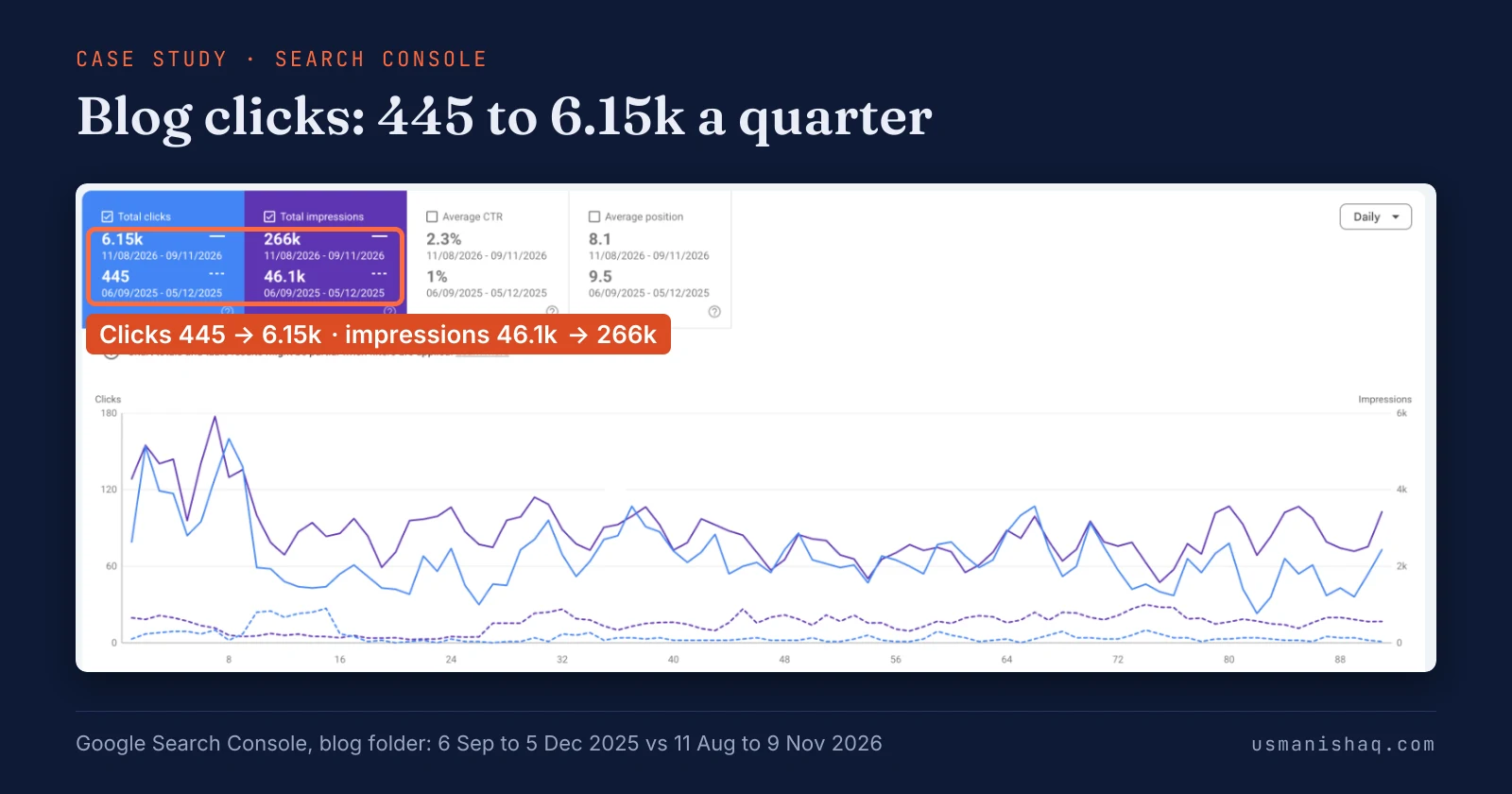
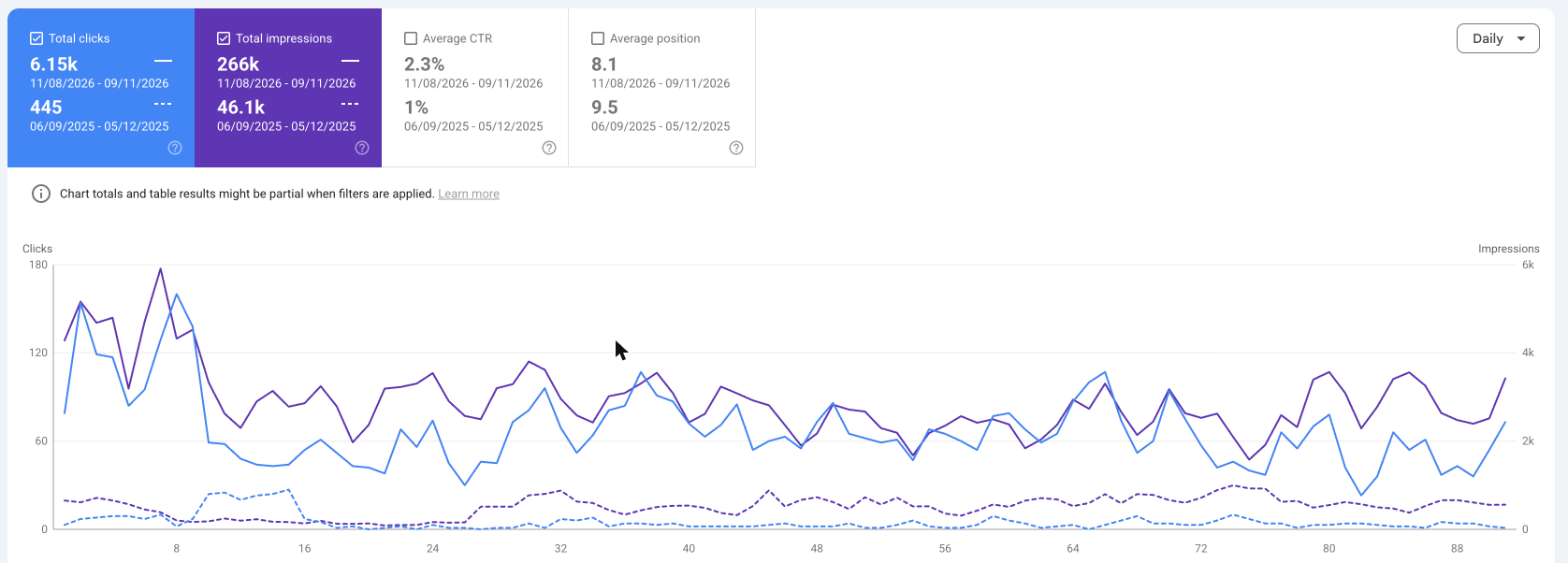
The work in this test prep SEO case study was semantic SEO for an online test-prep platform for consulting-firm candidates, and it ran from December 2025 to November 2026. The platform's blog went from 445 Google Search Console clicks in the quarter before the work to about 6,150 in the latest quarter.
Results at a glance
The blog folder moved the most, and whole-site clicks and citations in Microsoft Copilot and partners rose alongside the blog.
| Metric | Before | After | Change |
|---|---|---|---|
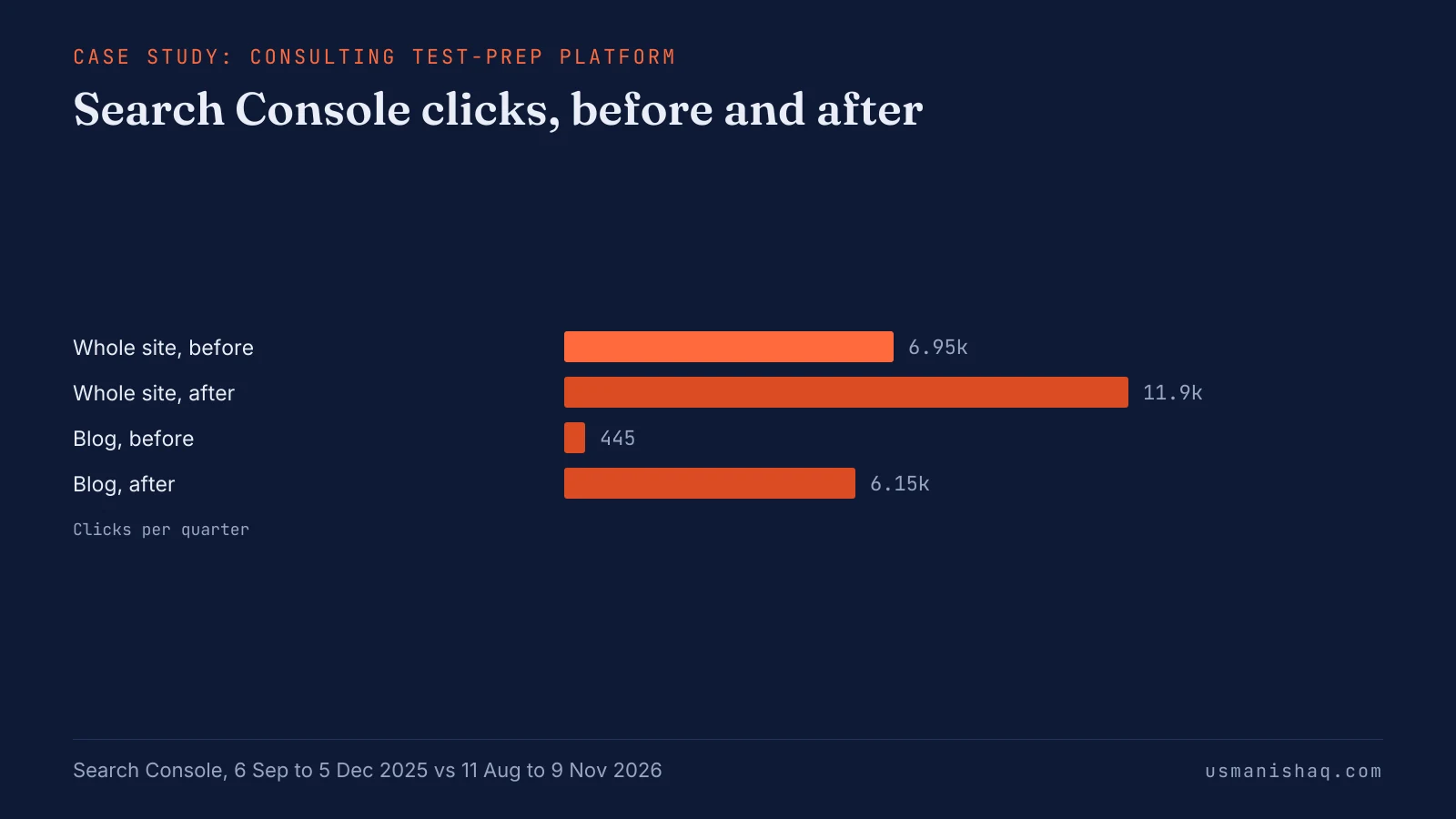
| Blog clicks per quarter | 445 | about 6,150 | about 13.8x |
| Blog impressions per quarter | 46.1k | 266k | about 5.8x |
| Whole-site clicks per quarter | 6,950 | 11,919 | +71.5% |
| Whole-site average position | 10.1 | 8.6 | 1.5 places higher |
| Citations per day, Microsoft Copilot and partners | about 40 (late May 2026) | 120 to 200 (Oct to Nov 2026) | 17.9K in six months |
Search Console rows compare 6 September to 5 December 2025 with 11 August to 9 November 2026; the citation row comes from Bing Webmaster Tools AI Performance for the six months read on 11 November 2026.
The starting point for online test prep platform SEO
The blog was thin, and competitors outranked the platform on the assessments it prepares candidates for. Google rankings were one goal, and recognition by ChatGPT and other AI assistants was the other. Consulting assessment preparation is a narrow niche, so each test name works as a query group of its own.
The blog folder earned 445 clicks in the quarter before the work. The whole site took 6,950 clicks in that quarter. Most search traffic over the last 16 months came from the United States, the United Kingdom and India.
What I did, in order
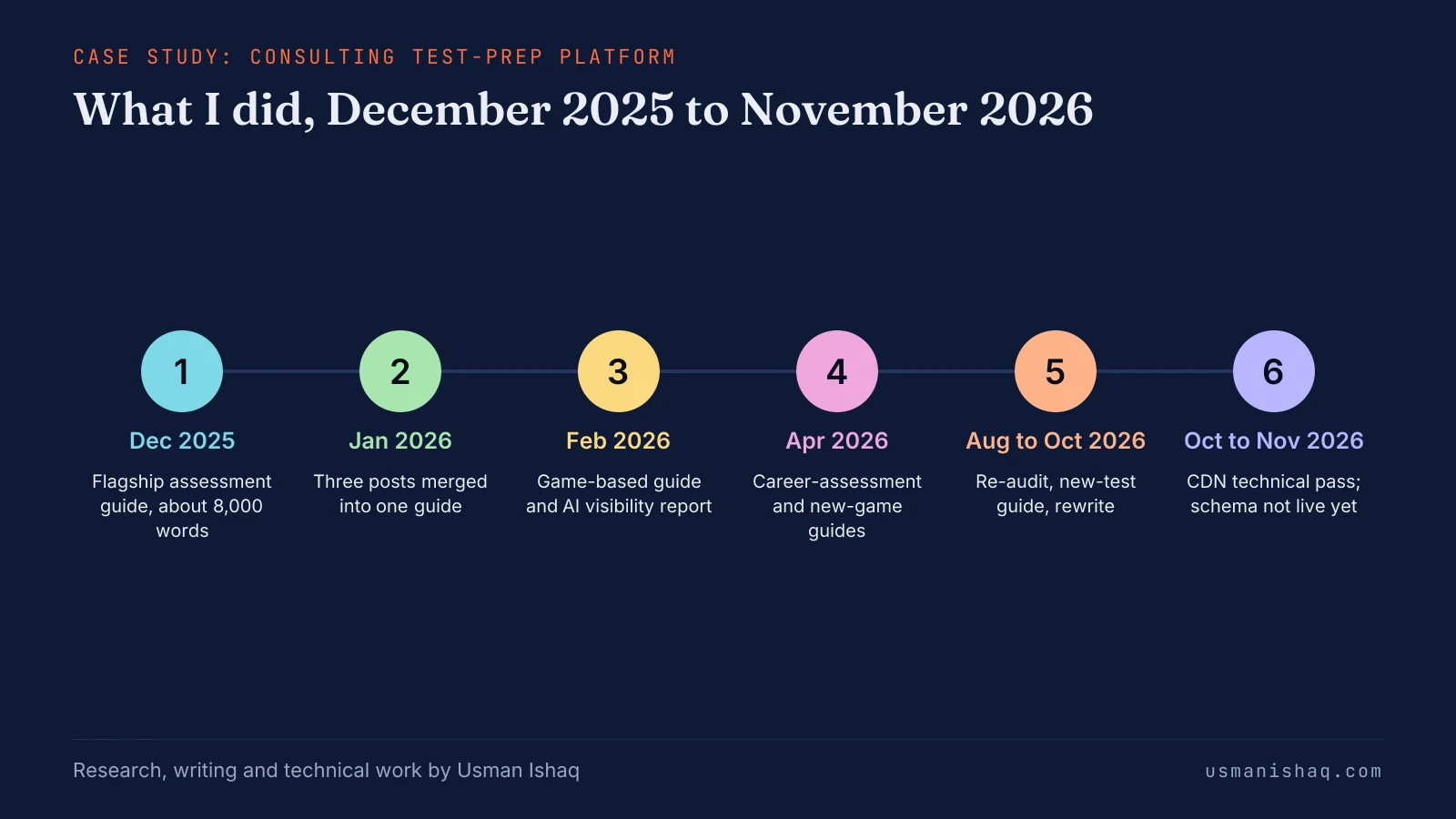
I wrote one long-form guide per assessment, merged old posts, and finished with a technical SEO pass and then schema markup. The order was:
- December 2025: a guide to the platform's flagship assessment. Built from the search results, competitor pages and current AI answers, the guide ran to about 8,000 words and replaced an older post.
- January 2026: one master guide in place of three posts. The guide to a second assessment ran to about 9,500 words and went live on 17 January. I also restored a renamed URL that had started returning 404.
- January to February 2026: two more assessment guides and an AI visibility report. The game-based assessment guide went live on 13 February; a third assessment guide came in the same weeks. An AI visibility report on the same day set out a plan of 20 to 30 topics.
- February to April 2026: comparisons and two more guides. I compared coaching services and prep platforms, and the career-assessment guide went live on 2 April. A guide to a brand-new assessment game followed within about six days of its launch.
- May to August 2026: pages for candidates close to applying. "What interviewers look for" went live on 7 August, next to "is coaching worth it". A re-audit and a new roadmap followed on 28 August.
- September to October 2026: a second firm's new test, and a rewrite. My own check, not a Search Console figure, put the new-test guide in Google's top 10 within weeks. I rewrote the new-game guide on 25 September, after the game itself changed.
- October 2026: a technical SEO pass through the CDN. I removed a Google-Extended block that stopped Gemini quoting the site and 301-redirected 26 duplicate and AI-guessed URLs. Sitemaps were fixed, and private paths got noindex after paid course PDFs showed up in Google.
- November 2026: schema markup and weekly reports. I wrote connected schema for 26 pages, and the weekly report added answers from ChatGPT and Perplexity.
Each guide was written as semantic content: one assessment and the questions candidates ask about it, on one page. The timeline below puts the same steps on one line.
What changed: blog clicks a quarter and Microsoft Copilot citations
Blog clicks rose about 13.8 times between the two quarters, and the searches that grew are the topics the guides cover. The chart below sets the blog folder and the whole site side by side.
The useful test in an edtech SEO case study is a match between the query groups that grew and the pages written. Here they match. The biggest gains came from searches the blog barely reached before.
"bcg online case assessment" went from 4 clicks to 226. "pymetrics" went from 0 to 219. "bcg shl assessment" went from 0 to 141.
Searches for McKinsey's Sustainable Futures Lab grew from zero clicks. The top phrasing reached 101. A guide from the list above covers that test.
The first three months of the work, 6 December 2025 to 5 March 2026, brought 9,108 site clicks. That was 31.1% more than the three months before. "mckinsey solve game practice" led that rise, from 63 clicks to 151.
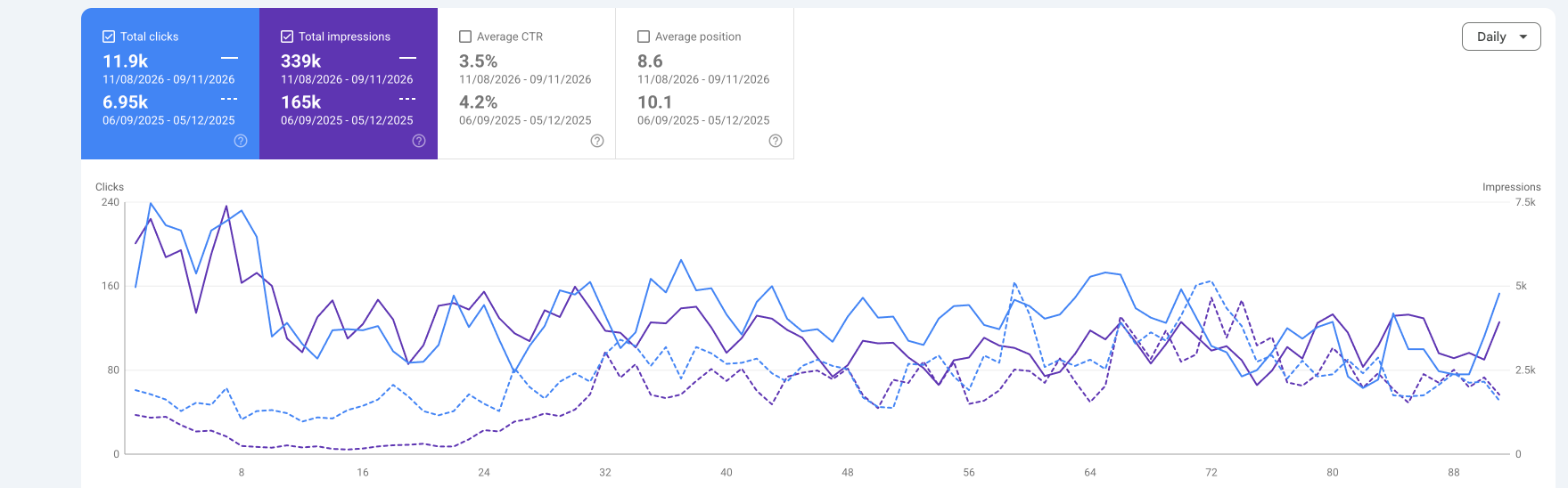
Whole-site clicks rose 71.5%, from 6,950 to 11,919. Average position improved from 10.1 to 8.6.
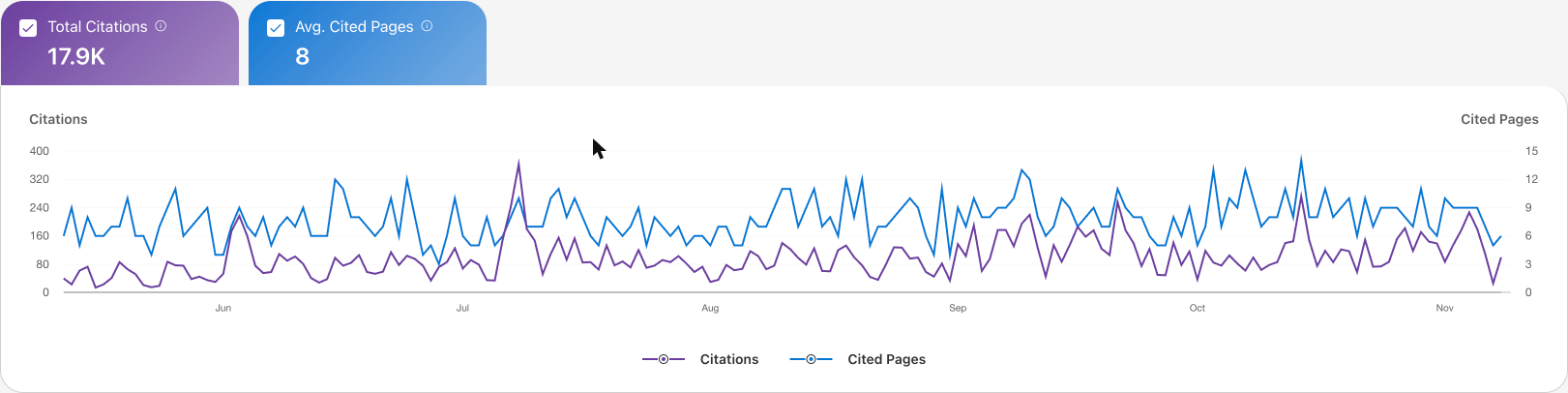
Microsoft Copilot and partners cited the site 17.9K times in six months. That count comes from the AI Performance report in Bing Webmaster Tools. The same report puts citations per day at about 40 in late May 2026 and at 120 to 200 by October and November.
Read as an AI citations case study, the list of cited pages matters more than the total. The game-based assessment guide was the most cited page, with 5.7K citations. The career-assessment guide came next, with 3.9K.
The homepage had 2.2K. The interviewer guide added 582.
What did not move
Not every number went up, and part of the gain belongs to factors outside my work. Site clicks peaked in June 2026 at 6,306 for the month. They fell every month after that, to 3,824 in October.
October still beat every month before February 2026, but the data doesn't say why the slide happened.
The baseline flatters the comparison a little. Most of September 2025 sits inside the before quarter, and the full month brought only 1,494 clicks. The drop started before my work, and I looked into that drop during the technical pass.
Brand searches grew too. One spelling of the brand name went from 232 clicks to 305, and I don't count that as my result.
Search Console warns that filtered totals can be partial, so read the blog figures as close, not exact.
Site click-through rate fell from 4.2% to 3.5%. Impressions grew faster than clicks, from 165k to 339k.
Length didn't buy citations. The master guide ran to about 9,500 words. It drew 177 citations in six months, far fewer than the game-based guide.
The schema wasn't live on 10 November, so none of the results above come from schema. The technical pass landed in the last weeks of the after quarter, so the numbers barely include the fixes. Bing's report covers Microsoft Copilot and partners only, and I have no comparable count for ChatGPT, Gemini or Perplexity.
What this test prep SEO case study means for your site
The pattern that worked here was one strong page per question buyers ask, kept current and readable by AI crawlers. Five points carry over to most sites:
- Give each topic its own page. The most cited pages here were single-topic guides, the work of Semantic Content Production. My experience is that a complete page earns more citations than AI-friendly formatting, and GEO compared with semantic SEO sets out why.
- Merge posts that split one topic. Three older posts became one guide here; a Semantic Content Audit checks for such competing pages.
- Publish when your topic changes. The new-game guide went live about six days after launch. A topic plan from Semantic SEO Architecture shows which changes deserve a page.
- Check what blocks AI crawlers. One Google-Extended block kept Gemini from quoting the platform. Crawler access and citation tracking are part of AI Search Visibility work.
- Read the blog apart from the site. Whole-site numbers mix brand searches and product pages with the content you publish. A Semantic Content Audit checks six things, with a site crawl and Google Search Console data as evidence.
The long-form guides did the heavy lifting.