
Semantic content is writing that organizes information around entities and their attributes and the relationships between them. Semantic content lets search engines and AI systems understand what a page means, fact by fact.
Semantic content has three layers: the entity layer, the structure layer and the retrieval layer. Semantic content writing, also called semantic writing, states each fact of one entity as an attribute and a value under question headings. An example of semantic content is a plumbing service paragraph that names the service, the town, the pipe materials and the price page.
Semantic content states facts about entities, and keyword content repeats a target phrase surrounded by qualifiers. Content is semantic when every section passes the five checks of semantic content: entity, verb, standalone, same-topic and fact.
What does semantic content mean in SEO?
Semantic content is writing that organizes information around entities and their attributes and the relationships between them. Semantic content lets search engines and AI systems read what a page means without counting repeated keywords.
An entity is a thing with one clear identity, such as a service, a town or a pipe material. An attribute is a property of the entity, such as cost, material or service area. A value is the specific answer for that property, such as PEX or Springfield.
A relationship joins two entities with a verb, such as a plumbing company that repipes homes in Springfield. Semantic content states the entities, attributes, values and relationships of a page in plain sentences.
Semantics is the study of linguistic meaning, as Wikipedia's entry on semantics opens. Semantic content in SEO applies the same idea of meaning to a web page. Content semantics in a content management system names the content model and its labels, a separate use of the words.
Business owners often meet the term on an agency proposal, as a line that reads "semantic content writing". The line names how each sentence of a page is written. Semantic content works on three layers of a page.
What are the layers of semantic content?
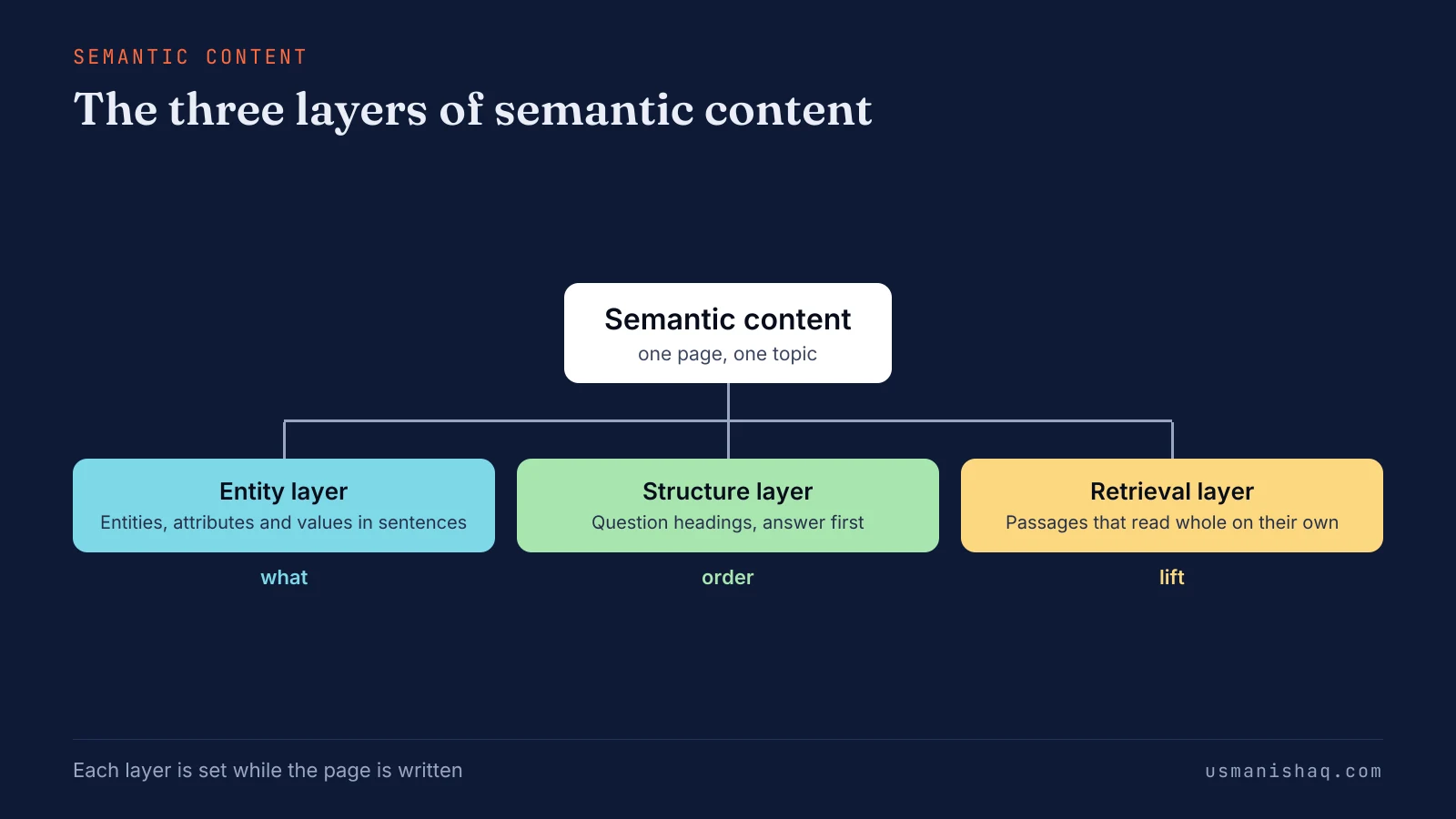
Semantic content has three layers: the entity layer, the structure layer and the retrieval layer.
The three layers of semantic content are given below:
- Entity layer: the entities of a page, their attributes and their values, stated in full sentences. A repiping page names whole-house repiping and its pipe material, PEX or copper, in plain sentences.
- Structure layer: the order of a page, with question headings and the answer in the first sentence under each heading. One page covers one topic, and every heading serves the topic.
- Retrieval layer: passages of a page that read whole when lifted out. A search engine or an AI system can then cite one section without the rest of the page.
The layers depend on each other. A page with named entities and a buried answer fails the structure layer. A page with question headings and no values fails the entity layer.
The figure below shows the three layers around one page of semantic content.
Each layer is set while the page is written.
How do you write semantic content?
Semantic content writing, also called semantic writing, states each fact of one entity as an attribute and a value under question headings. Semantic writing begins with the entity of the page, so every heading and every fact ties back to one subject. Each step produces a part the next step needs, so the order stays fixed.
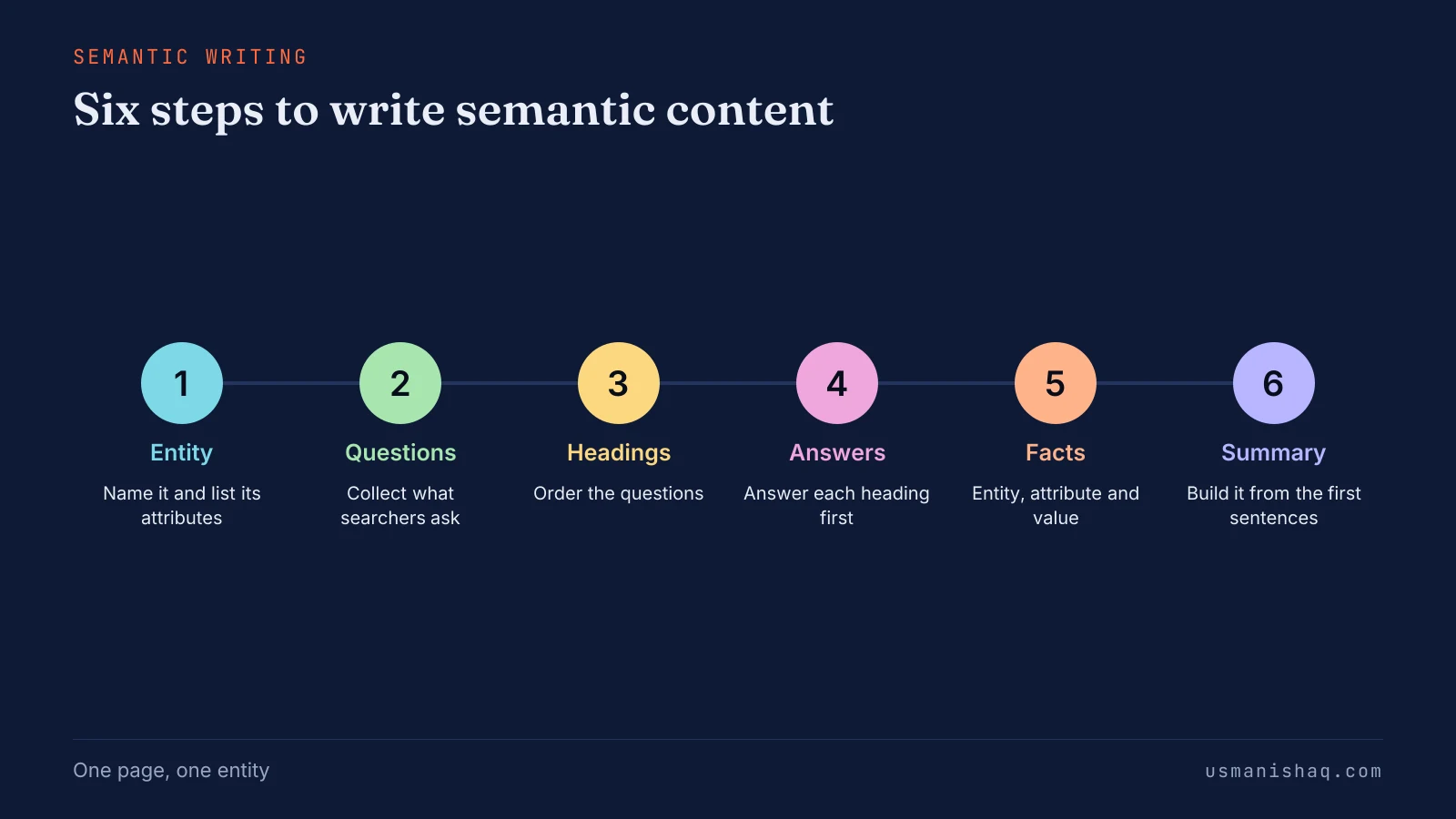
The six steps to write semantic content are listed below:
- Name the entity of the page and list its attributes, such as cost, material and service area for a repiping page.
- Collect the questions searchers ask about the entity, before and after the main search, from Google Search Console and search suggestions.
- Order the questions as headings: the definition first, then parts, process and comparisons, with yes-or-no questions last.
- Answer each heading in its first sentence, in bold, in a sentence that stands alone.
- State each fact as an entity, an attribute and a value, with a number or a name in place of "quality" or "experienced".
- Build the summary under the title from the first sentences of the sections, in heading order.
Step four decides the retrieval layer, because the first sentence under each heading is the passage a search engine can lift out. The figure below shows the six steps in order, from the entity to the summary.
The same six steps run page by page from a plan on a business website.
How is semantic content produced for a business website?
Semantic content for a business website is produced page by page from the topical map, through brief, draft, configured page and publication. A topical map is the plan of every entity, attribute and question a website must cover, with one owning page, section or sentence for each.
The content brief sets the questions, the order, the facts and the links of one page. Semantic Content Production is the service that runs that sequence. The Semantic Content Production pipeline sets out each stage, from brief to published page.
Pages publish in roadmap order, so each new page links to pages already live. One paragraph of a plumbing service page shows the result.
What is an example of semantic content?
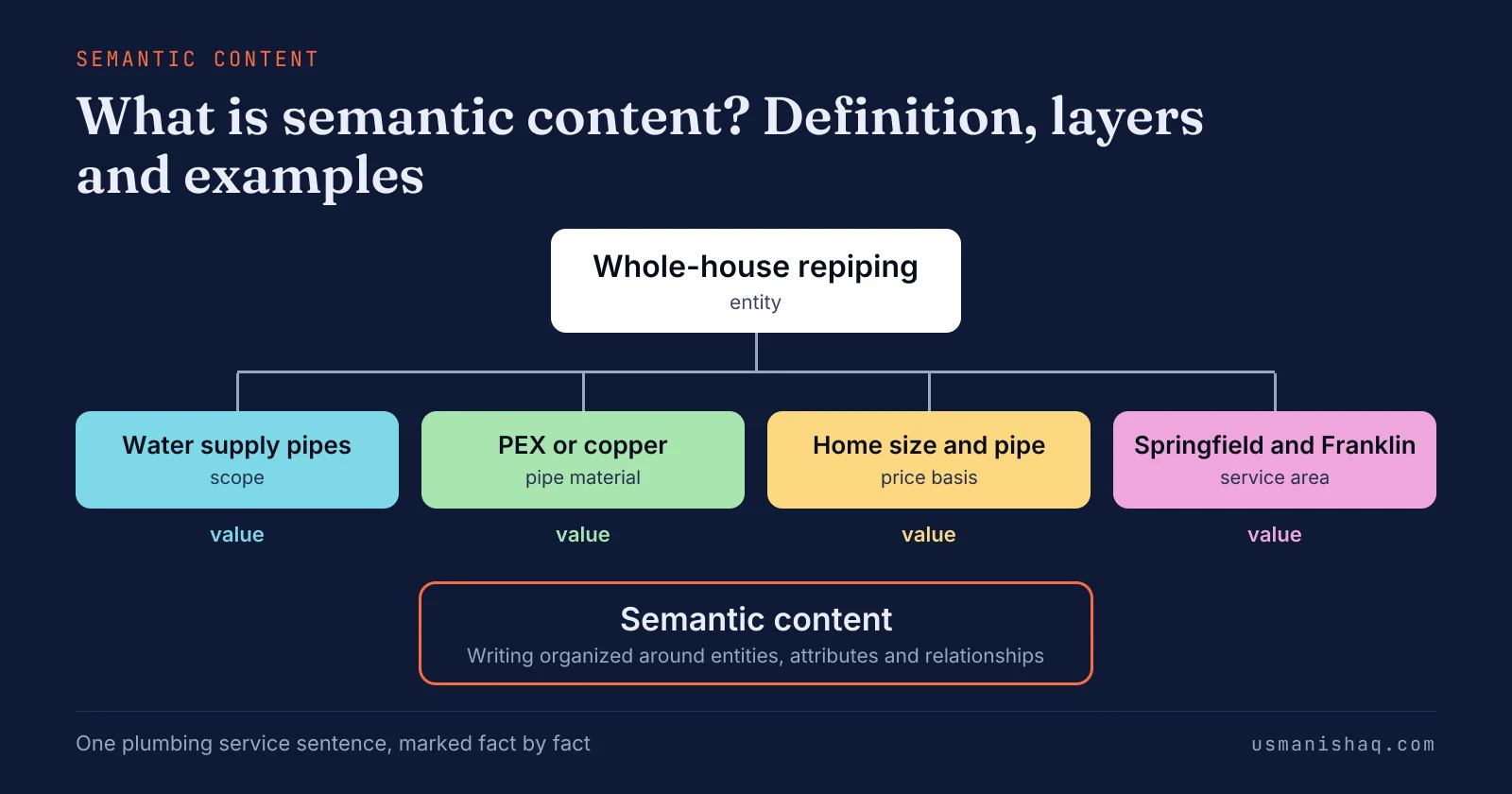
An example of semantic content is a plumbing service paragraph that names the service, the town, the pipe materials and the price page. The plumbing company in the example works from Springfield and offers whole-house repiping in Springfield and Franklin.
The service paragraph below is written as semantic content.
Whole-house repiping in Springfield replaces the water supply pipes of a home. The plumbing company repipes homes with PEX pipe or copper pipe. The repipe cost page lists price ranges by home size and pipe material. The same service runs in Franklin from a second town page.
Each sentence names an entity first and then states one attribute and its value. A customer who reads the paragraph learns the service, the pipe choices, where the price sits and which towns are served. The same paragraph can be written straight from a fact sheet before any wording is chosen.
The table below marks each fact of the paragraph as an entity, an attribute and a value.
| Entity | Attribute | Value |
|---|---|---|
| Whole-house repiping | scope | the water supply pipes of a home |
| Whole-house repiping | pipe material | PEX or copper |
| Repipe cost | price basis | home size and pipe material |
| Whole-house repiping | service area | Springfield and Franklin |
Every sentence of the paragraph states one fact a customer can check. The paragraph is a worked example, not a client result. The cover image marks the same paragraph.
A keyword version of the same paragraph states almost none of the four facts.
How is semantic content different from keyword content?
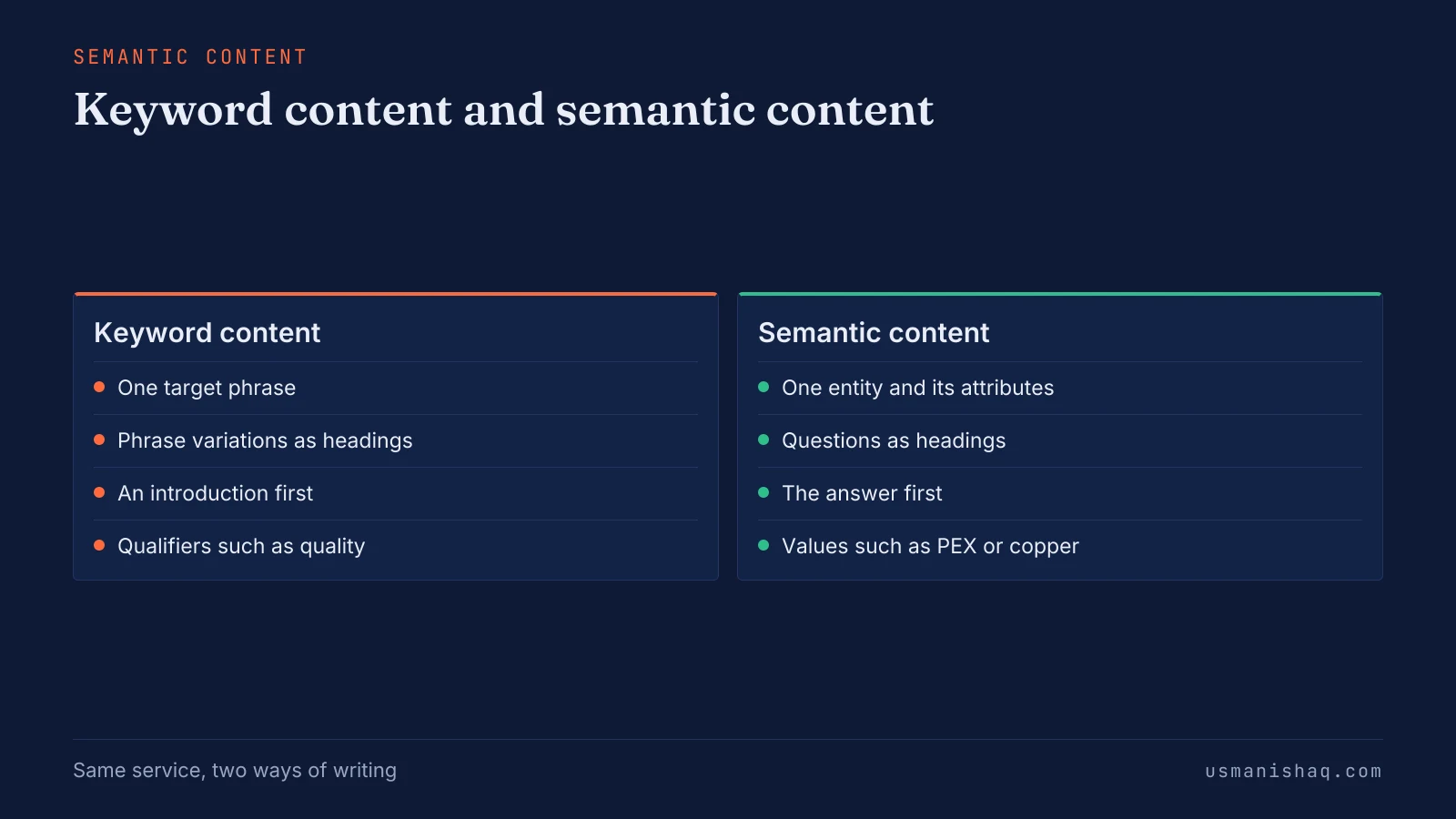
Semantic content states facts about entities, and keyword content repeats a target phrase surrounded by qualifiers. A keyword version of the repiping paragraph reads "Our experienced plumbers provide quality, affordable repiping services in Springfield." The sentence holds three qualifiers and one fact, repiping in Springfield.
A list of related words added to a paragraph is still keyword content, because the words state no fact.
The table below compares keyword content and semantic content on six features.
| Feature | Keyword content | Semantic content |
|---|---|---|
| Plan | one target phrase | one entity and its attributes |
| Headings | variations of the phrase | questions in one order |
| First sentence | an introduction | the answer |
| Claims | qualifiers such as "quality" | values such as "PEX or copper" |
| Passages | depend on the rest of the page | read whole when lifted out |
| Measure | how often the phrase appears | which facts the page states |
Semantic content keeps the search words and adds facts around the search words. The figure below sets keyword content beside semantic content on four of the six features.
Five checks show which kind a page already is.
How do you check if content is semantic?
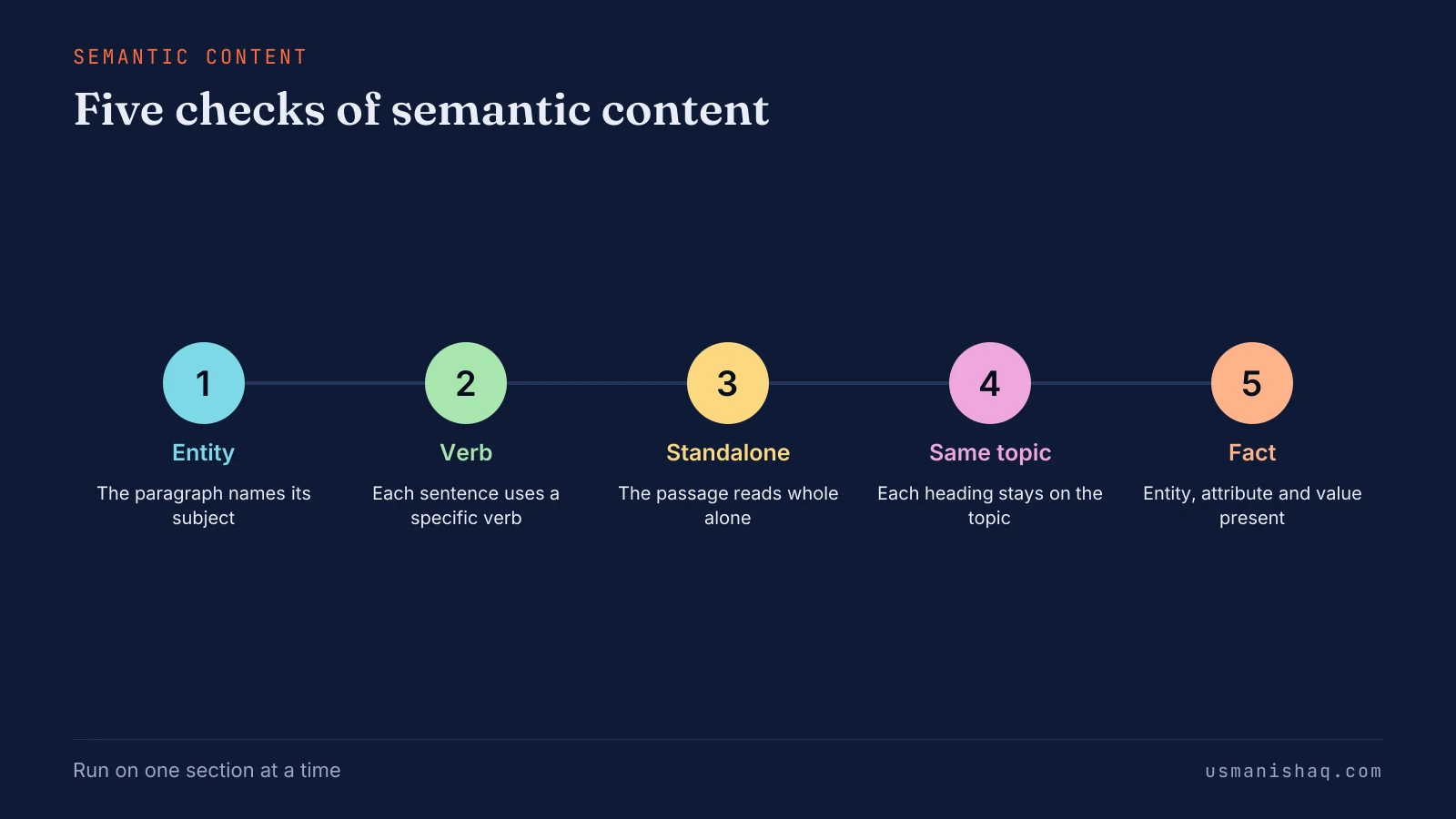
Content is semantic when every section passes the five checks of semantic content: entity, verb, standalone, same-topic and fact. Writers who ask if they already write semantic content often find that some sections pass already. I run the five checks on one section at a time, starting with the first section under the title.
A predicate is the verb that joins the entity to its attribute.
The five checks of semantic content are listed below:
- Entity check: each paragraph names its subject. Fails: "We provide professional services." Passes: "Whole-house repiping replaces the water supply pipes of a home."
- Verb check: each sentence uses a specific predicate. Fails: "handles", "provides", "helps". Passes: "replaces", "repipes", "lists".
- Standalone check: each passage reads whole when lifted out. Fails: "As mentioned above, the cost depends on size." Passes: "The repipe cost page lists price ranges by home size and pipe material."
- Same-topic check: every heading of the main content stays on the page's topic. Fails: a repiping page with a section on drain cleaning. Passes: every section answers a question about repiping.
- Fact check: each paragraph holds at least one entity, attribute and value. Fails: "Quality work from trusted plumbers." Passes: "The plumbing company repipes homes with PEX pipe or copper pipe."
The figure below shows the five checks in the order I run them on a section.
A section that fails one check is rewritten before the page goes live. The fact check also shows how dense the meaning of a passage is.
What is semantic content density?
Semantic content density is how much meaning a passage carries for its length. Keyword density counts how often a phrase appears, and semantic content density counts the facts a passage states.
A low-density sentence reads "Springfield homeowners trust our experienced team for quality repiping." A high-density pair reads "Whole-house repiping replaces the water supply pipes of a home. The plumbing company repipes homes with PEX pipe or copper pipe." The low-density sentence states no checkable fact, and the high-density pair states two.
Semantic content density has no agreed target number. A paragraph with no value fails the fact check, whatever its length. Higher density does not remove the search words from a page.
Does semantic content still use keywords?
Yes, semantic content still uses keywords, because the words searchers type name the entity of the page. The search words sit in the title, the first heading and the first sentence. Semantic content adds the attributes and values around the search words.
Older pages built on keywords keep their search words and gain facts when rewritten. Keywords and facts together are the writing step of semantic SEO. Writing is one of six kinds of semantic SEO work.
Where does semantic content sit in semantic SEO?
Semantic content is the writing step of semantic SEO, after the topical map and the content brief and before configuration and measurement. Semantic SEO is the practice of organising a website around entities, their attributes and the relationships between them, so that search engines and AI systems read what each page means.
The method runs in seven steps: source context, central entity, topical map, content briefs, semantic content, configuration and measurement. Semantic content is step five. The seven-step order is the framework of Koray Tuğberk Gübür, a method of work rather than a statement by Google.
Semantic SEO is the practice, and semantic content is the writing the practice produces. The topical map comes first and decides each page's coverage.
How does a topical map decide what semantic content covers?
A topical map decides what semantic content covers by giving every entity, attribute and question one owning page, section or sentence. Each page of semantic content then answers only the questions its row of the map assigns.
The guide on what a topical map for a business website holds shows the rows and the sections. A brief then turns one row of the map into instructions for one page.
Why is semantic content written from a brief?
Semantic content is written from a brief because the brief fixes a page's questions, order, facts and links before the first sentence. A semantic content brief tells a writer the questions, the order, the facts and the links for one page of a topical map.
The writer does not decide headings, so two pages never answer the same question. Pages written from briefs then join into a network.
How do pages of semantic content form a network?
Pages of semantic content form a semantic content network when the pages are built from one template per entity type and linked in sequence. Semantic content is the writing on each page, and a semantic content network is the set of pages that the writing fills.
The parts and the build order are set out in the guide on how pages form a semantic content network. One narrower term, entity-attribute-value writing, is sometimes taken for semantic content itself. A related view of networks built around meaning and intent is in semantic content networks by Ben Stace.
Is entity-attribute-value writing the same as semantic content?
No, entity-attribute-value writing is not the same as semantic content, because entity-attribute-value writing is the sentence method and semantic content is the whole page. Entity-attribute-value writing states each fact as a thing, a property and a value.
Semantic content also needs the structure layer and the retrieval layer of a page. The three layers together set what search engines and AI systems can read from a page.
How do search engines and AI systems read semantic content?
Search engines and AI systems can read semantic content as entities and the relationships between them when each sentence states them directly. Google Cloud's explainer What is semantic search, and how does it work?, updated 14 January 2026, describes knowledge graphs as "vast databases containing information about entities and their relationships".
A passage that names its entity and answers first can be cited in an AI answer without the rest of the page. Google's AI Overview for "what is semantic content" cited the earlier version of the present page when I checked on 12 November 2026.
One observation shows a citation on one date, not a cause. Writers shape each passage with a few sentence rules.
What should writers know about semantic SEO?
Writers need six sentence rules from semantic SEO, which control where the answer sits, what each sentence states and which words name the entity.
The six sentence rules for semantic content writers are given below:
- Answer first: the first sentence after a heading answers the heading.
- One fact per sentence: each sentence holds one entity, one attribute and one value.
- Entity as the subject: sentences open with the entity name, never with a pronoun.
- Verb form by claim: present tense for agreed facts, "can" for research findings, "should" for advice.
- List sentence: a sentence ending in a colon introduces every list.
- One phrase for one thing: the same term names the same entity in headings, links and body.
A writer who applies the six rules should check every value against the brief, whoever or whatever drafts the first version. Further questions about semantic content follow.
Questions about semantic content
Questions about semantic content cover schema markup, LSI keywords, length, existing pages, time to rank, tools, AI drafts, local businesses and semantic context.
Does semantic content need schema markup?
No, semantic content does not need schema markup, because schema describes a page in code and semantic content is what the sentences say. Schema markup states only what the page already shows.
Are LSI keywords part of semantic content?
No, LSI keywords are not part of semantic content, because a list of related words states no fact about the entity. Semantic content states the attributes and values of the entity in full sentences.
Is semantic content the same as long content?
No, semantic content is not the same as long content, because coverage of the entity's attributes decides the length. A short page that answers every question of its map row is complete.
Can existing content be turned into semantic content?
Yes, existing content can be turned into semantic content by rewriting each section's first sentence as the answer and replacing qualifiers with values. The five checks show which sections to rewrite first.
How long does semantic content take to rank?
Semantic content has no fixed time to rank, because the time depends on the site's history in the topic and on the competing pages. Google Search Console shows when the page first gains impressions for its questions.
Which tools help write semantic content?
Google Search Console shows the questions searchers ask, and no tool decides which facts a page should state. A tool can list terms, and the brief and the writer choose the facts.
Can AI write semantic content?
A language model can draft semantic content, and a person should check every fact, value and first sentence against the brief. A draft with an unchecked value fails the fact check.
Does a local service business need semantic content?
Yes, a local service business needs semantic content, because service pages carry the facts customers check: services, towns, prices and materials. The owner's word for the work is usually "content" or "blog posts".
What does semantic context mean?
Semantic context is the surrounding text that fixes which meaning a word carries in a sentence. Headings and nearby sentences on a page give each term of semantic content its semantic context.
Semantic content and the next step
Semantic content organizes each page around entities, their attributes and the relationships between them. Understanding the three layers comes first, and writing each page to the layers is the build. The next step is to run the five checks of semantic content on one service page and rewrite the first section that fails.