
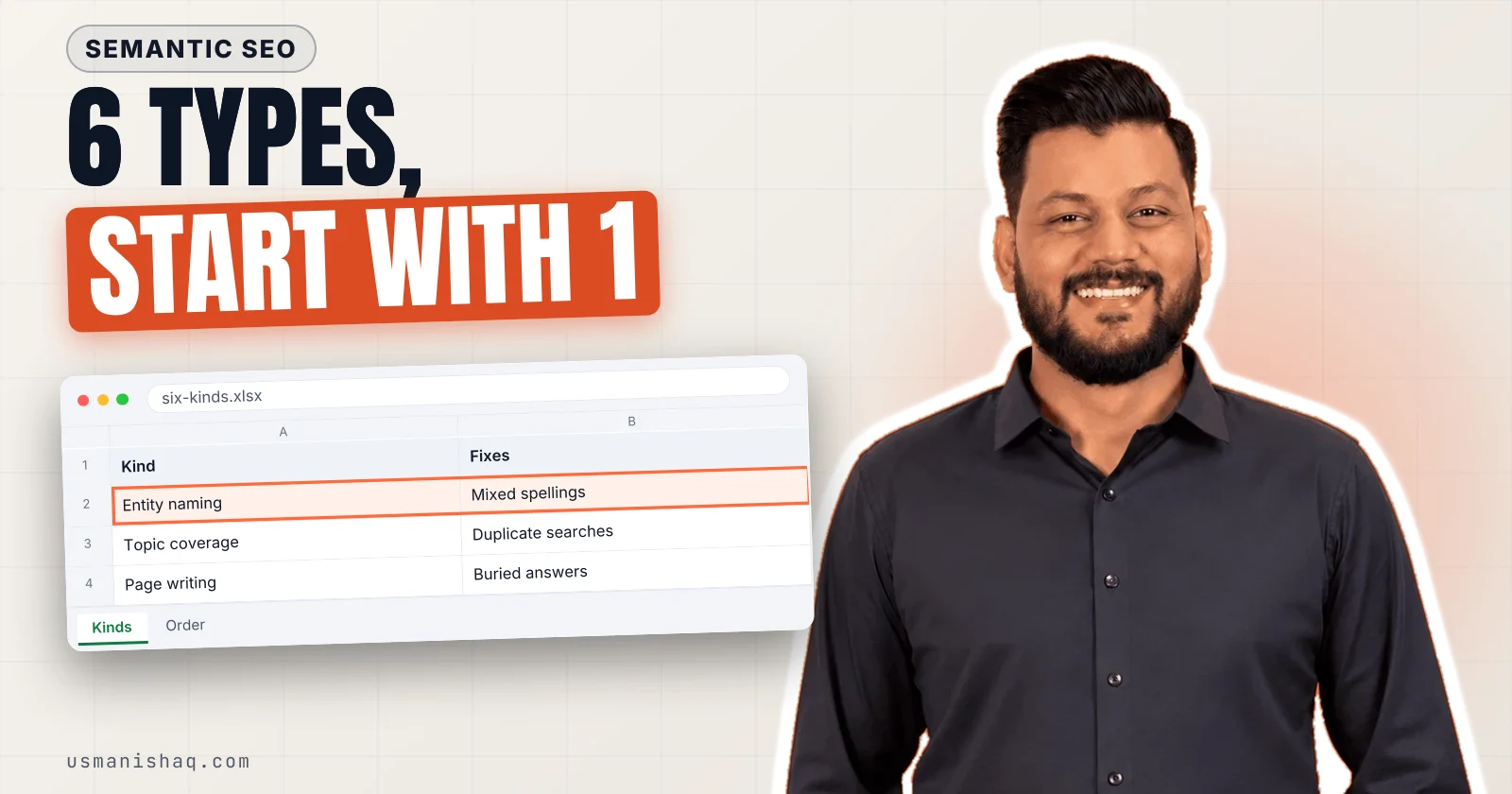
The types of semantic SEO are entity naming, topic coverage, page writing, site structure, markup and AI answer checks.
No search engine or standards body publishes a list of types. The six below are my working split, and other writers may group the same work differently.
The split helps because owners rarely need all six at once. A site that names one service three ways needs naming first. A site with clean names and missing pages needs a plan of pages first.
What are the types of semantic SEO?
The types of semantic SEO are kinds of work that help search engines read a site, and no official list exists.
Practitioners use the word "types" for different things. Some mean search types. Ahrefs's guide to semantic SEO describes lexical search, semantic search and hybrid search, and says large language models are almost completely semantic. That is a list of how systems retrieve, not a list of jobs you do.
Others mean the work itself. This page uses that second meaning, because it is the one a business owner can act on. You can hire or schedule a job. You cannot schedule a retrieval method.
The six kinds of semantic SEO work
The six kinds of semantic SEO work are entity naming, topic coverage, page writing, site structure, markup and AI answer checks.
Each kind is a job with a product at the end and a problem it fixes.
| Kind | Job | You end up with | Fixes this problem |
|---|---|---|---|
| Entity naming | Fix one exact name for each service, person, place and offer | A sheet of names and owner pages | One service spelled three ways |
| Topic coverage | Decide which searches earn a page | A topical map | Two pages answering one search, or no page for a search |
| Page writing | Put the answer first and state facts in plain sentences | Pages built from a brief | Answers buried under an intro |
| Site structure | Link pages by their relationships | A link plan | Pages nobody links to |
| Markup | Repeat the page's facts as structured data | Matching schema | Details that differ between page and markup |
| AI answer checks | Ask AI systems your customers' questions and log the answers | A record of what is said | An AI answer that misnames or skips you |
The kinds build on each other. Names come before the map, the map before the pages and the pages before the links.
Which type of semantic SEO should a service business start with?
A service business should start with the kind that fixes its most visible symptom, and a five-question test finds it.
Answer these in order and stop at the first yes.
- Does the site spell one service, person or town in more than one way? Start with entity naming.
- Do two pages answer the same search, or does a paying service have no page? Start with topic coverage.
- Do your main pages open with a long introduction before the answer? Start with page writing.
- Do pages exist that no other page links to? Start with site structure.
- Do the markup details differ from what the page says? Start with markup.

If all five answers are no, the basics are in place and the next job is the sixth kind. Check what AI systems say about the business.
The order follows the dependency, so a no at the first question never means the rest are fine. It means the first yes is your starting point, and the rest wait their turn. A Semantic SEO Architecture topical map holds the answers to questions one and two in one sheet.
A worked sheet for a Franklin law firm
A Franklin family law firm with a duplicated page, mixed spellings and thin links starts with entity naming, then topic coverage.
The firm is a sample, and its pages are invented to show how the test reads. Here are its answers.
| Question | Answer | Result |
|---|---|---|
| Mixed spellings | "Divorce lawyer" and "divorce attorney" used for one service across 6 pages | Yes, start here |
| Duplicate searches | Two pages answer "child custody Franklin" | Yes, next |
| Buried answers | Intros run three paragraphs | Yes, later |
| Orphan pages | Four blog posts have no links in | Yes, later |
| Markup mismatch | Not checked yet | Unknown |
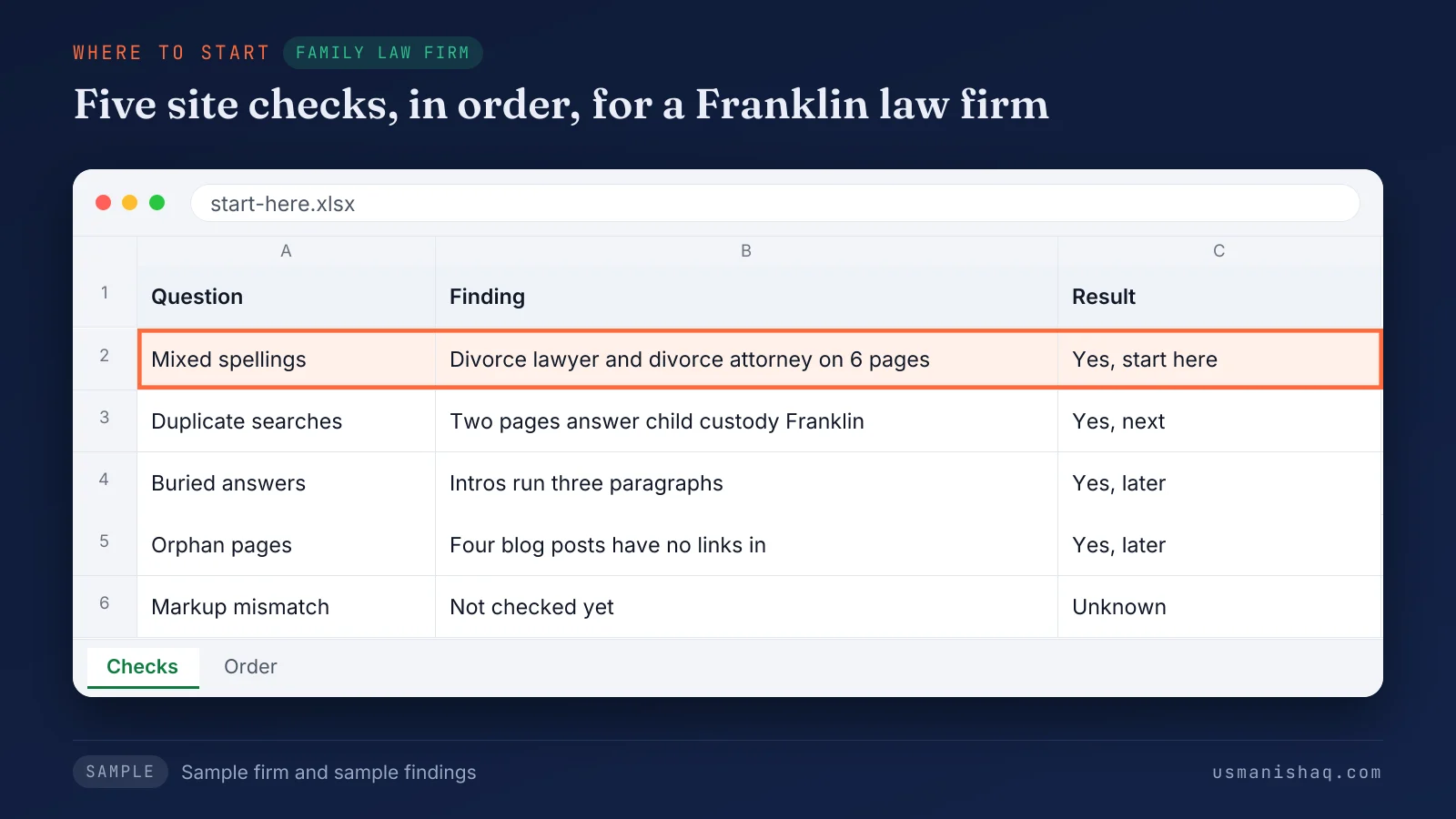
The firm has four yes answers and one unknown. It does not need all six kinds this quarter. It needs the first two, and the rest follow once the names and the map are settled.
What each type cannot do
Each type of semantic SEO has a limit, and none of them guarantees a ranking or an AI citation.
Entity naming cannot add a page the site lacks. Topic coverage cannot make a weak page answer well. Page writing cannot fix a page nobody can reach, however well its sentences read, because the reader never arrives. Markup repeats what the page says, so it cannot rescue a page that disagrees with it.
AI answer checks only observe. Results change between runs, so one answer is a sample and a pattern over many runs is the useful reading. Google's page on AI features says AI Overviews and AI Mode have no additional requirements or special optimizations. None of the six is one.
Nobody outside the search engines can say how much each kind adds, and I do not claim a number. What you can check is the symptom. If the site now spells one service one way, the first problem is fixed whatever the rankings do.
What owners ask once they pick a type
Owners ask how a type differs from entity SEO, whether all six are needed and how it relates to AI visibility.
Is semantic SEO the same as entity SEO?
No, entity SEO is one of the six kinds, the one about names, and semantic SEO covers all six.
Many sites call the whole job entity SEO. This page keeps the narrower meaning. For how the pieces fit into a content plan, see what semantic content is made of.
Do I need all six kinds?
No, most service businesses need two or three kinds at a time, in the order the test gives.
The plan of pages is the part owners skip most often. It is covered in how a business website's topical map is built.
Is this the same work as GEO or AEO?
No, GEO and AEO name the AI answer side, which is the sixth kind, and the first five kinds sit under both.
The terms differ and the job overlaps. GEO, AEO and SEO for a small business sets the labels side by side.
Types of semantic SEO in short
Types of semantic SEO are six kinds of work, and you start with the one that fixes your most visible symptom.
Run the five questions, take the first yes and leave the other kinds until it is done. The list is a working split and not an official one.