
Entity attribute value writing is writing a page from a fact sheet, one sentence per fact.
You do not start with a keyword and a blank page. You start with a sheet of facts about the business. Each row becomes a sentence naming one entity, one attribute and its value.
My sheet carries two columns beyond the facts, the source of each value and the date someone last checked it.
What is entity attribute value writing?
Entity attribute value writing is a way of writing where every fact sentence names its entity, one attribute and the value. Think of a row in a table. The entity is the subject, the attribute is the column and the value fills the cell.
The pattern comes from a data model. Holistic SEO, a practitioner site, describes entity, attribute, value as a data model for storing facts about entities. Practitioners claim that search engines read pages this way. I found no Google page that says so, so I treat it as a writing discipline and not a ranking rule.
A sample shows the shape. "Sample Law Office drafts wills in Franklin" has an entity, an attribute (service) and a value (wills). A customer can check it, and a sentence lifted out of the page still makes sense.
How do you write a page from a fact sheet?
You write a page from a fact sheet in six steps, and the sheet comes before any sentence.
- Name the one entity the page is about. Estate planning at one law office is one entity. The whole firm is another page.
- List the attributes customers ask about, using Search Console queries and the questions the office hears on calls.
- Fill each value from the owner's own record, such as the diary, the price list or the intake form.
- Write the source and the date checked beside each value.
- Write one sentence per row, with the entity named in the sentence.
- Lift each sentence out of the page and read it alone. It must still say who and what.
Put the attributes that people search first, and add one or two the customer needs next. A page with twelve attributes and no demand for ten of them is a catalogue.
Which attribute comes first?
The attribute with the most searches comes first, and the one that decides whether the customer calls comes second. On an estate planning page the second may be how the first meeting works. A client wants to know whether they must travel.
A worked fact sheet for an estate planning page
A worked fact sheet for an estate planning page has six rows, each with a value, a source and a check date. The sheet below is a sample for a made-up office in Franklin.
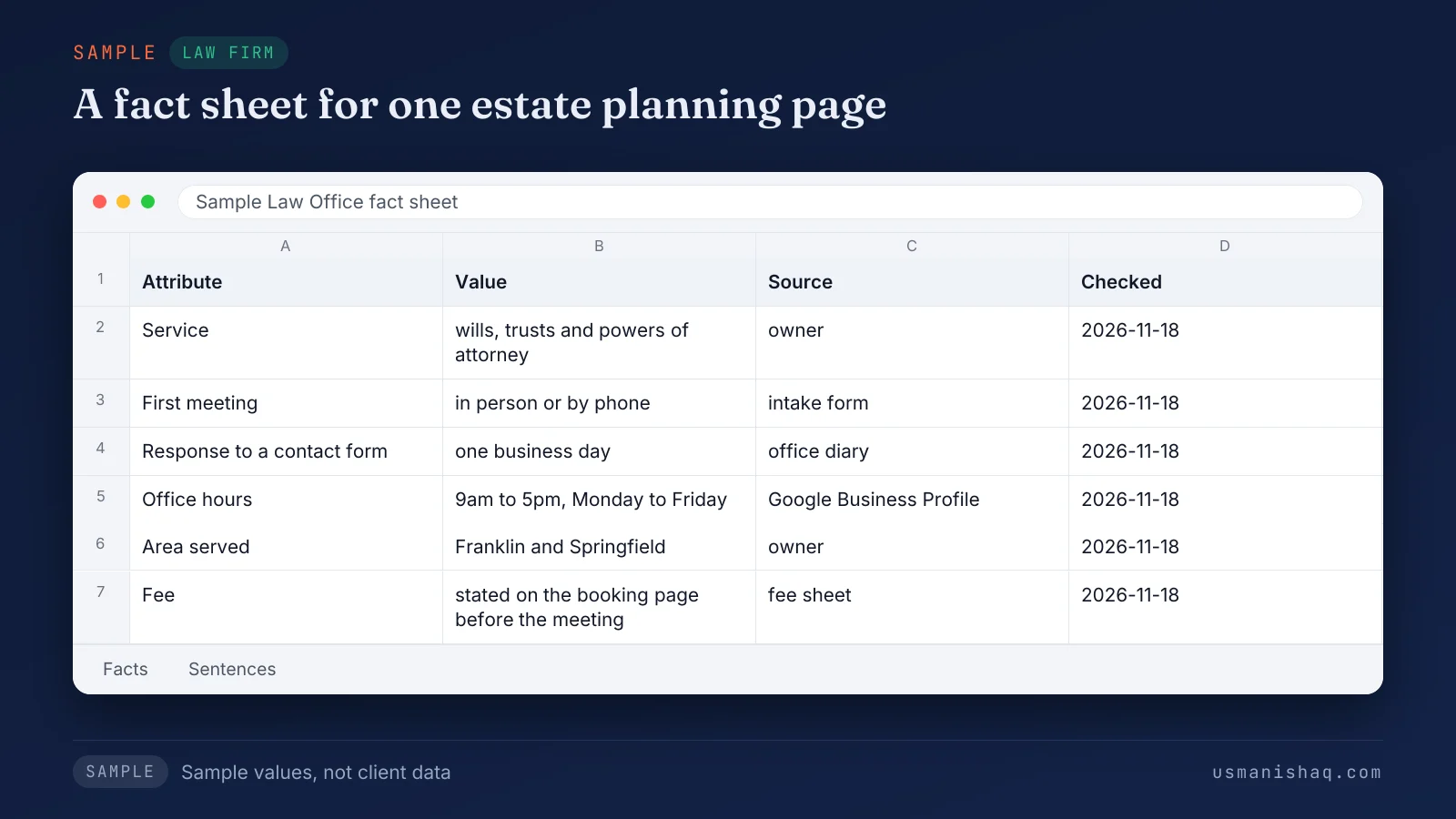
| Attribute | Value | Source | Checked |
|---|---|---|---|
| Service | wills, trusts and powers of attorney | owner | 2026-11-18 |
| First meeting | in person or by phone | intake form | 2026-11-18 |
| Response to a contact form | one business day | office diary | 2026-11-18 |
| Office hours | 9am to 5pm, Monday to Friday | Google Business Profile | 2026-11-18 |
| Area served | Franklin and Springfield | owner | 2026-11-18 |
| Fee | stated on the booking page before the meeting | fee sheet | 2026-11-18 |
Every value above is a sample. A real sheet takes them from the office's own records.
The six sentences that come out of the sheet read like this.
- Sample Law Office drafts wills, trusts and powers of attorney.
- Sample Law Office holds the first meeting in person or by phone.
- Sample Law Office answers a contact form within one business day.
- Sample Law Office is open 9am to 5pm, Monday to Friday.
- Sample Law Office serves clients in Franklin and Springfield.
- Sample Law Office states its fee on the booking page before the meeting.
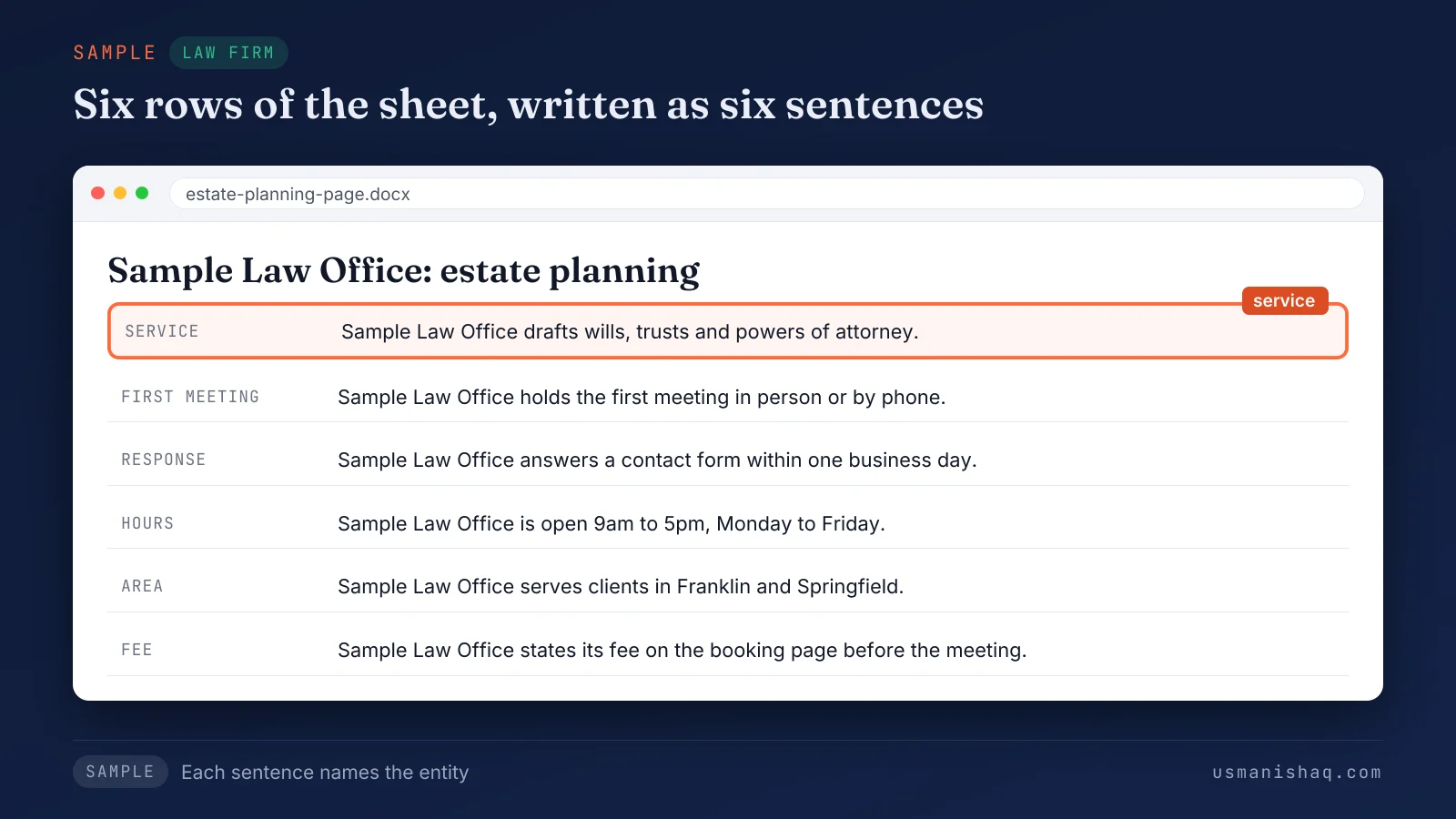
Six sentences in a row read like a stack of cards. I put a short reason between some of them, such as why a phone meeting suits a client who cannot travel.
Limits of entity attribute value writing
Entity attribute value writing has three limits, and each one needs a plain sentence of argument beside the facts.
- Facts alone read like a catalogue. A page also needs the sentences that explain why an attribute matters to the customer.
- Not every search asks for a fact. A comparison or a "should I" question needs a reasoned paragraph with the facts inside it.
- A value that changes, such as hours, must live in one record. Two copies drift apart within weeks.
I have no test that shows this style outranks ordinary prose. The case for it is that a customer can check each sentence on its own.
What do you write when the value is unknown?
When a value is unknown, you write the rule that decides it, or you leave the sentence out. A fee that depends on the case cannot be one number. The rule is a fact too. Estate plan fees depend on the number of documents and whether a trust is needed. That tells the customer what moves the price.
Keeping one value per attribute across pages
One value per attribute across pages means every page reads the same row of the same sheet. The office hours on the estate planning page must match the hours on the contact page and the Google Business Profile.
I keep one sheet per business and let each page take its rows from it. When a value changes, you edit the sheet once and then edit each page that shows the row. That check after the edit is the step people skip.
Running this for every page of a site is the job of Semantic Content Production fact sheets and page writing.
More questions about writing a page from facts
Three questions come up next: whether this is semantic content, how it works on a service page and where links go.
Does this replace the rest of a semantic content plan?
No, writing from facts is one step, and the plan around it still needs a map and a brief. The meaning of semantic content sets out the layers around it.
Does a service page use this pattern too?
Yes, a service page uses this pattern, with each fact sentence built on the service or the business. Writing the sections of a service page goes through each section of such a page.
Where do links go on a page written from facts?
Links go in the sentence where the reader needs the next answer. Internal linking between fact-based pages covers anchors and placement.
Entity attribute value writing in short
Entity attribute value writing is one fact sentence per row of a sheet of values, sources and check dates. You write the sheet first and check each sentence alone. You add short reasoning where facts alone read like a list.