
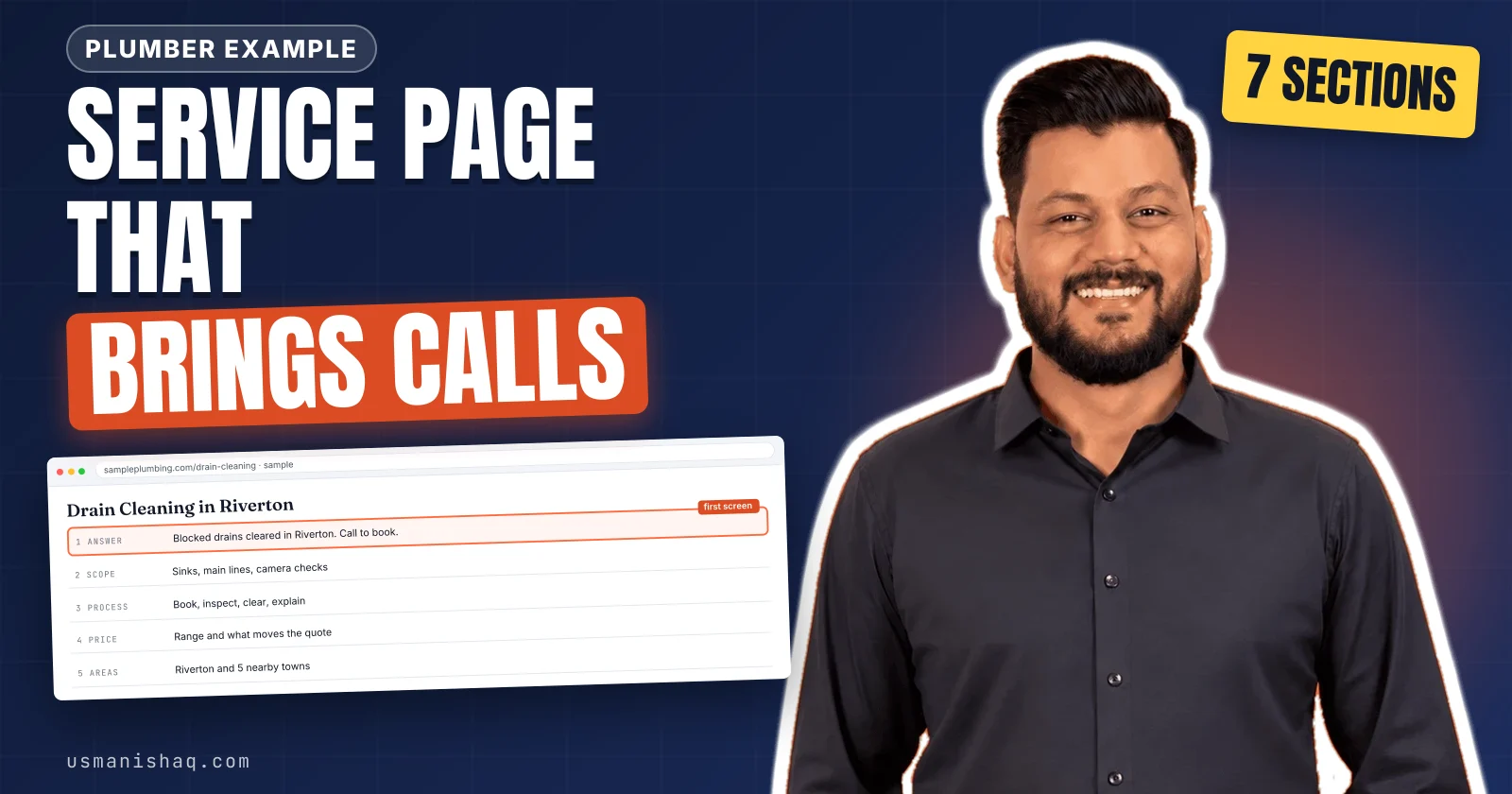
A service page is the one page of a website that answers, explains and books one service. A service page needs seven sections, in order: main answer, scope, process, prices or price factors, areas served, proof and questions. Owners who understand that order write pages that rank and bring calls.
Each service page section answers one question a caller asks, in that same order. A service page sentence states one fact: the service or the business, one attribute and that attribute's value.
A service page puts the service name, the town, the main answer and the phone number in the first screen. Semantic SEO gives each service exactly one owning service page, planned on the topical map. The goal is calls, not vanity traffic.
Which sections does a service page need, and in what order?
A service page needs seven sections, in order: main answer, scope, process, prices or price factors, areas served, proof and questions.
The seven sections of a service page, with the job each one does, are listed below:
- Main answer: one sentence that names the service, the place and the next step.
- Service scope: the jobs the service covers and the jobs it leaves out.
- Process: what happens from the first call to the finished job.
- Prices or price factors: a range, a starting price, or what moves the quote.
- Areas served: the towns covered and the base the team works from.
- Proof: reviews, licences, job photos and job notes tied to this service.
- Questions: the short questions callers ask about this service on the phone.
The order follows the doubts a caller settles before phoning. A caller first checks that the business does the job, then what happens and what it costs. Coverage, trust and the smaller questions come last.
Semantic SEO treats each section as one attribute of the service, answered once.
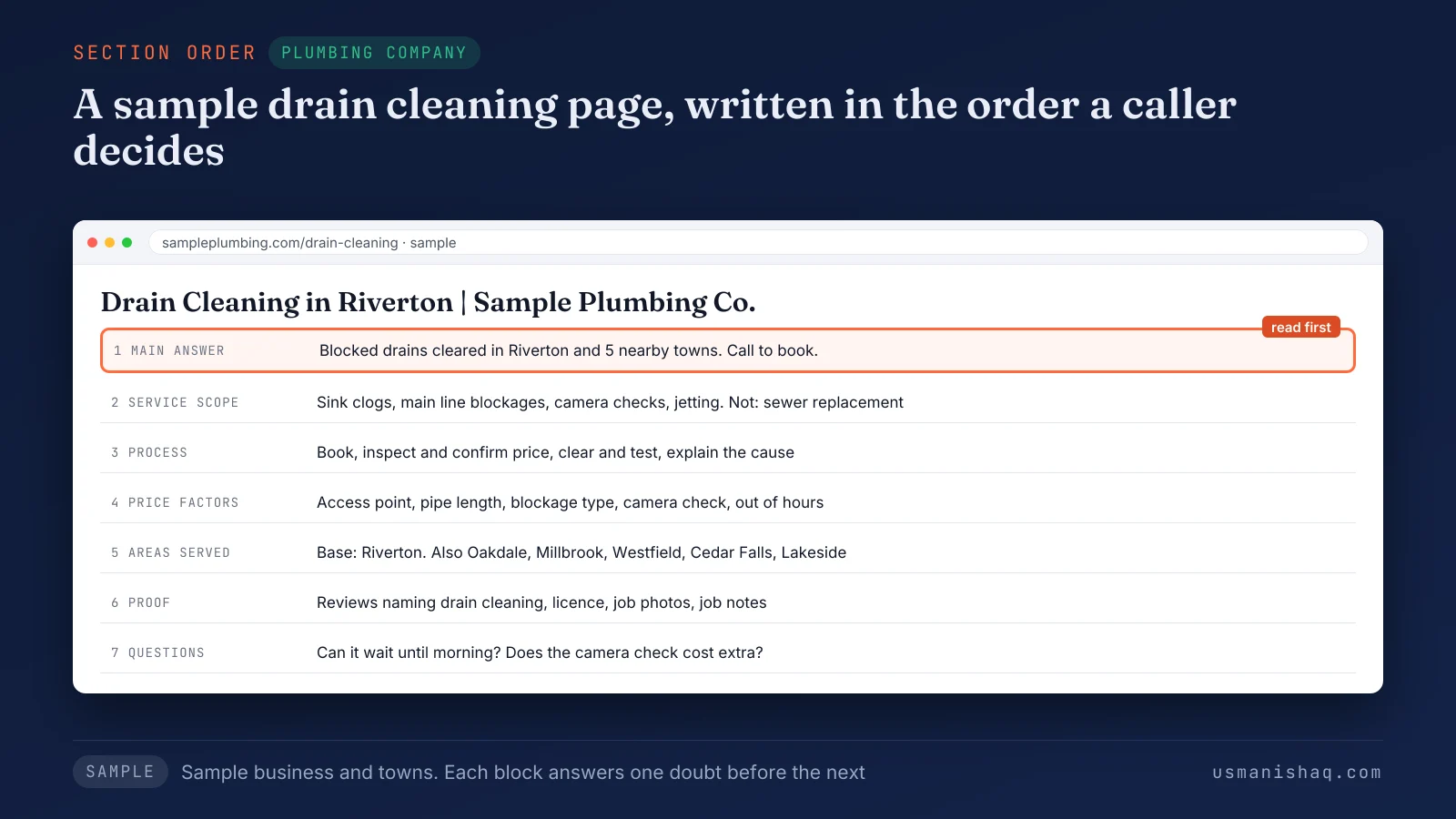
The sample drain cleaning page runs main answer, scope, process, price factors, areas, proof and questions, from top to bottom.
How do you write each section of a service page?
Each service page section answers one question a caller asks, in this order: main answer, scope, process, prices, areas, proof and questions.
The examples below use a sample drain cleaning page for a sample plumbing company. Semantic SEO keeps every section on that one service, so no section drifts into another job.
How do you write the main answer?
The main answer is one sentence that names the service, the place and the next step.
The sentence sits directly under the H1, before any image, badge or slider.
A sample main answer for a plumbing company reads as follows.
"Sample Plumbing Co. clears blocked drains in Riverton and five nearby towns. Call (555) 010-2040 to book."
The line replaces openings such as "Welcome to our family-owned company", which say nothing about the service.
What goes in the service scope?
The service scope lists the jobs the service covers and the jobs it does not cover.
A drain cleaning scope for a plumbing company covers these jobs:
- Kitchen and bathroom sink clogs
- Main sewer line blockages
- Camera inspection of the drain line
- Jetting for grease and tree roots
One line names a job the page does not cover. Sewer line replacement, for example, sits on its own service page. The excluded line shows the caller where drain cleaning ends and gives the next service its own page.
How do you describe the process?
The process section describes what happens from the first call to the finished job, in three to five steps.
A drain cleaning process can be written in four steps:
- Book the visit by phone or through the online form.
- Inspect the drain and confirm the price before any work starts.
- Clear the line and test the water flow.
- Explain the cause of the blockage and when to check again.
Short steps settle the doubt behind many hesitant callers: what happens after the phone call.
How do you write prices or price factors?
The price section states a price range, a starting price, or the factors that move the price.
A range fits a job that varies within known limits. A starting price fits a packaged job, such as a drain camera inspection. A list of factors fits a job that is quoted on site.
Drain cleaning prices depend on the access point, the pipe length, the blockage type, a camera inspection and out-of-hours calls. Contractor pricing guides favour ranges or starting prices with the scope stated, not exact prices.
Should a service page show prices?
Yes, a service page should show a price range or the price factors, because callers weigh cost before they phone.
A business that quotes every job on site names the factors and the visit step instead. The page then says the price is confirmed before any work starts.
How do you write the areas served?
The areas section names the towns the service covers and the base the team works from.
Sample Plumbing Co. works from Riverton and covers Oakdale, Millbrook, Westfield, Cedar Falls and Lakeside. Anything that changes by area belongs here, such as a longer response time or a call-out fee.
A list of towns does not make the page rank in each town. Towns with real demand get their own town page, linked from this section.
What counts as proof on a service page?
Proof on a service page is evidence tied to the service: reviews naming it, licences, job photos and job notes.
The proof a drain cleaning page can carry is listed below:
- Reviews that mention drain cleaning by name
- Licence and insurance details for the business
- Photos of the business's own jobs, each with a caption
- Short job notes: the problem, the fix and the town
Stock photos and generic badges prove nothing about the service. Proof sits beside the claim it supports, so a review about a cleared sewer line sits next to the process.
Which questions belong on a service page?
The questions section answers the three to six questions callers ask about this service on the phone.
The office staff already know these questions, because they hear them every week. Sample drain questions ask if a blocked drain can wait until morning, if inspection costs extra and if the clog returns.
Each answer takes one or two sentences. A question that needs a long answer gets its own page and a one-sentence answer here.
How do you write service page sentences as entity, attribute and value?
A service page sentence states one fact: the service or the business, one attribute and that attribute's value.
The entity is the thing the sentence is about, the attribute is one property, and the value is the answer. Semantic SEO writes pages this way, so each sentence still makes sense when lifted out alone. AI answers can quote sentences like these whole.
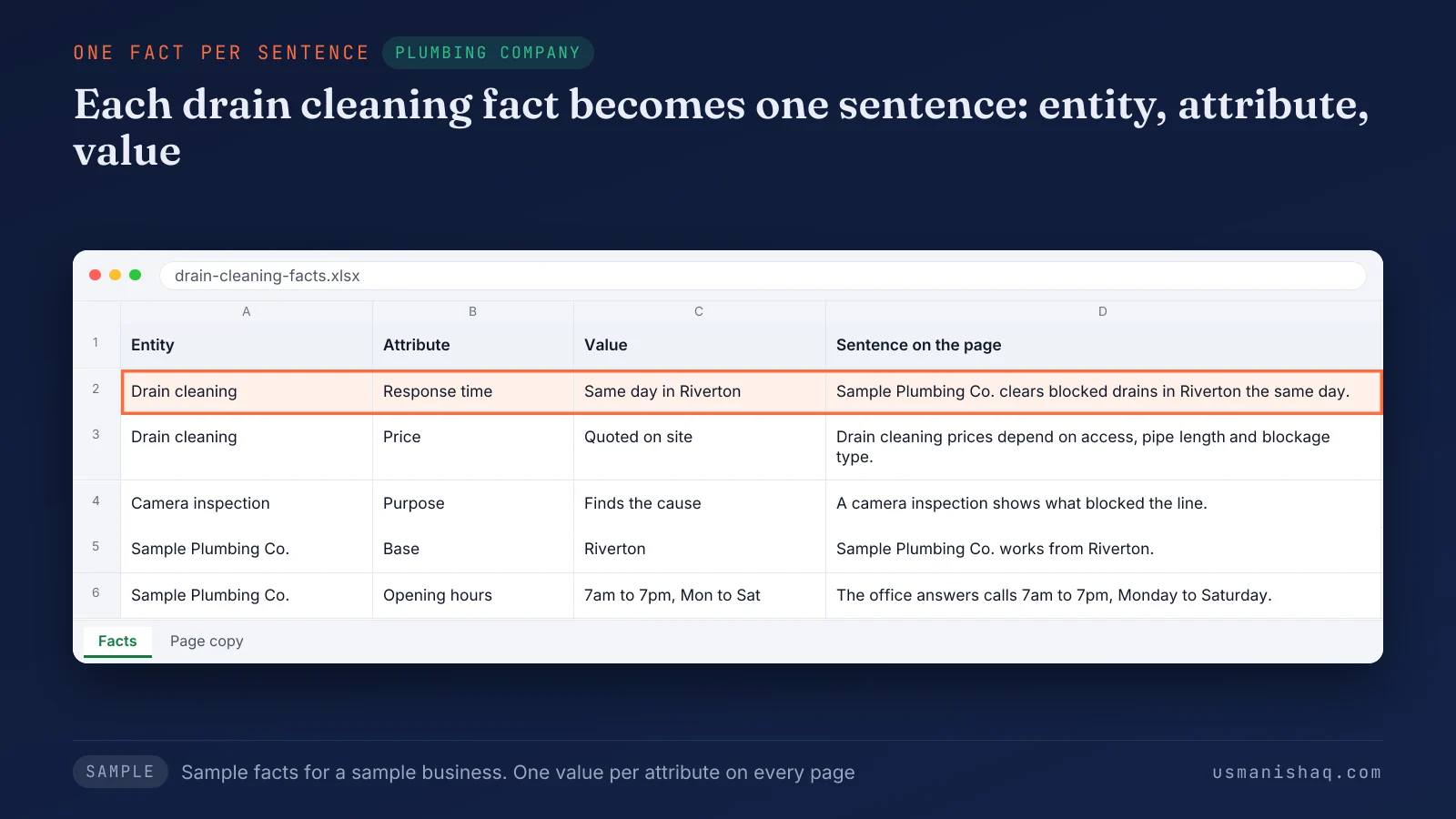
The sheet turns five sample facts into five sentences. Drain cleaning, response time and "same day in Riverton" become one sentence. Drain cleaning, price and "quoted on site" become another.
Two weak sentences and their fixed versions are given below:
- "We offer fast, affordable drain cleaning" becomes "Sample Plumbing Co. clears blocked kitchen drains in Riverton the same day."
- "Contact us for pricing" becomes "Drain cleaning prices depend on access, pipe length and blockage type."
One value per attribute holds across every page. The opening hours on the service page match the hours on the Google Business Profile.
How should the main content of a service page be laid out?
A service page puts the service name, the town, the main answer and the phone number in the first screen.
Sliders, full-screen hero images and welcome text push that answer further down the page.
Google's guide "Creating helpful, reliable, people-first content" describes what counts as main content. Google defines it as "any part of the web page that directly helps the page achieve its purpose." The list in that guide includes page titles, headings, and tabbed or expanded sections.
Questions inside an accordion therefore still count as main content.
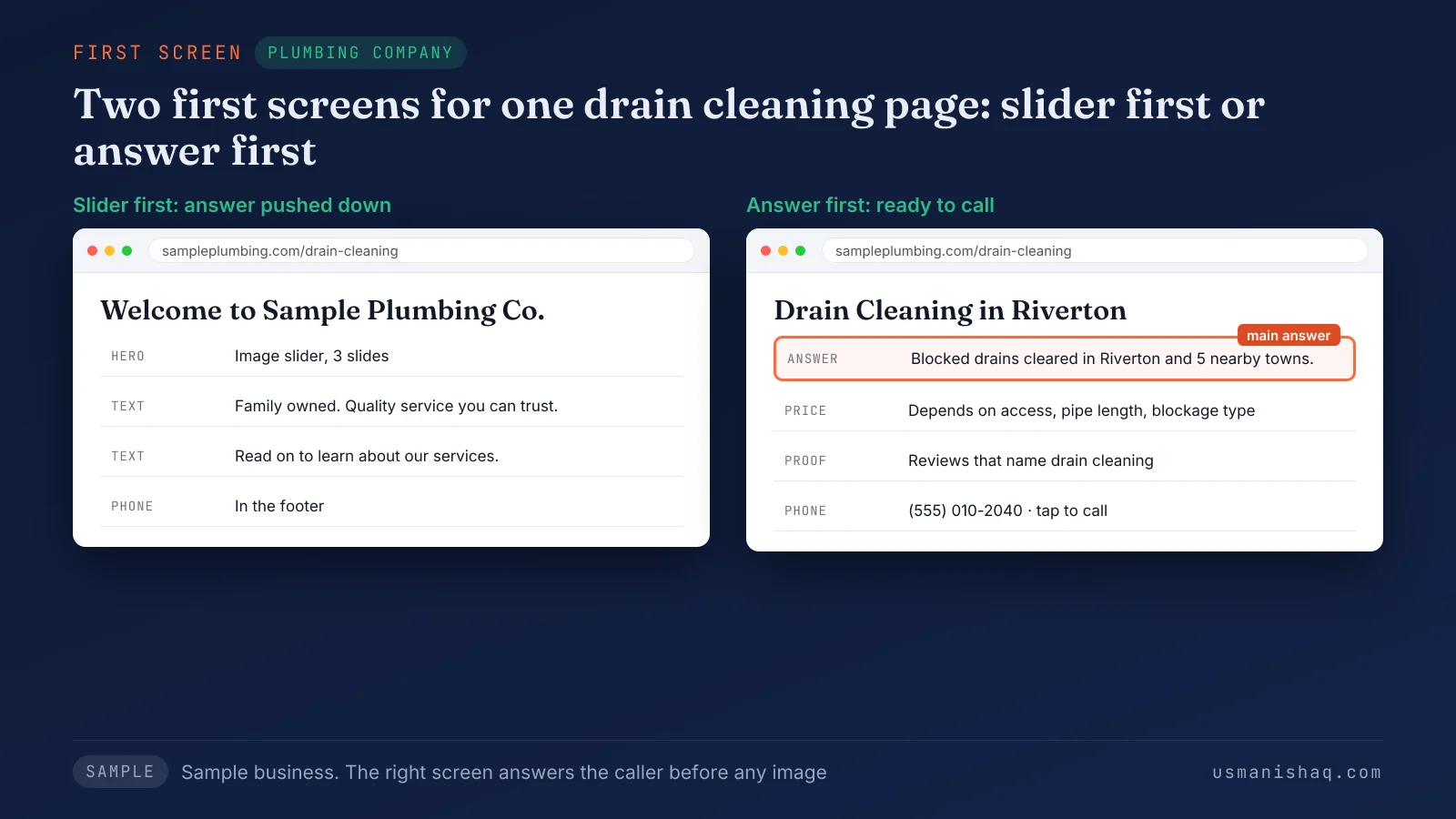
The left screen opens with a slider and welcome text, and the phone number sits in the footer. The right screen shows the H1, the main answer, the price factors, the proof line and the phone number at once.
Every value shown in an image, a price table or a badge should also appear in a written sentence. Semantic SEO treats layout as part of what the page says, and written text is the version every reader can use.
Does each service need its own service page?
Yes, a service page should own exactly one service, because one page can only state one service's scope, price and proof.
The main services page then lists each service in one sentence and links to its page.
A question about the same service with the same task stays a sentence on that page. A question about a different service, town or task gets its own page.
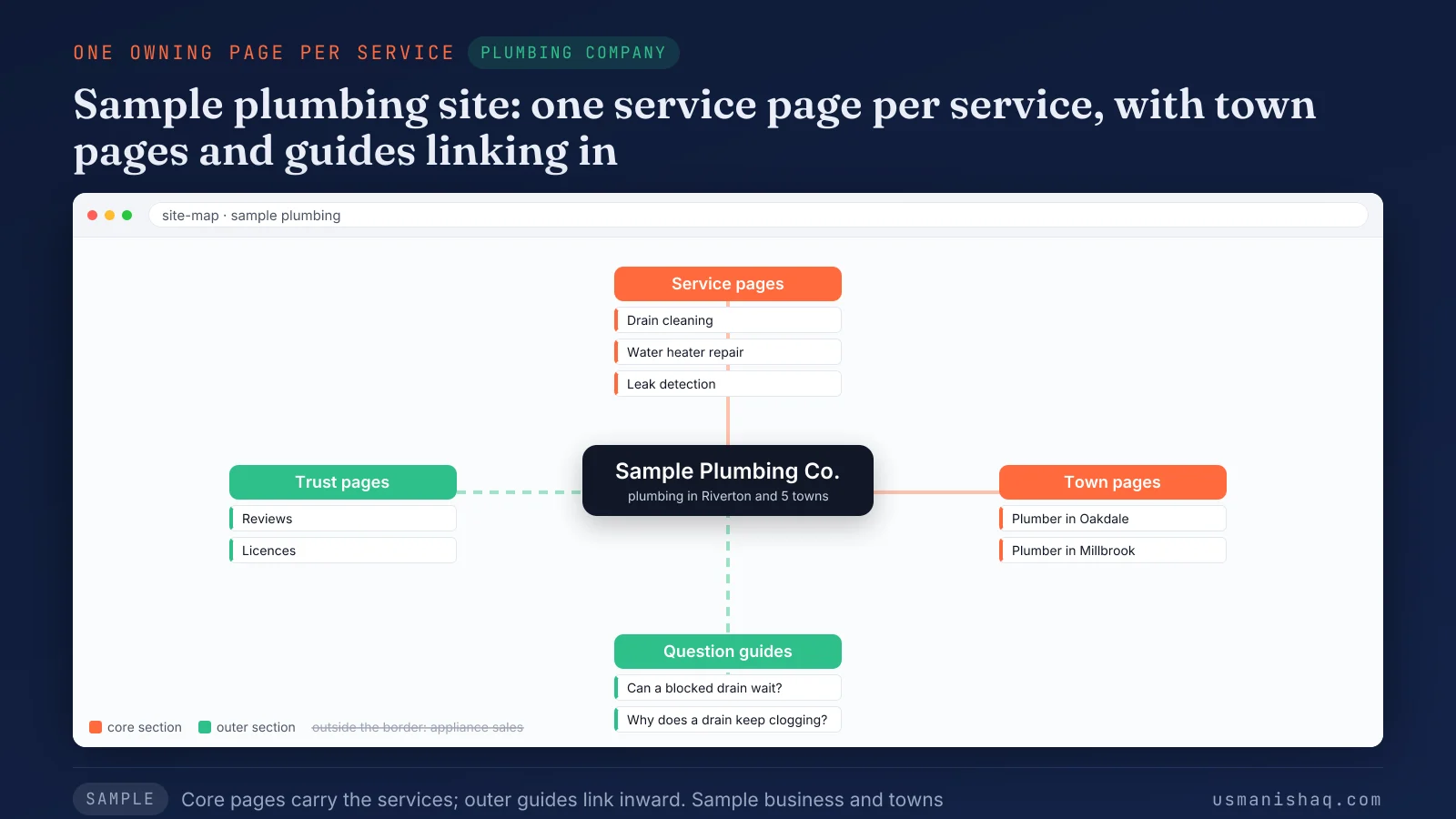
The sample site gives drain cleaning, water heater repair and leak detection one page each. Town pages, question guides and trust pages link to those three service pages.
Semantic SEO plans these owning pages on the topical map before any page is written. Semantic content production then starts from a brief that names the service, its attributes and its questions. The same sequence runs in Semantic Content Production for service pages: the map, the brief, the written page and the configured page.
What does a service page leave to other pages?
A service page leaves town details, timing questions and the full site plan to their own pages.
Semantic SEO gives each of those subjects its own page, so every section here stays on the one service. Each of those pages links back to the service page it supports.
Visual semantics explains why the first screen matters so much. The guide to the visual semantics of a page layout shows how layout carries meaning.
Why does a service page rank in only one town?
A service page ranks in only one town when one page stands for every town and the map results depend on distance.
A list of towns on the service page does not change that. Town details such as local permits or a longer response time belong on that town's own page. The full reasoning is in the guide on why a website ranks in only one town.
How long does a new service page take to bring calls?
A new service page can take months to bring calls, passing indexing, impressions and clicks before the first call.
Each stage shows up in Google Search Console before the phone rings. An owner can see where a slow page has stopped. Every stage and its check is set out in the guide on how long a new service page takes to bring calls.
Which service pages does a plumbing website need?
A plumbing website needs one service page for each plumbing service that callers search for by name.
Drain cleaning, water heater repair and leak detection are typical examples, and each follows the same seven sections. The full page list sits in the topical map for a plumbing company website.
Service page questions
A service page raises four more questions, about length, landing pages, updates and results.
How long should a service page be?
A service page should be as long as its seven sections need, and no longer.
Google's guide Creating helpful, reliable, people-first content says Google has no preferred word count. Padding a page to a target length adds nothing a caller needs.
What is the difference between a service page and a landing page?
A service page is a permanent page for one service; a landing page is any page a visitor arrives on.
Landing pages are often built for one ad campaign. Semantic SEO keeps service pages on the topical map and leaves campaign pages outside it.
How often should a service page be updated?
A service page should be updated whenever its scope, prices, areas, proof or questions change.
A quarterly look at the page's queries in Search Console also shows new questions worth a sentence.
How do you know a service page is working?
A service page is working when Search Console shows impressions and clicks and the calls bring booked jobs.
Rankings alone are not the result. Calls and booked jobs are the result.
Which service page should a business write first?
The first service page to write is the page for the service that brings the most booked jobs.
I start there because that service already has callers, questions and proof to draw on. The main answer comes first, then the other six sections, in the order a caller needs them before a call. Semantic SEO then adds the next service page from the map.