
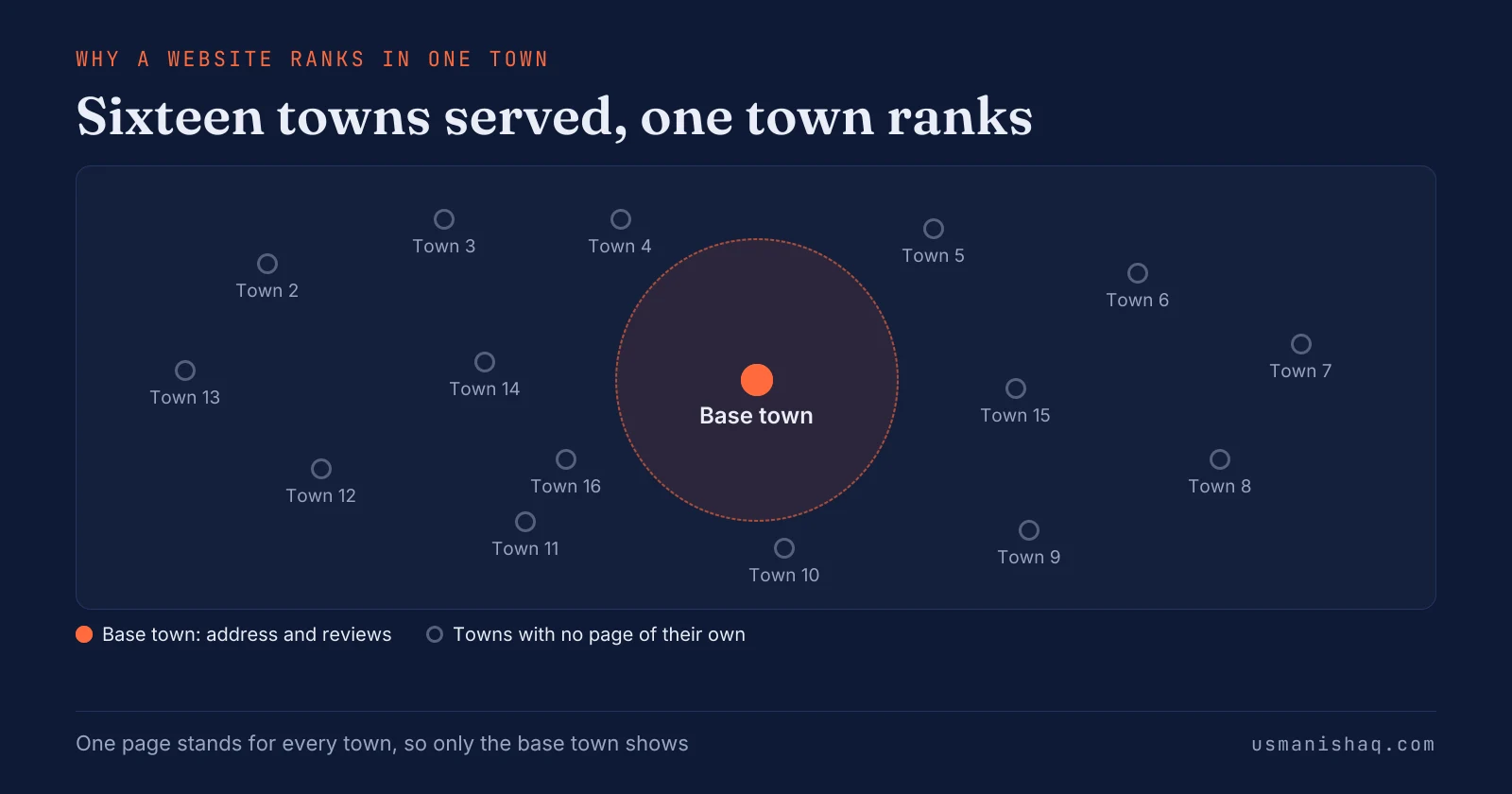
A website ranks in one town and not the others because one page stands for every town and the map results depend on distance. Semantic SEO treats each town as a thing a search engine must understand through its own page. Three factors decide where a business shows up in the local results of each town: relevance, distance and prominence. A search engine reads a town on a website through the page that names the town in its title, H1 and main content. An owner checks which towns the website ranks in with the Performance report in Google Search Console, filtered by the name of each town.
Why does a website rank in one town and not the others?
A website ranks in one town and not the others because one page stands for every town and the map results depend on distance.
The website lists every town the business serves, and the phone rings from one town. One search page shows two kinds of result. The map results show the Google Business Profile, the Google listing of the business. Practitioners call the website results below the map "organic results". A business not showing up on Google in other towns and cities fails in one kind of result or both, for different reasons. The first diagnostic step is to find which result is missing.
Is the business missing from the maps or from the website results? A business can show in the map results of the home town and in no website result, or the reverse. The figure below sets the two results side by side.
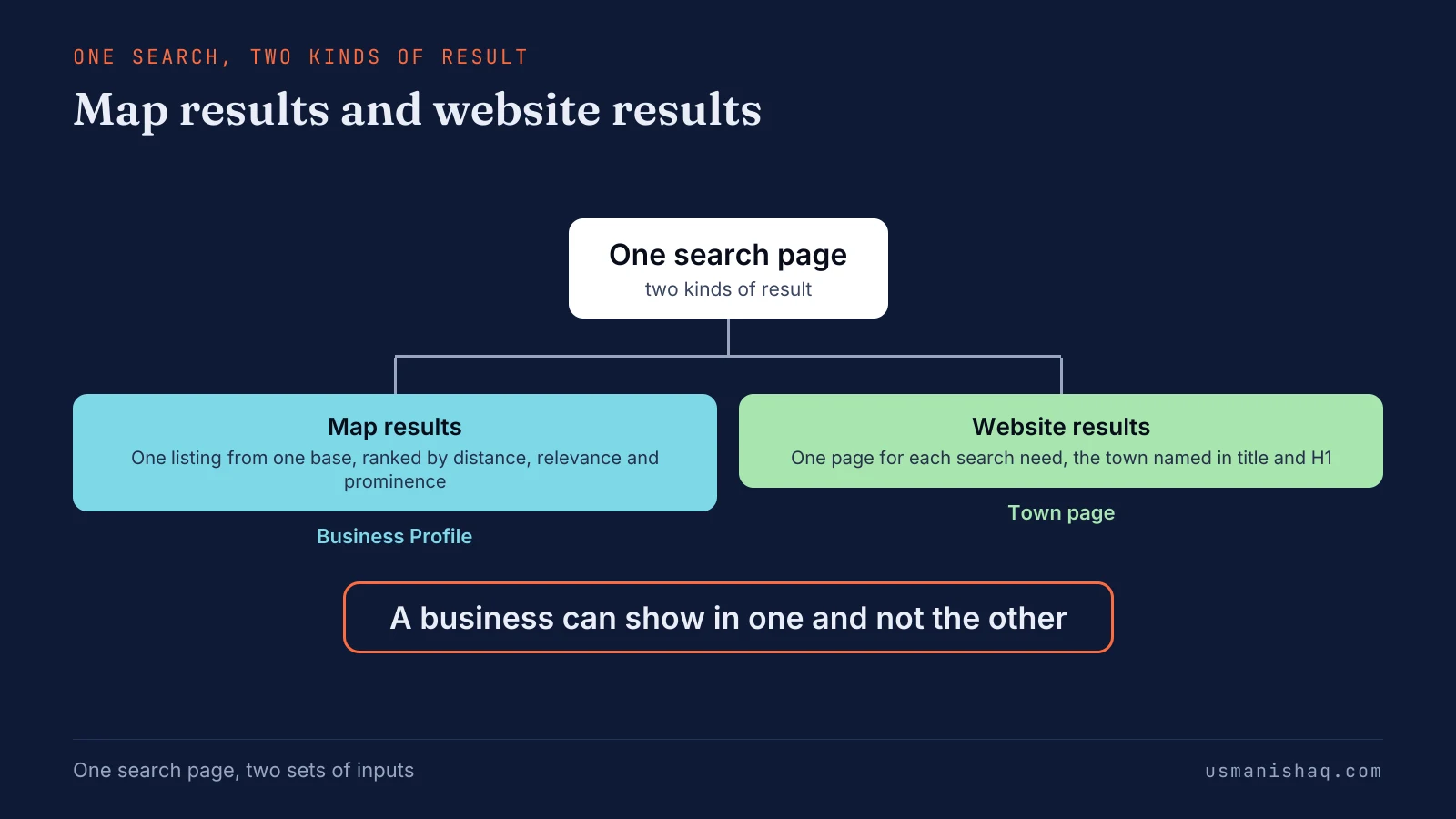
Semantic SEO separates the two, because the website is the part an owner builds page by page. Google names three factors behind the map results.
What decides where a business shows up in each town?
Three factors decide where a business shows up in the local results of each town: relevance, distance and prominence.
Google names the three factors on the help page "Tips to improve your local ranking on Google". Google defines the three factors of local results as listed below:
- Relevance: "how well a Business Profile matches what someone is searching for".
- Distance: "how far each business is from the customer who's searching".
- Prominence: "how well-known a business is", based on links to the business and on reviews.
The summary line of the same Google page calls the third factor "popularity", a second name for prominence. Local SEO practitioners report that the map results and the website results are decided differently. The table below adds the part an owner controls.
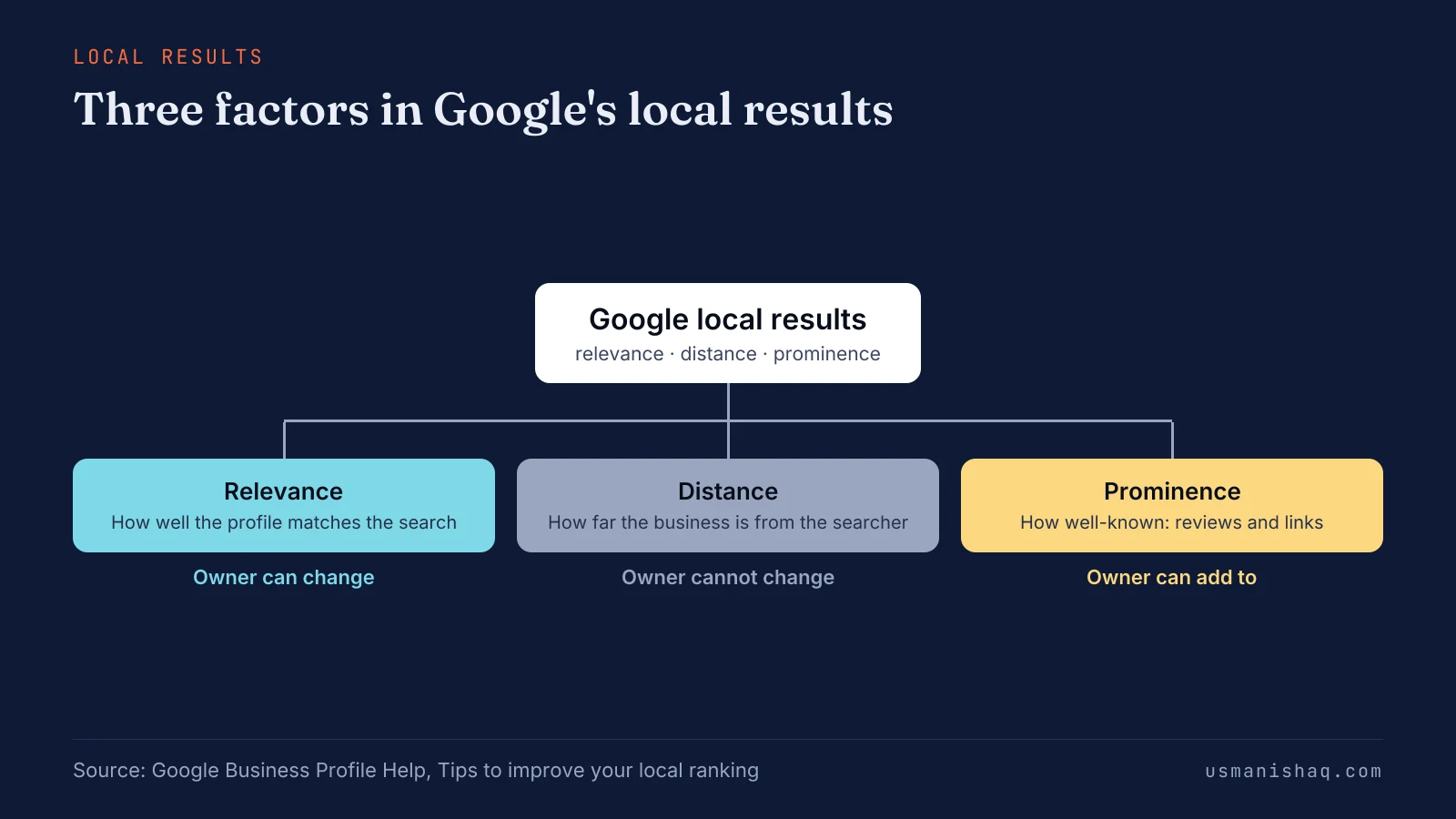
Semantic SEO targets relevance first, because relevance is the factor the website controls. Only distance, of the three factors, depends on where the customer is when searching.
How does distance keep the map results near the home town?
Distance keeps the map results near the home town because Google measures distance from the business to the person searching.
Google's definition of distance adds a second sentence: "If a customer doesn't share where they are, Google uses what it knows about their location." The Google Business Profile is one listing, measured from one base, not from the towns the business drives to. Owners describe the limit as a business that shows on the maps in one area only. The 3 pack, the owners' name for the top map listings, follows the same measure. A customer two towns away sees businesses closer to that customer first in the map results, when a closer business matches the search. Distance is the one factor the owner does not change. Semantic SEO leaves distance alone and strengthens the factors a page can change. Reviews and links are the inputs of prominence an owner can add to.
How do reviews and links favour the home town?
Reviews and links from the home town count toward prominence and can lift the business there more than in the next town.
Google bases prominence on "how many websites link to your business and how many reviews you have". Practitioners report that reviews and local links that name a town can support the business in that town. Google gives no geographic rule for reviews or links. A roofing company whose reviews all come from jobs in the home town holds proof for that town only. Semantic SEO gives each town page the reviews and photos of jobs done in that town. Reviews still leave open why a competitor ranks higher in the next town.
Why does a competitor with fewer reviews rank higher in the next town?
A competitor with fewer reviews can rank higher in the next town by being closer to the searcher or better matched to the search.
Google states that "More reviews and positive ratings can help your business's local ranking". Relevance and distance are separate factors. Google states that "Together, these factors help Google find the best match for customers' searches". Competition varies by town. The other towns can go, in the website results, to businesses with town pages. Owners report losing towns even with more reviews. Semantic SEO starts from that gap: the town with no page of its own. Town pages shape how a search engine reads the towns.
How does a search engine read the towns on a website?
A search engine reads a town on a website through the page that names the town in its title, H1 and main content.
Each town is an entity: a distinct place a search engine identifies, with its own searches, jobs and customers. A page has one title, one H1 and one main subject. A page that lists sixteen towns gives each town one mention on a page about something else. The other fifteen towns on the service area list have no page on the website. Grouping nearby towns on one page gives each grouped town the same single mention. The page can rank for one place. The home town can take that place, because the page, the Google Business Profile address and the reviews agree there. Owners sum up the result in one line: "my site lists sixteen towns but rings from one". A town page is a page about the business or one service in one town served.
Semantic SEO for trade and service businesses gives each service and each town one owning page. The site structure for a business that serves several towns is set out in the guide to semantic SEO for trade and service businesses. The same reading applies to town pages that already exist.
Why do existing town pages still rank in one town only?
Existing town pages still rank in one town only when every page repeats one text with the town name swapped.
No such page holds anything that belongs to its town. Owners call such pages city pages or location pages. Google's "Spam policies for Google web search", section "Doorway abuse", name pages for cities that "funnel users to one page" and "substantially similar pages". Google warns that violating sites "may rank lower in results or not appear in results at all". A second cause can keep pages from appearing: a town page with no link from its service page is an orphan. Semantic SEO plans each town page around jobs, reviews and questions from that town. A business with no address raises another question.
Can a business rank in a town where it has no address?
Yes, a town page can rank in the website results where the business has no address, and distance still limits the map results.
The website results follow the page that answers the search. The map results follow the three factors, and distance is one of the three. A towing or septic pumping business with one yard and no address in the next town meets both sides of that split. The town page for the next town holds jobs, reviews and questions from that town. Semantic SEO gives that town a page of its own. Owners often try a different route first: adding the town to the service areas of the Google Business Profile.
Does adding a town to the service areas make the business rank there?
No, a town in the service areas shows customers where the business works, and service areas are not among Google's local ranking factors.
Google's "Manage your service areas for service-area & hybrid businesses" says a service area "shows customers where you can provide your products and services". Practitioners who test local results report that service areas leave rankings unchanged. A profile holds "up to 20 service areas" as of November 2026. Service areas are set by "cities, postal codes, or other areas", never as a radius. The area stays within "about 2 hours of driving time" of the base. Larger areas "may be appropriate" for some businesses, Google adds. Semantic SEO keeps the service areas and the town pages in step, town for town. Search Console gives the check.
How do you check which towns your website ranks in?
An owner checks which towns the website ranks in with the Performance report in Google Search Console, filtered by the name of each town.
Google Search Console is Google's free report on how a website appears in Google Search. The steps to check which towns the website ranks in are listed below:
- Open the Performance report for Search results.
- Add a query filter, "Queries containing", with the town name.
- Read the clicks and impressions of the queries that name the town.
- Open the Pages tab to see which page Google shows for that town.
- Repeat the filter for every town the business serves, and list the towns with no impressions or the wrong page.
Search Console groups searches by country and holds no town dimension. A search such as "plumber near me" typed in the next town names no town, so the filter misses the search. Anonymized queries drop out of the totals once a query filter is on. The flow below sets out the five steps of the check in order.
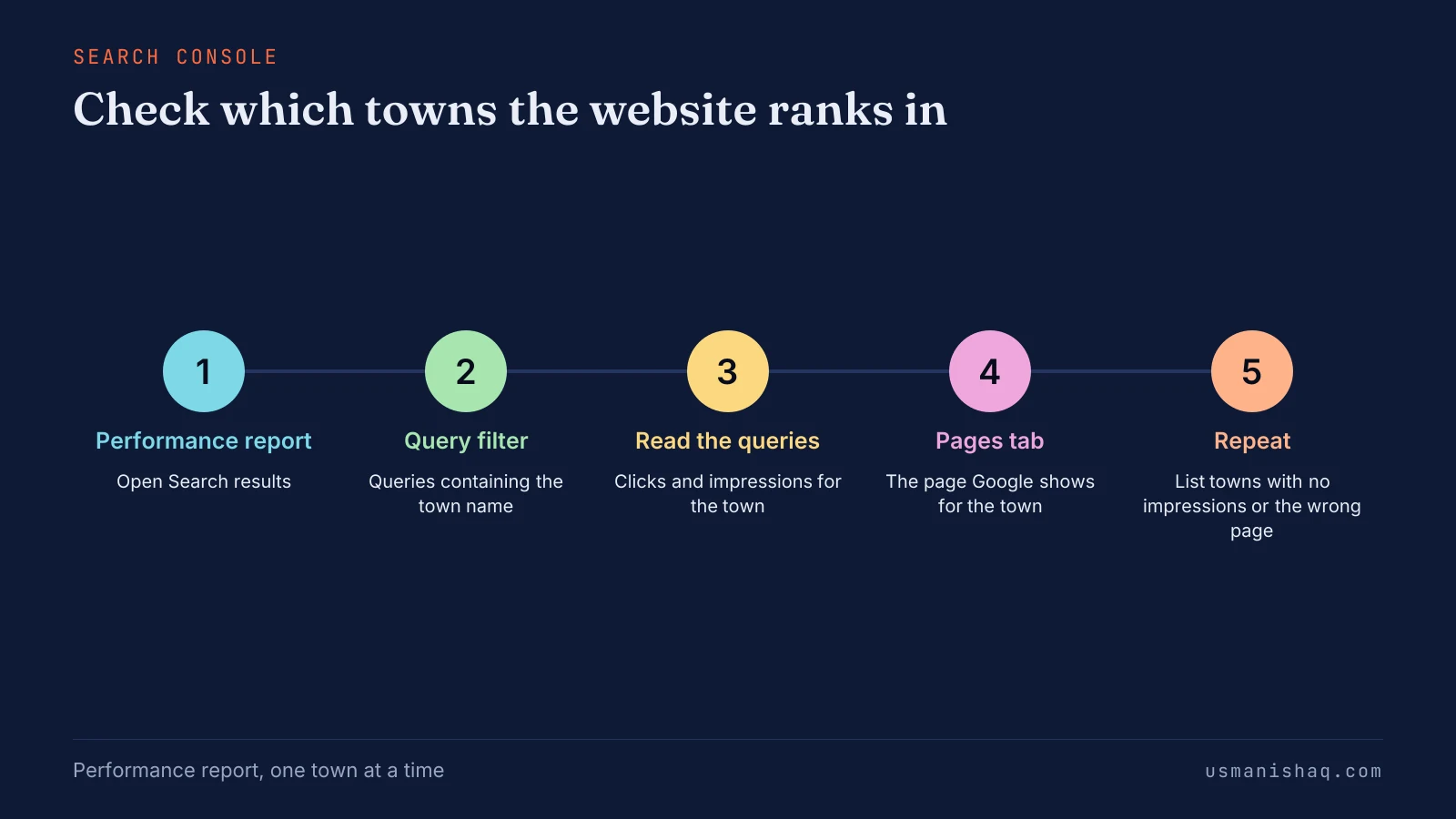
Semantic SEO reads the same report town by town before any page is planned. A plumbing company that serves two towns shows how the check reads.
What does the check show for a plumbing company that serves two towns?
The check shows a plumbing company that serves Springfield and Franklin whether Franklin has searches, and which page Google shows for them.
The plumbing company, based in Springfield, is the illustration used across the site's guides, not a client result. Reading one: queries that name Springfield, such as "repiping springfield", show impressions on the service area list or the home page. Reading two: queries that name Franklin, such as "repiping franklin", show no impressions or show the service area list far down the results. Reading two means that Franklin has no page that matches the Franklin searches. Semantic SEO answers reading two with a page for Franklin, once Franklin earns one. A Franklin page needs the parts each town page needs.
What does each town page need to rank in its town?
Each town page needs five parts to rank in its town: the town name, local proof, service page links, profile match and schema.
A town earns its own page when the town has its own searches, its own jobs and its own proof. Owners often call such pages service area pages. The five parts each town page needs are listed below:
- Town name: the title and H1 both name the service and the town.
- Local proof: jobs, reviews, photos and customer questions from the town.
- Service page links: from the service page to the town page and back.
- Profile match: the same services and towns as the Google Business Profile, kept in step by semantic SEO.
- Schema: Plumber, Service and areaServed set to the town.
Live town pages are checked against the five parts in a semantic content audit. A Semantic Content Audit checks which pages compete for the same service or town and which towns have no owning page. Part four depends on the same towns in both places.
Why must the town pages and the Google Business Profile name the same towns?
The town pages and the Google Business Profile must name the same towns because Google matches a profile to searches by its details.
Google's help page Tips to improve your local ranking on Google asks for "complete and detailed business info". Google's page Manage your service areas for service-area & hybrid businesses states that service areas show customers where the business works. The website repeats those towns, one town page each. A Google Business Profile and a website must match on name, services, service areas and hours. The towns are one field of the Google Business Profile and website match. Semantic SEO lines up each town in the profile with its page on the site. Owners often test the result with a search from the shop.
Why does a search from the shop show the business first?
A search from the shop shows the business first because the person searching stands almost no distance from the business.
Google measures distance from the person searching. A search from the next town starts farther away. Owners check from the shop and see the business at the top. Search Console, read town by town, gives the better check. Google's Performance report (Search results): Dimensions and data groupings states that the country dimension groups data by the country where the search originated. The report holds no town or city dimension. Semantic SEO measures each town from the searches that name the town. A different fix owners often hear is more blog posts.
Will more blog posts make the website rank in other towns?
No, more blog posts about the trade add no town page, so the other towns still lack a page that matches their searches.
More blog posts do not fix a site that search engines fail to read. A post that answers one customer question has its own search. Such a question page links to the service page that owns the job. Some SEO proposals offer a monthly post count for the home town only. Semantic SEO fixes the town structure first and adds posts after. Several more questions owners ask about other towns have short answers.
Questions owners ask about ranking in more than one town
Owners asking about ranking in more than one town raise five further questions: paying Google, map positions, P.O. boxes, town pages and penalties.
Can a business pay Google to rank higher in other towns?
No, Google states that there is no way to request or pay for a better local ranking.
The statement sits on Google's help page "Tips to improve your local ranking on Google". Semantic SEO's answer to how to rank higher in Google local listings is relevance, through a page for each town.
Does a business have one map ranking for a whole town?
No, a business holds a different map position in each part of a town, because Google measures distance from each person searching.
Two customers on opposite sides of one town can see different businesses first.
Can a P.O. box in the next town give the business an address there?
No, Google's "Guidelines for representing your business on Google" state that P.O. boxes or mailboxes at remote locations are not acceptable.
The Guidelines for representing your business on Google state that a virtual office in the next town is not eligible for a Business Profile.
Do town pages on the website help the map results?
A town page can support the relevance of a business for that town, and distance still limits how far the map results reach.
Practitioners disagree on how much town pages move the map results, and agree that a page with the town name swapped does not.
Is ranking in one town a sign of a Google penalty?
No, ranking in one town follows from distance and from the pages the website holds, and a penalty is a separate event.
The Spam policies for Google web search state that violating sites "may rank lower in results or not appear in results at all".
What is the next step when a website ranks in one town?
The next step when a website ranks in one town is giving a town page to each town with searches and no page.
Search engines understand a town through the page that names the town. An owner builds the town pages in the order the towns earn a page, with semantic SEO deciding the order. Distance, one list of towns and copied town pages are the three causes behind ranking in one town.