
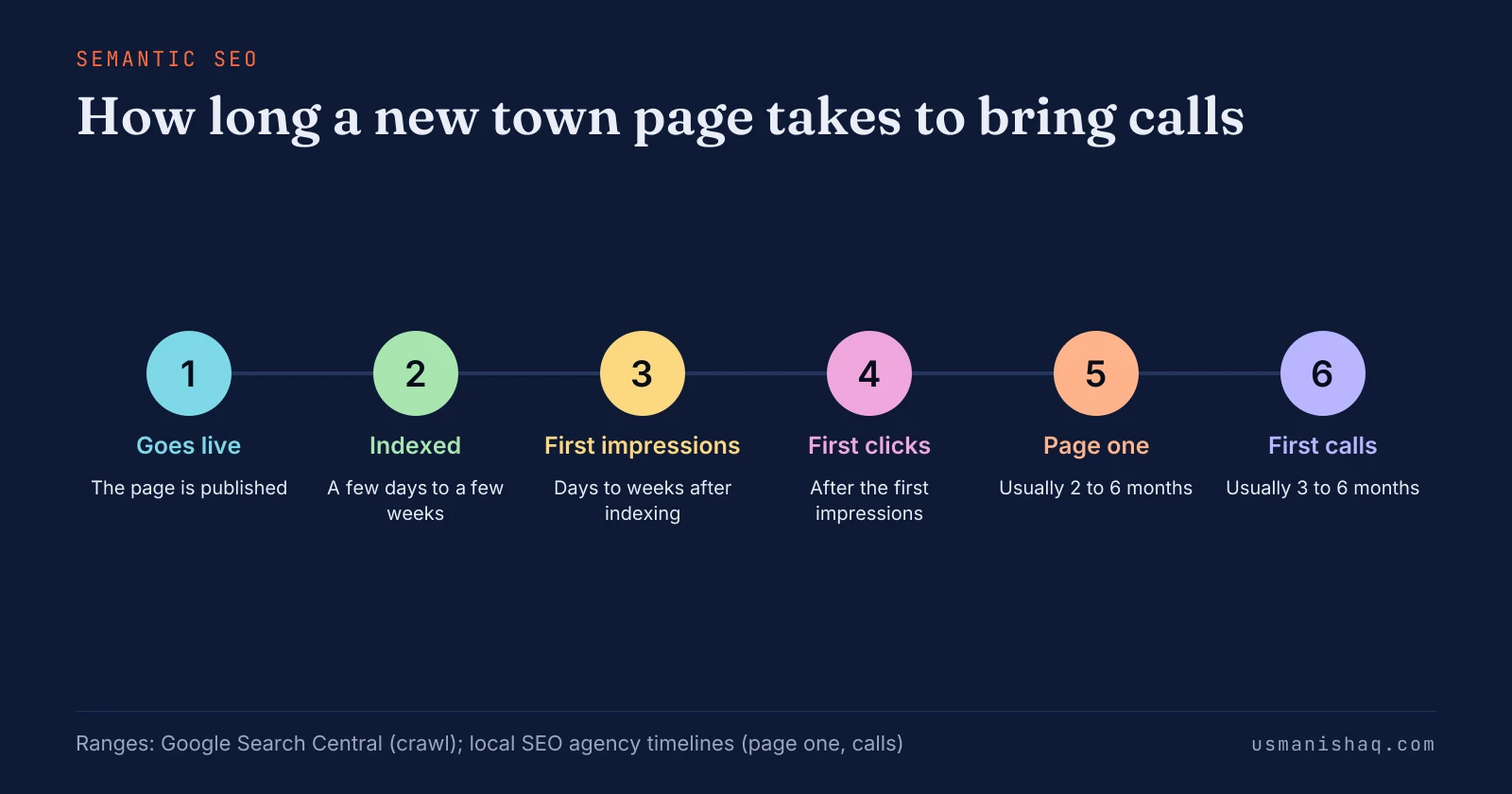
A new town or service page on an established site usually brings first calls in 3 to 6 months, after indexing, impressions and clicks. Semantic SEO times a new page by its stage, so an owner understands what each stage shows.
A new town page passes four stages before its first call: indexed, first impressions, first clicks and first calls. Five factors decide how fast a new town page brings calls: the site, the town's searches, the competition, the page and its links.
An owner reads each stage of a new town page in Google Search Console, through URL Inspection and the page's Performance report.
How long does a new town or service page take to bring calls?
A new town or service page on an established site usually brings first calls in 3 to 6 months, after indexing, impressions and clicks. Local SEO agencies that publish timelines report the first traceable calls or enquiries in months 3 to 6.
Google's "SEO Starter Guide" states: "Some changes might take effect in a few hours, others could take several months." Google gives no fixed time to rank a page or to bring calls. The order is fixed: Google indexes the page, shows the page in results, searchers click, and a customer calls.
A semantic SEO plan writes each town page to answer the searches of its own town from the first day. Timelines quoted for "local SEO" or "a new website" time a whole business or a new domain. The range above times one new page on an existing site.
Owners ask: "How long until it brings calls?" Does a new service page wait as long as a new town page? Service pages and town pages pass the same four stages, and a town page also meets the map results of its town.
What are the stages between a new page going live and its first call?
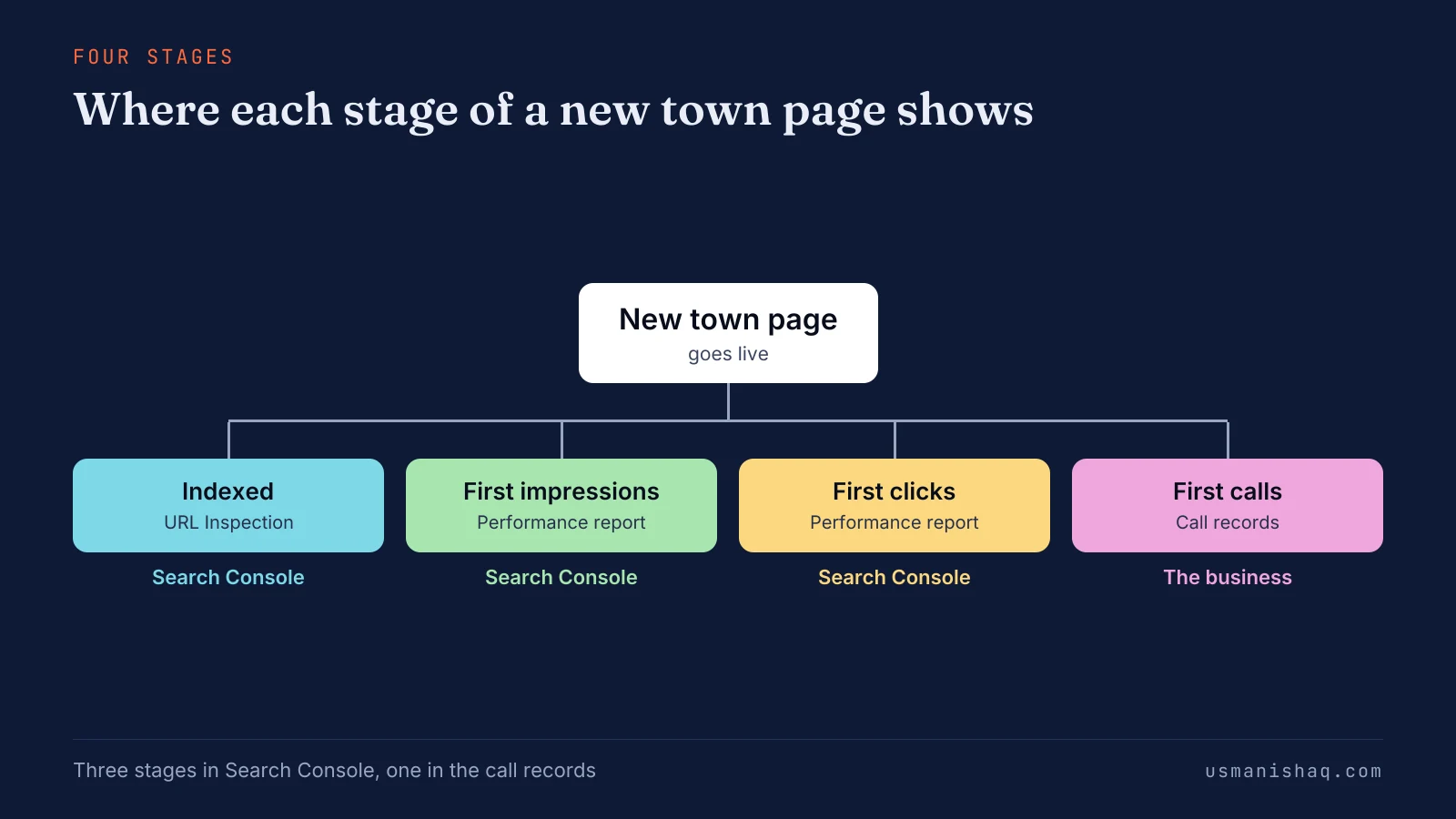
A new town page passes four stages before its first call: indexed, first impressions, first clicks and first calls. Owners name no stage between "it went live" and "the phone rang".
The four stages of a new town page are listed below:
- Indexed: Google has crawled the page and holds it in its index. URL Inspection in Search Console shows the stage.
- First impressions: the page appears in Google results for a search. The Performance report shows the stage.
- First clicks: a searcher opens the page from the results. The Performance report shows the stage.
- First calls: a customer phones the business after finding the page. The call records of the business show the stage.
The figure below places each stage in its report, and the fourth stage sits outside Search Console.
A town page is a page about the business or one service in one town served. Reading a new page stage by stage is how semantic SEO decides the next step for that page. The index comes first.
How long does Google take to index a new page?
Google can take a few days to a few weeks to index a new page, since the crawl alone can take that long. Google's help page "Ask Google to recrawl your URLs" states: "Crawling can take anywhere from a few days to a few weeks."
No Google document gives a separate time for indexing, and indexing cannot come before the crawl. A crawled page has been fetched by Google's crawler. Google "primarily finds pages through links from other pages it already crawled."
A town page with no link from its service page is an orphan, and an orphan can wait longer to be found. Linking each town page from its service page before launch is a fixed step in semantic SEO.
URL Inspection shows "URL is on Google" once the page is indexed. Google adds that the status "doesn't guarantee that your page is appearing in Search results." An indexed page then waits for first impressions.
When does a new page get its first impressions?
A new page on an established site can get its first impressions within days of indexing, and pages on weaker sites can wait weeks. Google defines impressions as "How many times your site appeared in Search results."
Justin McKelvey's study "We Timed 283 New Pages" queried the Search Console API for three sites, from 1 September to 23 October 2026. Posts can appear within a day: 93 and 83 percent on two sites showed by day 1. The third site showed 50 percent by day 14.
The 283 new posts came from one writer's blogs, not town pages. A town page built with semantic SEO carries the town name in its title and H1, matching searches that name the town. Owners call the wait "indexed but no impressions".
Ranking is the next stage.
How long does a new service page take to rank?
A new service page on an established site usually takes 2 to 6 months to reach the first page for the searches it targets. Local SEO agencies that publish timelines report 2 to 4 months on an established site and 3 to 6 months in general.
Google's AI Overview for the query also gives 3 to 6 months, as an AI answer rather than Google documentation. Practitioners report that positions on page two move before page one. Google defines average position as "The average position of the topmost result from your site."
One owning search per service page is the semantic SEO rule that keeps the page competing for one set of searches. First clicks can come before the first page: in the same 2026 study, clicks trailed impressions on all three sites.
The median wait to a first click was 2 and 8 days on the two stronger sites. Clicks are not yet first calls.
Do the first calls come from the town page or the Google Business Profile?
The first calls for a new town often come through the Google Business Profile, because map results can move before the town page ranks. Local SEO agencies report map results moving within weeks to 3 months, while the website is still catching up.
The map results show the Google Business Profile, and the website results show the town page. The profile and the page list the same services and towns under a semantic SEO plan.
Google counts profile calls with one metric: "The number of times a customer clicked on the call button on your Business Profile." Profile calls and page calls are counted apart. The business counts the calls, quote requests and booked jobs that follow, town by town.
How fast the town page brings calls depends on five factors.
What decides how fast a new town page brings calls?
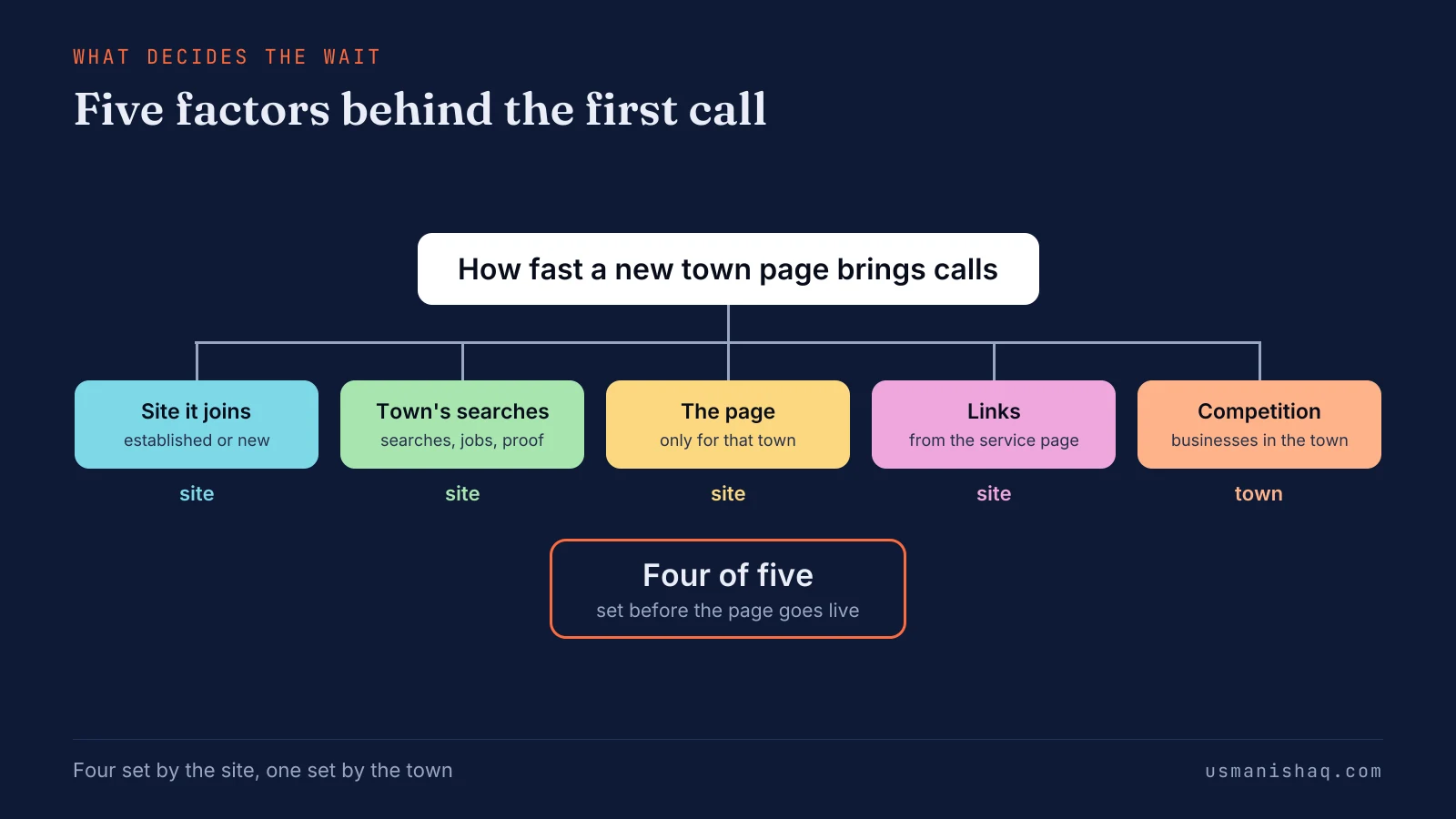
Five factors decide how fast a new town page brings calls: the site, the town's searches, the competition, the page and its links.
The five factors that decide how fast a new town page brings calls are listed below:
- The site it joins: a page on an established site usually moves sooner than a page on a new website.
- The town's searches: a town with no searches for the service gives the page nothing to appear for. A town earns its own page when the town has its own searches, jobs and proof.
- The competition: the number and strength of businesses already ranking for the service in that town.
- The page: content that exists only for that town, against a text repeated with the town name swapped. Local SEO agencies report that copied town pages tend to be ignored.
- The links: Google primarily finds pages through links, and a town page with no link from its service page is an orphan.
Four of the five factors are set by the owner's site, and the competition is set by the town. A semantic SEO plan settles those four before the page goes live. The figure below splits the five factors the same way.
The first factor sets an established site against a new website.
Does a new page on an established site bring calls sooner than a new website?
Yes, a new page on an established site usually brings calls sooner than a page on a brand-new website. One local SEO agency reports rankings moving in 2 to 4 months for service and town pages on an established site.
The agency's reason is that the new pages "inherit the trust the site already has". Another agency gives 24 to 48 hours for indexing on an established site and 1 to 4 weeks on a new small site.
Google publishes no comparison of the two. Adding town pages to the site the business already has, rather than a new domain, is the semantic SEO default. Timelines told to owners are often written for "a new website", not for a new page on an existing site.
Either kind of site shows the same stages in Search Console.
How do you read each stage of a new town page in Search Console?
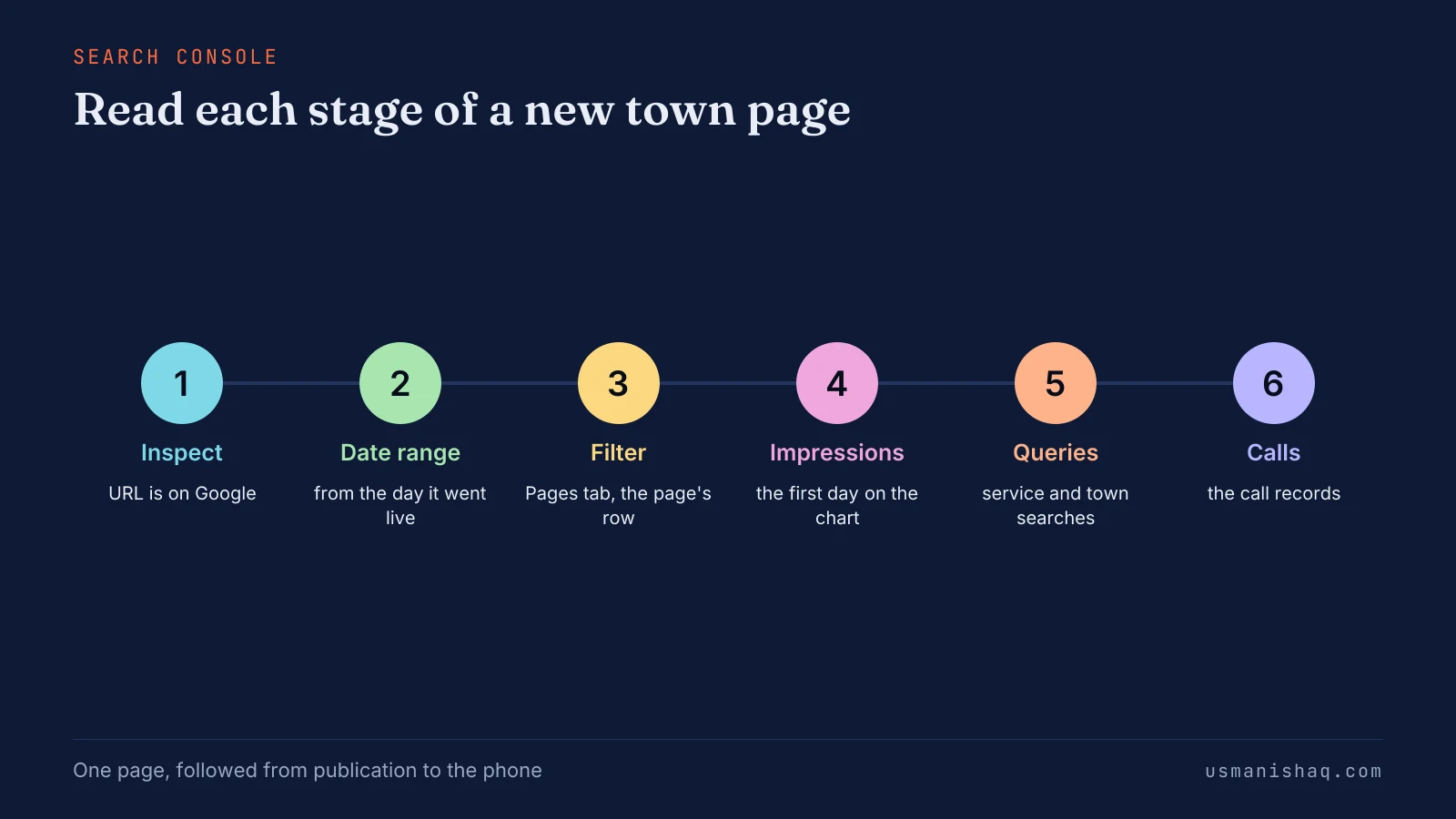
An owner reads each stage of a new town page in Google Search Console, through URL Inspection and the page's Performance report. Google Search Console is Google's free report on how a website appears in Google Search.
The steps to read the stages of a new town page are listed below:
- Inspect the page URL in URL Inspection and look for "URL is on Google".
- Open the Performance report and set the date range to start on the day the page went live.
- Filter the report to the page: open the Pages tab and click the page's row.
- Read the first day with impressions on the chart.
- Open the Queries tab and read the searches that name the service and town, with average position and clicks.
- Count the calls that follow in the call records, town by town.
Google's report opens on "the past three months" by default. The newest data "can be preliminary". Filtering by URL "can affect the report totals".
The page filter follows one page over time, not a whole site by town name. The same chain from an impression to a booked job measures a site structure that serves several towns. The measure is set out in the guide to measuring semantic SEO for trade and service businesses in calls.
The figure below lays out the six steps.
A plumbing company's new town page shows the steps at work.
What does the reading show for a plumbing company's new Franklin page?
The reading shows a plumbing company whether its new repiping page for Franklin is indexed, seen, opened and phoned, one stage at a time. The example is an illustration: the site's worked plumbing company, based in Springfield, adds the town page "Repiping in Franklin" at /franklin/repiping/.
The Franklin page is judged on its own search in semantic SEO, not on the traffic of the whole site. URL Inspection shows "URL is on Google" for the Franklin page. The filtered Performance report shows the first day with impressions for "repiping franklin".
The average position for that search usually moves from page two toward the first page, and first clicks appear. The first call that names Franklin goes into the call records as a Franklin job. A Franklin page with impressions and no calls raises a separate question.
Is it normal for a new town page to show impressions and no calls?
Yes, impressions without calls are normal for a new town page in its first months, because clicks and calls come after impressions. Impressions can run days ahead of first clicks, as the 2026 study above found.
Owners ask "Is that normal" when the chart rises and the phone stays quiet. Impressions that run for months with no clicks or calls point to the page, not to the wait.
A town page with impressions and no calls needs a better answer on the page, not more pages. A rewrite of the page's answer is the semantic SEO fix for a page that gets seen and not called. The fix for a slow page depends on where the page stopped.
What should an owner do when a new town page is slow to bring calls?
An owner finds the stage where a new town page stopped and fixes that stage, rather than adding pages or waiting longer.
The table below sets each stage a slow town page can stop at beside what the reading shows and the next step.
| Stage reached | What the reading shows | Next step |
|---|---|---|
| Not indexed after a few weeks | URL Inspection does not show "URL is on Google" | Link the page from its service page and inspect it again |
| Indexed, no impressions | No impressions for the page in the Performance report | Check that the town has searches and the title and H1 name the service and town |
| Impressions, no clicks | The page appears and searchers do not open it | Rewrite the title and the opening answer for the searches that name the town |
| Clicks, no calls | Searchers open the page and do not phone | Put the phone number and the answer for that town at the top of the page |
None of the four fixes is a new page. Each fix is semantic SEO page work, done in the brief, the writing and the configuration of one page. The Semantic Content Production service turns each topical map page into a brief, a written page and a configured page, in roadmap order.
Some owners meet the opposite pattern: the home town keeps ringing while the new town page waits.
Why does the home town keep the calls while a new town page waits?
The home town keeps the calls while a new town page waits, because distance keeps the map results near the business. Distance keeps the map results near the home town because Google measures distance from the business to the person searching.
The next town's own page, planned with semantic SEO, can compete in the website results, where distance is not the limit. The full answer to why a website ranks in one town covers more than distance. The guide on why a website ranks in one town sets out every cause.
Owners watching the next town often ask whether more town pages would bring calls sooner.
Will more town pages bring calls sooner?
No, more town pages do not bring calls sooner, because each new page passes the same four stages on its own. Owners also say "city pages" or "location pages" for the same pages.
Some sites publish many town pages in one afternoon. Pages repeated with the town name swapped sit next to Google's doorway examples. A town earns its own page when the town has its own searches, its own jobs and its own proof.
Owners often call such pages service area pages. Only a town that passes the test gets a page in a semantic SEO plan. A wait with no visible stage raises another worry: SEO work that is not happening.
How does an owner tell a slow page from SEO work that is not happening?
An owner tells a slow page from work that is not happening by asking for each new page's stage in every monthly report. Owners often hear that "SEO is a long game". A long game still has stages an owner can check each month.
Google's SEO Starter Guide advises: "you likely want to wait a few weeks to assess whether your work had beneficial effects in Google Search results." A semantic SEO report lists each new page with its stage, so a missing stage points to a named page.
A monthly report should show each new page's live date, index date, first impressions, town searches, first clicks and calls. How to read an SEO report is a separate question. Five shorter questions owners ask follow below.
Questions owners ask about new town pages and calls
Owners waiting on a new town page ask five further questions: indexing requests, three months, a holding period, early drops and ads.
Can requesting indexing make a new page bring calls sooner?
No, requesting indexing asks Google to crawl the page, and Google states that a request does not guarantee instant inclusion in results. The help page Ask Google to recrawl your URLs also sets a quota on requests, so a request is no shortcut to ranking faster.
Can a new town page bring calls within three months?
Yes, a new town page on an established site can bring first calls by the third month, the early end of the usual range. A town page on a brand-new website usually passes three months without a call from the page itself, as local SEO agencies report.
Does Google hold new pages back on purpose?
Practitioners disagree on whether Google holds new sites back, and no Google document reviewed for this page describes such a period. The stages of a new page explain most of the wait without a holding period, which owners often call the "sandbox".
Is a drop in impressions in the first month a sign of a penalty?
No, a drop in early impressions is not a penalty by itself, because Google reports manual actions in Search Console. Google's Manual actions report notifies the owner of an action that leaves "some or all of that site", new pages included, out of results.
Can Google Ads bring calls while a new town page waits?
Yes, Google Ads can bring calls during the wait, and Google states that advertising has no effect on a site's search presence. Google's Do you need an SEO? page makes the point, and a town page built with semantic SEO can outlast the ads.
What should an owner expect after a new town page goes live?
An owner should expect a new town page to pass four stages, from indexed to first calls, before the page brings calls.
Search Console shows an owner, from the day the page goes live, which stage the page has reached, so the owner understands the wait. An owner builds the page so each stage has nothing to fix, with semantic SEO setting the town test, the page and the links.