
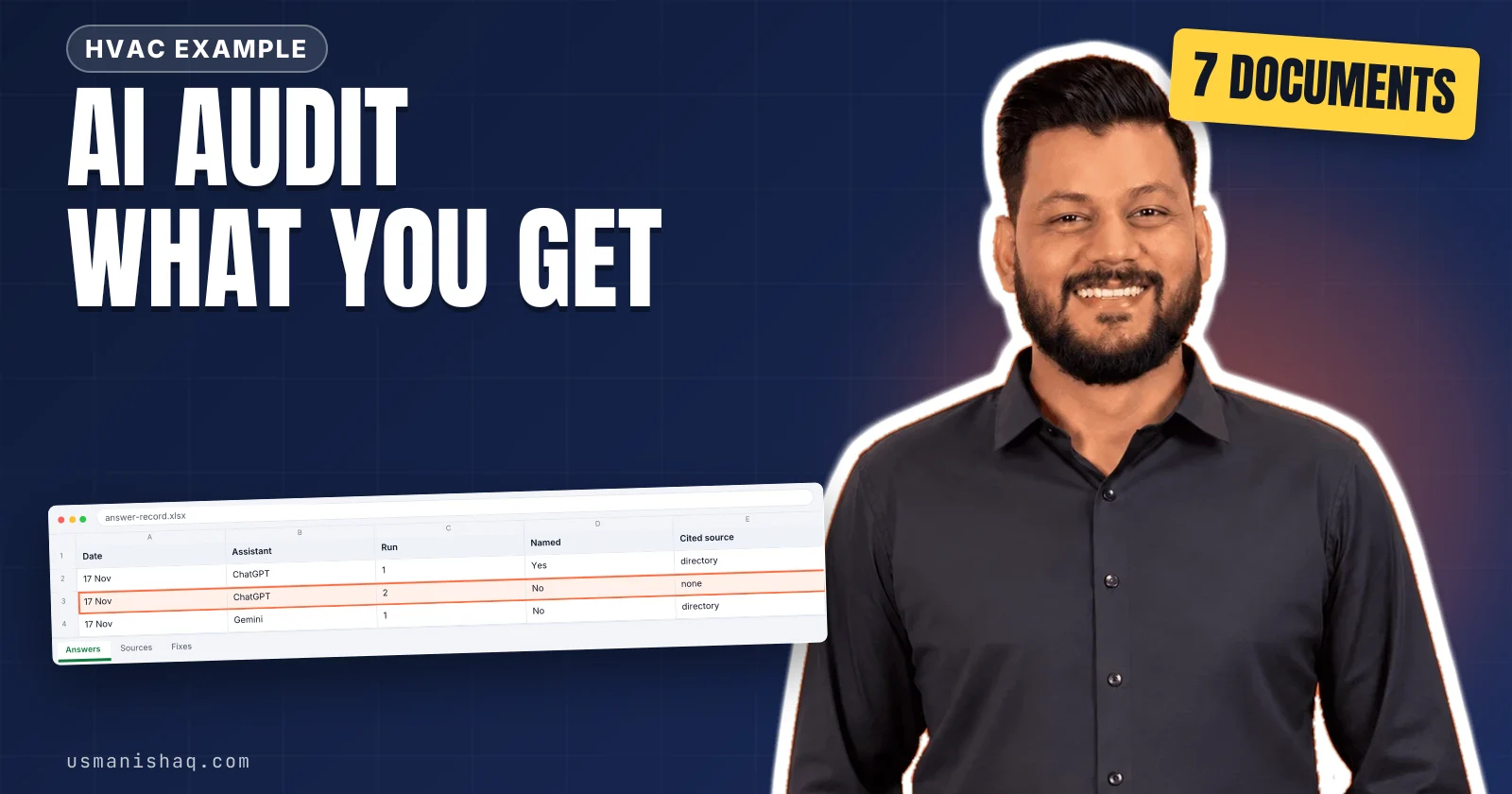
An AI visibility audit is a dated review of what AI answers say about a business and which sources they cite.
The audit should give an owner evidence: real answers, dated and quoted, plus a fix list in order. A score alone is not evidence.
The full audit hands over seven documents, from the question set to the fix list. The Google side comes from Google Search Console, which counts impressions in AI Overviews and AI Mode but shows no answers.
A weak audit gives a bare score, or a promise nobody can keep. The fixes then run in order: facts at their sources first, new pages last.
What is an AI visibility audit?
An AI visibility audit is a dated review of what AI answers say about a business and which sources they cite.
The audit ends with a list of what the business should fix first.
The review covers the assistants buyers ask: ChatGPT, Gemini, Perplexity, and Google's AI Overviews and AI Mode. A mention is an answer that names the business. A citation is an answer that links to a source or credits one.
GEO, AEO and LLM SEO name the same work. A "GEO audit" or an "LLM visibility audit" is the same review under another label. The audit is the first step of AI search visibility work.
The semantic SEO reading of the audit is simple. AI systems either read the business as one entity with the right services, towns and facts, or they blur it with others. The starting point, buyer questions instead of pages, is what separates the audit from an SEO audit.
Is an AI visibility audit the same as an SEO audit?
No, an AI visibility audit starts from the questions buyers ask AI assistants, while an SEO audit starts from pages and rankings.
An SEO audit leaves out the answer text itself, the competitors an answer names and the sources it cites. The two audits meet at one point: the site check.
What should an AI visibility audit give a business owner?
An AI visibility audit should give a business owner seven documents, from the question set to a fix list in order.
Each document answers a plain owner question about what the money bought or what comes next. The seven deliverables of an AI visibility audit are listed below:
- Question set: the buyer questions the audit asked, in the buyers' own words. A good set mixes service and town questions, problem questions, comparisons and the business name, and stays fixed for the next audit.
- Answer record: every answer from each assistant, dated, with the business named or absent and the way it was described. A good record quotes the answers and asks each question more than once, because answers change between runs. The share of answers that name the business, often called share of voice, comes from this record.
- Fact check: each fact the answers state about the business, set against the true value. Hours, towns served, services, phone number and licence are the usual suspects.
- Source map: the pages and sites the answers cite. A good map gives a URL for each source: directories, review sites, forums, competitors and the business's own pages.
- Google-side reading: the business's impressions in AI Overviews and AI Mode, page by page, from Google Search Console.
- Site check: crawler access, and pages that state the facts plainly. A good check names the passages an answer could lift, page by page.
- Fix list in order: every fix ranked, with the person who makes it. The owner, the web developer, the listings manager and the consultant each get their own lines.
None of the seven is a score.
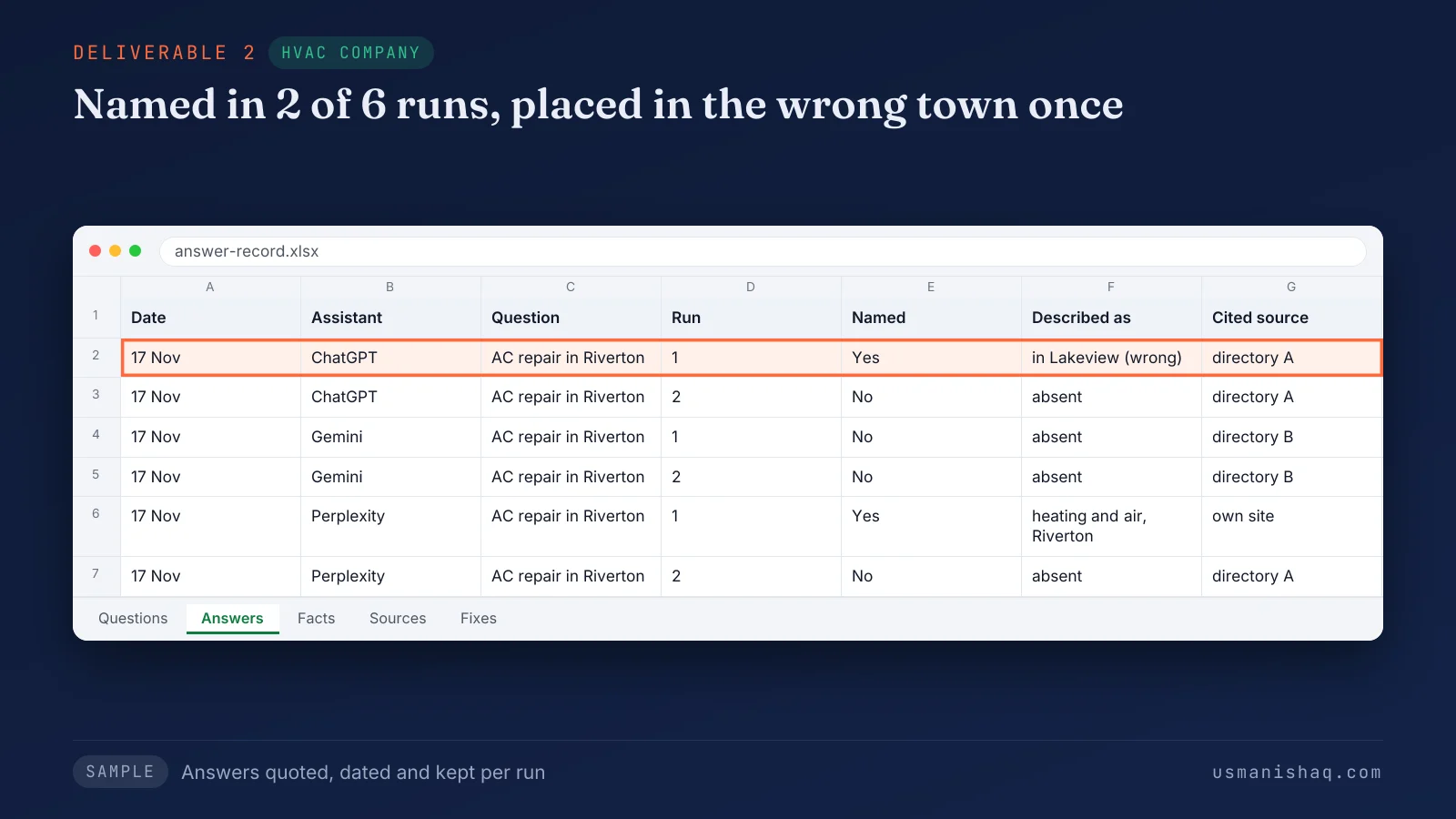
The sample record for a heating and air company shows the business named in two of six runs and absent in four. One answer places the business in the wrong town. Two directories carry five of the six citations.
The fix list is also the scope a consultant prices. Owners who hand it to a consultant should expect an AI Search Visibility engagement to start at item one. Item five, the Google side, has limits an owner should know first.
What should the Google side of an AI visibility audit show?
An AI visibility audit should show Google's side as AI Overviews and AI Mode impressions from Search Console, with unreliable dates marked.
Google Search Console's generative AI performance report counts impressions in those two features. The report's table groups them by page, country, device and date. Google rolled the report out to all websites worldwide on 31 August 2026.
The report counts impressions only. No answer text, prompt or click appears in it.
The audit uses the report for one job: finding the pages Google's AI features show and the pages they skip. The audit then sets those pages beside the answer record and the source map.
The reading earns its place once a site shows up in AI features at all. A site with no AI impressions gets one honest line: none yet.
What did Search Console show when I opened the generative AI report?
Search Console showed a banner, an "Open report" link and a "Generative AI report" entry on 19 November 2026.
I saw the banner on the site's Performance report. The banner read: "Get more details on your site's performance in generative AI features on Google Search." The banner came with an "Open report" link, and Search Console also listed a "Generative AI report" entry.
The Performance report showed six tabs: Queries, Pages, Countries, Devices, Search appearance and Days. Google's help page lists four dimension tabs for the generative AI report: pages, countries, devices and dates. No query or prompt dimension appears in that list.
Google confirmed a logging error that lowered generative AI impressions from 9 to 11 November 2026. Semrush reported the confirmation in its coverage of the November core update.
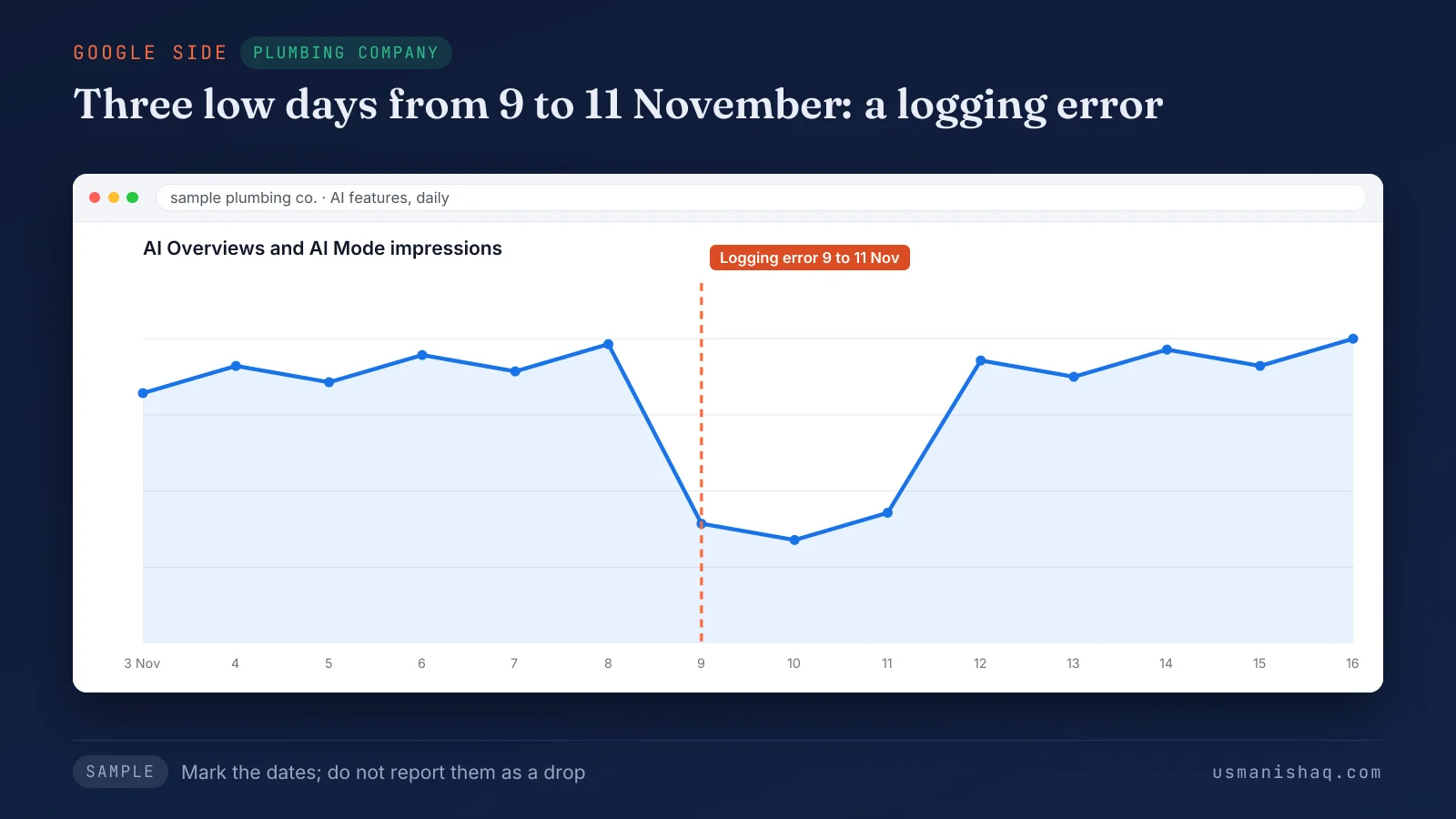
The sample chart for a plumbing business shows that pattern. Impressions dip from 9 to 11 November, then return to the earlier level.
An audit that covers November 2026 should mark those three days. Reported as a drop, they would send an owner chasing a problem the business does not have.
What should an AI visibility audit not give you?
An AI visibility audit should not give a bare score, a citation promise, an early pay link or an access demand.
Ritner Digital describes a cold pitch that lands in business contact forms: a claimed free audit with a specific-sounding score. The agency notes that such scores can be generated algorithmically from a handful of signals.
The four signs of a weak AI visibility audit are listed below:
- Bare score: a number with no dated answers behind it. Nobody can check where such a number came from.
- Citation promise: a claim that the audit or its fixes will get the business cited. AI systems choose their sources, and no audit controls that choice.
- Early pay link: a payment request before anyone has agreed the scope in writing. Ritner Digital lists payment links in cold pitches among its warning signs.
- Access demand: a request for owner or admin access to Search Console, analytics or the website before a scope exists. An audit needs to view data, not change it.
A pitch that ticks all four boxes is a sales funnel with a number on top, not an audit.
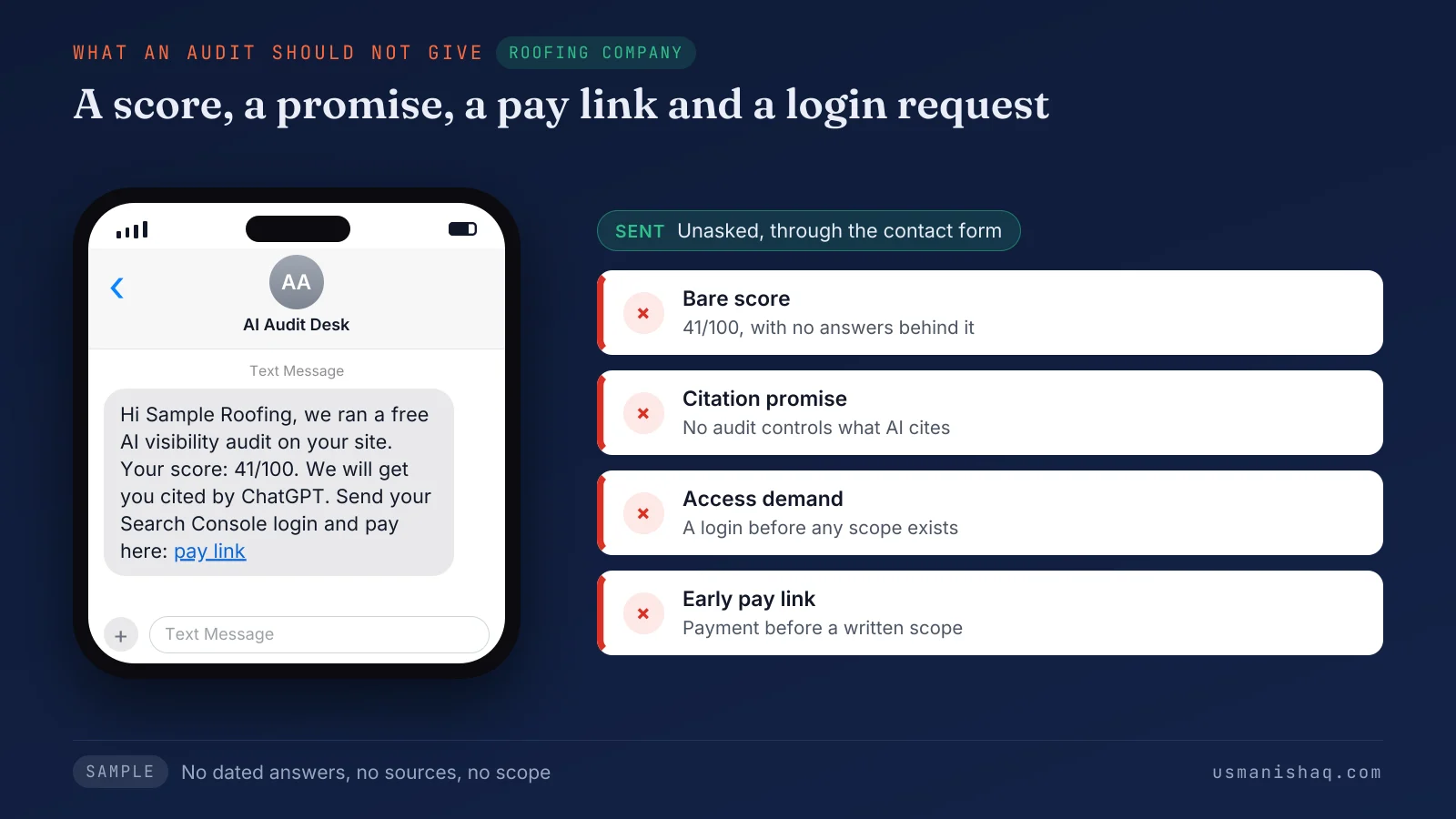
The sample roofing text shows all four signs: a score, a citation promise, a pay link and a login request. Free audits are not all like that, though.
Is a free AI visibility audit worth anything?
Yes, a free AI visibility audit is worth something when it shows the dated answers and the sources they cite.
Sellers give the audit away because it previews what they sell next, such as monthly tracking or a fix package. The free record still holds value when it carries real answers the owner can check.
What happens after an AI visibility audit?
An AI visibility audit is followed by fixes in list order, from facts at their sources to new pages.
Facts come first, because a wrong fact at its source keeps coming back in answers. The business's own profiles are the sources the owner controls. The guide on how to claim your business in ChatGPT covers one of them.
Listings come second. The facts a Google Business Profile and website must share are the same facts the fact check tested.
Pages come last. The answer record shows which questions found no good source. Each of those questions points to a page the site lacks or a passage it needs.
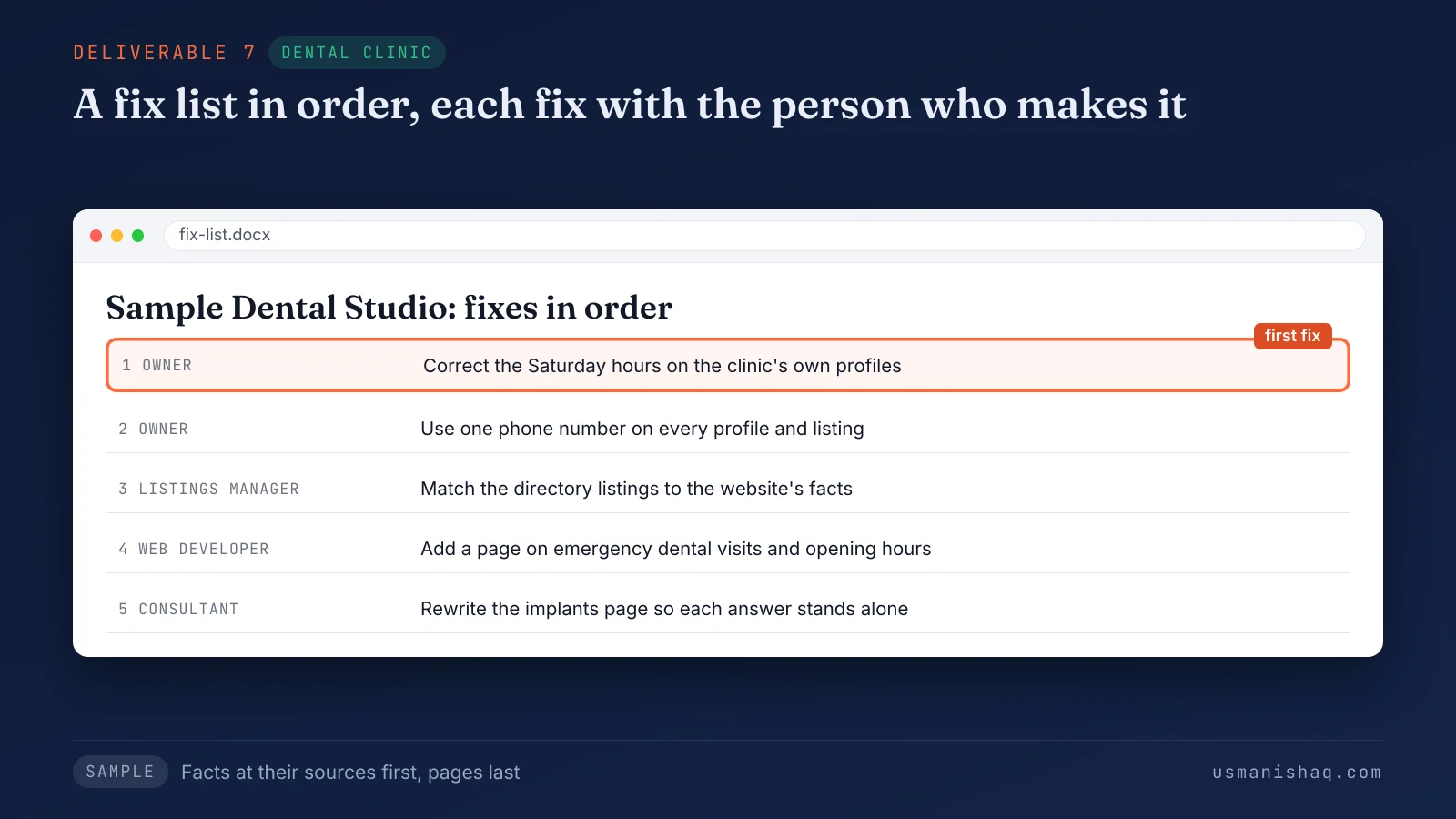
The sample fix list for a dental clinic runs in that order. Hours and phone on its profiles come first, then the listing matches, then two page fixes, each with a named owner. The page work draws on a different kind of audit.
How is an AI visibility audit different from a semantic content audit?
An AI visibility audit reads what AI answers say about a business, while a semantic content audit reads the website's own pages.
The semantic content audit checks entities, coverage and which query earns which page. Owners who want the steps can see how a semantic content audit runs. The two audits meet at the site check, where answers and page structure point to the same gaps.
How often should a business repeat an AI visibility audit?
A business should repeat an AI visibility audit after each round of fixes, using the same question set so the dates compare.
The Google side moves every day, so a monthly look at Search Console costs little between audits. The report's dimensions and date view are set out in Google Search Console Help.
Questions about AI visibility audits
AI visibility audits raise three more owner questions: running one alone, Search Console access and measuring results.
Can a business owner run an AI visibility audit alone?
Yes, a business owner can record the answers alone, and the source map and fix order take practice.
Recording is the easy half. Working out why an answer chose a source is the hard half.
Does an AI visibility audit need access to Search Console?
Yes, the Google side of an AI visibility audit needs Search Console access, and view-only access is enough.
Owner-level access stays with the owner.
How do you measure results after an AI visibility audit?
Results after an AI visibility audit show in a second answer record on the same questions and in calls and booked jobs.
The way to read an SEO report in calls and booked jobs applies to AI answers too.
What should a business owner keep from an AI visibility audit?
An AI visibility audit should leave a business owner with a dated answer record and a fix list in order.
Every later check is measured against those two documents. The answers show what AI systems understood about the business, and the fix list shows what semantic SEO work comes next. A score can sit on top, yet a score never replaces the answers or the sources they cite.