
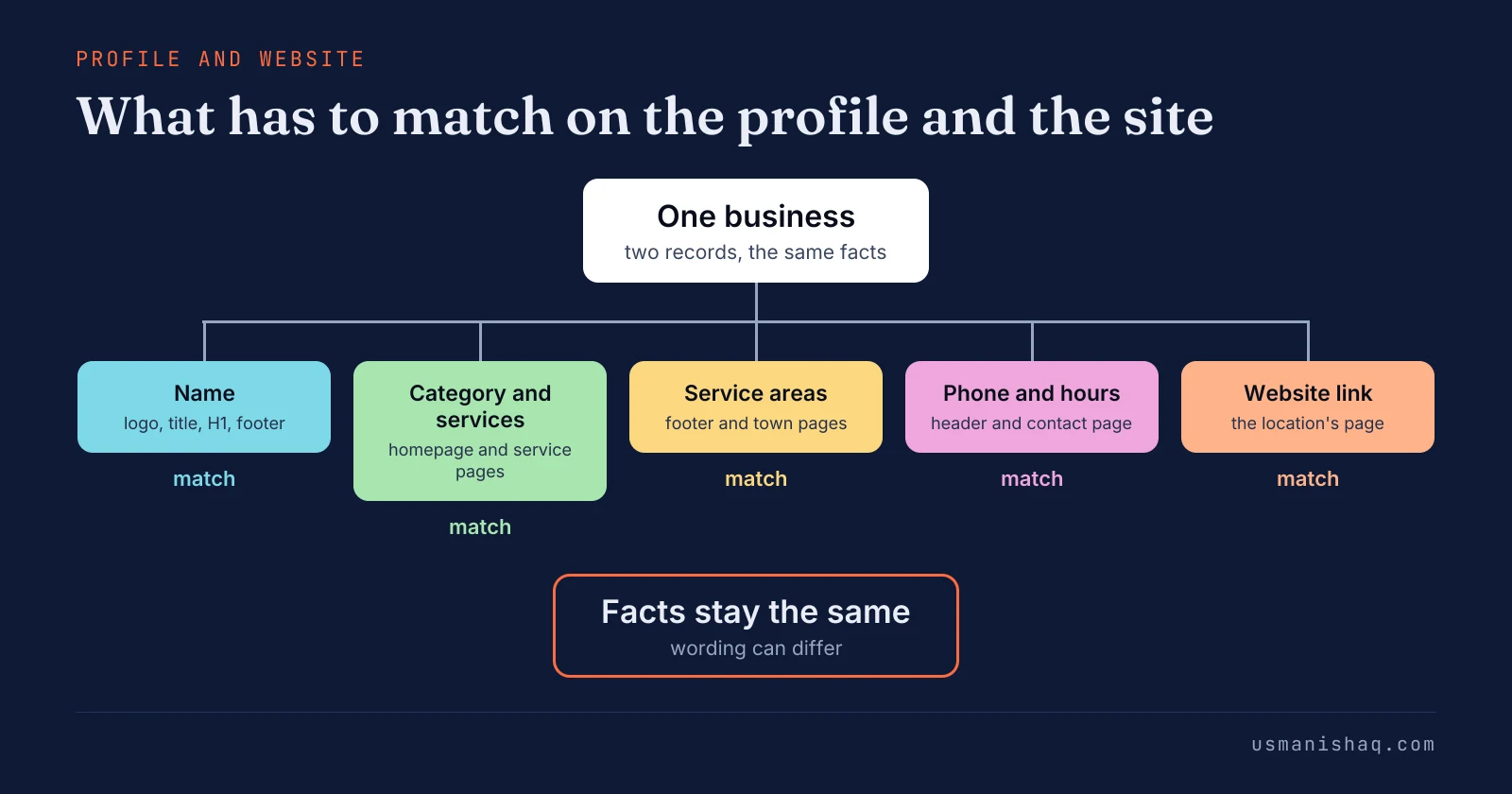
Yes, a Google Business Profile and a website must match on name, services, service areas and hours, and the wording can differ. Semantic SEO treats the profile and the website as two records of one business a search engine must understand.
Seven details have to match on a Google Business Profile and a website: name, category, services, area, phone, hours and website link.
A Google Business Profile that disagrees with the website might not show up for relevant searches, because one of the two records is inaccurate. An owner fixes a mismatch by settling the true facts, updating the website first and then editing the Google Business Profile to match.
Does a Google Business Profile need to match the website?
Yes, a Google Business Profile and a website must match on name, services, service areas and hours, and the wording can differ. The primary category, the phone number and the website link complete the list of facts that must agree.
The two records must state the same facts, not the same words. Google's AI Overview for the question and TDD Technology agree on that limit. A website that writes "Street" and a profile that writes "St." name one address.
Is a small difference in wording a mismatch? A difference in wording is not a mismatch when the fact stays the same. Owners still ask, in their own words, "is it OK if the address doesn't match" what the Google listing shows.
The profile and the website are two records of one business. An entity, in semantic SEO, is a distinct thing a search engine identifies, such as one business with its name, place and services. Semantic SEO keeps every fact about that business identical wherever the business is described.
Seven details carry those facts on both records.
Which details have to match between the profile and the website?
Seven details have to match on a Google Business Profile and a website: name, category, services, area, phone, hours and website link. Practitioners use the label NAP for three fields of a listing: name, address and phone. Category, services, hours and website link carry as much weight for a trade business as name, address and phone.
The seven details of a Google Business Profile and the place where the website states each one are given below:
| Profile field | Where the website states the same fact | What a match means |
|---|---|---|
| Business name | Logo, title tag, H1, footer, schema name |
The real-world name, with no added keyword, tagline or legal term |
| Primary category | Homepage H1 and main subject | One "IS a" description of the core business |
| Services and additional categories | One service page or section for each | Every listed service has a page |
| Address or service areas | Contact page, footer, town pages, schema address or areaServed |
The same towns; a hidden home address stays off both |
| Phone | Header, contact page, schema telephone |
The main number on both; any extra number reaches the same business |
| Hours | Contact page, footer, schema openingHoursSpecification |
The same regular hours, and the same special hours for holidays |
| Website link | The page that confirms the location | The homepage, or each location's own page |
Google's "Local business (LocalBusiness) structured data" documentation requires name and address for a business. The same documentation recommends telephone, openingHoursSpecification and url. Semantic SEO gives each of the seven facts one owning place on the website and repeats the fact unchanged everywhere else.
The name, the categories and services, the service areas and the phone raise most owner questions. The business name comes first.
Does the business name on the website have to match the profile name?
Yes, the business name on the website has to match the Google Business Profile name, and the domain name can differ. Google sets the name rule in "Guidelines for representing your business on Google". The profile name should reflect the business's "real-world name, as used consistently on your storefront, website, stationery, and as known to customers."
The profile name leaves out taglines, keywords, phone numbers and website addresses. Google also rules out "irrelevant legal terms (e.g. LLC, LTD, INC)" unless signage and invoices show them. Google warns: "Including unnecessary information in your business name isn't permitted, and could result in the suspension of your Business Profile."
Local Search Forum replies agree the domain name can differ, as long as the website shows the same business. Owners see competitors with keywords in the profile name. The website title can carry the service and the town, and the profile name carries the real-world name only.
Semantic SEO keeps one business name string on every page, every profile and every schema node. The category comes next.
Do the profile categories and services have to match the service pages?
Yes, the primary category of a Google Business Profile should describe the homepage's main service, and each listed service should have a website page. Google's guidelines ask owners to "Use as few categories as possible to describe your overall core business". The test is to "complete the statement: 'This business IS a' rather than 'this business HAS a.'"
A profile holds one primary category and, as of November 2026, "up to 9 more categories", according to Google's edit page. A plumbing company whose primary category is plumber presents plumbing as the main subject of the homepage.
Google's services editor keeps "your menu items or services, along with their prices, accurate" on the profile. Each listed service, such as repiping or water heater repair, then needs a page or a section that names the service. Owners call the categories "what I do" and the services list "my services".
Semantic SEO for trade and service businesses gives each service its own page, linked from the homepage. The page structure for a business that serves several towns is set out in the guide to semantic SEO for trade and service businesses. A category with no matching page describes a service the website never states.
Service areas raise a different question for owners who work from a home address.
What does a service-area business show on the website instead of a home address?
A service-area business should hide its home address on the Google Business Profile and show the same service areas on its website. Google's guidelines state: "If you're a service-area business, you should hide your business address from customers." Google's own example is a plumber working from a residential address, who should "clear the address from your Business Profile."
Google allows "up to 20 service areas based on the cities, postal codes, or other areas you serve", as of November 2026. Google's "Manage your service areas for service-area & hybrid businesses" page rules out "a radius distance around your business".
The area stays within "about 2 hours of driving time from where your business is based", according to Google's guidelines. Google adds: "For some businesses, larger service areas may be appropriate."
The website should list the same towns on the contact page and footer, and give a town page to towns with their own searches. The map below shows one hidden base and the towns listed on both records.
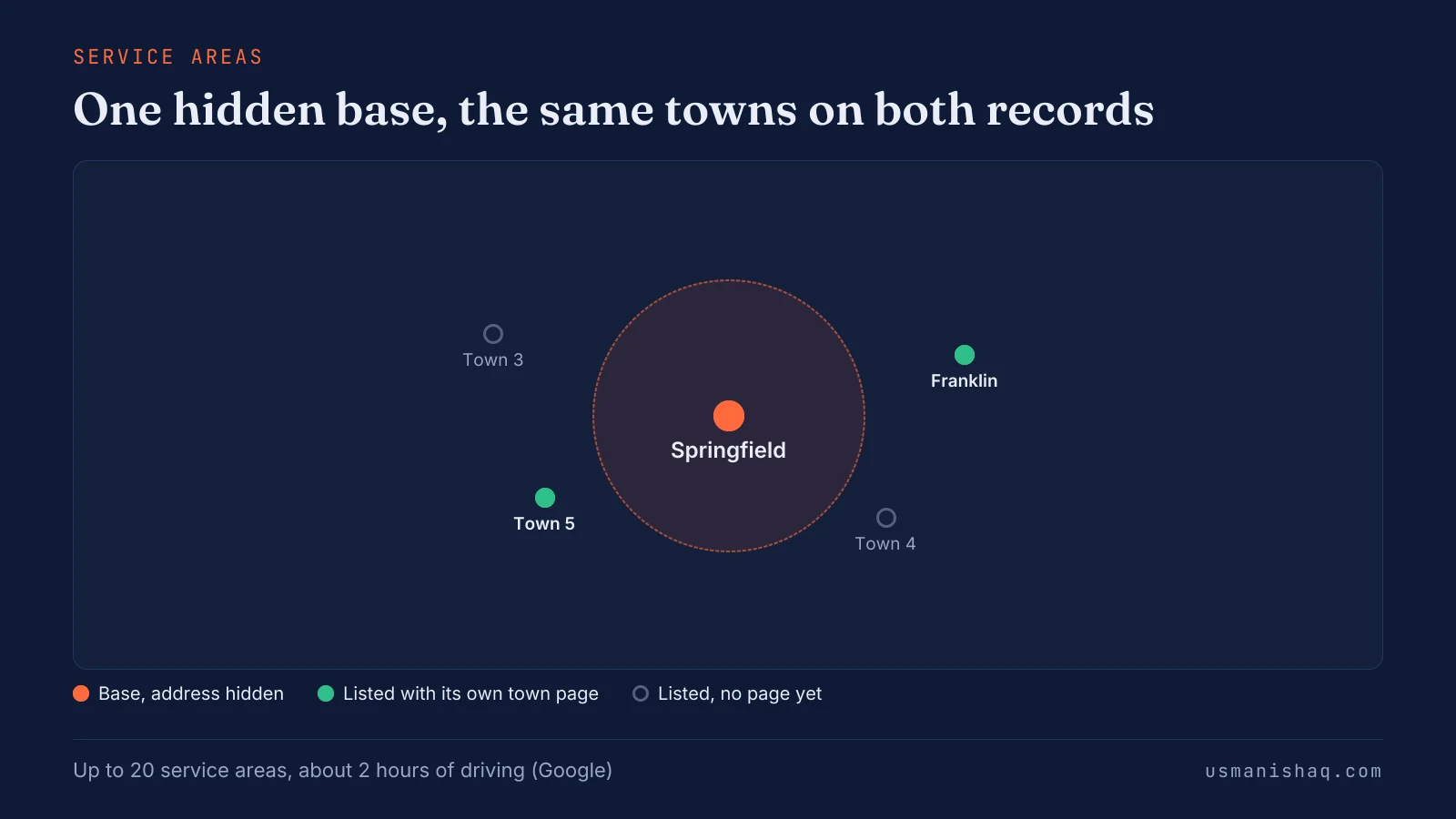
The website should not publish the hidden home address as a storefront address. Owners call the setting "the areas I cover" and worry about "my home address" showing online. Semantic SEO lists the same towns in the profile, the footer, the contact page and the schema areaServed property.
The phone number has one allowance, for tracking lines.
Can the profile show a different phone number from the website?
Yes, a Google Business Profile can show a call-tracking number when the website's main number also appears on the profile. Google states: "The phone number must be under the direct control of the business." A profile takes "up to 2 more phone numbers" beside the primary number, as of November 2026.
Practitioner advice differs on which number leads. DreamHost keeps "one clear primary number" and lists the tracking line as an additional number. TDD Technology keeps "the established business number available as an additional number" and checks that "the tracking line reaches the same business".
Both readings share one condition: both numbers ring the same business. Owners ask if "the phone number on the signage" has to lead. Semantic SEO marks the main number as the business telephone in the site schema and keeps that number on every page header.
A second number is one of several details that can differ.
What can differ between the profile and the website?
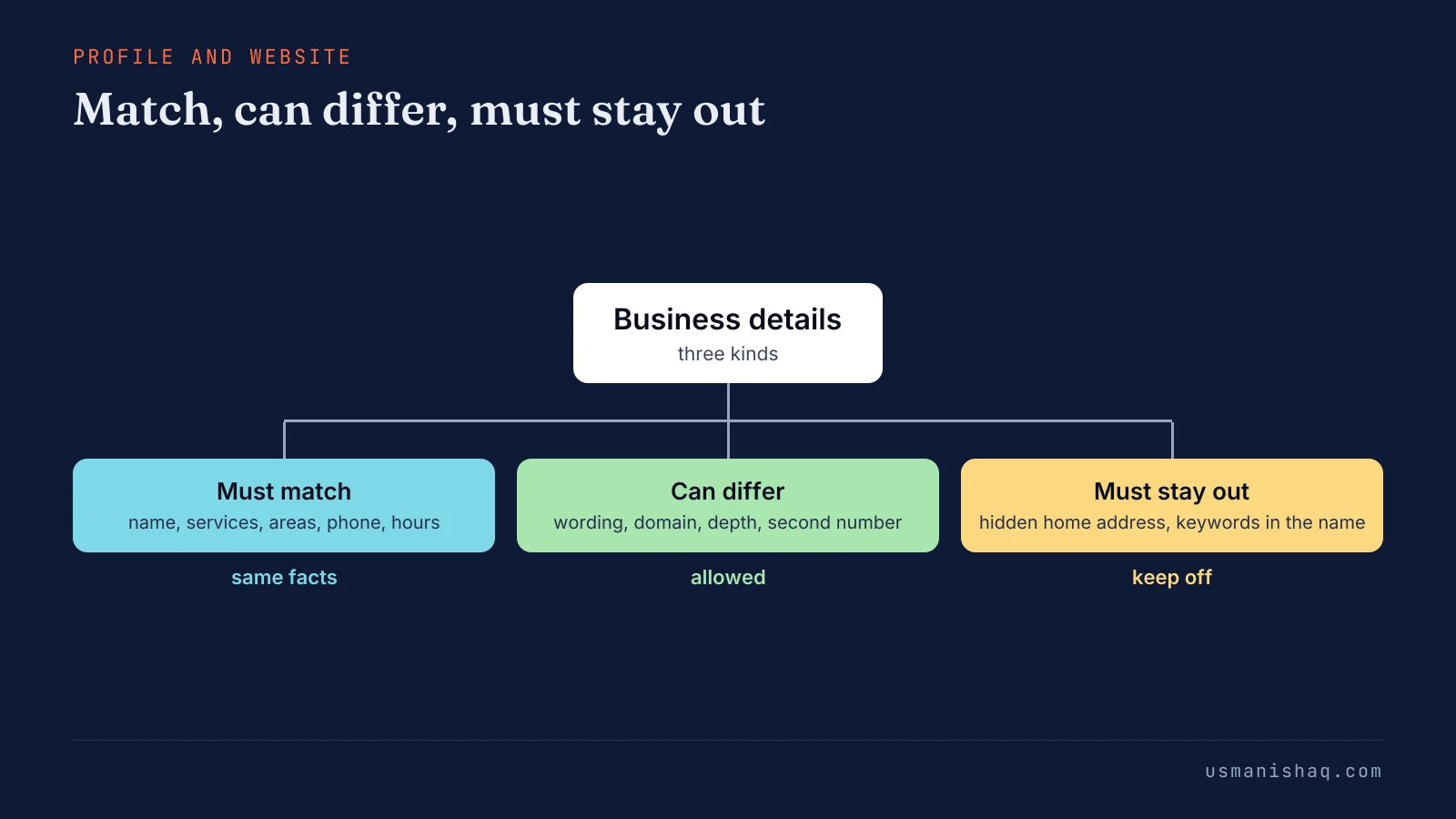
The wording, the domain name, the depth of content and a second phone number can differ between a Google Business Profile and a website. The profile description and the page copy can use different words. The domain name can differ from the business name.
Blog posts, prices and team pages live on the website only, so the website goes deeper than the profile. A second phone number can sit on the profile as an additional number.
Two details must stay out. A hidden home address stays off the website. A keyword, tagline or legal term stays out of the profile name, even where the website title carries the service and the town.
The seven details of the match table must match on both records, as the diagram below shows.
Matching does not mean copying the same text into every listing. Semantic SEO holds the facts fixed and lets the wording follow the purpose of each page. Trouble starts when the facts do not match.
What happens when the profile and the website do not match?
A Google Business Profile that disagrees with the website might not show up for relevant searches, because one of the two records is inaccurate. Google's help page "Tips to improve your local ranking on Google" sets out the rule.
Google states: "Businesses with complete and accurate info are more likely to show up in local search results." The same page adds: "If your business info isn't accurate, your Business Profile might not show up for relevant searches in your area."
Google names the risk its guidelines prevent: "changes to your information or, in some cases, removal of your business information from Google". Google's address rule reads: "Google determines how best to display your business address based on your business information and information from other sources."
DreamHost studied 230 local businesses in a report published in March 2026. DreamHost found that 53 percent had at least one missing or mismatched detail between Google and the website. Hours, phone numbers and URLs were the most frequent mismatches in the DreamHost study.
A customer who sees two sets of hours or two phone numbers can call the next business instead. Semantic SEO removes the second version, so the profile and the website state one set of facts. Owners fear a worse outcome: a profile suspended after an edit.
Can a mismatch get a Google Business Profile suspended?
Google ties suspension to a profile that does not reflect the business accurately, and names no separate rule for a website mismatch. Google's rule reads: "To make sure your Business Profile won't be suspended we require that you" ... "Reflect your business accurately." The business name rule quoted above adds a second written trigger: unnecessary information in the name.
Owner threads and forum replies list a profile and website mismatch among suspension causes. No Google document read for the present article states that rule. Owners report suspensions after name, category or address edits made by the owner or a contractor.
An edit that changes a real-world fact needs the website to show the same fact first. Semantic SEO keeps keywords on the service pages and out of the profile name. The fix follows that order.
How do you fix a mismatch between the profile and the website?
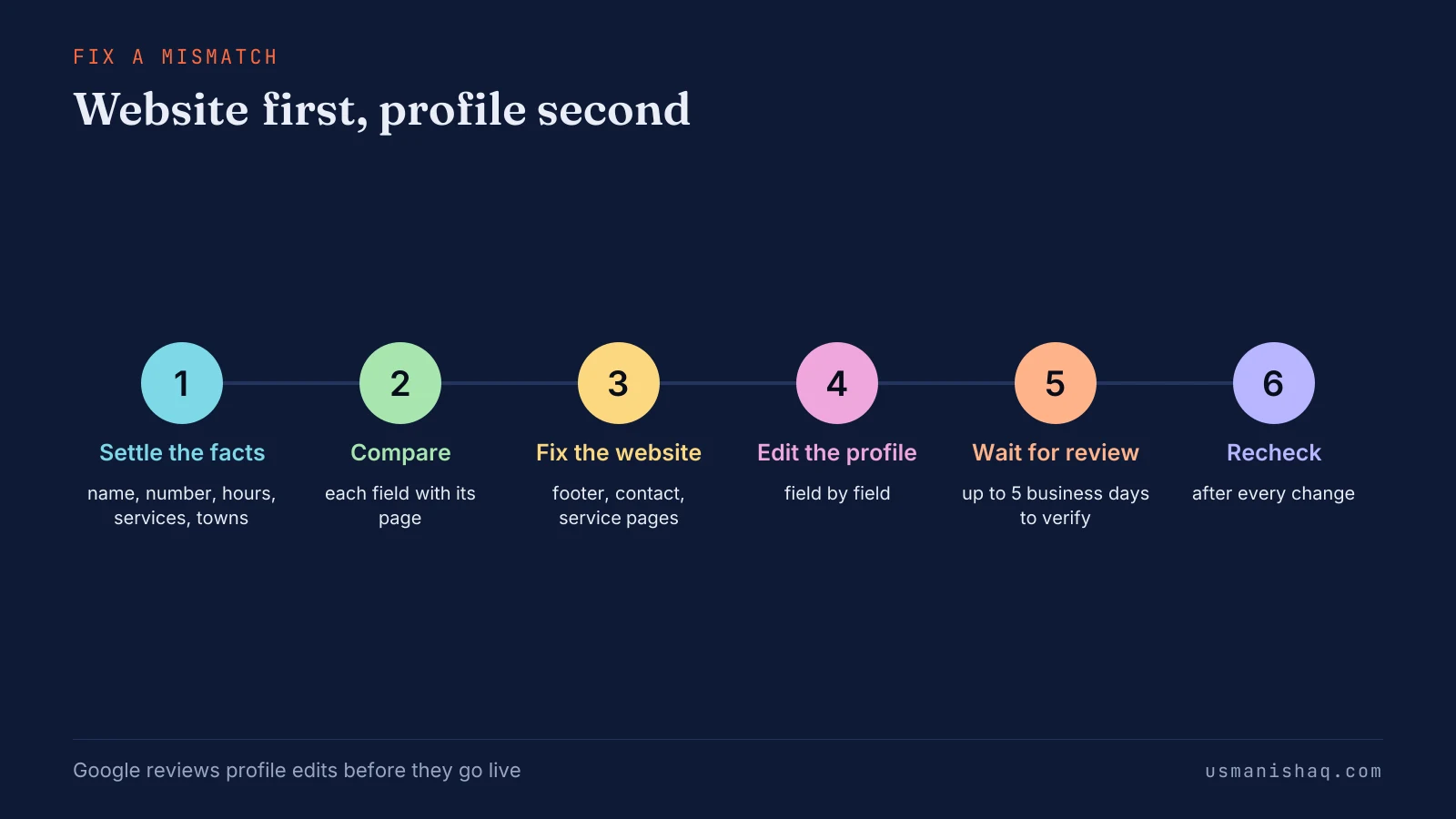
An owner fixes a mismatch by settling the true facts, updating the website first and then editing the Google Business Profile to match. The steps to fix a mismatch between a Google Business Profile and a website are listed below:
- Settle the true facts: the name on the signage, the main number, the regular hours, the services and the towns.
- Compare each profile field with the website place named in the match table.
- Update the website first: footer, contact page, service pages, town pages and schema.
- Edit the profile second, field by field. A name change after verification means "you might need to verify your business again", according to Google's "Edit your Business Profile" page. A move means "you must verify your business again".
- Wait for Google's review, because Google states: "We review your changes before we update them live on your profile." Google's "Verify your business on Google" page puts verification reviews at "up to 5 business days" as of November 2026, longer on rare occasions.
- Recheck both records after every change of phone, hours, services or towns.
Practitioners call the settled list of facts the "source of truth". Semantic SEO changes the website first, so every profile edit has a page that confirms the edit. The six steps run in one line, website before profile.
A plumbing company shows what the check finds in practice.
What does a match check find for a plumbing company?
A match check for a plumbing company based in Springfield finds the profile services, towns and hours that no website page states. The plumbing company of the site's worked example is based in Springfield and serves Franklin. The check is an illustration, not a client record.
The Google Business Profile lists water heater repair, and the website has no page for water heater repair. The profile's service areas include Franklin, and the website names Franklin only in a footer list. Holiday hours sit on the profile and nowhere on the website.
Water heater repair gets a page of its own. Franklin gets a town page once Franklin earns one. The contact page shows the same special hours.
DreamHost found at least one missing or mismatched detail for 89 percent of the plumbers in its sample. Semantic SEO answers each finding with a page, a profile edit or a schema property. A website holds details the profile has no room for.
What does the website hold that the profile has no room for?
A website holds a page for each service and town that earns one, while a Google Business Profile holds up to 20 service areas. Google's page Manage your service areas for service-area & hybrid businesses states: "Your service area shows customers where you can provide your products and services."
A town page is a page about the business or one service in one town served. A town earns its own page when the town has its own searches, its own jobs and its own proof.
A profile with 20 towns and a website with one list of towns is the usual reason a website ranks in one town. The cause and the fix are set out in the article on why a website ranks in one town.
Local SEO and Google Business Profile work aligns the profile, the service areas and the town pages so each town has one owner. A Semantic Content Audit checks which pages compete for the same service or town and which towns have no owning page. The Semantic Content Audit service runs that check on one site as a fixed-fee written diagnostic.
Semantic SEO builds the pages the profile points to, one service and one town at a time. The link from the profile changes for a business with several locations.
Which page should the profile link to when a business has several locations?
Each location's Google Business Profile should link to that location's page, because Google asks for a website that represents the individual location. Google's Guidelines for representing your business on Google ask owners to "provide a website that represents your individual business location". A business with several staffed offices needs one page and one Google Business Profile for each office.
Google's Local business (LocalBusiness) structured data documentation defines the url property as "The fully-qualified URL of the specific business location." A business with one location should link the profile to the homepage or the page that best confirms name, area and phone. Owners on Reddit give the same advice: each location's profile links to its own location page, not the homepage.
Semantic SEO gives each location one page, one profile and one url in the schema. The same facts then reach directory listings.
Do directory listings have to match the website too?
Yes, directory listings should state the same facts as the website and the Google Business Profile, after the owner fixes the website first and the profile second. Owners name these other records "Yelp, Facebook, directories". Practitioners call such listings citations.
The website comes first and the Google Business Profile second, because the owner controls both. Bing Places and the main directories come next, and old listings come last. Owners object that directory listings and old listings sit outside their control.
Semantic SEO starts from the two records the owner controls and lists every other record after them. AI assistants can read the same records too.
Do AI assistants read the profile and the website?
Yes, AI assistants can read a business's details from the website, the Google Business Profile and other sources, so matching facts give one answer. ChatGPT holds a business profile of its own. ChatGPT may also use other sources besides the profile, according to OpenAI.
An owner who claims the business in ChatGPT can check which details ChatGPT holds. The steps to claim your business in ChatGPT show where the owner checks those details. The sources an AI answer compares decide which local business AI answers recommend.
No tested AI answer to the match question is recorded for the present article. Semantic SEO gives AI assistants one set of facts to repeat, on every record the owner controls. Five more questions owners ask complete the match.
Questions owners ask about matching the profile and the website
Owners matching a Google Business Profile with a website ask five further questions: no website, changing hours, rejected links, worth and reviews.
Can a business have a Google Business Profile without a website?
Yes, a business can have a Google Business Profile without a website, because Google asks for a location phone number or a website. A website gives the profile a page that confirms the profile's facts, and semantic SEO builds that page.
Why does Google keep changing the hours on the profile?
Google can update profile details from information Google collects, including automated calls or texts to the verified phone number. Google's Edit your Business Profile page states that answers to those messages "may be used to update your profile".
Why is the website link not approved on the profile?
A website link fails Google's rules when the URL redirects to another landing page or the site blocks Googlebot. A popular Facebook comment reports that a rejected link can land on a page showing a different name or address from the profile.
Is a Google Business Profile worth having when the website already ranks?
Yes, a Google Business Profile is worth having, because the profile is what appears in the local results on Google Maps and Search. Google's help page Tips to improve your local ranking on Google states: "You can use your Business Profile to improve your business's local ranking."
Are Google reviews tied to the profile or to the website?
Google reviews are tied to the Google Business Profile, and Google counts the reviews toward prominence in local results. Google states: "More reviews and positive ratings can help your business's local ranking."
What is the next step after the profile and the website match?
The next step after a Google Business Profile and a website match is a recheck after every change of phone, hours, services or towns. A search engine understands one business when both records state the same facts. An owner builds a page for every service and town the profile names, with semantic SEO deciding the order.
The seven details stay the same on both records: name, category, services, area, phone, hours and website link.