
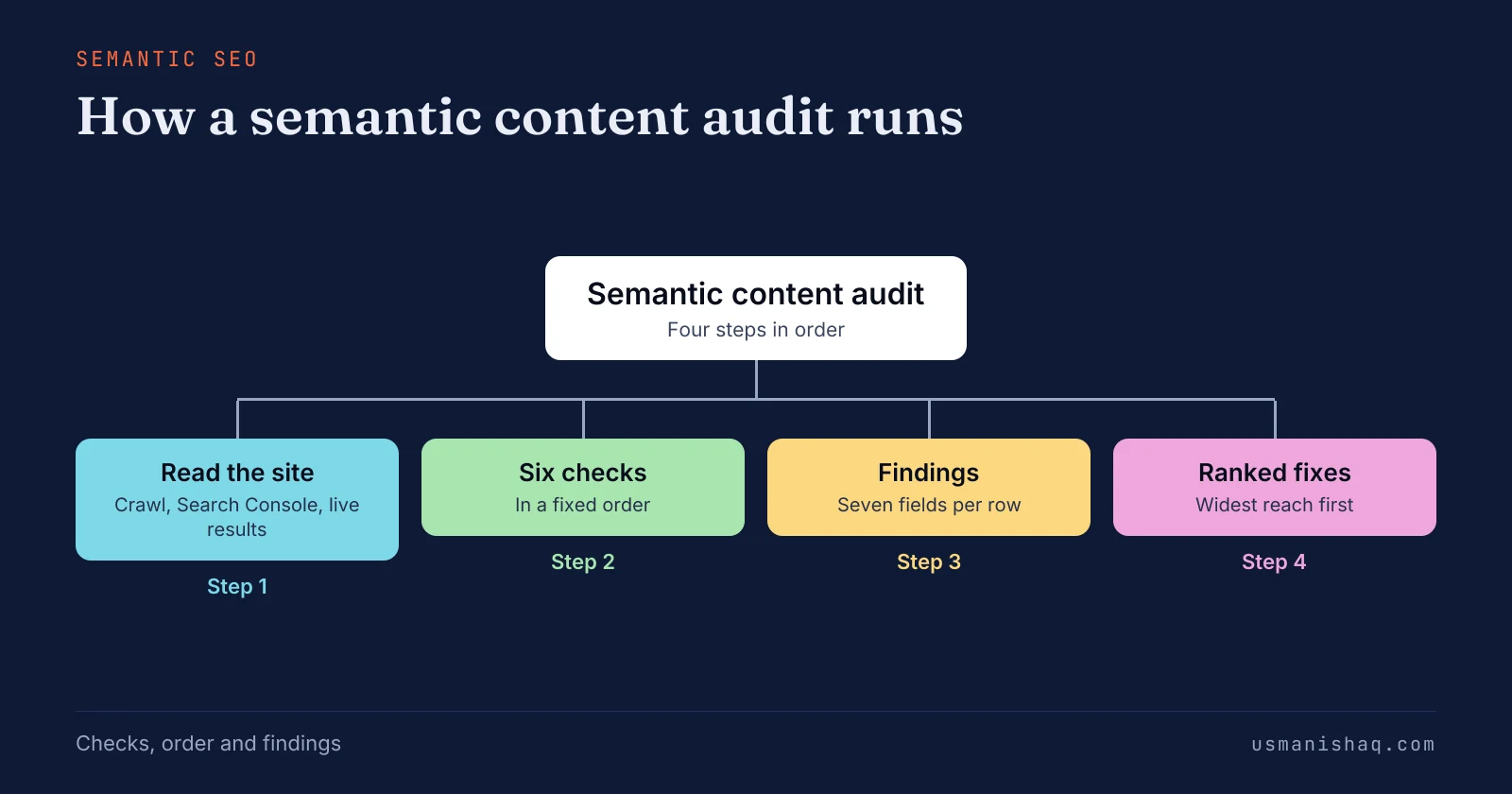
A semantic content audit is a review of website pages by meaning, topic coverage and entity relationships, with each fix ranked by cost. A semantic content audit runs in four steps: read the site, run six checks in order, write each finding and rank the fixes.
Semantic SEO work on an existing site starts from the ranked fixes. A semantic content audit reads four inputs first: a site crawl, Google Search Console queries, the business's services and towns, and live search results.
A semantic content audit runs six checks in a fixed order, and each check works on the pages the previous check settled. A semantic content audit writes each finding as one row with seven fields, ending in the reach and the cost of the fix.
A semantic content audit ranks fixes by reach first, and puts the larger problem first when two fixes cost about the same. A cannibalization audit and an AEO content audit each run one check of a semantic content audit on its own.
How do you do a semantic content audit?
A semantic content audit runs in four steps: read the site, run six checks in order, write each finding and rank the fixes. Owners ask what literally happens in a semantic audit, and where to start. The four steps of a semantic content audit are listed below:
- Read the site: crawl every indexable page, pull the Search Console queries for each page and run each core search before any check.
- Run the six checks in a fixed order, from competing pages to consistent wording.
- Write each finding with its page, check, cause, evidence, fix, reach and cost.
- Rank the fixes from the findings by reach and give each page in question one decision.
The steps are plain; the order carries the method. The Semantic Content Audit adds view-only access before the four steps and a review call once the findings are written. The Semantic Content Audit service runs the four steps on one site and leaves the owner ranked fixes to build on, with no page edited during the audit.
The fee is worth paying when the rebuild, migration or retainer decision ahead costs more than the audit. Semantic SEO fixes chosen before the four steps tend to land on a page the site later merges. The inputs come first.
What does a semantic content audit read before the checks start?
A semantic content audit reads four inputs first: a site crawl, Google Search Console queries, the business's services and towns, and live search results. Search Console is Google's free report on how a site appears in Google Search. The four inputs of a semantic content audit are listed below:
- Site crawl: a site crawler lists every indexable page as the page inventory.
- Search Console queries: the searches each page earns impressions for. The window should cover at least three months, and twelve months show seasonal services.
- Services and towns: the list the business names, from one contact for business facts.
- Live search results: the recorded top results of each core search, with three competitors.
I read the core pages in full, because a crawl lists pages and does not read them. A full crawl export often leaves a first-time auditor with "a sense of overwhelm", because the export decides nothing. Search Console queries matter more than the crawl totals, because semantic SEO reads a site by search first.
The crawl export is often mistaken for the audit.
Is a crawl export the same as a semantic content audit?
No, a crawl export is the page inventory of a semantic content audit, and the audit starts after the inventory is complete. A crawl export holds URLs, titles, status codes and word counts, with no decision on any page. Published content audit guides and semantic SEO practice agree that the inventory comes first and the analysis follows.
The export answers "which pages exist", and the audit answers "which page should answer which search". The reading of a semantic content audit happens in six checks.
In what order does a semantic content audit run the six checks?
A semantic content audit runs six checks in a fixed order, and each check works on the pages the previous check settled. A fix chosen before an earlier check is settled can land on a page that later merges or loses its search.
The table below gives the six checks with the input, the reason for the position and the finding of each:
| Order | Check | Method term | Reads | Why at the position | A finding names |
|---|---|---|---|---|---|
| 1 | Competing pages | semantic dilution | Search Console queries by page | Each search needs one owning page before any page is judged | two pages, one search |
| 2 | Missing topics | entity coverage | services and towns against the inventory | Gaps show only after every search has one owner | a service or town with no answer |
| 3 | Competitor gaps | competitive entity gaps | live results, three competitors | Compares the owning pages, so the owners come first | questions every top result answers |
| 4 | Citable answers | AI citation readiness | core pages, a prompt set | Judges sentences on the pages that stay | an answer AI systems skip |
| 5 | Page layout | centerpiece and block order | the opening 400 characters, by template | Looks for the answer check 4 settled | a block above the answer |
| 6 | Consistent wording | predicate consistency | every kept page | The wording list covers the final page set | one service, two verbs |
The figure below sets the six checks on one line, in the order the audit runs them.
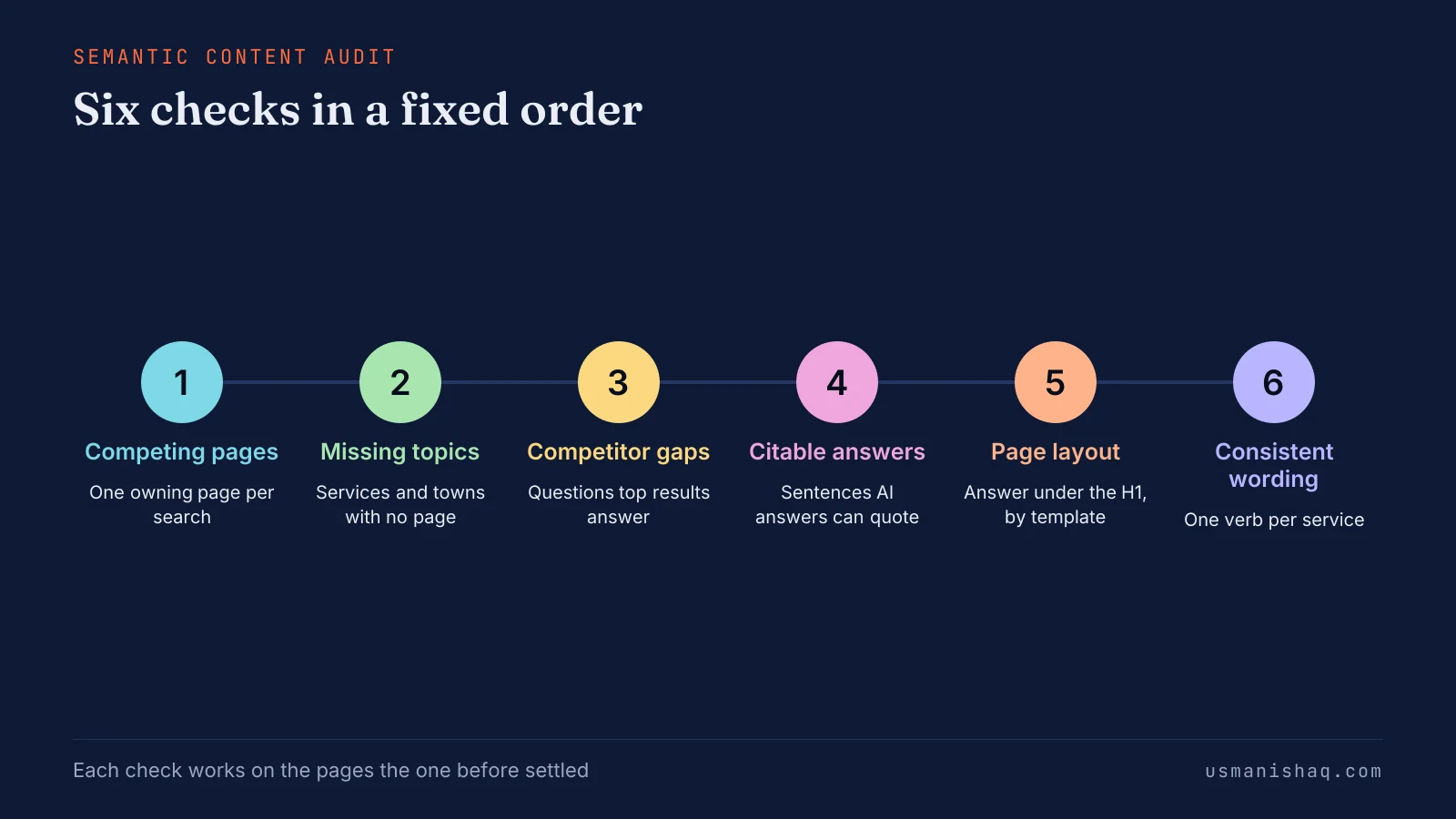
Owners in forum threads on audits say the order of the work matters more than any single tactic. Semantic SEO plans a site from searches to pages to sentences, and the six checks follow the same direction. Competing pages come first.
How does a semantic content audit decide that two pages compete?
A semantic content audit decides two pages compete when Search Console shows both pages for one search and both pages answer the same need. Owners describe pages "competing", ask "where the line is" and admit to deciding by "gut instinct". The first test is the Search Console sign of overlap.
One search shows two or more site pages with impressions, or the shown page keeps changing. Search Console Help defines "Impressions: How many times your site appeared in Search results." The sign shows in the Performance report, filtered to one query, on the Pages tab.
The second test asks whether both pages answer the same need with the same verb, as two Springfield drain cleaning pages do in the plumbing example. A service page and a how-to guide shown for one search answer different needs, and both can stay.
Semantic dilution is the semantic SEO term for one search split across several pages of one site. Practitioners call the fault keyword cannibalization.
The finding names the pair, the search and the pending page decision. The next check looks for a search with no page.
How does a semantic content audit find a service or town with no page?
A semantic content audit finds a missing topic by matching each service and town to a page, a section or no answer. Every service crossed with every town the business serves gives the rows to match. The example plumbing company lists water heater installation in one line on the Springfield home page, and no page answers repiping in Franklin.
Search Console queries with impressions and no answering section show customer questions. Entity coverage is the method term for every service, town and customer question having a page or a section with the answer.
Each gap later becomes a page, a section or a sentence, and semantic SEO builds the gaps in order of search demand. Competitor gaps show in the top results.
How does a semantic content audit compare a page with the top results?
A semantic content audit compares each core page with the top results for its search and lists the questions every top result answers. The audit records the top results, three competitors and the People Also Ask questions for each core search. Every top result for repiping in Springfield names pipe materials such as PEX and copper, in the plumbing example.
A question every top result answers and the core page does not is a gap. The agreed answers come first in semantic SEO, and depth comes after, never copied from a competitor page. Competitive entity gaps is the method term for questions every top result answers and the site does not.
The core questions then go to AI answers.
How does a semantic content audit test whether AI answers cite a page?
A semantic content audit tests citable answers by asking AI assistants the core questions and recording which sources each answer names. I record which answers name the site and which name competitors. The three faults the check marks on a core page are listed below:
- Two claims in one sentence: an AI answer cannot quote one claim without the other.
- No named author: the page gives no person who stands behind the answers.
- A claim with no evidence: the sentence gives no source, figure or example a reader can check.
Semantic SEO writes one answer per sentence, so each answer is a passage that stands alone when lifted from the page. AI citation readiness is the method term for the check. AI systems can still skip a passing page, because each system picks sources differently.
Layout can still bury a clear answer.
How does a semantic content audit check where the main content sits?
A semantic content audit reads layout by template and checks that the opening 400 characters under the H1 state the page's answer. One template shapes every service page, so one reading covers the set. The check fails when a banner, an image slider, share buttons or a date stamp sits above the answer.
The template passes when the first 400 characters after the H1 carry the service name, the answer and the purpose of the page. Centerpiece and block order is the method term for a page's main content and the order of the blocks around the main content.
A visitor sees the first screen, not the HTML, so semantic SEO places the answer first on every template. The last check reads the verb each page uses.
How does a semantic content audit find one service described with different verbs?
A semantic content audit finds mixed wording by listing the verb each page uses per service and marking services with more than one verb. One plumbing page in the example "installs" water heaters, and the Franklin page "fits" water heaters. The verb that joins the business to a service is the predicate in semantic SEO.
Owners notice the fault as one product called three things on three surfaces. Predicate consistency is the method term for one verb per service across every page. The wording list waits for the final page set, after merges and new pages are decided.
Two verbs for one service can leave the owning page of a search unclear. Each fault becomes a written finding.
How is a finding written in a semantic content audit?
A semantic content audit writes each finding as one row with seven fields, ending in the reach and the cost of the fix. The seven fields of a finding in a semantic content audit are listed below:
- Page: the URL, or the template when one template causes the fault.
- Check: which of the six checks the page fails.
- Cause: what on the page produces the fault, in one sentence.
- Evidence: the crawl row, a saved search result or a sentence quoted from the page.
- Fix: the change, written as one action.
- Reach: how many pages one fix corrects.
- Cost of the fix: the work needed, from a sentence edit to a new page or a template change.
Owners often ask for a score; a finding gives an action instead. The set of findings forms the issue map, with a page decision recorded for every page in question. Semantic SEO work starts from findings written in the seven fields, because each finding names a page.
A plumbing company finding shows the seven fields at work.
What does one finding look like for a plumbing company?
One plumbing company finding names the service page template, a slider above the answer and one template change as the fix. The example is a plumbing company based in Springfield that also serves Franklin. Eight service pages, an example value, share one template.
The page is the service page template, and the failed check is page layout. The cause is an image slider and a date stamp above the first sentence about the service. The evidence is the slider caption and the date filling the opening 400 characters under the H1.
The fix moves the answer sentence directly under the H1 in the template. The reach is eight service pages. The cost of the fix is one template change, since semantic SEO fixes layout in the template, not page by page.
The figure below writes the same finding as one row of an issue map.
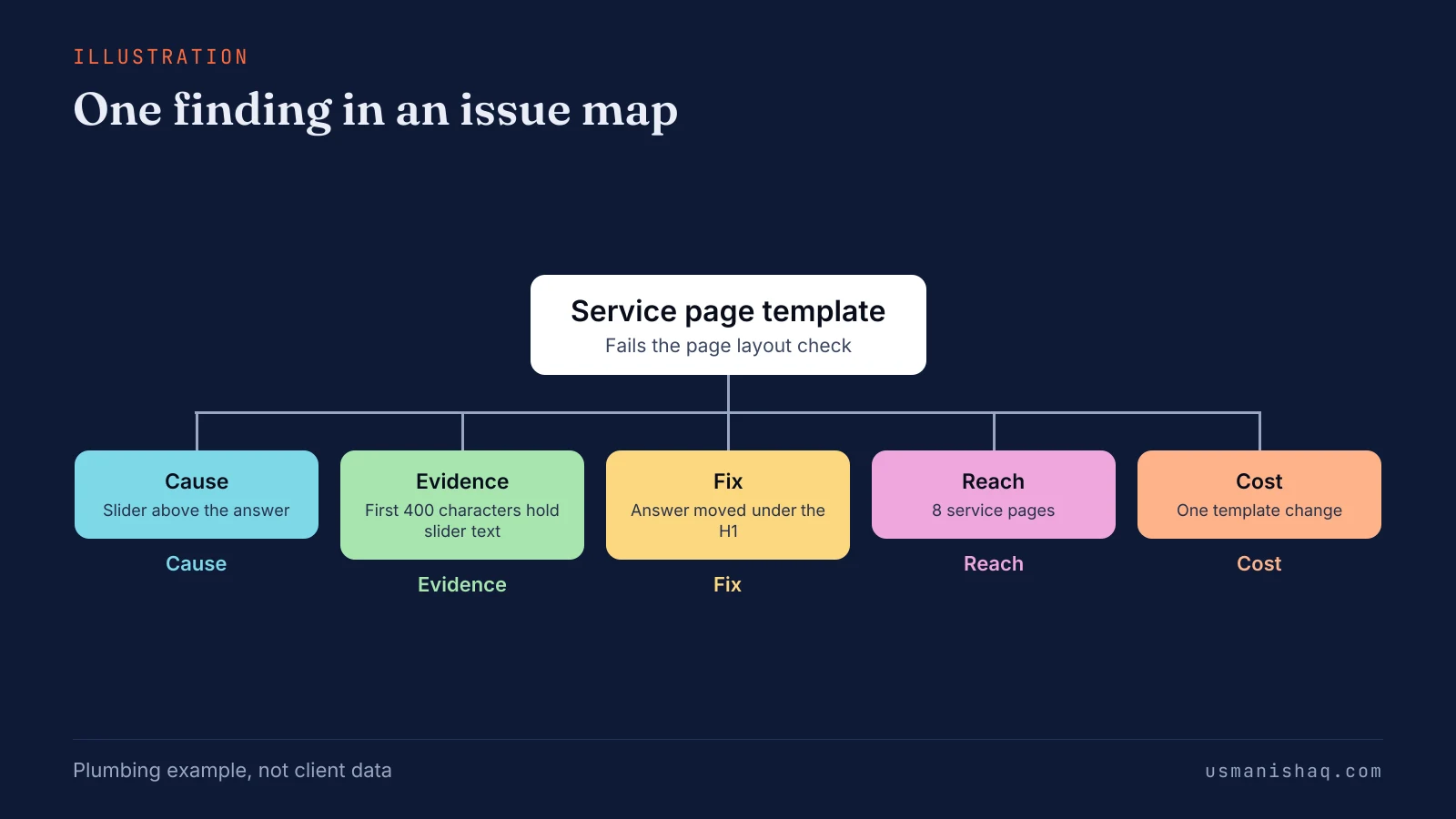
A person can act on the row alone. Reach decides which fix comes first.
How does a semantic content audit decide which fix comes first?
A semantic content audit ranks fixes by reach first, and puts the larger problem first when two fixes cost about the same. Reach counts the pages one fix corrects. The cost of the fix is stated in work: a sentence edit, a merge and a redirect, a new page or a template change.
Three findings from the plumbing example, with reach, cost and order, are compared in the table below:
| Finding | Reach | Cost of the fix | Order |
|---|---|---|---|
| Slider above the answer on the service page template | 8 pages | One template change | First |
| "Drain cleaning" and "blocked drains" pages compete | 2 pages | One merge and one redirect | Second |
| Water heaters "installed" and "fitted" | 2 pages | Two sentence edits | Third |
The template fix comes first because one change corrects eight pages. The merge goes before the wording edit, because a split core search is the larger problem. An owner who feels overwhelmed by a long list can start with the first rows, because the first rows name the first fixes to make.
The first budget in semantic SEO goes where one fix reaches the most pages. The ranked fixes end with one decision for each page.
What decision does each page get after a semantic content audit?
Each page in question gets one decision after a semantic content audit: keep, update, merge and redirect, or remove. Each missing topic gets a fifth decision, create. The five decisions after a semantic content audit are listed below:
- Keep: the page passes all six checks and stays as published.
- Update: sections or sentences change, and the URL stays.
- Merge and redirect: the weaker of two competing pages moves into the kept page, and the weaker URL redirects.
- Remove: the page answers no search the business serves.
- Create: a missing service, town or question gets a page or a section.
The figure below groups the five decisions around one page.
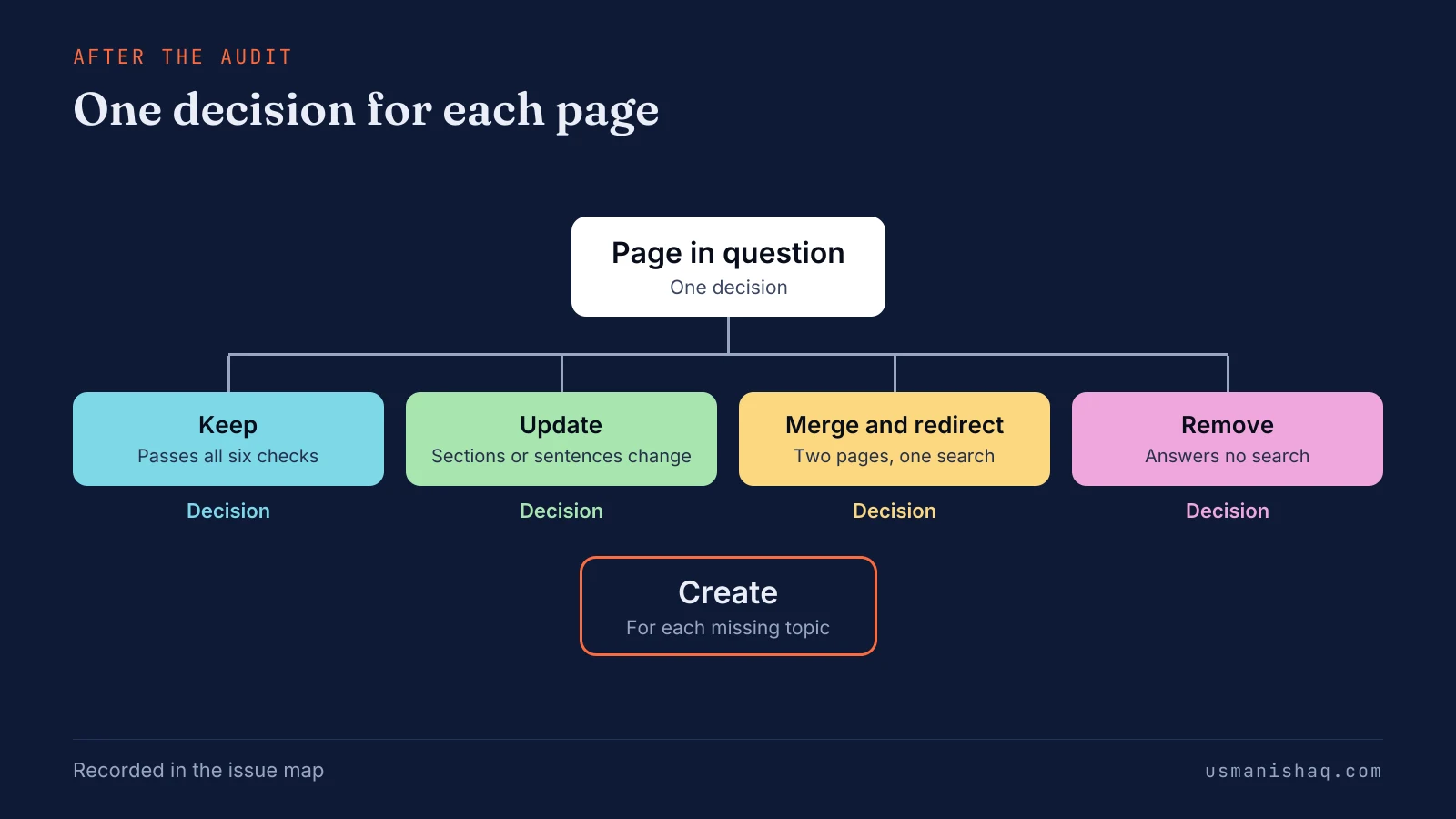
The page decision, recorded in semantic SEO for each search, is the choice of a page, a section or a sentence. Owners then ask whether every page needs a change.
Does every page need a change after a semantic content audit?
No, a page that passes all six checks of a semantic content audit stays unchanged, because keep is a decision too. An owner who "automatically assumed" the content "would be on point" fears the opposite result. A keep decision marks the pages semantic SEO work should leave untouched.
Narrower audits run only one of the six checks.
Which narrower audits sit inside a semantic content audit?
A cannibalization audit and an AEO content audit each run one check of a semantic content audit on its own. A cannibalization audit runs check 1 alone and lists pages that compete. The output is a list of page pairs, with no reading of missing topics or layout.
Founders search for firms that audit a content library for semantic overlap and cannibalization. Owners also search for a "content overlap and cannibalisation audit" as a separate service.
An AEO content audit runs check 4 alone and tests answers against AI assistants. The output of an AEO content audit is a list of skipped answers, with no reading of overlap. GEO, AEO and LLM SEO name the same work.
A single check finds one fault and misses the order of the checks. A merged page can then still lack the missing topic the merge should absorb.
Both narrower audits read the same Search Console data and live results as the full audit. The difference sits in the order, not in the inputs.
The choice of the page that keeps a search after a cannibalization audit is a page decision. A separate guide covers deciding which query earns a page.
Semantic SEO runs all six checks because each fault changes the next one. Owners who find a competing page often ask whether the page should be de-indexed.
Should a competing page be de-indexed after a cannibalization audit?
No, a competing page should not be de-indexed, because Google advises against noindex as a way to choose between similar pages on one site. Google's document How to specify a canonical URL with rel="canonical" and other methods states: "We don't recommend using noindex to prevent selection of a canonical page within a single site, because it will completely block the page from Search."
A noindex tag removes the weaker page from Search. Any search the weaker page held is lost with the page.
The same document limits permanent redirects with one line: "Use this only when deprecating a duplicate page." A semantic SEO merge moves the weaker page into the kept page with a redirect, and the search stays with the kept page. Search Console reports then show whether the merge worked.
Which Search Console reports show whether the fixes worked?
The Performance report and the Page indexing report in Search Console show whether the fixes of a semantic content audit worked. Each kept page is read again in the check 1 query view, because semantic SEO measures a fix on the changed page.
The Queries tab lists the searches a kept page earns impressions for, and the Pages tab confirms one page per search. The site reads the queries and impressions of a kept page first, because the two numbers usually rise before the clicks of the page do.
Search Console Help describes the second report in one line: "The Page indexing report shows how many URLs on your site have been crawled and indexed by Google." A redirected URL leaves the index, and the kept page holds the search.
A guide on how to read an SEO report separates the Search Console numbers that show demand from the numbers that show progress. Owners running the audit raise a few more questions.
Questions owners ask about running a semantic content audit
Owners running a semantic content audit ask five more questions, about time, doing the audit in-house, new posts, town pages and other methods.
How long does a semantic content audit take?
A semantic content audit takes longer as the number of indexable pages and core pages read in full grows. The delivery date is fixed in writing before the audit starts.
Can you run a semantic content audit yourself?
Yes, an owner can run the competing pages and missing topics checks with Search Console and a list of services and towns. The later four checks need recorded live results, a prompt set and practice in reading pages by meaning.
Should you write a new post on a topic the site already covers?
No, a new post on a covered topic should wait until the audit names the page that owns the search. A second post on one search splits the search, and the competing pages check then has to undo the split.
Should the main service page be de-optimized when a town page competes?
No, the main service page keeps the service search, and the town page is rewritten for the service in that town. Semantic SEO gives each page its own search, so neither page needs weaker wording.
Do all content audits follow the same steps?
No, published content audit guides use five to seven steps, and the guides agree only on the first step and the last. Every guide starts with an inventory of pages and ends with a decision for each page.
Semantic content audit process: the short answer
A semantic content audit runs four steps in order, from reading the site to ranking the fixes, and every finding names a page. An owner who understands the six checks and their order can read any audit and see where each finding comes from.
The ranked fixes are where semantic SEO builds next, starting with the fix of widest reach. The order of the checks is the method, and the issue map is the result.