
A semantic content editor checklist is seven tests an editor runs on a draft before the page goes live.
Some software also calls itself a semantic content editor. This page covers the human review that sits after the writer and before the page goes live.
The tests confirm that the page names its entity, answers each heading and states each fact once. They need no tool. You read the draft, run them in order and return it if any of the first three fail.
What does a semantic content editor check?
A semantic content editor checks meaning, which means the entity, the answers, the facts and the way the headings fit together.
Spelling and grammar belong to a copy editor. Meaning belongs to the semantic content editor, who asks whether the page does its job. Does it name its subject the same way each time? Under each heading, does sentence one answer the heading? Do all numbers match what the business confirmed?
Google documentation lists questions of the same kind for people writing for searchers. One asks whether the content gives original information, reporting, research or analysis. The seventh test below puts that question into a step.
The seven tests in order
The seven tests are answer, name, fact sheet, one fact, alone, heading path and gap.
| Test | How the editor runs it | Pass line |
|---|---|---|
| Answer | Read the H1 and the first sentence under each heading | Each first sentence answers its heading |
| Name | Search the draft for the entity and every variant of it | One name, spelled the same each time |
| Fact sheet | Check each number, name, date and unit against the fact sheet | No mismatch, and every number has a source |
| One fact | Find sentences that carry two values | None left |
| Alone | Paste one paragraph into a blank page | It still names the entity and the attribute |
| Heading path | Read the headings top to bottom | They read as one plan with no repeats |
| Gap | Compare with the top three results | One step, limit or number that none of them has |
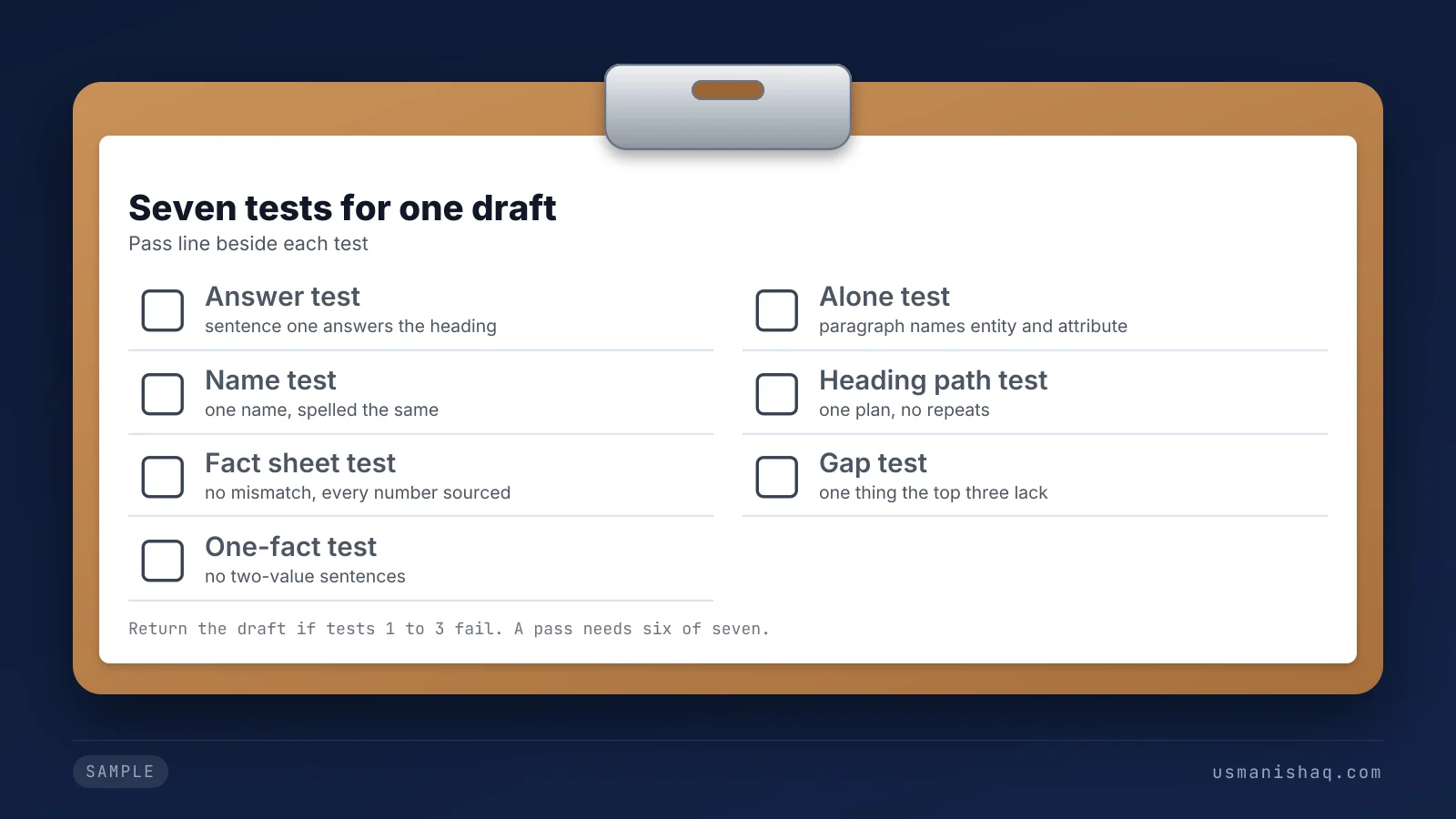
Tests one to three decide whether the draft is returned. Failing one of them means the writer reworks sections, not words. Tests four to six are fixes the editor can often make alone. The gap test usually needs something new from the writer or the owner.
The name test in practice
The name test asks whether the draft calls its subject by one name, and it counts every variant to find out.
Open find and replace and search "estate plan". Then search "estate planning" and "wills and trusts". Say the counts come back four, nine and three. The draft has three names for one service, and a reader may take them for three services.
Pick the name the customers search, which is usually the one in the brief. Replace the others, except where a sentence truly means something narrower, such as a will alone.
The alone test in practice
The alone test asks whether a paragraph still makes sense when it sits on a blank page with no heading above it.
Passages travel. A customer may land on one through a search snippet, and an AI answer may quote one. Take a paragraph that begins "It also covers this, and the same applies." On a blank page nobody knows what "it" is.
Rewrite it so it names the firm, the service and the one thing it says. Three sentences usually do it.
The gap test in practice
The gap test asks what the page says that the top three results do not.
Open the three results for the page's main phrase and list their sections. Then list yours. If none of the three says which documents to bring to a first meeting, your page can list them. The gap can be a step, a limit, a worked sheet or a number from the business's own records.
If you find no gap, the draft repeats what already ranks. That is a reason to send it back, even when the other six tests pass.
How do you run the tests on one draft?
Run the tests in table order, and write each failure on a list instead of fixing it as you read.
I keep the list separate because fixes made mid-read hide the pattern. Three failed answer tests can mean the writer never had the brief. That is a conversation, not a rewrite.
- Get the fact sheet and the brief before you open the draft.
- Run the answer test first, with the body hidden.
- Run the name test with find and replace open, and count each variant.
- Check every number against the fact sheet and mark the ones with no source.
- Split two-value sentences, then run the alone test on three paragraphs from the middle.
- Read the headings in one pass.
- Compare with the top three results and find the gap.
A Semantic Content Production editor review runs checks like these after the draft and before the page goes live.
What counts as a pass?
A draft passes when it clears the first three tests and at least six of the seven in total.
This is my rule of thumb, not an industry standard. A page that fails the answer, name or fact sheet test is wrong in a way that wording fixes cannot reach. Failing only the heading path test is a quick job.
Send the failure list back with the test name beside each line. Write "alone test, paragraph four, starts with 'it'" and the writer knows what to do. "Needs polish" tells them nothing.
Worked example for a law firm in Franklin
A law firm draft in Franklin fails three of the seven tests, and the editor sends it back with the failures listed.
Everything here is a sample. The firm, the town and the draft are invented. The page is an estate planning service page.
| Test | Result | What the editor found | Fix |
|---|---|---|---|
| Answer | Fail | The heading asks what a simple will costs, and sentence one says many factors apply | Open with the fee type and the range the owner confirms |
| Name | Fail | The draft says estate plan, estate planning and wills and trusts for one service | Pick "estate planning" and use it every time |
| Fact sheet | Fail | The draft says the office opens Saturday and the fact sheet says Monday to Friday | Correct the draft and ask the owner |
| One fact | Pass | No sentence carries two values | None |
| Alone | Pass | Paragraphs name the firm and the service | None |
| Heading path | Pass | Headings read as one plan | None |
| Gap | Pass | The page lists documents to bring that no top result lists | None |
Four of seven pass, which is below six, so the page goes back. The editor does not rewrite the three failures. The writer fixes them, and the editor re-runs only those three tests.

The fact sheet failure matters most. A customer who trusts a wrong opening day arrives at a locked door.
What the checklist cannot catch
The checklist cannot catch a wrong fact that sits on the fact sheet too, and it cannot predict a ranking.
If the owner gives you the wrong licence number, the draft matches the sheet and passes. The tests check the page against the sheet, so the sheet needs the owner's confirmation. Passing also says nothing about where the page will rank. It says the page is clear, consistent and carries something the results lack. Whether Google shows it depends on far more than one edit.
Questions editors ask after the first review
After the first review, editors ask about software, the fact sheet and old pages.
Can software run the checklist?
Software can help with the name test and part of the gap test, and a person runs the rest.
Software can count name variants and list terms the top results use. It cannot judge whether the first sentence answers its heading. What software maps and what a person decides sets out the split.
Who writes the fact sheet?
The business owner confirms the fact sheet, and the editor builds it from the owner's own records.
Start with a one-page list of the entity, its attributes and the value of each. Hours, service areas, licence numbers and the jobs the firm takes belong there. Mark any value the owner has not confirmed, and do not let it reach the page.
How often should an editor review old pages?
An editor should review old pages when the facts change and when a whole site is audited.
Run the seven tests on a page when its fact sheet changes. For a whole site, how an audit checks every page against the map shows how the same tests scale to many pages.
Semantic content editor checklist in short
A semantic content editor checklist is seven tests, and a draft that fails the answer, name or fact sheet test goes back.
Run the tests in order, write each failure with its test name and re-run only the tests that failed. Six of seven passes, and the draft goes live.