
A semantic SEO tool maps what web pages already say, and a semantic SEO consultant decides which pages a website needs.
Semantic SEO is the practice of organising a website around entities, their attributes and the relationships between them. The aim is that search engines and AI systems read what each page means.
A semantic SEO tool returns entities, terms, coverage gaps, link suggestions and AI answer logs. A person decides which pages exist and which source type and framing each search rewards. The same person decides which pages merge and what changes after a core update.
The sections below cover the difference, the kinds of SEO software, the decisions software leaves to a person and the choice itself. A business that understands the split can weigh a subscription against a person on evidence.
What is the difference between a semantic SEO tool and a semantic SEO consultant?
A semantic SEO tool is software that outputs entities, and a semantic SEO consultant is the person deciding which pages to build.
Semantic SEO software reads entities, topics and intent instead of exact-match keywords alone. The tool's output is a list of entities, terms, scores and gaps. The next section names that list the raw map and shows what a person turns it into.
The table sets a semantic SEO tool and a semantic SEO consultant side by side on five attributes.
| Attribute | Semantic SEO tool | Semantic SEO consultant |
|---|---|---|
| What it reads | The pages already ranking and your own page | The business, its services and towns, and the results page by source type |
| What it returns | Entity lists, coverage scores, topic clusters, link suggestions, schema, AI answer logs | Page decisions: an own page, a section or a sentence per search, framing, merges, order |
| What it does not see | Which services and towns pay, and which kind of page a search rewards | Every page at scale without software |
| How it is paid | A subscription | A fixed fee or a monthly fee |
| When it changes | On every re-run | At review points and after core updates |
The row that decides the choice is "What it returns". A score and a list describe the pages a site has. A page decision changes which pages the site has.
What are a raw map and a processed map in semantic SEO?
A raw map lists every entity, attribute and search, and a processed map gives each one a page, section or sentence.
A person makes each of those page decisions. Both terms come from the topical map method of Koray Tuğberk Gübür. The terms describe planning work, not a Google system.
A semantic SEO tool produces the raw map. The processed map is a decision, and software does not make it.
Take a plumbing company. A tool lists "water heater repair", "tankless water heater", "water heater replacement cost" and a town variant of each.
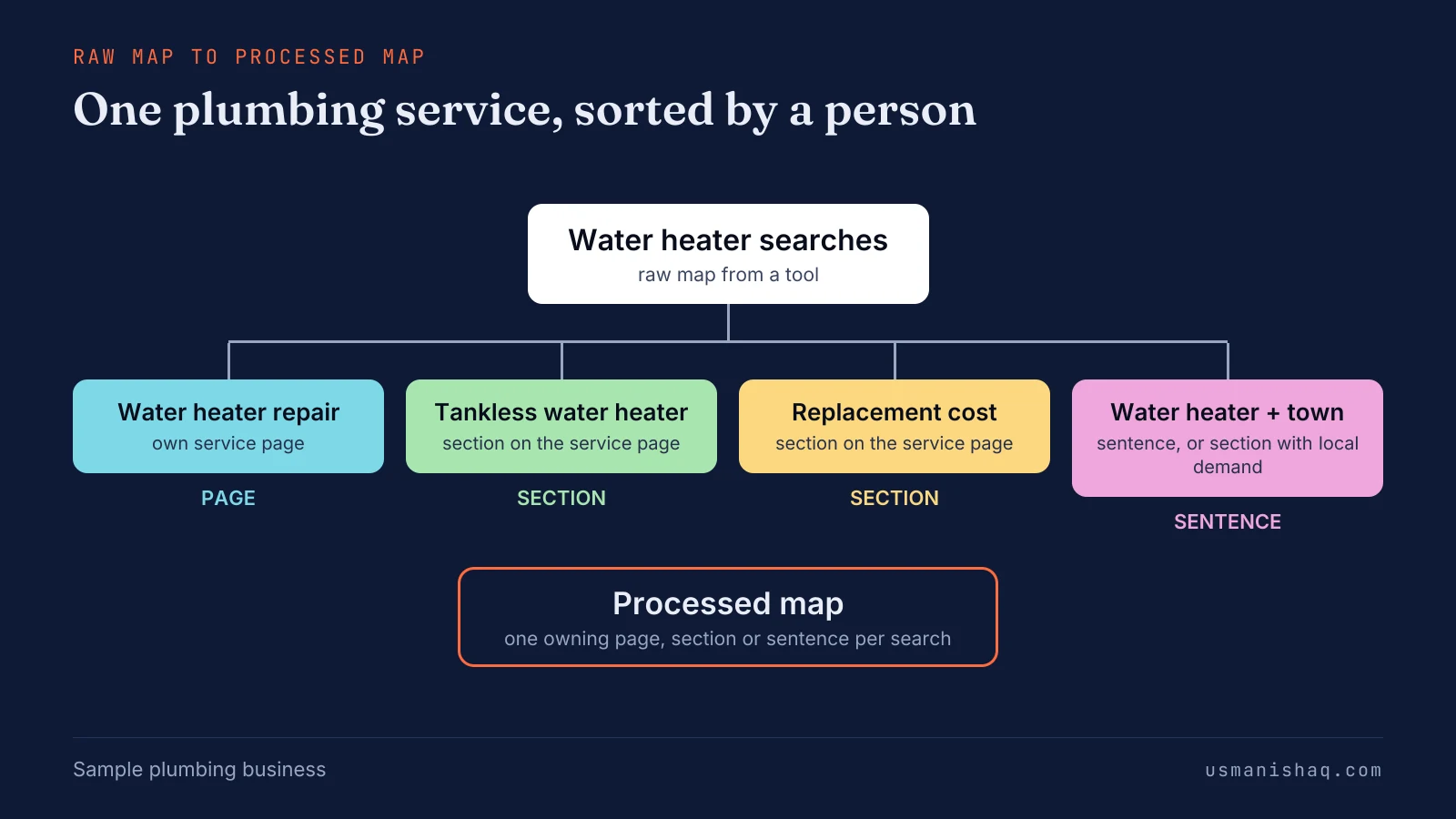
The figure keeps water heater repair on its own service page. Tankless water heater and replacement cost become sections on that page. Each town variant gets a sentence, or a section where the town has its own local demand.
What kinds of SEO tools use semantic relationship graphs to improve topic coverage?
Five kinds of SEO tools use semantic relationship graphs to improve topic coverage: entity extraction APIs, content optimizers, topical map generators, content graph and internal link tools, and schema and knowledge graph tools.
A sixth kind, the AI visibility tracker, measures AI answers and maps no relationships.
Google Search Console recorded 562 impressions of my site for this exact question in the three months to 17 November 2026. The average position was 7.4, and not one impression became a click.
Query fan-out is the step where an AI system splits a long question into smaller searches. The question above reads like one of those smaller searches.
Each kind of semantic SEO tool returns its own output and leaves one decision to a person.
| Kind | What it returns | Example (vendor's own page, read 19 November 2026) | What it leaves to a person |
|---|---|---|---|
| Entity extraction and NLP API | Entities with a type, a relevance score and their mentions | Google Cloud Natural Language API | Which entity the page is about |
| Content optimizer | Entities and terms ranking pages use and the page lacks, with a coverage score | SEOmatic's Semantic SEO Analyzer | Which missing term belongs on this page |
| Topical map and topic cluster generator | A two-level topic cluster from one seed keyword | Cuik's topic cluster tool | Which cluster earns a page, a section or a sentence |
| Content graph and internal link tool, or semantic network generator | Topical clusters, the gaps between them and link suggestions | InfraNodus; InLinks | Which page is the target, with which anchor |
| Schema and knowledge graph tool | Structured data and a knowledge graph of the site | WordLift; InLinks schema | Which facts are true and shown on the page |
| AI visibility tracker | Share of voice in Google results, AI Overviews, ChatGPT and Perplexity | SERPrecon | Which page or listing to change |
The order follows a project from one text to the whole site, and no product is ranked or linked.
SEOmatic defines its coverage score as "the share of the competitor-common entities and terms your page already covers".
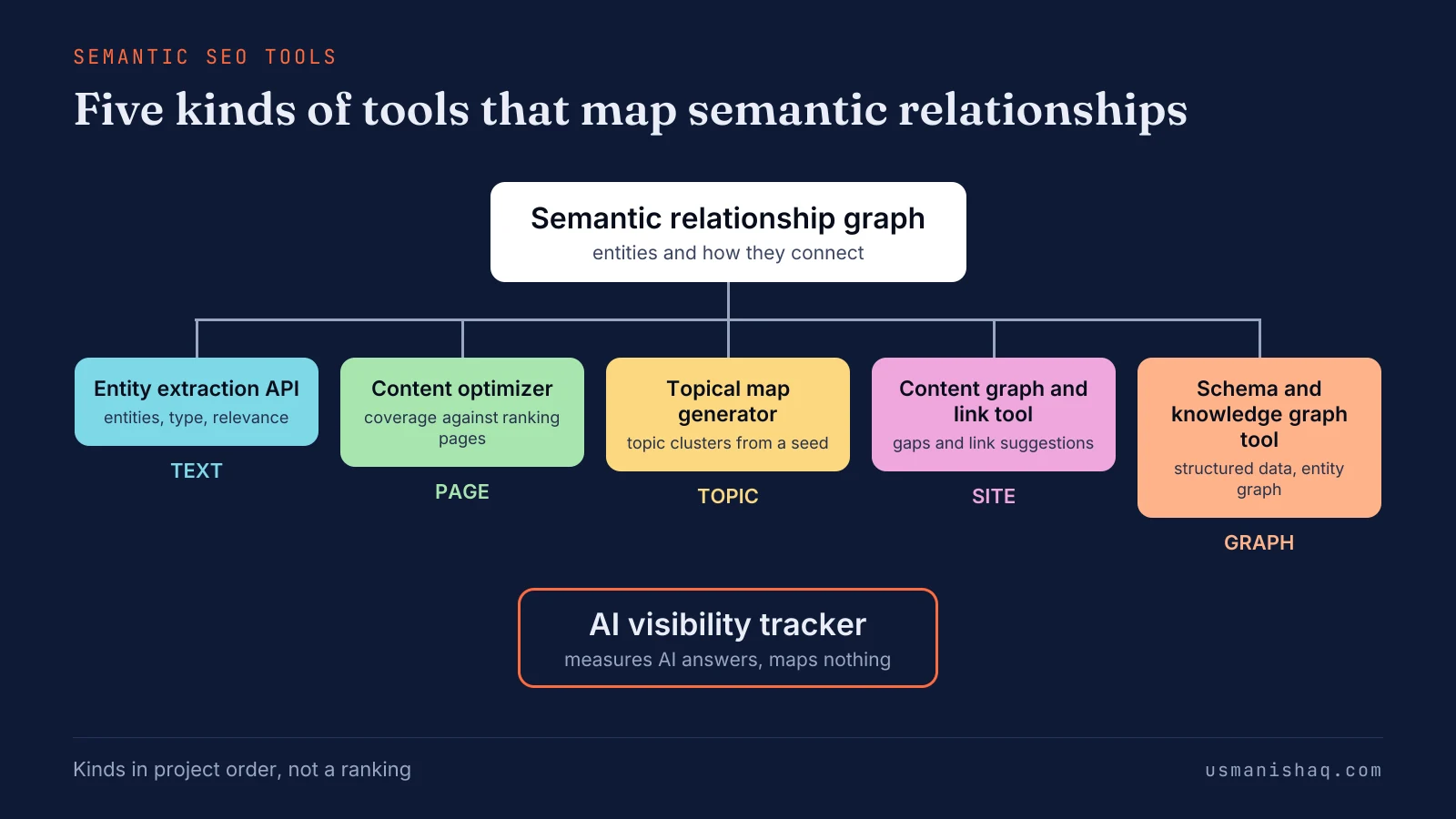
The diagram sets the five kinds around one semantic relationship graph and places the AI visibility tracker apart, because it maps nothing.
Does a semantic SEO tool read a page the way Google does?
No, a semantic SEO tool compares a page with pages already ranking, and no vendor page read here shows Google's ranking.
A higher content score is no sign that a page will rank, because the score does not see authority. SERPrecon's own page says an authority gap is one where "No rewrite fixes this".
SEOmatic states that its score is entity coverage, "not vector or embedding similarity", while SERPrecon claims to score "the way engines score". Keyword density metrics and semantic relevance scores, in either form, still measure a page against current results.
Which decisions does a semantic SEO tool leave to a person?
A semantic SEO tool leaves five decisions to a person: processing the raw map, source type, page framing, merges and core updates.
The three sections after the list take source type, page framing and core updates in turn.
The five decisions a semantic SEO tool leaves to a person are given below.
- Processing the raw map: the tool lists every topic it finds. The person gives each topic an owning page, a section or a sentence.
- Source type: the tool scores the words on ranking pages. The person reads which kind of site ranks, such as a vendor page, a forum thread, a guide or a consultant's page.
- Page framing and H1 context: the tool flags missing terms. The person decides which question the page answers and what its H1 promises.
- Cannibalization and consolidation: the tool flags two pages that compete for the same terms. The person decides which page keeps the search and what merges into it.
- Core update review: the tool re-scores the page against the new ranking pages. The person compares which pages and source types gained or lost.
Semantic SEO automation runs the tool side more often and leaves these five decisions where they were.
More entities do not settle any of the five. InLinks's home page tells users "We can help you flood your niche with relevant entities!" Koray Tuğberk Gübür sees entity stuffing as the failure that has replaced keyword stuffing.
Semantic SEO Architecture is the planning work that writes these decisions down before a page is built. The five decisions, recorded for one business, are what a Semantic SEO Architecture page plan contains.
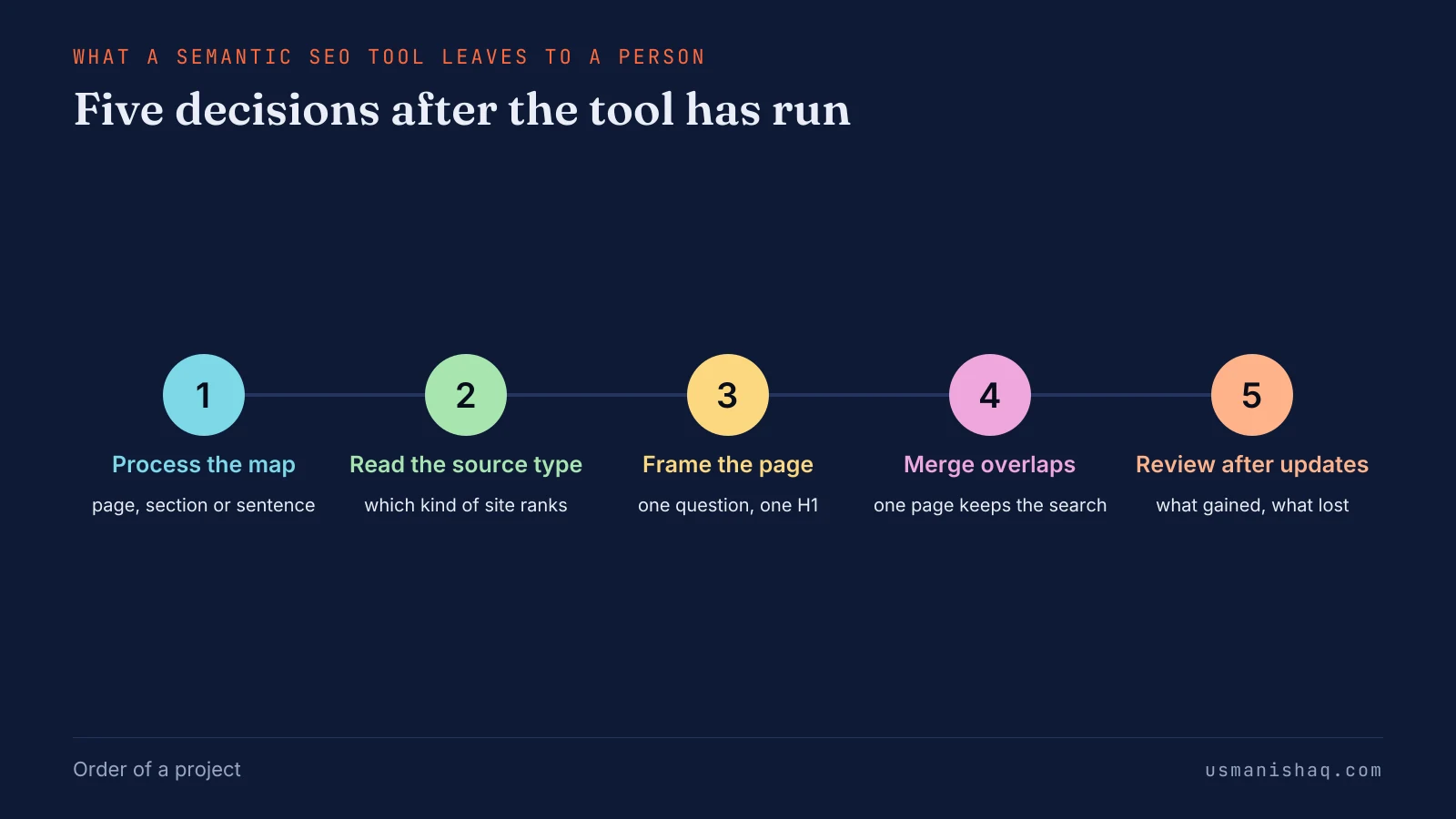
The steps run from processing the map, through source type, page framing and merging overlaps, to the review after updates.
Source type comes first among the three decisions below.
Which source type does a search reward?
A search rewards the source type its results page already shows, such as vendor pages, forum threads or consultant guides.
Source context is the kind of business a site is, and it decides which pages that site can rank. Koray Tuğberk Gübür's topical map matrix holds that several source types can rank for one query network. The winning type changes between updates, in his observation.
The results for "semantic seo tools" in the United States on 19 November 2026 showed five vendor product pages. Two agency roundups, one forum thread and one SaaS guide filled the rest. No consultant page appeared.
A consultant's site does not belong in that set as a tool list. The page you are reading is a semantic SEO decision page for that reason.
How does page framing change what a semantic SEO tool reports?
Page framing decides which question a page answers, and a semantic SEO tool scores the words without choosing the question.
Take a plumbing company with a "water heater repair" page and a "water heater replacement cost" page. A tool returns near-identical term lists for both.
The person decides that one page answers "fix it today" and the other answers "what will it cost". The H1 of each page says so in plain words, and the search intent of each page stays separate.
SERPrecon calls this problem wrong framing, an intent mismatch. The vendor's wording is plain: "Your page answers a different question than the one the results are ranking for."
What changes in a semantic SEO plan after a core update?
A core update can change which pages and source types win a search, and a person then re-reads the results.
Koray Tuğberk Gübür observes that core updates move topical borders. The tool re-scores the page against the new ranking pages. The person decides if the page, the headings, the links or the map itself changes.
Topical authority, in his reading, grows from coverage and time together. A semantic SEO cluster is judged after it has history, not one month after an update.
Should you buy a semantic SEO tool or hire a semantic SEO consultant?
A semantic SEO tool fits measuring existing pages, and a semantic SEO consultant fits deciding which pages should exist.
The sections below cover a tool alone, a consultant as well as a tool, and a consultant's own tools.
Four questions decide between a semantic SEO tool and a semantic SEO consultant.
- Page set: existing pages in the right order point to a tool, and a missing page set points to a consultant.
- Reading the results: staff who read results by source type point to a tool, and nobody who does points to a consultant.
- Competing pages: two pages that compete for the same searches point to a consultant, because a merge is a decision.
- Core update: a stable site points to a tool, and a site that a core update moved points to a consultant.
A subscription to a semantic SEO platform answers none of the four by itself.
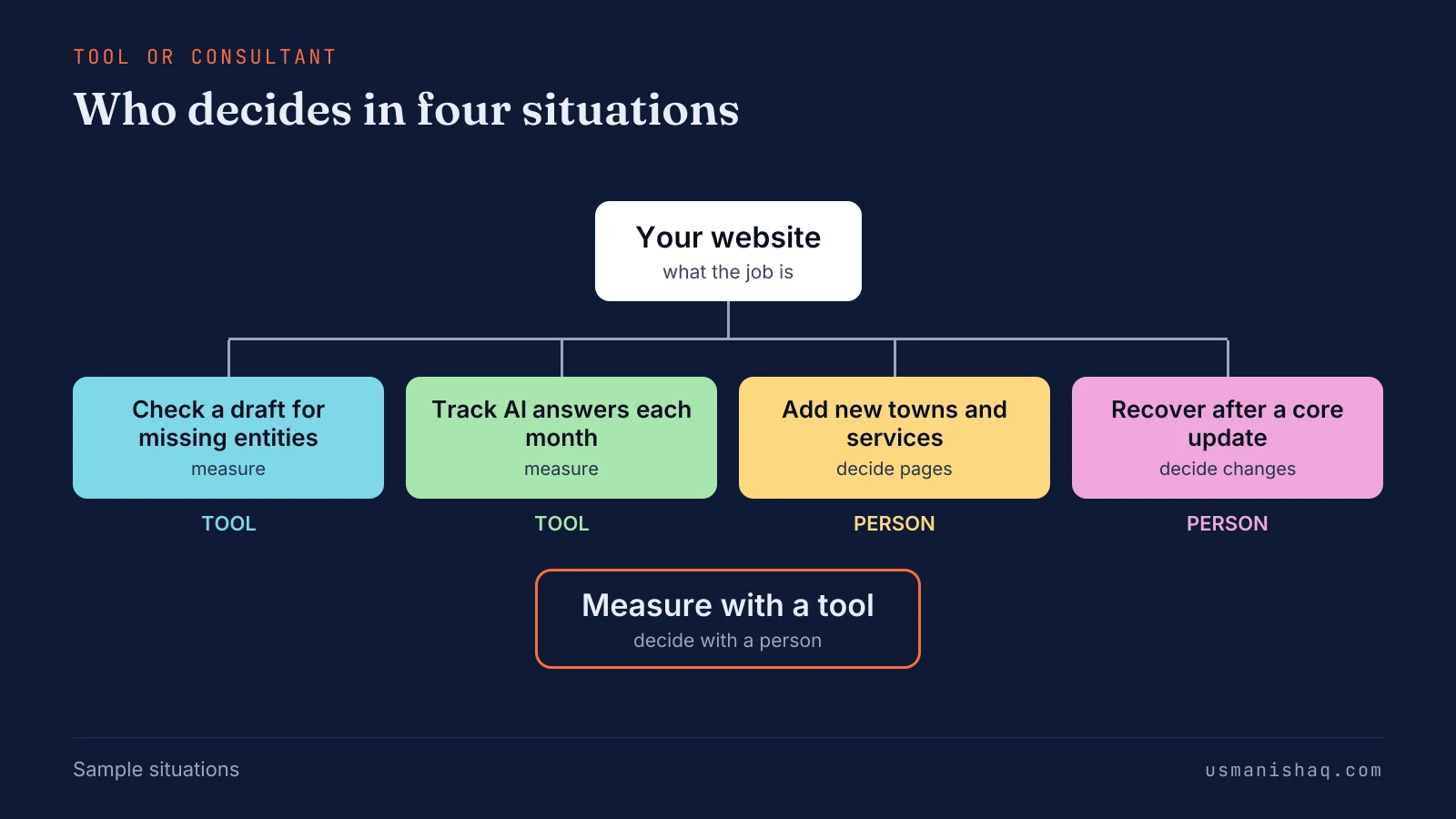
Checking a draft for missing entities and tracking AI answers each month point to a tool. Adding new towns and services and recovering after a core update point to a consultant. The figure's banner reads "measure with a tool, decide with a person", and the next two sections test each side.
When is a semantic SEO tool enough on its own?
A semantic SEO tool is enough on its own when each search has one owning page and an in-house editor maintains them.
Picture a marketing lead whose editor runs each draft through a content optimizer before it goes live. The tool flags missing entities, and the editor adds the ones that fit the page.
One Reddit reply puts the speed plainly: "You could spend 5 minutes to do a report with any of the seo tools." The report is fast. The reading is the work.
The setup holds while the page set stays fixed. The setup breaks once the business adds a town or a service.
When does a business need a semantic SEO consultant as well as a tool?
A business needs a semantic SEO consultant as well as a tool when nobody can turn tool output into page decisions.
Four situations point to a semantic SEO consultant as well as a tool.
- New towns or services are planned, and nobody has decided which ones earn a page.
- A content score rose while calls stayed flat.
- Two pages compete for the same search.
- Traffic dropped after a core update.
One Reddit reply says "audit reports produced by SEO software are pretty much useless without" an expert reading them. The consultant reads the report, and the tool still writes it.
Does a semantic SEO consultant use semantic SEO tools?
Yes, a semantic SEO consultant uses tools to collect the raw map, and the consultant's work is the decisions taken from it.
The business keeps the decisions when a subscription ends, because the topical map and page briefs hold them. The tool's reports stay in the tool's account.
I read Search Console and the live results page for each search before a page decision. No named product decides that for me.
What should you read after choosing between a semantic SEO tool and a consultant?
A semantic SEO tool or consultant choice raises five next questions: topical maps, consultants, link plans, overlaps and AI answers.
Each question below has its own page on this site. Each answer keeps the same split between what software returns and what a person decides.
How does a topical map for a business website record the processed map?
A topical map for a business website records the processed map: one owning page, section or sentence per search.
Every entity and attribute on the map gets the same treatment, so the semantic SEO plan has no orphan topic. The raw map and the processed map are terms from the topical map method of Koray Tuğberk Gübür.
The steps are set out in how a person plans a topical map for a business website.
How do you compare semantic SEO consultants before hiring one?
Semantic SEO consultants are compared on method, proof, scope and who does the work, set side by side in writing.
The choice of a person leads straight to the choice of which person.
The comparison is fairest when each consultant shows a sample topical map or page brief. A business that has chosen a person then uses the criteria that compare semantic SEO consultants to pick one.
Can an internal link tool replace an internal linking plan?
No, an internal link tool suggests links from matching words, and the link plan decides the target, the anchor and the section.
The tool does not know which page is the target of a search, because that is a semantic SEO page decision. A link plan names the target page for every search, and the tool's suggestions are measured against that list.
The plan itself is covered under internal linking architecture for a business website.
Which page keeps a search when a tool flags two overlapping pages?
The page whose main topic matches the search keeps it, and the other page merges, links to it or changes its question.
Cannibalization is the name for two pages of one site competing for the same search. A semantic SEO tool flags the overlap, and the page decision stays with a person.
The test for which page keeps a search is in page decisions on which query earns a page.
What should an AI visibility tracker's results be checked against?
An AI visibility tracker's results should be checked against the pages and listings AI answers cite, since trackers change nothing.
The tracker row in the table above leads to that check. A competitor named for a service question points to an answer the site is missing. Semantic SEO work then changes the cited pages themselves.
A tracker's numbers mean more beside what an AI visibility audit should give an owner.
Questions about semantic SEO tools and consultants
A semantic SEO tool raises three more questions, about AI-built maps, free tools and guarantees.
Can ChatGPT or an AI tool build a topical map?
No, ChatGPT or an AI tool builds a list of topics, and the page decisions need the business's own facts.
A generated list is a raw map, and the processed map in semantic SEO needs a person who knows the business.
Are free semantic SEO tools accurate?
Yes, free semantic SEO tools return the same kind of entity gap as paid tools, and accuracy depends on the pages compared.
SEOmatic and Cuik both offer free semantic SEO tools on the pages read for this article.
Can a semantic SEO tool or consultant guarantee rankings or AI citations?
No, neither a semantic SEO tool nor a consultant can guarantee rankings or AI citations, since Google and AI systems decide them.
Google's guide "Do you need an SEO?" states that "No one can guarantee a #1 ranking on Google."
What decides between a semantic SEO tool and a consultant?
A semantic SEO tool or consultant is decided by the job: measuring pages, or deciding which pages exist.
The tool returns the raw map, and a person decides the processed map. A business first understands what the software maps, then builds semantic SEO into the website with the person who decides.