
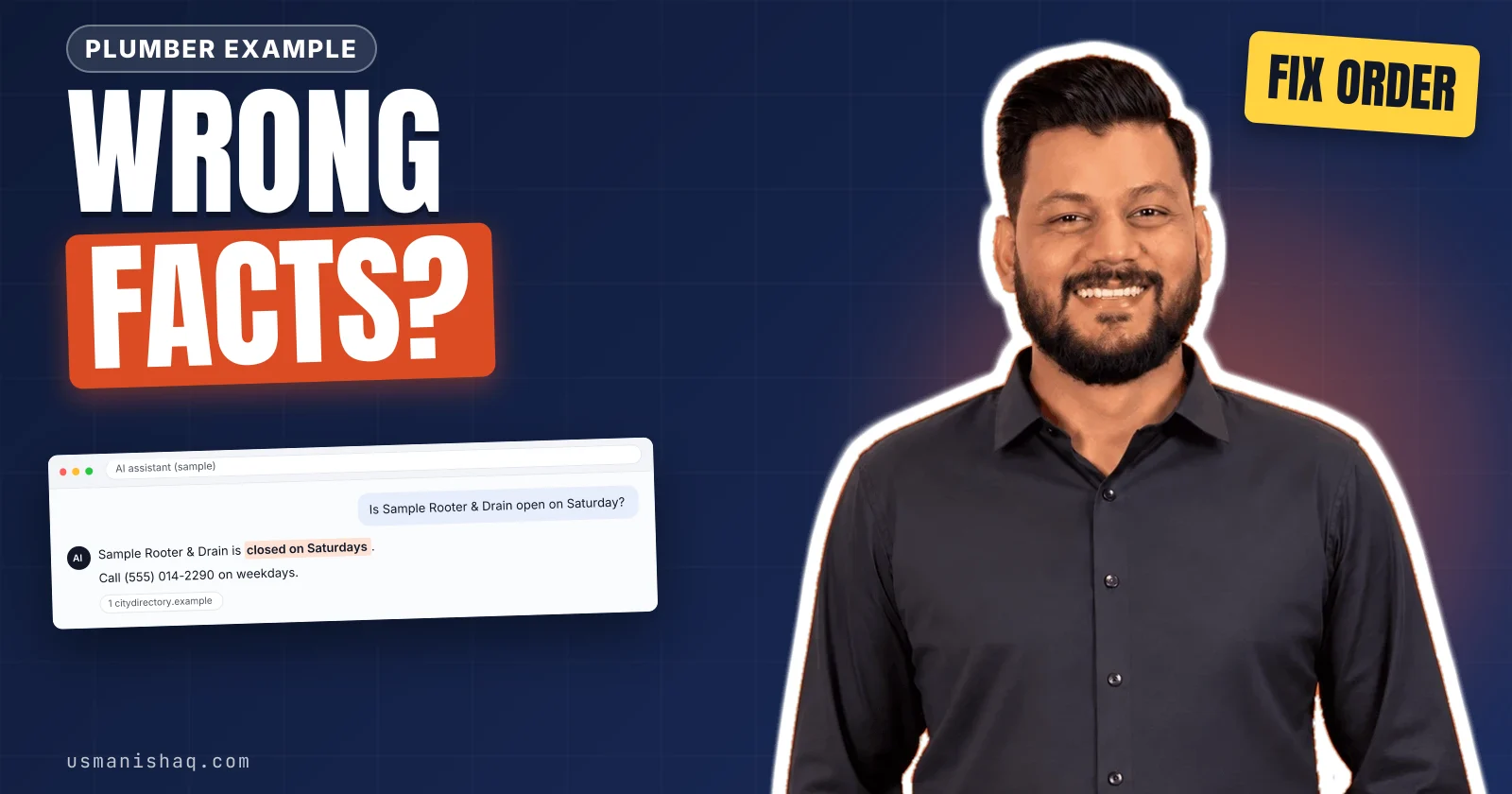
Wrong business information in an AI answer is a fact about your business that ChatGPT or Google states differently from the truth.
The fix starts at the source the assistant read, because no assistant offers an edit button for one fact.
Wrong hours, an old address or a dead phone number all trace back to a record somewhere. Your website gets fixed first, because every other record is checked against it.
Your Google Business Profile and ChatGPT's own business profile come next. Bing Places, Apple Business Connect and third-party directories follow, and a report on the wrong answer comes last. Semantic SEO treats the business as one entity with one set of facts on every record it controls.
Why does ChatGPT have wrong information about my business?
Wrong business information in a ChatGPT answer comes from a source the assistant read or from older training data.
A wrong fact is often a fact that was true once, or true for another business. Four causes put a wrong fact into an AI answer:
- An old fact on a source the assistant still reads, such as last year's hours on a directory page.
- Two sources that disagree, so the assistant picks one of the two values.
- A mix-up with a similarly named business in the same area or the same trade.
- Facts learned during model training, before the business moved or changed its number.
Searchable tested ChatGPT, Gemini and Perplexity with 13,365 questions about 165 London businesses. Searchable's single study, reported by CMOTech, found 93 percent of those businesses with at least one basic fact wrong or missing.
Owners usually hear about it from a customer who called a dead number or drove to the old address. Semantic SEO reads a wrong answer as a pointer to a record, and the record gets fixed.
Can an owner correct the AI answer itself?
No, an owner has no edit button for a single fact inside a ChatGPT, Gemini or AI Overview answer.
The correction happens in the sources the answer was built from.
Five records sit within reach: the website, Google Business Profile, ChatGPT's profile after a claim, Bing Places and Apple Business Connect.
Feedback buttons exist on ChatGPT and AI Overview answers. A feedback report flags the answer for review; the report does not rewrite the fact.
Which sources put wrong business facts into AI answers?
Wrong business information enters AI answers through the website, Google Business Profile, ChatGPT's profile, Bing Places, Apple Business Connect and directories.
Each one is a record of the same business. The platforms document only part of which assistant reads which record.
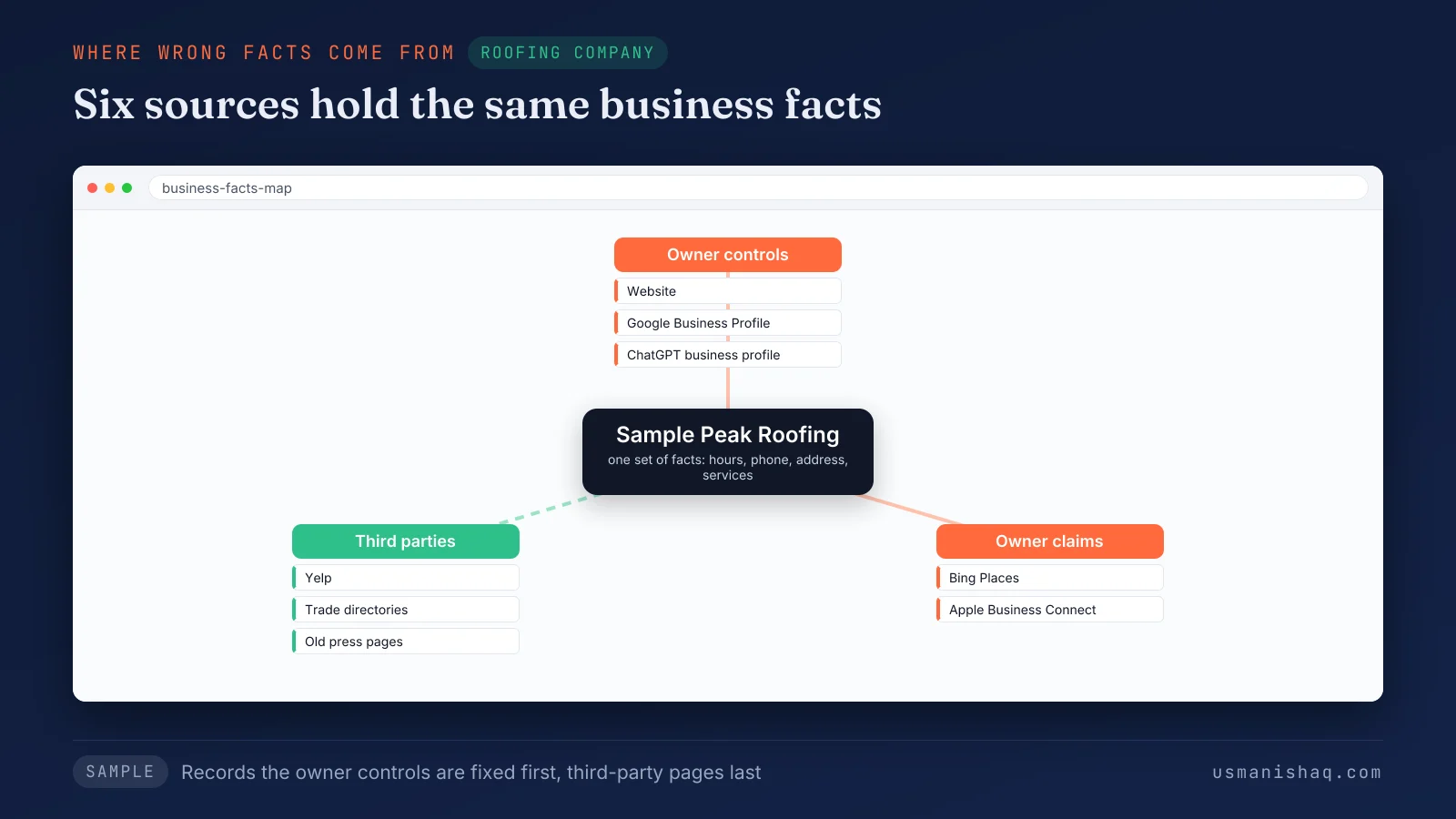
The diagram sorts the six for a sample roofing company. The website, the Google Business Profile and the ChatGPT profile are records the owner controls. Bing Places and Apple Business Connect are listings the owner claims, and Yelp, trade directories and old press pages are third-party pages.
Semantic SEO treats all six as records of one entity, so one wrong record can reach an answer. The six sources that can carry a wrong business fact are given below, from most owner control to least:
1. The business website
The business website is the one source the owner controls fully, and an old page on the website spreads an old fact.
Old contact pages, footers, PDF price sheets and old moving notices keep old facts alive. The website should state hours and phone number in plain text, not only inside an image.
Google's documentation on LocalBusiness structured data lists name, address, telephone and openingHoursSpecification among its properties. Semantic SEO makes the website the source of truth, the record every other listing is checked against.
2. Google Business Profile, Google updates and collected info
A Google Business Profile can change without the owner, because Google gathers facts from user reports, licensed content and automated calls.
Google's page "Understand Google updates on your Business Profile" says Google gathers info from "user reports and licensed content". Google may update the profile when sources report the profile's info as incorrect or outdated. The updates show on Maps, Search and other Google services, according to the same page.
Users can also suggest edits to a profile. The owner has 4 days to accept or reject a suggested edit after Google's notice. Google may publish an unanswered edit when other public information supports the change.
Collected info is a newer view that holds facts Google gathered by automated call, text or WhatsApp to the verified number. The view sits under Edit profile, then Collected info, and shows each item's source and date.
Google's "Edit your Business Profile" page says deleting an item removes the item from Google's records only. Other profile details stay unchanged.
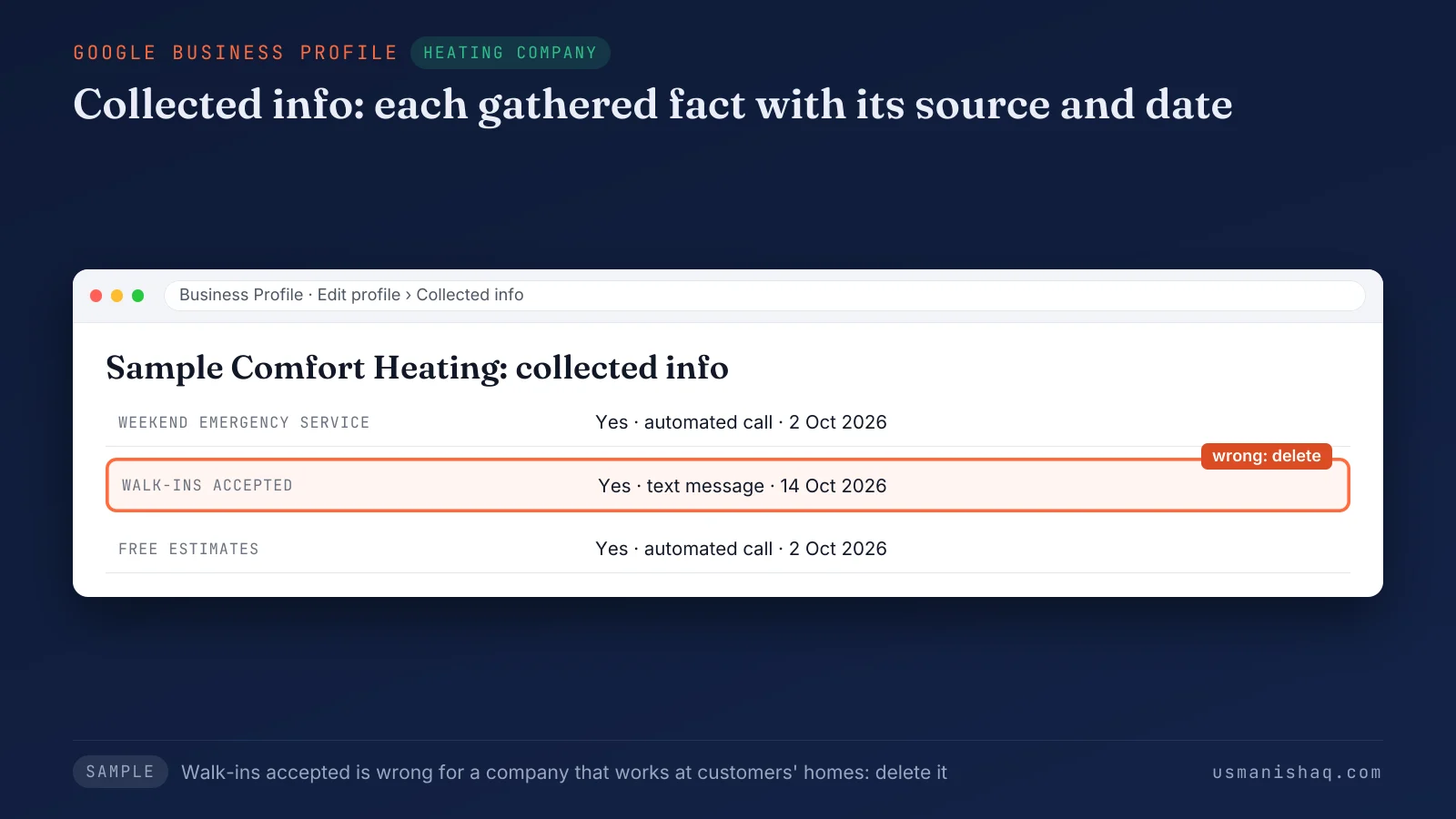
The heating company's sample screen lists three facts, each with a source and date: weekend emergency service, walk-ins accepted and free estimates. Walk-ins accepted is wrong for a company that only works at customers' homes.
The view is limited to select regions, languages and business categories. Semantic SEO keeps the website's facts equal to the profile, so public information supports the true value.
3. ChatGPT's business profile in Business Hub
ChatGPT holds its own business profile, built from public data, and a verified owner edits it in Business Hub.
OpenAI launched Businesses in ChatGPT in beta on 10 November 2026. I searched one business in Business Hub the next day. ChatGPT already held its name, category and street address, though nobody had submitted them.
A verified owner can change the website, description, category, logo, delivery and return policy and cover photo. OpenAI requires a Persona identity check before changes publish, and OpenAI reviews each change.
Local stores and restaurants can claim only an existing US listing for now. Owners elsewhere join a waitlist. OpenAI notes that ChatGPT may also use other sources besides the profile.
4. Bing Places
Bing Places for Business is Microsoft's listing tool, and Microsoft ties the tool to the business details shown in Bing Maps results.
Microsoft's support page does not say that Copilot or ChatGPT reads Bing Places directly, although vendor guides make that claim. A wrong Bing listing is still a wrong public record, and the owner corrects it in Bing Places.
5. Apple Business Connect
Apple Business Connect controls the place card Apple shows in Maps, Siri and other Apple apps.
Apple's guide asks that place-card hours match the hours on the official website whenever possible. The display name should match the name on the storefront or the website.
Temporary hours exist for holidays, maintenance and other short closures. Apple's guide pages now carry the name Apple Business.
6. Directories, review sites and old pages
Directories, review sites and old pages carry wrong facts the owner does not control, such as an old directory address.
Yelp, trade directories, old press articles and supplier pages all repeat business details. A page about a similarly named business can also end up cited for yours.
Each site has its own edit or claim process. Third parties are the slowest part of every fix.
How do you find which source holds the wrong fact?
Wrong business information traces back to its source through the answer's citations, a search for the wrong value, and your own records.
The steps to trace a wrong fact to its source are listed below:
- Save the question, the answer, the assistant's name and the date.
- Open the sources cited beside the wrong statement.
- Search the wrong value itself, such as the old phone number or the old street name.
- Compare the fact on your website, Google Business Profile, Business Hub profile, Bing Places and Apple Business Connect listing.
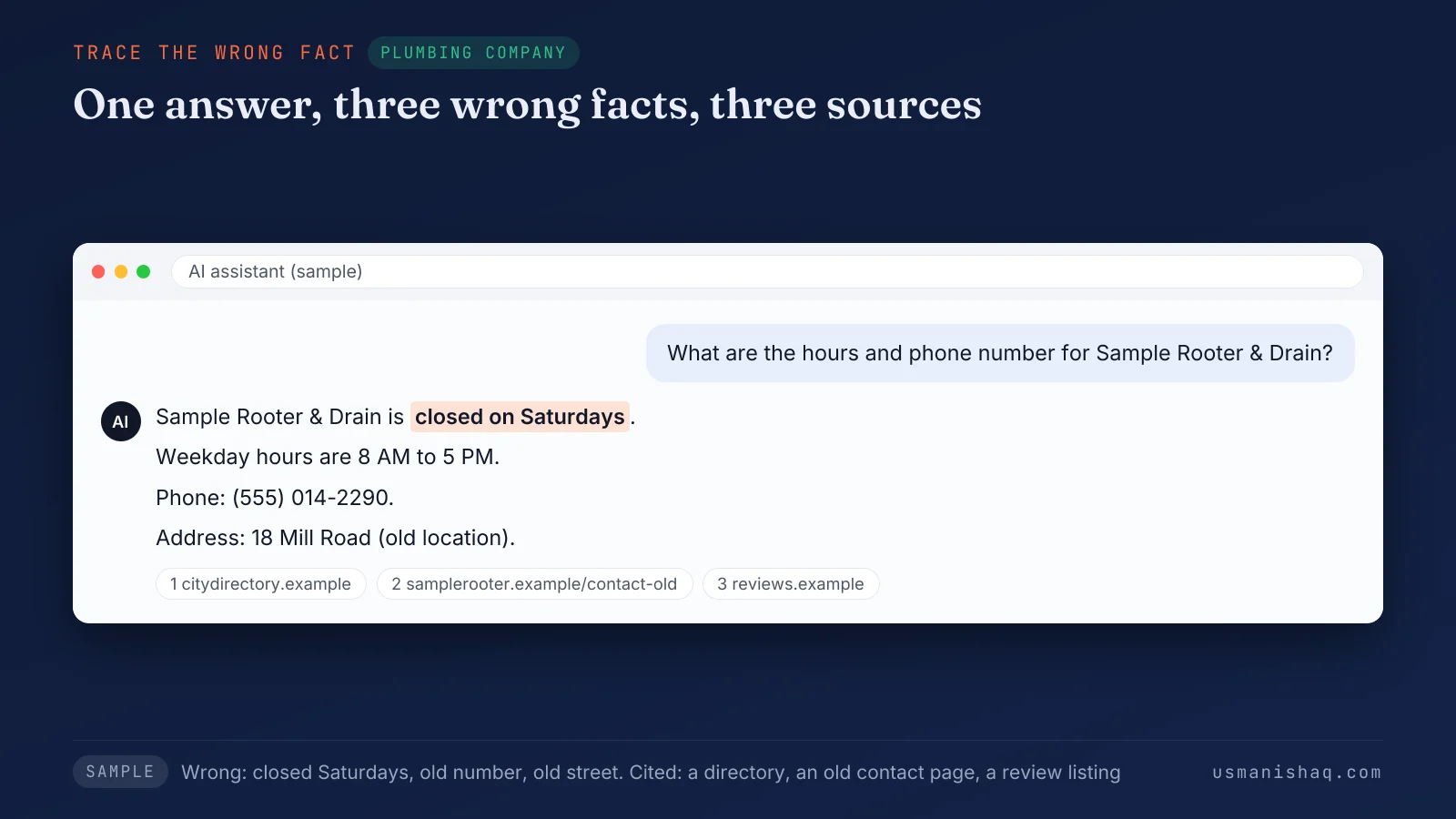
The sample answer gives a plumbing company three wrong facts: closed on Saturdays, an old phone number and an old street. The answer cites a city directory page, the company's old contact page and a review listing.
An answer with no citation points to training data or an uncited source, so every record that states the fact gets checked. Semantic SEO reads the result as a list of records to correct.
In what order should wrong business information be fixed?
Wrong business information should be fixed in seven steps, from settling the true facts to reporting the answer and rechecking it.
The order to fix wrong business information is listed below:
- Settle the true facts: name, address or service area, phone, hours, services and open status.
- Fix the website first, including the footer, contact page, PDFs and structured data.
- Fix the Google Business Profile, answer any suggested edit within its 4 days, and delete wrong collected info.
- Edit ChatGPT's business profile in Business Hub, where the business is able to claim the profile.
- Update Bing Places and Apple Business Connect with the same facts.
- Ask directories and review sites to correct the fact, starting with the pages the answer cited.
- Report the wrong answer with the assistant's feedback control, then ask the same question again later.
The website goes first because every other record is checked against the website. Google's AI Overviews carry a thumbs-down and a "Report a problem" option, and ChatGPT answers carry a thumbs-down too.
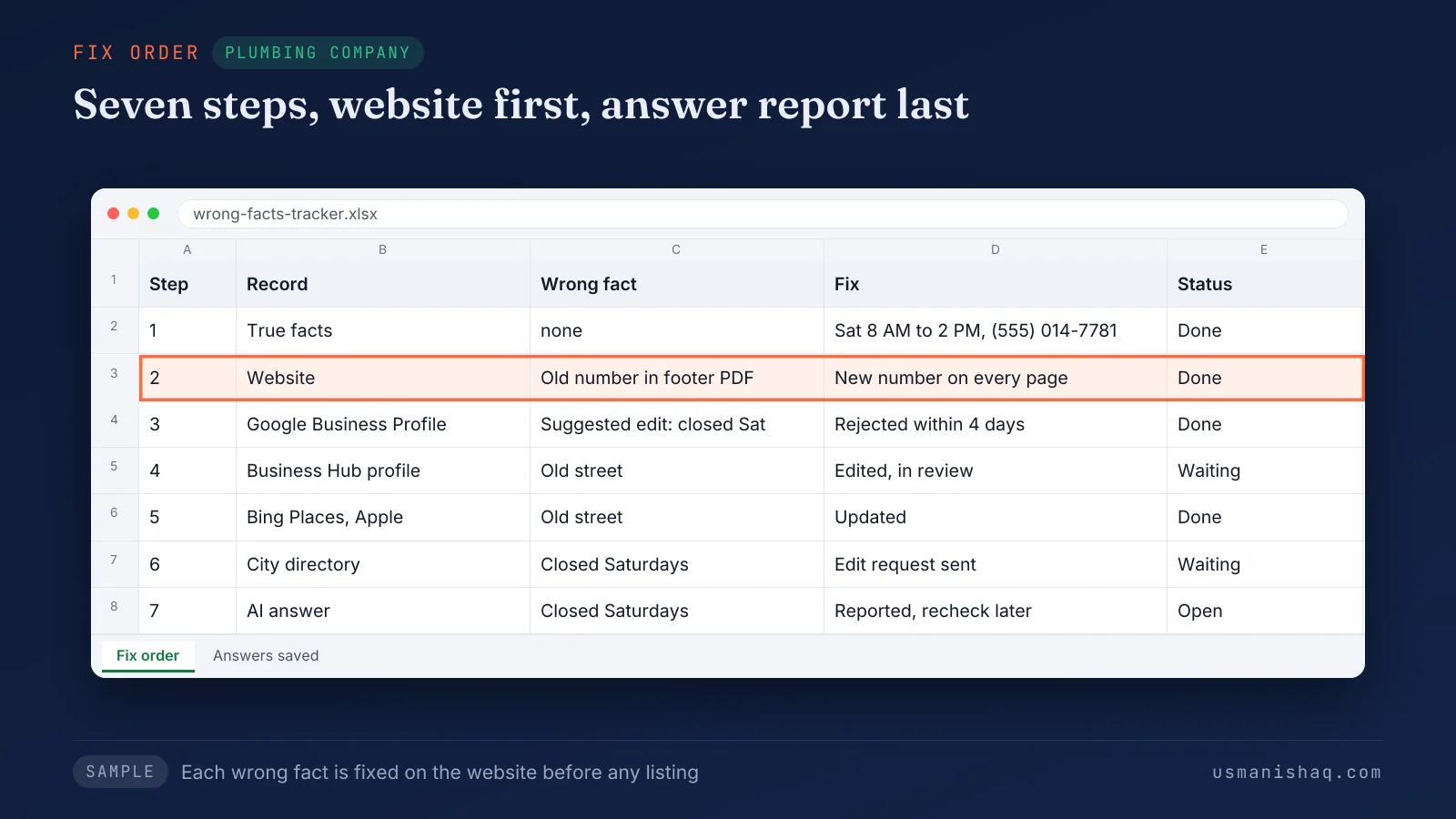
The sample plumbing tracker lists the seven steps in order, each with its record, wrong fact, fix and status.
Semantic SEO turns the list into one rule: change a fact on the website first, then everywhere else the same day. Keeping one set of facts on every record is the work of AI Search Visibility consulting.
How long until the AI answer changes?
No assistant publishes a time for a corrected source to reach its answers, so the owner rechecks the question after each fix.
Google gives the owner 4 days to answer a suggested edit, and OpenAI reviews Business Hub changes before they publish. Facts learned in training can stay in answers until a newer model replaces the old one.
What should an owner do when an AI answer says the business is closed?
An owner whose business an AI answer calls closed should check the Google Business Profile status first, then every other listing.
A profile marked "permanently closed" or "temporarily closed" shows that status on Google's own surfaces. Users can suggest a closed status, and Google can apply a suggested edit when other public information supports it.
Inc., writing about Apple Maps errors, reported owners on Reddit complaining of a false "permanently closed" label. Apple Business Connect and Bing Places need the same check.
The website should show current hours in plain text. A real holiday closure belongs in special or temporary hours, not in a closed status. One closed label is one inconsistent fact, and consistency is where semantic SEO starts.
How does semantic SEO keep business facts consistent across AI answers?
Semantic SEO keeps business facts consistent by treating the business as one entity with one set of facts on every record.
An entity is a distinct thing a search engine identifies, such as one business with its name, place and services. The website states the facts once, in plain text and in structured data. Every profile and listing is then edited to match the website.
Google's page Understand Google updates on your Business Profile explains how outside reports can change a profile. Wrong business information has fewer places to come from when every record the owner controls agrees.
How is a wrong AI answer different from a profile and website mismatch?
A profile and website mismatch is two owned records disagreeing, while a wrong AI answer can come from any record at all.
A mismatch is one common cause of a wrong answer, not the only one. Seven details have to match between a Google Business Profile and a website: name, category, services, area, phone, hours and website link.
The field-by-field rule sits in the guide to what has to match between a Google Business Profile and a website. Semantic SEO fixes the mismatch first, because the mismatch is the part the owner controls.
Does claiming the business in ChatGPT fix a wrong answer?
No, claiming the business in ChatGPT does not fix a wrong answer by itself, because ChatGPT may also use other sources.
A claim lets a verified owner edit the profile's details and see mentions and website clicks. OpenAI's help article Setting up your business on ChatGPT says claiming does not give "direct control over ChatGPT's independent recommendations."
The verification steps are in the guide on how to claim your business in ChatGPT. Semantic SEO treats the claimed profile as one more record that must match the website.
Questions owners ask about wrong AI answers
Wrong business information raises two more owner questions: why answers vary by day, and why answers list services the business never offered.
Why is the AI answer right one day and wrong the next?
AI answers vary between runs because an assistant can search different sources each time and rewrite the question first.
Owners on OpenAI's community forum report that naming the business's web address in the question reduces mix-ups with similar names.
Why does an AI answer list a service the business does not offer?
An AI answer lists a service the business never offered when a source describes a lookalike business or a broad category.
Semantic SEO gives every real service its own page and keeps profile categories to the work the business does.
What keeps AI answers right after the fix?
Wrong business information stays fixed when every change goes to the website first and to every listing on the same day.
New hours, a new number, a move or a dropped service each count as a change. The owner then asks the same question again and compares the AI answer with the website.
Semantic SEO keeps one set of facts on every record, so an AI answer has only true facts to repeat.