
A passage gets cited in Google AI Overviews when its page can show a snippet and the passage answers on its own.
Passage independence is the name for that second condition. An independent passage names its subject, answers one question and needs no other sentence on the page.
The first sentence under each heading of a service page carries the answer. Each passage is checked by reading the passage alone, searching its question and reading Search Console. Semantic SEO plans which questions a page answers, and the passage answers each one in place.
What does it take to get cited in Google AI Overviews?
A passage gets cited in Google AI Overviews when its page can show a snippet and the passage answers without its neighbours.
Google's requirements come first. One question about llms.txt files follows them.
The first condition belongs to Google. Google Search Central's page "AI features and your website" sets the eligibility rule for AI Overviews and AI Mode alike.
The second condition belongs to whoever writes the page. A passage that leans on the paragraph above it makes a weak supporting link. The reader of the answer never sees that paragraph.
Owners usually call the result "showing up in the Google AI answer", and marketers say ranking in AI Overviews. Both name the same goal. Google notes that AI Overviews and AI Mode may use different models, so the links they show can differ.
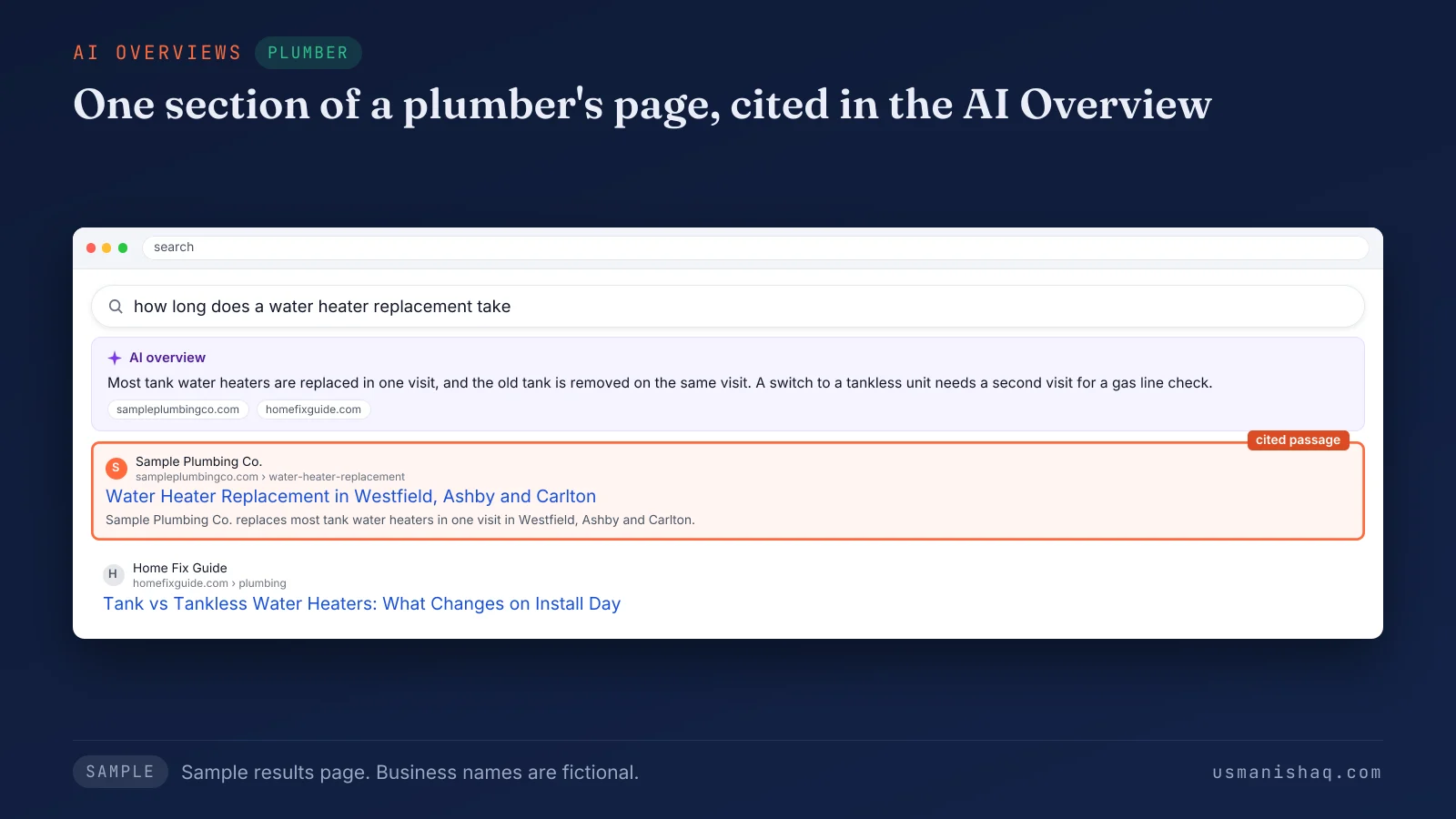
The sample AI Overview for a water heater question cites one section of Sample Plumbing Co.'s service page. The cited section is the one whose first sentence answers the question.
The eligibility half is a short checklist taken from Google's own documents.
What does Google require before a page can be cited?
Google requires a page to be indexed and eligible to show with a snippet, with no other technical requirement.
The checks that follow from Google's two documents are listed below:
- Indexed: the page appears in Google Search, and Search Console's URL Inspection confirms the index status.
- Snippet allowed: no nosnippet, data-nosnippet, restrictive max-snippet or noindex setting sits on a page meant to be cited. Developers often add these for other reasons.
- Crawl allowed: robots.txt, the CDN and the hosting layer all let Googlebot fetch the page.
- AI features switched on: Google's optimization guide says the site must be included in Search generative AI features in Search Console.
- Answers in text: the important content sits in text, not only inside an image or a video.
Google adds that meeting every requirement still leaves crawling, indexing and serving to its own systems. A page can pass all five checks and stay uncited.
Does a page need an llms.txt file to be cited?
No, a page does not need an llms.txt file, because Google says Google Search ignores such files.
Google asks for no special markup either. Google's documents name no AI text file and no special schema.org type for AI features.
What is passage independence?
Passage independence is the quality of a passage that names its subject, answers one question and needs no sentence outside itself.
A passage on a service page is a heading plus the one to three short paragraphs under it. Two readers meet that passage alone.
One reader is a homeowner who lands on the water heater section straight from a search. The other is a system that lifts the passage into an answer.
The three signs of a dependent passage are listed below:
- The subject is a pronoun such as "we", "it" or "this".
- The text points elsewhere, with phrases such as "as mentioned above".
- The answer arrives late, after a greeting or a story.
Passage independence sits on the writing side of AI search visibility and semantic SEO. A topical map decides which questions a page answers. The passage answers each one where it stands.
Owners often hear the rule described as chunking, which is a different idea.
Is passage independence the same as chunking?
No, passage independence is not chunking, because chunking cuts a page into small blocks while independence keeps normal sections.
Google's optimization guide says pages need no chunking and no special writing style for generative AI search. The passage rules here are reader rules first. A person who arrives mid-page reads a section the same way a system lifts one.
How do you write an independent passage on a service page?
An independent passage on a service page answers its heading in the first sentence and names the service, business and place.
The five rewrite steps for a service page passage are listed below:
- Answer the heading in the first sentence. A passage fails this step when a greeting, a story or "Great question" comes first. Move the answer up and cut the warm-up.
- Name the service, the business and the place. A passage fails when its first sentence starts with "we", "it" or "this". Write "Sample Plumbing Co. replaces water heaters in Westfield" rather than "We do it all".
- Keep one claim in each sentence. A passage fails when price, area and warranty share one sentence joined by "and". Split the sentence so each fact stands alone.
- Remove pointers to other parts of the page. A passage fails when the text says "as mentioned above", "see below" or "our process". Repeat the fact the pointer stands for, in one short sentence.
- Keep the condition beside the answer. A passage fails when the exception sits two sections away. Add the exception after the answer, inside the same passage.
Pages written to be read from top to bottom tend to fail steps 2 and 4. Each section leans on the one before it, and nobody notices until a section is read alone.
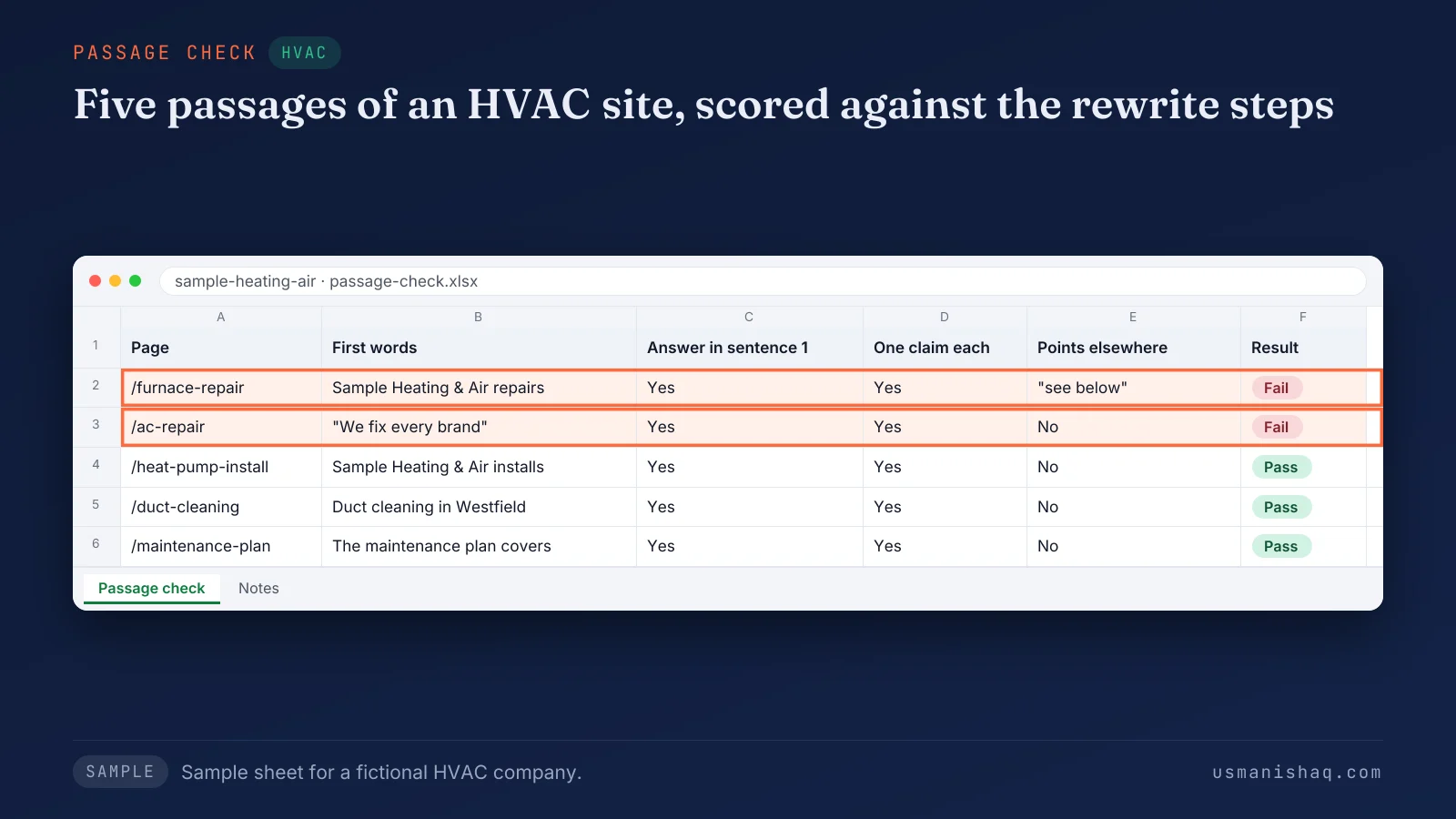
The sample sheet scores five passages of Sample Heating & Air against these checks. Three passages pass every check. The AC repair passage opens with "We", and the furnace passage sends readers to "see below".
Passage independence is the first check an AI Search Visibility project runs on each page.
A worked rewrite shows the five steps on one water heater section.
What does a rewritten service page passage look like?
A rewritten service page passage names the business, the service and the towns in its first sentence and answers the heading first.
The sample is the water heater section of Sample Plumbing Co., a fictional plumber. The section heading asks how long a water heater replacement takes.
| Sentence | Before | After |
|---|---|---|
| 1 | We've got you covered when your water heater gives out! | Sample Plumbing Co. replaces most tank water heaters in one visit in Westfield, Ashby and Carlton. |
| 2 | Our team handles it fast, and we'll haul the old one away too. | The visit includes removal of the old tank. |
| 3 | See our process below for more details. | A switch to a tankless unit needs a second visit for a gas line check. |
The rewrite changes four things. A named business replaces "we" as the subject. The answer to "how long" moves into sentence one.
Each sentence now holds one fact. The tankless exception stays inside the passage, and the pointer to "our process below" is gone.
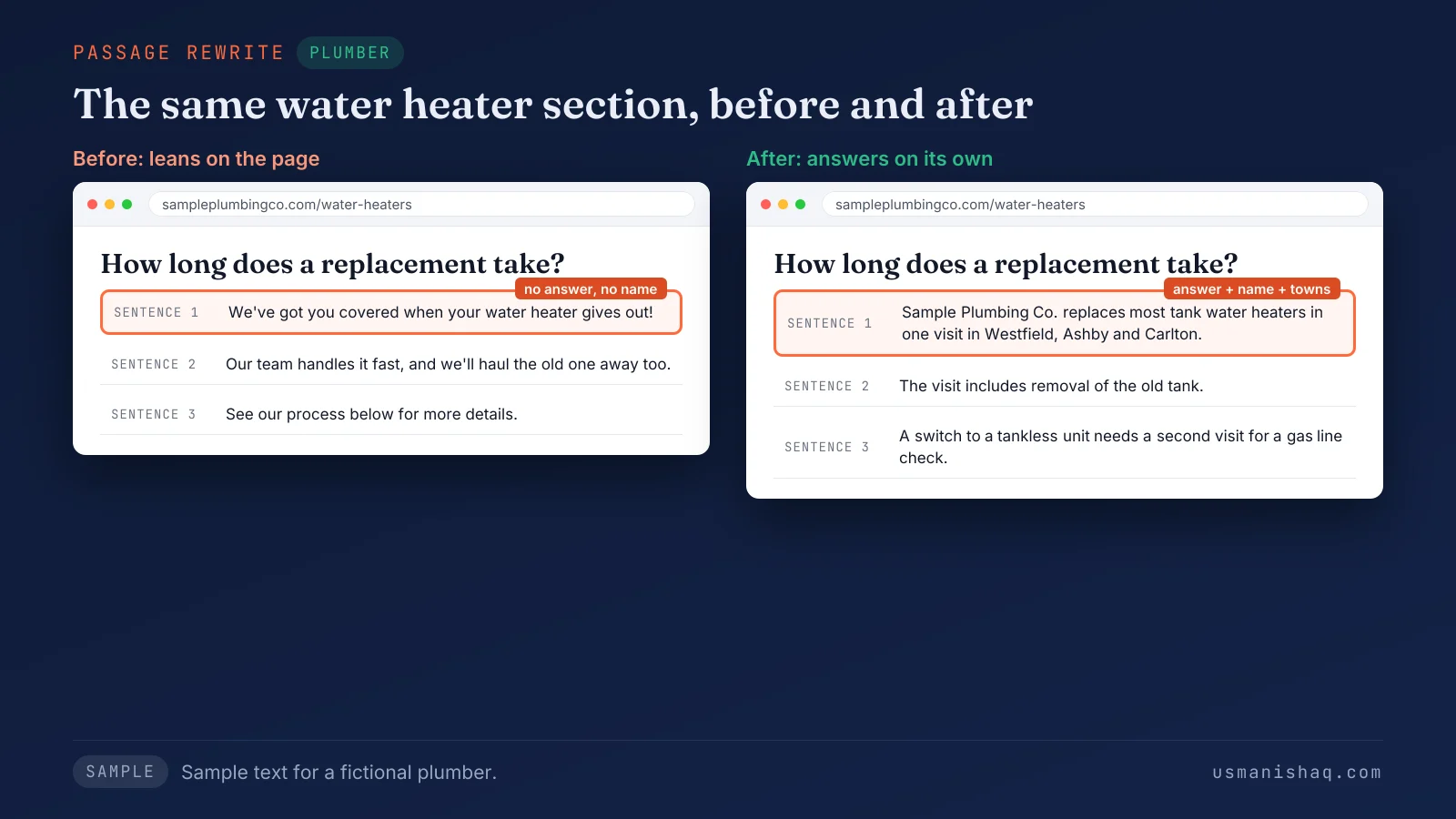
The figure shows the same section side by side. The after version names Sample Plumbing Co., water heater replacement and Westfield, Ashby and Carlton before anything else.
The same rewrite pays off most on a few page types.
Which pages of a service business site need this first?
Service pages need passage independence first, then the FAQ page, the town pages and the page that states licences and service areas.
The order of the rewrite, page type by page type, is listed below:
- Service pages: each section answers one question a customer asks about one service.
- The FAQ page: each answer already stands alone, so the first sentence mostly needs the business and the service named.
- Town pages: each one names the town and the service together in its first sentence.
- The licence and service area page: licence numbers, towns served and hours are facts a customer checks before calling.
How do you check whether a passage is cited?
A passage is checked three ways: read alone, searched on its question, and tracked in Search Console's Generative AI performance report.
The three checks are listed below:
- Read the passage alone. Paste the passage into a blank document, and the first sentence must still answer the heading.
- Search the question. Search the question the heading asks, open the AI Overview or AI Mode, and note which page and section the answer links.
- Read the report. Google's optimization guide names the Generative AI performance report in Search Console. Google's AI features page adds that AI feature traffic also sits inside the Web search type of the Performance report.
Reading that report in full is a separate task from writing the passage.
What decides which passage Google's AI cites?
A passage is cited by Google's AI only from pages its core ranking systems already retrieve for the question.
Google's guide, Optimizing your website for generative AI features on Google Search, roots the features in core Search ranking and quality systems. The same guide names retrieval-augmented generation, also called grounding, as the step that pulls pages from the Search index.
A passage therefore competes only after its page is retrieved. Google's AI features and your website page holds the snippet rule for both AI Overviews and AI Mode.
Semantic SEO works on both halves: the page that gets retrieved and the passage that gets lifted. Three questions follow: query fan-out, schema markup and the evidence from one-task guides.
How does query fan-out change which passage is cited?
Query fan-out sends several related searches for one question, so a passage can be cited for a sub-question its page answers.
Google defines query fan-out as concurrent, related queries the model generates to fetch more results. A water heater question, as an illustration, can fan out to replacement cost, tank or tankless, and installation time.
Search Engine Journal reported that Gemini 4 Hydrogen became the default model in AI Mode on 12 November 2026. The same report says Google described a wider fan-out that links a broader range of sites.
Google also warns against making a page for every fan-out variation. Pages made to manipulate generative AI answers break its scaled content abuse policy.
Fan-out questions are easier to plan when the site already knows which questions a topical map for a business website covers.
Does schema markup get a passage cited?
No, schema markup does not get a passage cited, because Google says AI features need no special schema.
Schema markup names entities in code. The passage still has to name the same entities in its sentences: the business, the service and the town. Google asks that structured data match the visible text on the page.
Semantic content is the name for that habit in semantic SEO. Writing that names entities in each sentence is the subject of how semantic content organizes facts around entities.
What does a calling app case study show about one-task guides?
A calling app's service-number guides, each built to answer one task, drew about 43.2K AI citations over six months in Bing's report.
The figure comes from Bing Webmaster Tools AI Performance for the six months to 11 November 2026. The citations come from Microsoft Copilot and its partners, not from Google AI Overviews.
I make no causal claim from that number. The guides answer one question each, and the citations followed. The dates and limits sit in the calling app case study on AI citations to service guides.
A Shopify skincare store's FAQ answers followed the same first-sentence rule, with the product named instead of "it". That audit makes no AI citation claim, and the Shopify FAQ SEO case study says so plainly.
Questions about getting cited in Google AI Overviews
A passage rewrite leaves four common questions about Google AI Overviews, each answered in one sentence.
Does a page need to rank first to be cited?
No, a page does not need to rank first, because Google's rule names indexing and snippet eligibility, not a position.
Vendor studies disagree on how often cited pages also rank in the top ten, so no single figure settles the question.
Is there an ideal passage length for AI Overviews?
No, Google sets no ideal passage length, and its optimization guide says there is no ideal page length either.
Word targets in vendor guides come from their own samples, not from Google.
Does semantic SEO help a site get cited in AI Overviews?
Yes, semantic SEO helps, because semantic SEO plans each page around entities and the questions a fan-out can reach.
No method promises a citation. Google's systems still choose which passage to link.
Should a business turn off AI Overviews for its site?
No, a business should keep AI features on while the business rewrites pages, because an opted-out site gets no AI feature traffic.
Google said in June 2026 that sites which opt out receive no traffic or impressions from its generative AI features. The setting sits in Search Console.
Getting cited starts with one passage that answers alone
A passage that answers its heading alone, on a snippet-eligible page, is what Google AI Overviews and AI Mode can cite.
Passage independence turns each service page section into that kind of passage. Semantic SEO decides which questions those passages answer, one service page at a time.