
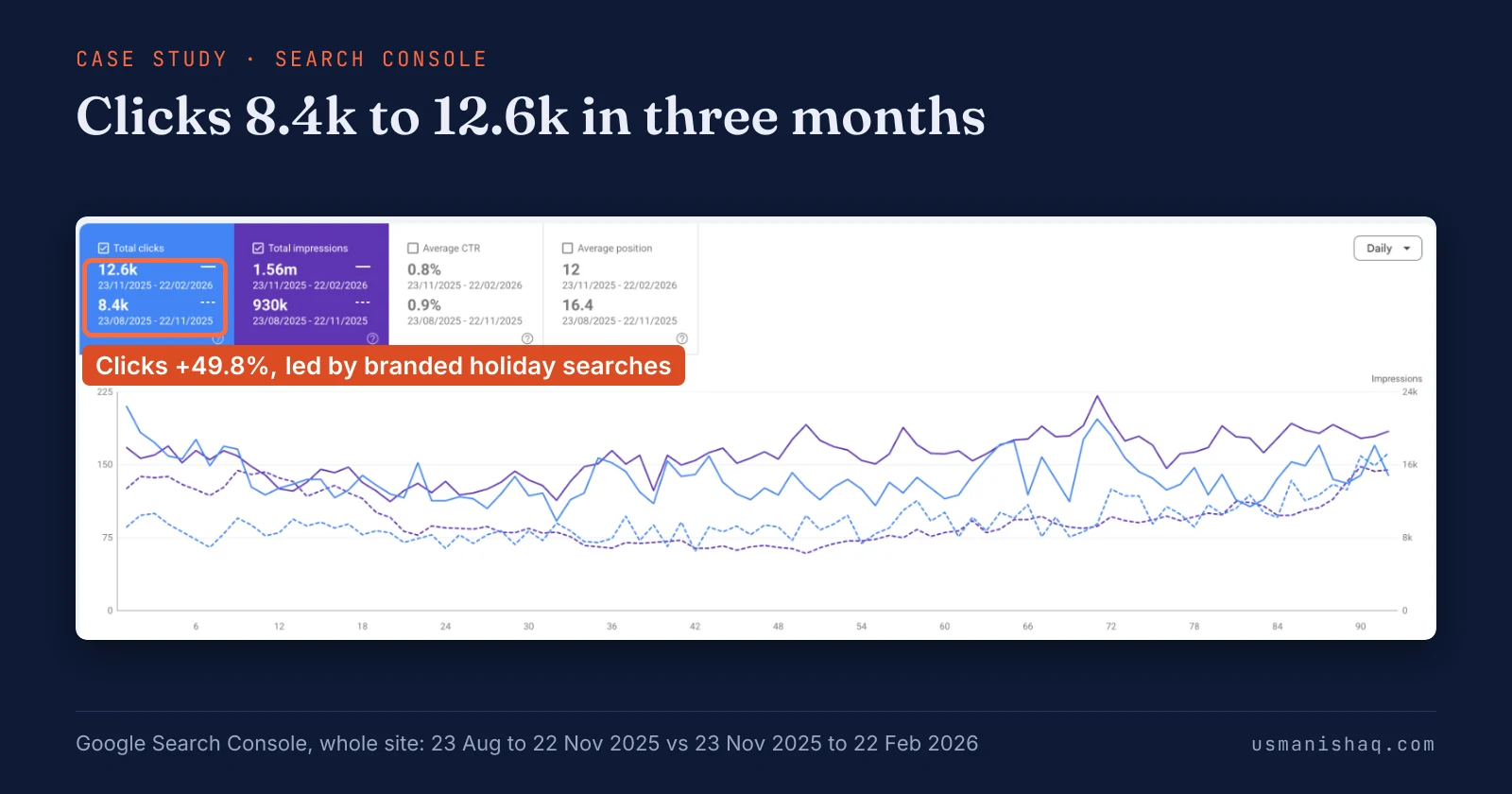
Here's a Shopify FAQ SEO case study from a North American store that sells at-home skincare devices: a two-month AI-ready FAQ audit, November 2025 to January 2026. Google Search Console clicks rose 49.8% in the three months from its start, led by branded holiday searches, so I don't count that rise as a result of the audit.
Results at a glance
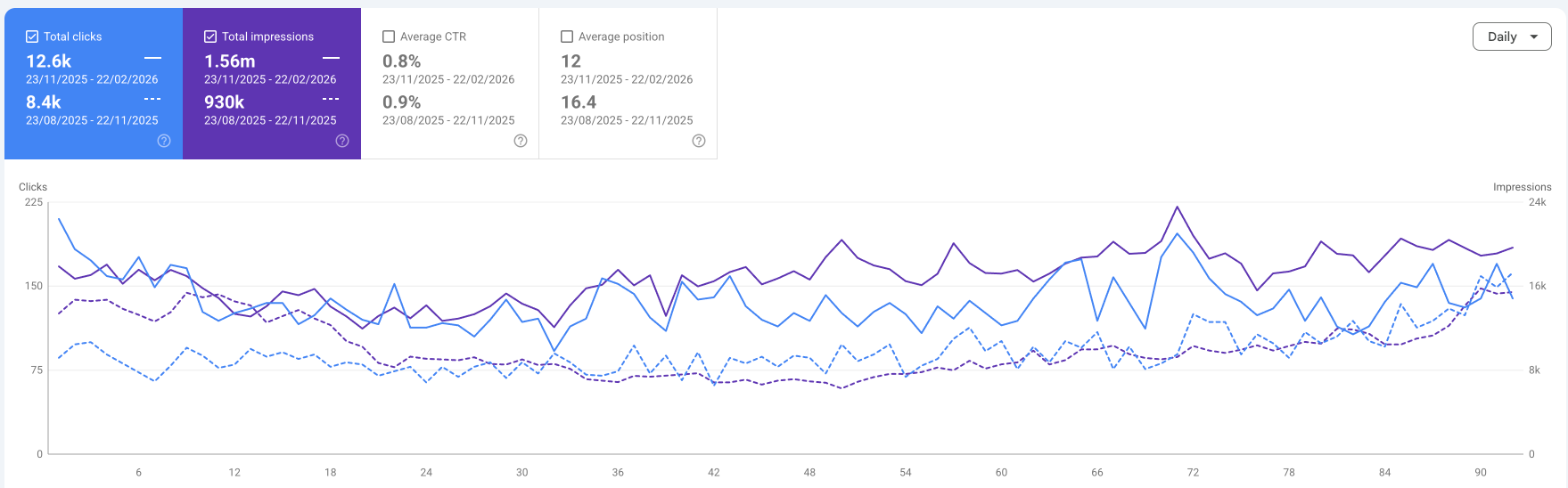
The store's Search Console clicks rose from 8,400 to 12,579 in the three months from the audit's start.
The whole-site values are below:
| Metric | Before | After | Change |
|---|---|---|---|
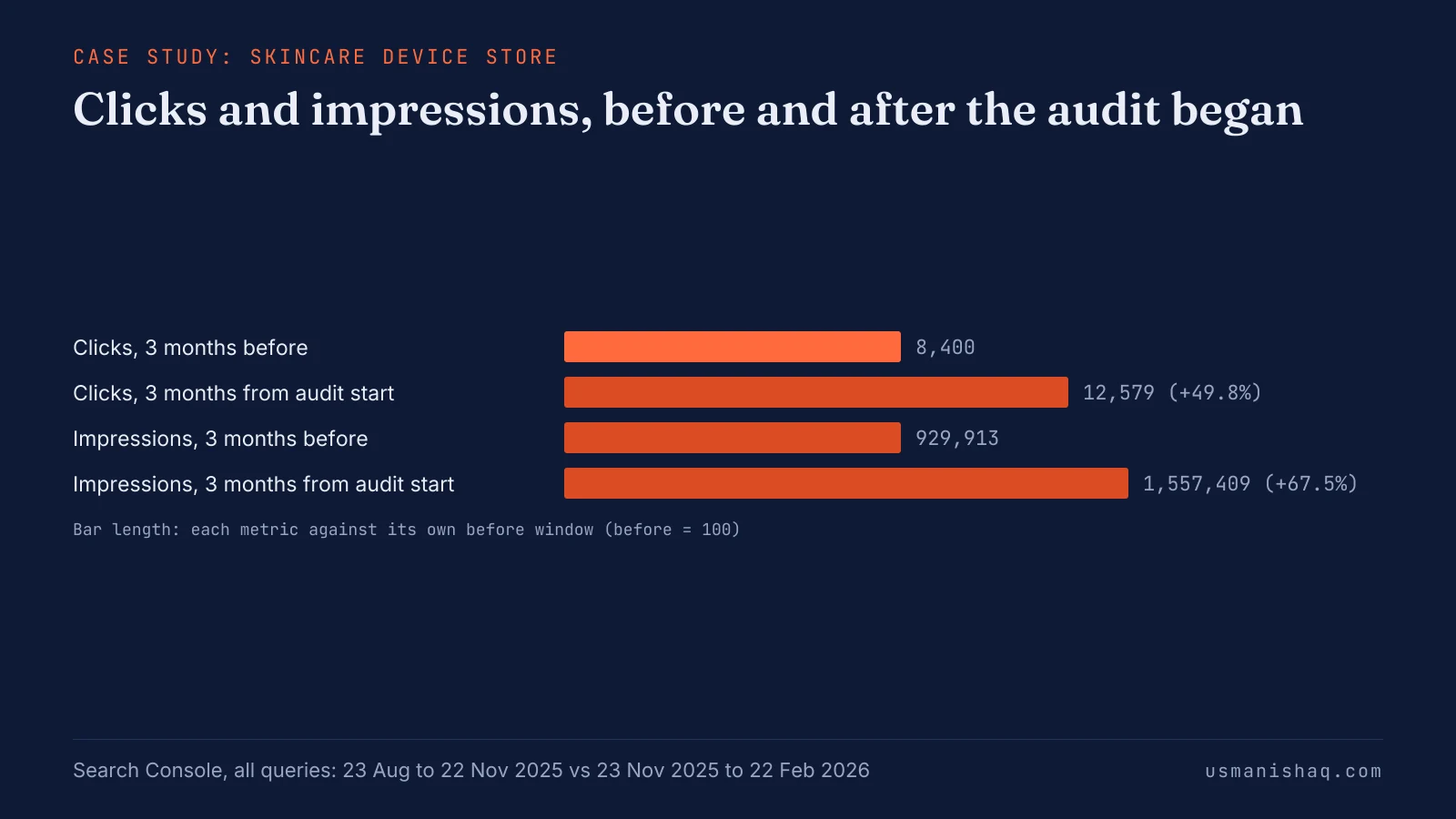
| Clicks, first 3 months from the audit's start | 8,400 | 12,579 | +49.8% |
| Impressions, first 3 months | 929,913 | 1,557,409 | +67.5% |
| Average position, first 3 months | 16.4 | 12 | 4.4 places higher |
| Average CTR, first 3 months | 0.9% | 0.8% | 0.1 points lower |
| Clicks, 11 Aug to 9 Nov 2026 | 8,400 | 28,995 | +245.2% |
The before window is 23 August to 22 November 2025; the after window is 23 November 2025 to 22 February 2026 for the first four rows and 11 August to 9 November 2026 for the last row, all read from Google Search Console (web search, all queries).
The starting point: product page FAQs for AI answers
The store needed AI-ready product FAQs that assistants could lift and quote for buyers.
The assistants in view were ChatGPT, Perplexity, Claude, Copilot and Gemini. The United States is the store's largest search market.
A product page FAQ audit is narrow semantic SEO work: one FAQ block per product detail page, read question by question.
Search traffic was flat before the audit. Monthly clicks sat between 2,390 and 2,950 from August to October 2025. Average position was 16.4 for 23 August to 22 November 2025, which is page two.
What I did, in order: the AI-ready FAQ audit
The work was an audit of the current FAQs, four rewritten product FAQs and one question set grouped by funnel stage.
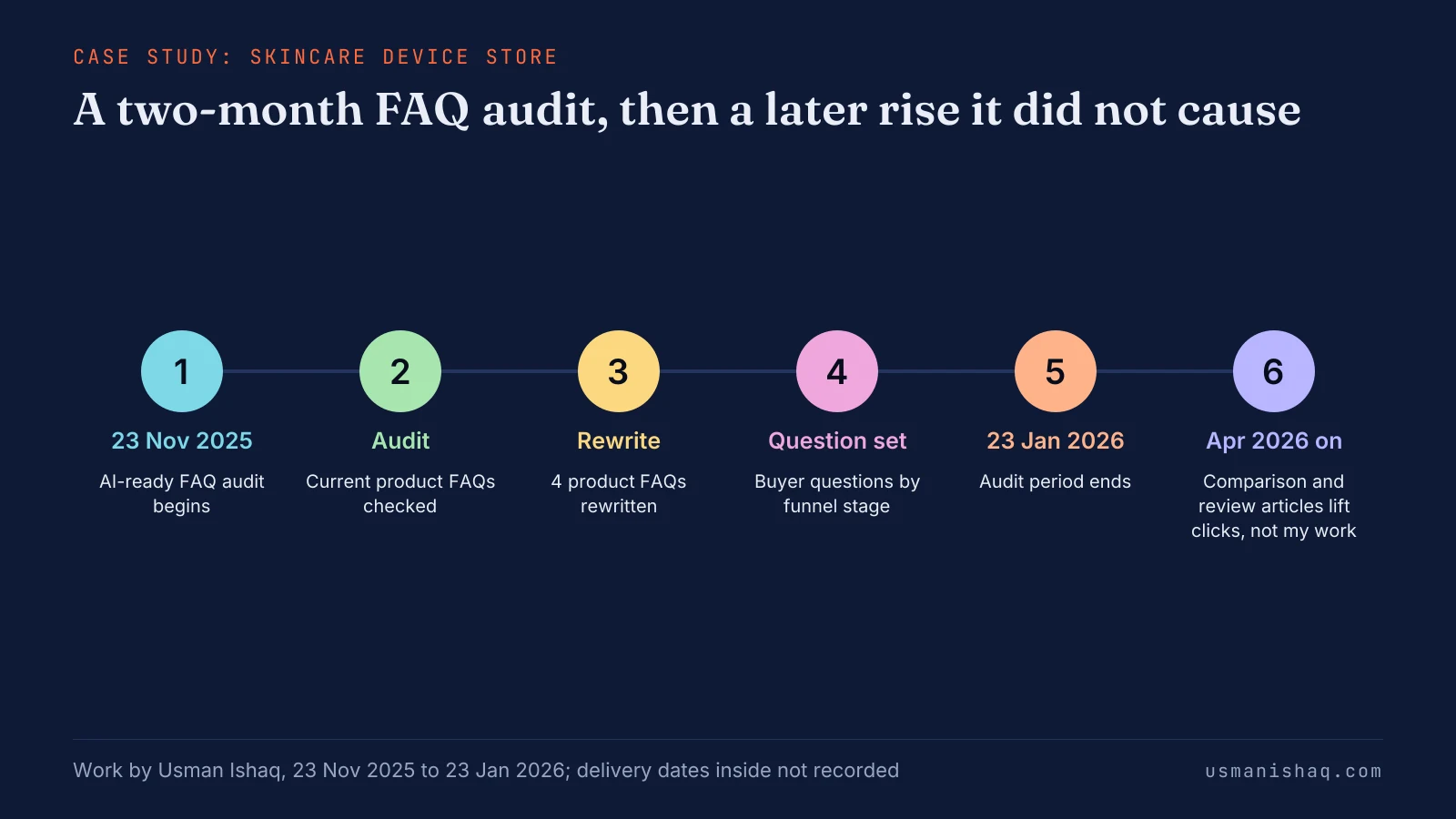
- November 2025: the AI-ready FAQ audit. I started on 23 November 2025 by checking the existing product-page FAQs against what an AI assistant needs to lift and quote an answer. The audit came first, because a rewrite without one only moves the problems around.
- November 2025 to January 2026: four product FAQs rewritten. I rewrote four product FAQs to pass the audit's checks, as a sample rather than the whole catalogue.
- November 2025 to January 2026: a question set by funnel stage. I grouped the store's buyer questions into one consolidated set, split into top, middle and bottom of the funnel.
The audit ran for two months, from 23 November 2025 to 23 January 2026. My records don't date each delivery inside that window, so the list gives the range.
An AI-ready FAQ audit checks five things on every product question:
- Real demand: buyers type or ask the question, in Search Console queries, forums or AI answers, rather than the store wishing they did.
- Unique to the product: each product page answers its own questions, not store-wide boilerplate.
- A standalone answer: the first sentence answers in full when an assistant lifts it out alone, with the product named instead of "it".
- Facts as values: session length, how often to use the device, skin types, what's in the box, warranty and returns stated as plain values, not adjectives. Each value belongs to a product attribute, the same logic as e-commerce semantic keyword mapping.
- Visible first, schema second: the answer sits in the HTML a crawler reads, reads the same on the policy pages, and any FAQPage schema matches the visible text word for word.
None of the five needs a new page. They need someone to read every answer as a stranger would.
A funnel question set is usually built in three stages. Awareness questions ask if a device type works at all, and consideration questions compare devices and brands. Purchase questions cover use, delivery and returns, and matching each answer to its stage is plain semantic copywriting.
What changed: branded vs non-branded clicks
Eight of the ten queries that gained the most clicks in the first three months were branded searches for the store's own name.
The bars below compare the three months before the audit with the three months from its start.
The biggest gainer was a branded product query, up from 29 to 94 clicks. The plain "[brand]" query went from 429 to 475. The two non-branded queries in the top ten were searches about at-home skincare devices, up 14 and 13 clicks.
The monthly table puts the step in November 2025, at 3,925 clicks against 2,694 in October. The level then held near 4,000 until March 2026.
A step that starts in the audit's first month, on branded queries, in the holiday season, reads as demand for the brand. Four rewritten FAQs don't make that shape. Plenty of skincare ecommerce SEO case study pages would stop there and credit the work.
The bigger rise came later. Clicks reached 4,451 in April 2026. May brought 6,577.
July reached 8,007. The peak came in September 2026, at 9,880 clicks.
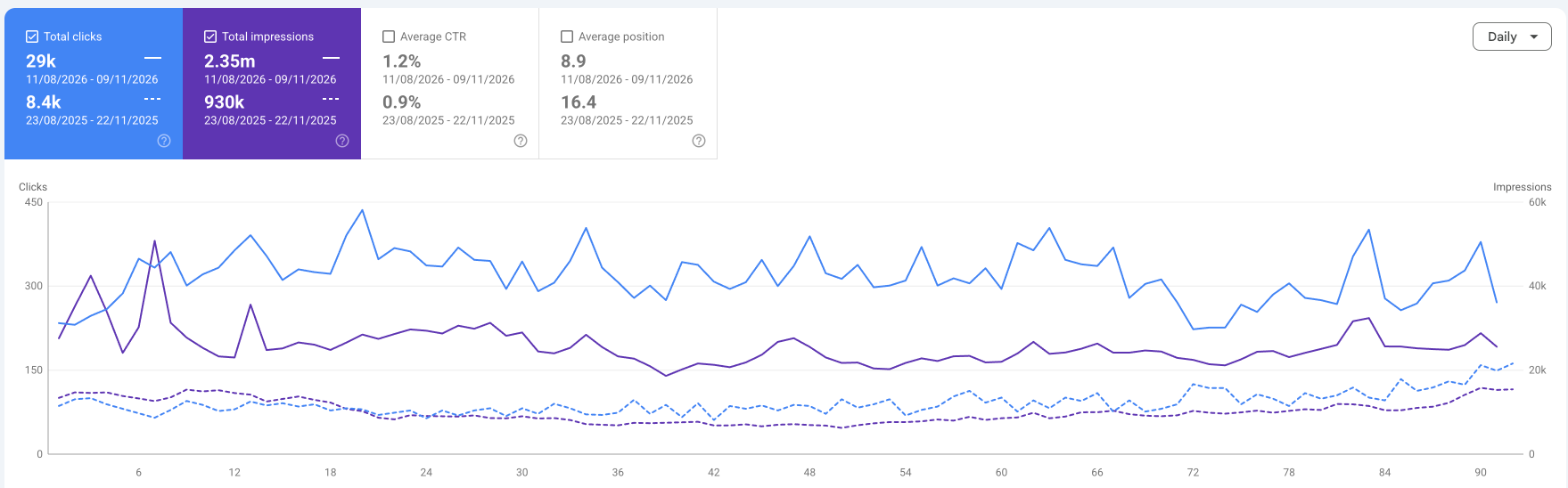
The later window shows 28,995 clicks against the same baseline. That's a rise of 245.2%.
Six of the ten biggest gaining queries are competitor review and comparison searches with zero baseline clicks. The top gainer is still a branded product query, up from 29 to 246 clicks.
One competitor's reviews query went from 0 to 208 clicks. Two competitor-versus-competitor queries added 91 and 82.
Two of the top pages in the 16-month table (10 July 2025 to 9 November 2026) are device comparison articles published after January 2026. A buyer's guide to at-home skincare devices earned 6,100 clicks.
A multi-brand device comparison earned 3,066. I didn't write or brief either page.
What did not move
The Search Console data I read does not isolate the FAQ pages, so this case claims no result for the audit.
Every reading here is site-wide. None covers the four product pages whose FAQs I rewrote, and I have no dated record of when, or whether, the rewrites went live.
Click-through rate slipped from 0.9% to 0.8% in the first window. Average position improved from 16.4 to 12, but that figure is site-wide and mixed with branded demand.
The audit work built no FAQ hub and no FAQPage schema, so this case claims nothing from either. I have no Bing Webmaster Tools AI Performance reading for this store either, so I make no claim about AI citations.
Three outside factors explain the numbers better than the audit does: the holiday season, demand for the brand's own name, and the comparison and review articles published after January 2026.
What this Shopify FAQ SEO case study means for your site
An FAQ audit is a small, checkable piece of semantic SEO, and its results should be read page by page, never from a site-wide total.
Five points help an owner read numbers like these:
- Match the windows before you read the percentage. Compare equal date ranges, and remember that a November-to-February retail window carries the holidays.
- Split branded vs non-branded clicks. Branded clicks follow demand for your name; credit SEO work only with the non-branded queries it targeted.
- Read the pages, not the property. Gains on pages the work never touched mean the work didn't cause them.
- Ask for dates. A fair audit report names the day each change went live and compares the changed pages before and after that day, which is the standard I hold a Semantic Content Audit to.
- Finish what the audit starts. Four rewrites set a pattern; the value comes once every product FAQ, the hub and the FAQ schema on Shopify product pages follow it and someone measures them.
Judge an AI-ready FAQ audit on the FAQ pages, with dates.