
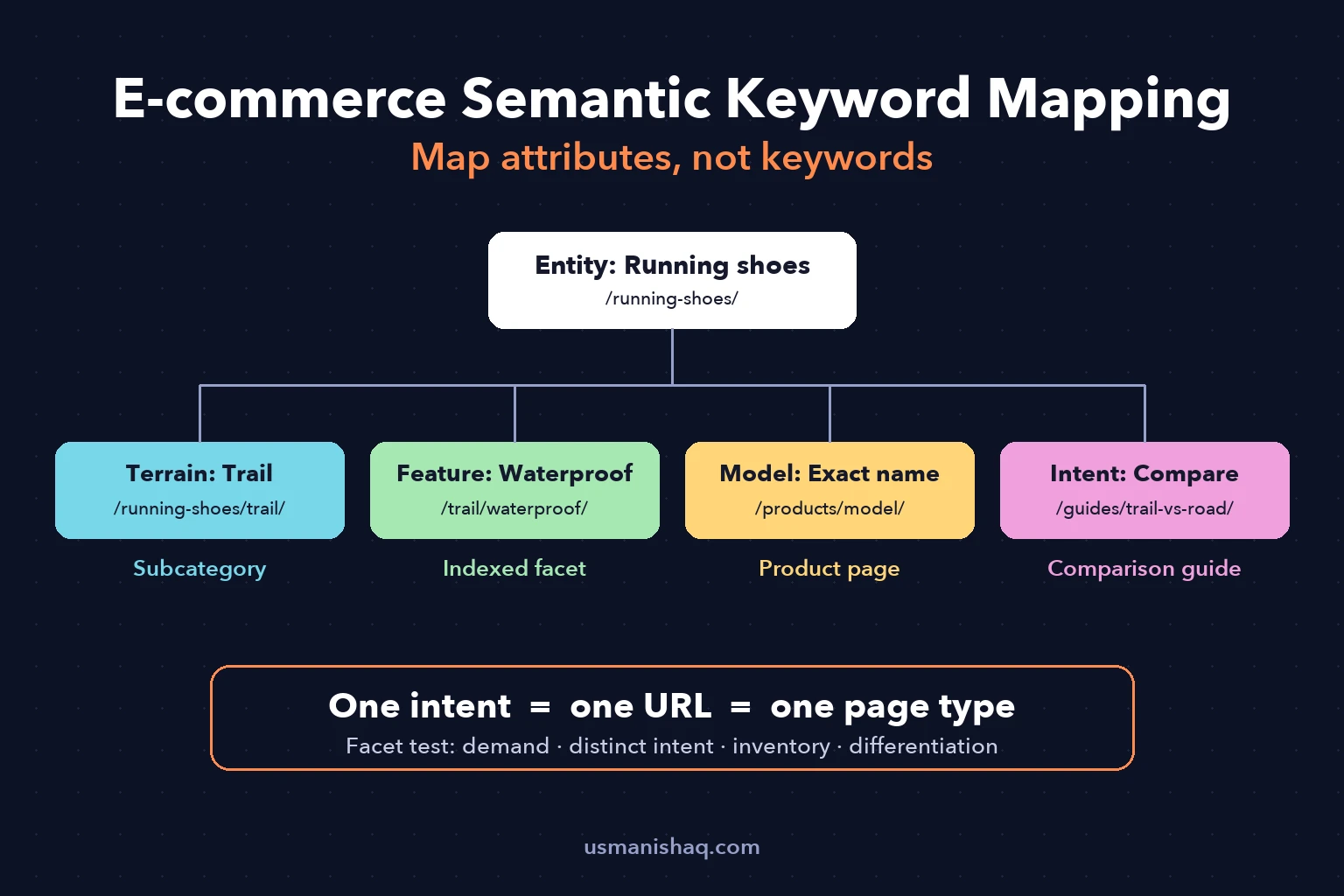
E-commerce semantic keyword mapping is the process of assigning every product entity and attribute in a store's catalogue to one URL, so that each search intent has a single page built to satisfy it. Category pages own broad product classes. Facet pages own attribute combinations with real demand. Product pages own exact models. Guides own research questions. Keywords are the evidence that validates the map, not the material it is built from. Done this way, the map removes cannibalization, cuts index bloat from filters, and gives Google and AI search a clear picture of what each page is for.
What Is E-commerce Semantic Keyword Mapping?
E-commerce semantic keyword mapping connects search queries to URLs through the entities and attributes they describe, instead of through matching strings of words. A traditional keyword map is a spreadsheet of phrases with a URL next to each one. A semantic map starts one level deeper. It asks which product entity a query refers to, which attribute narrows it, and which page type serves that need.
Take "running shoes for flat feet" and "stability running shoes." A clustering tool splits them because the words differ. Semantically they are one node: the entity is running shoes, and the attribute is pronation support. One URL should own both. I covered the wider shift from strings to meaning in semantic SEO: from keywords to knowledge.
Why Does String-Based Keyword Mapping Fail on E-commerce Sites?
String-based keyword mapping fails on e-commerce sites because catalogues multiply near-identical phrases faster than any spreadsheet can assign them, and each phrase tempts a new page. Three problems follow:
Cannibalization: "black running shoes", "men's black running shoes" and "men's running shoes black" end up on three thin pages competing for one intent.
Index bloat: every filter combination becomes a crawlable URL, and Google spends crawl budget on pages nobody searches for.
Margin blindness: the map follows search volume, so the store builds pages for low-margin lines it only stocks, while profitable lines get one generic category.
Google's own guidance on managing crawling of faceted navigation exists because this problem is so common.
How Do You Build a Semantic Keyword Map for an E-commerce Store?
You build a semantic keyword map in six steps: define the source context, inventory the attributes, collect the query network by attribute, assign page types, test facets for indexation, and connect everything with internal links and schema.
Step 1: Define the Source Context
The source context is what the store sells, to whom, and which product lines make the money. I start every e-commerce project here, before opening a keyword tool. A store with 4,000 SKUs and 12 profitable product lines gets a map weighted around those 12 lines. Depth goes where margin is.
Step 2: Build the Attribute Inventory From the Catalogue
The attribute inventory is the entity-attribute-value layer of the store, taken directly from the product database. E-commerce has an advantage over service sites here: the attributes already exist as product fields. Export them:
Entity | Attribute | Example values |
|---|---|---|
Running shoes | Terrain | Road, trail, track |
Running shoes | Support | Neutral, stability |
Running shoes | Feature | Waterproof, wide fit |
Running shoes | Audience | Men, women, kids |
Running shoes | Brand | Brand names you stock |
Running shoes | Use case | Marathon, beginners, gym |
This table defines the semantic boundary of the catalogue before any keyword research begins.
Step 3: Collect the Query Network and Group It by Attribute
The query network is every search that touches your entities, grouped by the attribute it expresses rather than by its wording. I pull queries from Google Search Console, internal site search, People Also Ask, related searches, product reviews and support tickets. Each query is tagged with the entity, the attribute, and the dominant intent: browse, compare, buy, or learn.
Intent is validated against the live SERP. If Google shows product grids, the query belongs to a commercial page. If it shows guides and videos, it belongs to editorial content. I treat SERP overlap as supporting evidence, not as a fixed percentage rule.
Step 4: Assign Each Node to One Page Type
Each entity-attribute node is assigned to exactly one page type, and each page type has a defined job.
Page type | Semantic role | Example query | Example URL |
|---|---|---|---|
Category | Broad product entity | running shoes | /running-shoes/ |
Subcategory | Entity + defining attribute | trail running shoes | /running-shoes/trail/ |
Indexed facet | Entity + attribute combination with demand | waterproof trail running shoes | /running-shoes/trail/waterproof/ |
Product page | Specific product entity | exact model name | /products/model-name/ |
Buying guide | Learn intent | how to choose running shoes | /guides/choose-running-shoes/ |
Comparison | Compare intent | trail vs road running shoes | /guides/trail-vs-road-shoes/ |
The rule is simple: one intent, one preferred indexable URL. I explain how to decide when a query deserves its own page in query deserves page content structure.
Step 5: Run the Facet Indexation Test
A facet deserves an indexable page only if it passes four tests: demand, distinct intent, inventory depth, and differentiation.
Demand: real searches exist for the entity and attribute combination.
Distinct intent: the SERP for the combination differs from the parent category's SERP.
Inventory depth: enough products sit behind the filter to make a useful page, not two items.
Differentiation: the page can carry its own heading, copy and FAQ, not just a filtered grid.
Facets that fail stay as filters. They are canonicalised to the parent or kept out of the crawl. Sort orders, price sliders and most size filters fail almost every time.
Step 6: Connect the Map With Internal Links and Schema
Internal links and structured data turn the map from a spreadsheet into an architecture search engines can read. Every product links up to its subcategory and category through breadcrumbs. Category pages link down to indexed facets with descriptive anchors such as "waterproof trail running shoes", not "shop now". Guides link to the commercial pages they answer for. Mark up products with Product structured data and navigation with BreadcrumbList, following Google's guidance on helping Google understand e-commerce site structure.
This is the same logic I use for content networks on informational sites, described in my semantic content network strategy guide.
What Should an E-commerce Semantic Mapping Sheet Contain?
A semantic mapping sheet should record the node, the evidence and the decision for every URL, so anyone on the team can see why a page exists. I use these columns:
Entity and attribute (the node)
Primary query and supporting queries
Dominant intent and SERP page type
Page type and target URL
Indexation decision: index, canonical, or noindex
Current ranking URL, to spot cannibalization
Margin priority: high, medium, low
Action: protect, improve, consolidate, create, or ignore
How Do You Measure Whether the Map Is Working?
You measure a semantic keyword map in Google Search Console by page type, not by individual keyword. Group URLs by category, indexed facet, product and guide, then track impressions, clicks and average position for each group. Two signals tell you the map is healthy. Each important query should have one ranking URL instead of several rotating ones. Facet pages should rank for attribute combinations without pulling impressions away from their parent category.
What Mistakes Break an E-commerce Keyword Map?
The most common mistakes are mapping by search volume alone, indexing every filter, and letting product pages compete with categories.
Creating a page for every keyword variation instead of every intent.
Indexing colour, size and sort filters with no search demand.
Writing category copy that targets an exact product model.
Mapping by tool volume and ignoring margin.
Building the map once and never refreshing it as the catalogue changes.
Frequently Asked Questions
What is the difference between keyword mapping and semantic keyword mapping?
Keyword mapping assigns phrases to pages. Semantic keyword mapping assigns entities and attributes to pages, and uses phrases as evidence for those assignments.
Should every product filter have its own indexable page?
No. Only filters that pass the demand, distinct intent, inventory and differentiation tests should be indexable.
How often should an e-commerce keyword map be updated?
Update the map whenever the catalogue changes significantly and review it each quarter against Search Console data.
Does semantic keyword mapping help with AI search?
Yes. A page with one clear entity and intent is easier for AI systems such as ChatGPT, Perplexity and Google AI Overviews to retrieve and cite.
Which tools do I need for semantic keyword mapping?
A catalogue export, Google Search Console, a SERP checker and a spreadsheet are enough to start. Keyword tools add volume data but should not define the map.
How I Build Semantic Keyword Maps for E-commerce Stores
I build e-commerce semantic keyword maps as part of a full semantic SEO architecture: source context, attribute inventory, page-type map, facet rules, internal linking and schema, delivered as a working document your team can follow. If your store has cannibalizing categories, a crawl full of filter URLs, or profitable lines buried under generic pages, the map is where the fix starts. See my semantic SEO architecture service or start with a semantic content audit. For the difference this approach makes against keyword-led SEO, read semantic SEO vs traditional SEO.