
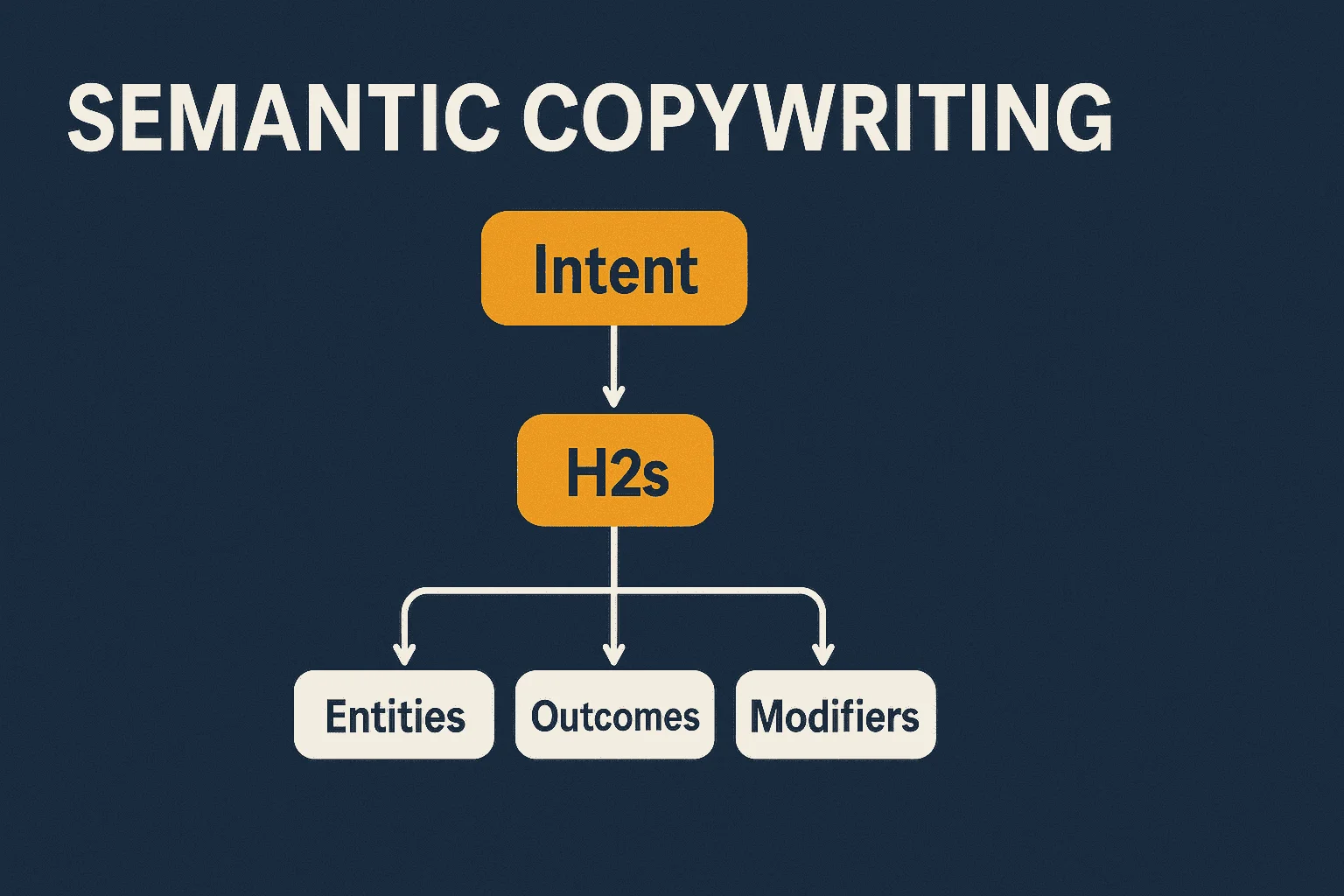
Why traditional copywriting tactics fail, and how semantic frameworks drive conversion, clarity, and rankability
Conversion-focused content has evolved. In 2025, persuasive language alone is no longer enough to drive measurable business outcomes. Today's digital audiences — and search engines — demand more than emotional appeals, urgency tactics, or formulaic calls to action.
They expect content that respects their intent, matches their mental model, and delivers information that connects, not just convinces.
This is where Semantic Copywriting enters.
Semantic copywriting combines the science of structured language with the psychology of conversion. It doesn't treat a web page as a pitch deck. It treats it as a meaning system, designed to guide user thought from interest to action through context, entity relevance, and internal structure.
Search engines like Google have moved beyond keywords. They now interpret meaning through semantic relationships between words, phrases, and the entities behind them. Your audience is doing the same — scanning for coherence, trust signals, and next-step clarity.
That’s why conversion now depends on three things:
Structure: The flow and hierarchy of your content
Intent: The alignment between query, copy, and offer
Semantics: The clarity of meaning delivered per line
Semantic copywriting ensures that each headline, section, sentence, and link fulfills a specific cognitive role in the conversion journey.
In this article, we’ll show how to:
Replace vague copy with entity-connected language
Build internal structures that guide user flow
Use semantic signals to increase conversions and authority
Create landing pages and service content that scale trust
Semantic SEO and conversion copywriting are no longer separate disciplines.
They are one system — and it starts with understanding how structure meets intent.
What Is Semantic Copywriting?
How does semantic copywriting differ from traditional conversion copywriting?
Traditional copywriting prioritizes persuasion. Semantic copywriting prioritizes relevance, intent alignment, and contextual clarity. The shift is not stylistic — it is structural, cognitive, and strategic.
Semantic copywriting focuses on delivering high-density meaning per line, structured to follow user intent paths. It does not rely on surface-level emotional hooks. Instead, it uses search-intent mapping, entity references, and layered question-answer frameworks to guide decisions.
Key Characteristics of Semantic Copywriting:
Every paragraph teaches or guides
Each sentence supports a semantic relationship (user, problem, solution, context)
Entity references (product names, features, attributes) are purposeful and relational
Filler and generic transitions are eliminated
Traditional copy:
"We help you grow your business with fast, flexible solutions you can trust."
Semantic version:
"Our marketing automation platform helps small retailers increase repeat purchases by 43% using targeted product lifecycle email sequences."
The second version connects:
Entity (marketing automation platform)
Audience (small retailers)
Action (increase repeat purchases)
Attribute (targeted product lifecycle emails)
Each clause answers what, who, how, and why. This is semantic precision. It serves both search engines and human decision-makers.
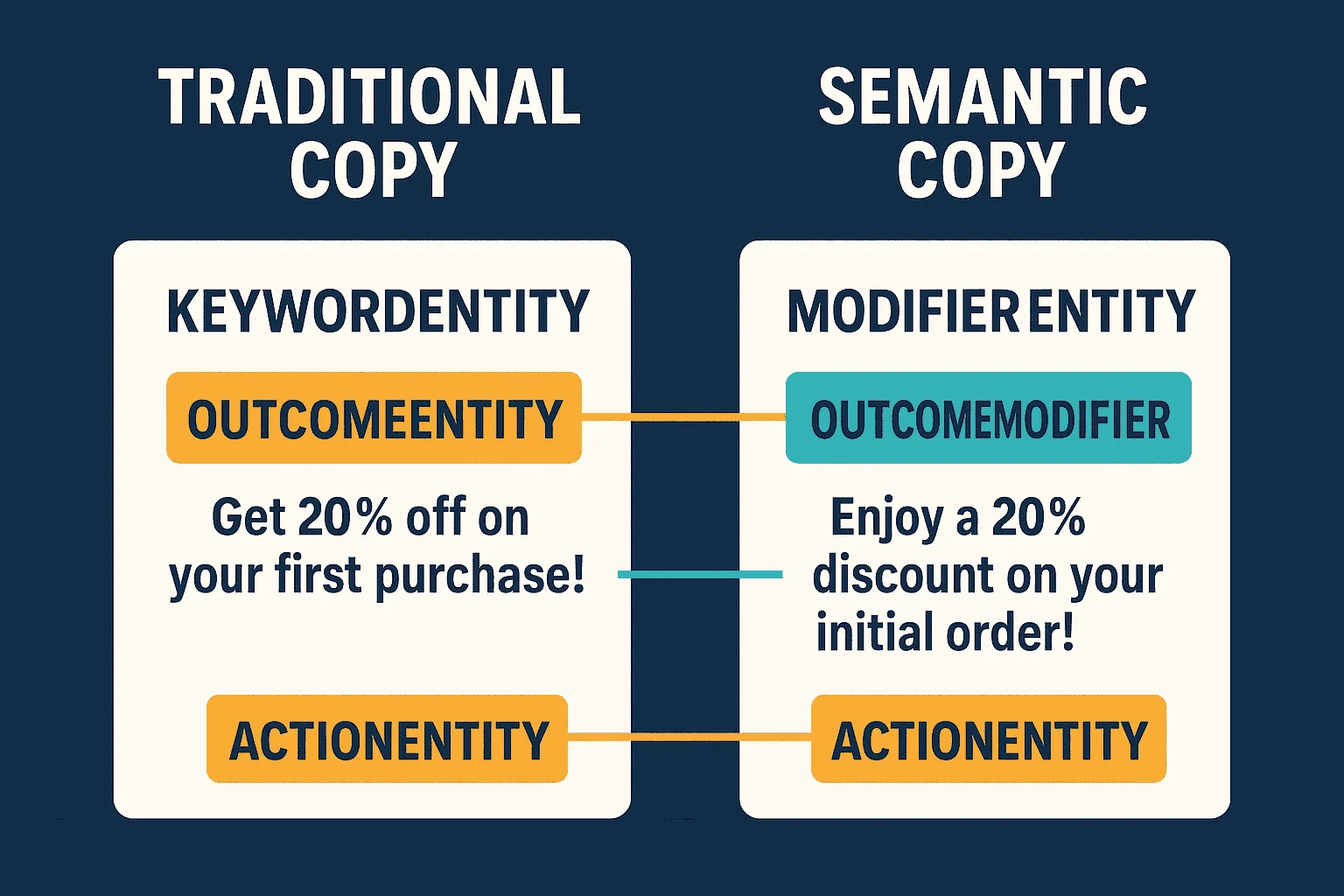
Comparison of traditional vs semantic copy with highlighted entity terms
Semantic copywriting is not longer copy. It is denser, more aligned, and structurally mapped to intent.
Why Structure Beats Style in Modern Conversion Copy
Why format and information architecture influence more conversions than tone alone
Persuasive tone cannot compensate for poor structure. Modern users do not read content linearly — they scan, segment, compare, and decide in milliseconds. If your copy lacks a structural pathway, it fails to convert regardless of how clever or emotional it sounds.
Semantic Copywriting Prioritizes Structural Alignment
Copy that converts consistently is built on a semantic framework, not stylistic flair. Every component of your page — from H1 to CTA — must answer:
What does the user want here?
What do they need next?
What meaning must this section deliver?
Example: Service Page Copy Structure (Semantic-Optimized)
Section | Purpose | Semantic Role |
H1: Core Promise | Define intent | Establish entity and goal |
Intro: Clarity Block | Confirm relevance | Solve cognitive friction |
H2: Feature Layer | Detail solutions | Attribute mapping |
Testimonials | Trust signal | Third-party context |
CTA | Next action | Intent bridge |
Semantic copywriting sees layout as conversion scaffolding, not decoration.
Information Architecture as Conversion Engine
Every scroll segment should answer a next-step mental query:
“Is this for me?”
“How does it work?”
“Will it solve my need?”
“Can I trust this provider?”
“What happens if I click?”
Pages that convert do not just read well. They flow well — built with semantic HTML, logical hierarchy (H1 → H2 → H3), and tightly mapped meaning per section.
Search engines recognize this structure. So do users. It builds trust, scanability, and engagement, all precursors to action.
Understanding Conversion Intent Through Semantic Layers
How to map user thought patterns to semantically written copy
Conversions do not occur in a vacuum. Every user arrives with a layered intent — starting with a core query and expanding into adjacent needs, doubts, and decision triggers. Semantic copywriting identifies and addresses these layers to guide users from question to conversion without friction.
Primary vs. Secondary Intent in Semantic Copy
A single query like “CRM for small business” carries multiple implicit intents:
Core: “What is the best CRM for small business?”
Secondary: “Is it affordable?”, “Does it integrate with Gmail?”, “Is it scalable?”
Traditional copy may answer the core query.
Semantic copy answers the next three questions — before users ask.
This anticipatory approach builds trust. It reduces bounce. It leads to conversion momentum.
Intent Layering Framework
Intent Layer | Description | Copy Strategy |
Primary | User’s explicit search goal | Match page title, intro, H1 |
Secondary | Common adjacent concerns | Embed in subheads and FAQs |
Tertiary | Post-conversion questions | Use internal links, follow-ups |
Example:
Query: Best magnesium supplement for sleep
Semantic expansion:
“When should I take it?”
“Any side effects?”
“What if I’m on medication?”
If your copy flows through those secondary layers naturally, it feels smarter — because it is.
Writing with Follow-up Question Logic
Each major section should:
Answer the query clearly
Guide to 2–3 logical follow-up questions
Provide the answers or link semantically to the next page
This technique mirrors Google’s understanding model — where answers are evaluated based on:
Contextual fit
Entity matching
Predictive follow-through
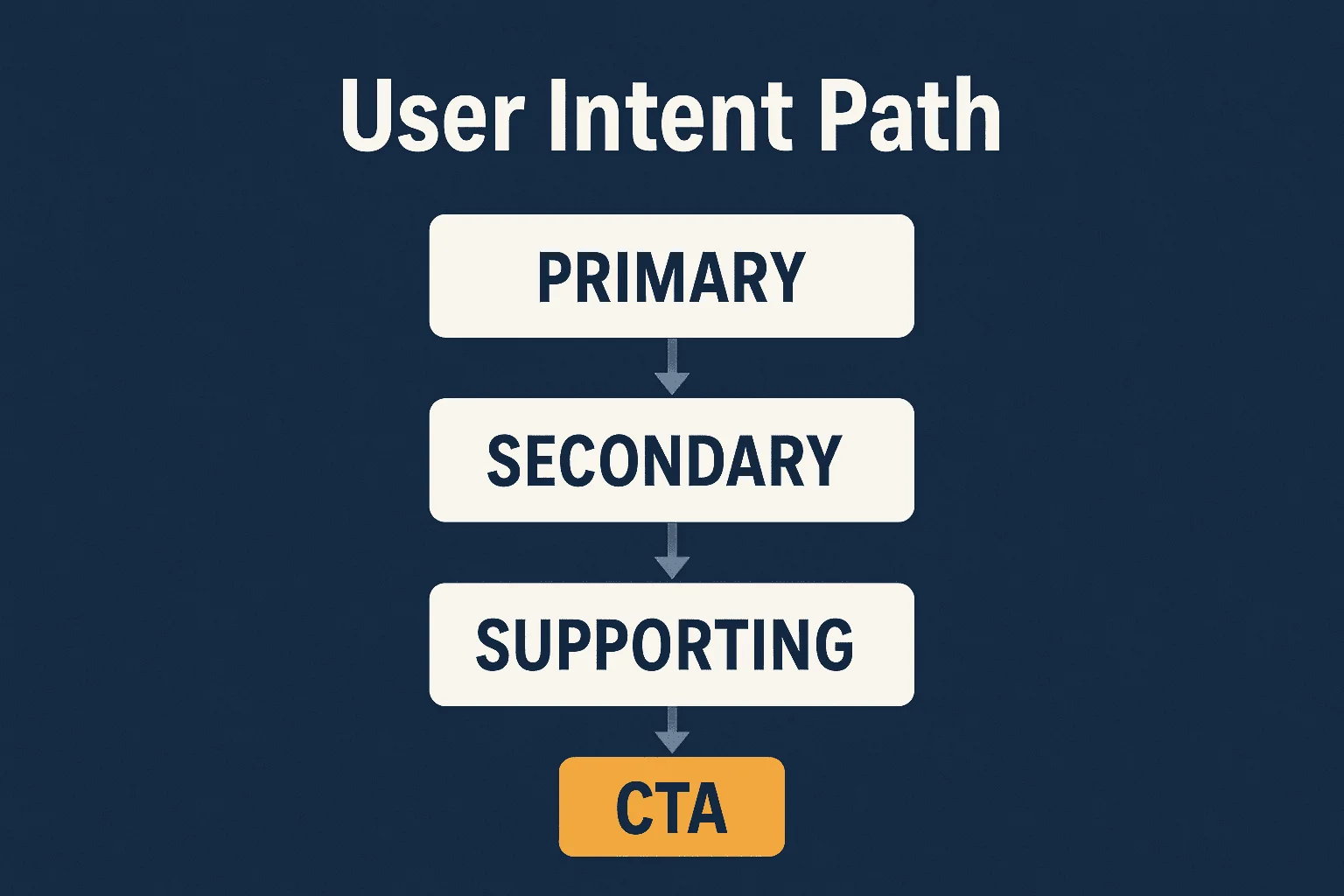
Semantic copywriting is not about “sounding complete”. It’s about completing the thought journey.
Entity-Driven Copywriting: From Words to Meaning Systems
How entity mapping enhances trust, clarity, and rankability
Semantic copywriting does not rely on keywords in isolation. It builds meaning through entity relationships — identifiable concepts that search engines associate with topics, industries, products, and actions.
An entity can be:
A product or brand name
A category (e.g., CRM, magnesium supplement)
A feature or function (e.g., email automation, organic sourcing)
A person, location, tool, or regulatory standard
Google’s Knowledge Graph connects these entities using contextual meaning, not surface repetition.
Why Entity Mapping Outranks Keyword Stuffing
Traditional keyword-focused copy:
"Our SEO service is the best SEO service because we offer SEO for all industries."
Entity-focused semantic copy:
"We optimize content for legal firms, eCommerce brands, and SaaS platforms using a semantic SEO framework built on entity mapping, intent targeting, and internal relevance scoring."
The second version introduces:
Target audience entities: legal firms, SaaS, eCommerce
Methodology entities: semantic SEO, intent targeting
Functional value: internal relevance scoring
This improves both search engine interpretation and user comprehension.
Entity Clusters Build Authority
Pages that reference semantically connected entities within a specific niche:
Establish topical depth
Build domain authority
Signal content expertise to Google and readers alike
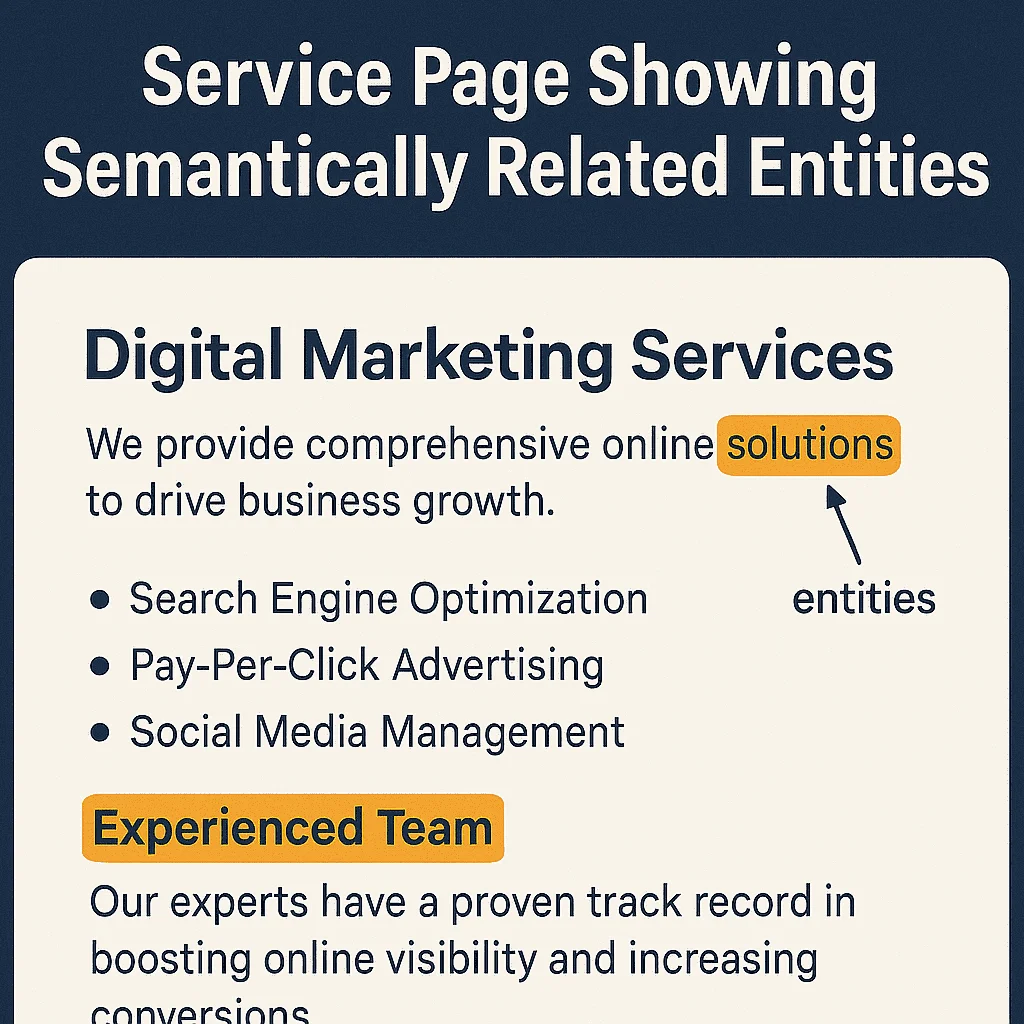
For example, a service page for a nutritionist might include:
Primary entity: magnesium supplements
Related entities: absorption rate, sleep cycles, FDA guidelines, dosage timing
Supporting entities: melatonin, calcium interaction, clinical studies
These aren’t “LSI keywords” — they are semantic signals of authority.
Embed Entities to Clarify, Not Cram
Entity-driven writing clarifies intent through:
Specific attribute naming (e.g., “US-based fulfillment center” not “fast delivery”)
Contextual examples (“We helped a SaaS firm with 200k users scale retention using XYZ”)
Secondary signal strength: reviews, metrics, case studies, use cases
Use Semantic SEO Strategy for Service Businesses to demonstrate applied entity strategy:
“We apply this entity-first approach inside our Semantic SEO Strategy for Service Businesses to drive contextual relevance and visibility across service verticals.”
Semantic copywriting turns web pages into meaning systems — understandable by machines, memorable to humans, and aligned with commercial intent.
Semantic CTAs: Writing Calls-to-Action That Convert Through Context
Why most CTAs fail and how semantic writing makes them effective
A Call-to-Action (CTA) is not just a button or a phrase — it's a semantic decision point. Traditional CTAs rely on urgency or hype:
“Buy now.”
“Limited offer.”
“Don’t miss out.”
But in modern conversion paths, users need contextual confirmation, not pressure. A high-converting CTA is the result of aligned meaning, clear intent, and relevance to the user’s query path.
What Makes a CTA Semantic?
A semantic CTA considers:
What problem was just solved above it
What decision the user is making now
What question is likely to follow
It connects where the reader is in the journey — cognitively and emotionally — with what they need next.
Compare:
❌ Generic:
“Submit”
“Learn More”
✅ Semantic:
“Get My Free Audit Based on Your Industry”
“Compare CRM Plans for Freelancers”
“Download 3 Case Studies in Organic Skin Care Marketing”
These CTAs:
Echo the user’s exact use case
Reinforce the entity or topic just discussed
Transfer trust through clarity
Microcopy: Semantic Layer Beneath the Button
Don’t stop at the button. The text above, below, or around the CTA provides essential semantic scaffolding:
“See how our service helped 9 SaaS companies increase LTV by 2.3x — download their exact funnel structure.”
CTA: “Get the Funnel Blueprint”
This microcopy builds trust, answers unspoken doubts, and frames the action as a solution.
CTA Layering by Page Type
Page Type | CTA Style | Semantic Cue |
Landing Page | Action-focused | Mirrors ad intent and benefit context |
Service Page | Decision-support | Matches user segment (e.g., “Get a Law Firm Quote”) |
Blog Post | Lead-in or soft CTA | Connects topic to next curiosity or resource |
Comparison Page | Friction-reducing | Clarifies “why choose” logic (e.g., “Try risk-free — no card needed”) |
Semantic CTAs convert because they are meaningful in context, not manipulative out of context.
They don’t force behavior — they complete the thought.
Internal Linking as Semantic Reinforcement for Copy
Why internal linking is not just technical SEO—but conversion architecture
Most internal links are added as afterthoughts — scattered keywords hyperlinked to unrelated blog posts or landing pages. But in semantic copywriting, internal links serve as intent bridges: they guide users through a journey of meaning and relevance that improves both SEO and conversions.
The Semantic Role of Internal Links
Internal links help:
Reinforce entity relationships across your domain
Transfer topical authority to core pages
Guide users to their next natural question
Improve crawl depth and indexability
Semantic copywriting uses internal links not as shortcuts, but as storytellers. They extend the narrative, connect answers, and continue user education — right when curiosity peaks.
How to Link Semantically, Not Strategically
❌ Misaligned Internal Linking:
“Check out our blog.”
“Read more SEO tips here.”
These links are vague and interrupt the intent flow.
✅ Semantic Internal Linking:
“Learn how to apply this structure using our Query Deserves Page framework to reduce content waste and increase ranking consistency.”
“Explore our complete Semantic SEO strategy for service businesses and see how we map entity clusters across your services.”
Semantic links:
Match the topic, tone, and question of the paragraph
Use anchor text that predicts the next user need
Help the user arrive where they want before they know they want it
Link Placement = Meaning Hierarchy
Where you place the link matters:
Early: Establish core topic authority
Middle: Reinforce secondary questions
End: Invite deeper exploration or action
Internal Linking as Conversion Strategy
Strategic internal linking also reduces decision friction:
Blog → Service Page (educate → convert)
Service → FAQ or Comparison (assure → decide)
CTA → Case Study (promise → prove)
Semantic linking turns your website into a map, not a pile of pages.
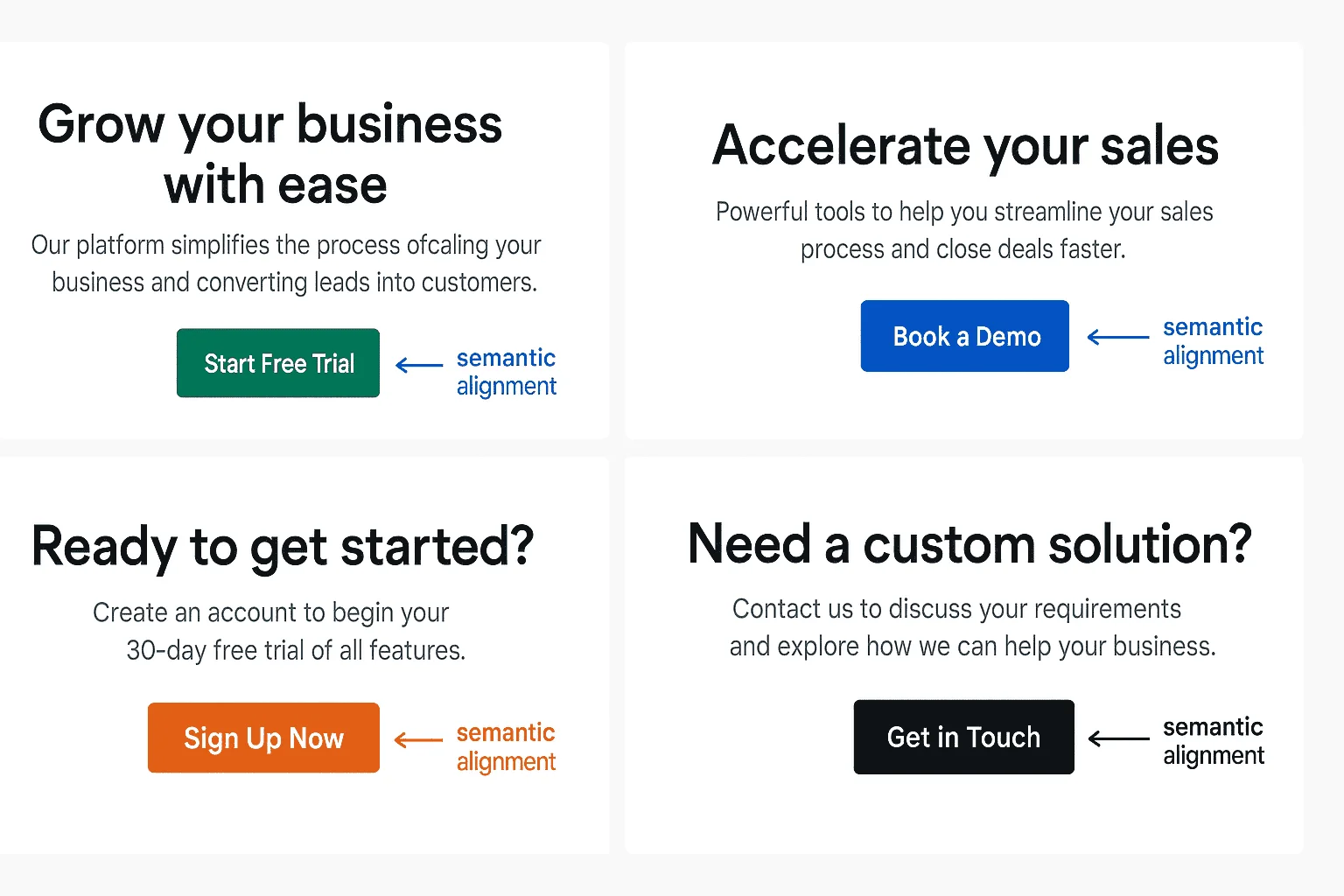
“Our homepage explains how we use semantic SEO principles to structure copy that both ranks and converts — visit the site to see it in action.”
**Semantic internal links are not technical artifacts. They are contextual signposts in your brand’s meaning architecture.
Case Study Snapshot: Rewriting for Semantic Conversions
Example: Semantic copy upgrade for a SaaS service page
Theory proves nothing without execution. Semantic copywriting succeeds when applied to real content with real intent conflicts. The following snapshot demonstrates how restructuring and semantically optimizing a SaaS service page transformed both user behavior and business outcomes.
Project Background
Client: Mid-sized SaaS company offering automated workflow software
Problem: High bounce rate (68%), low CTA engagement, and weak organic rankings for key commercial terms
Page Type: Core service landing page targeting the term “workflow automation for teams”
Before: Feature-Focused, Keyword-Heavy Copy
Page Issues:
Dense with product jargon
Repetitive keyword phrases ("workflow automation" used 19 times)
No clear semantic relationship between sections
Weak CTA structure ("Sign up now") placed without intent layering
Missing supporting content blocks (FAQs, use cases, semantic interlinks)
Typical Copy Example:
"Our workflow automation tool helps you streamline tasks, reduce errors, and automate more workflows. Our workflow automation is the best for businesses that need workflow automation."
Result:
Organic impressions: low
On-page time: under 40 seconds
Conversion rate: 0.7%
After: Entity-Based Semantic Copy Rebuild
Key Copy Changes:
Mapped user journey from search to decision
Used structured subheads: “Who it’s for,” “What it automates,” “How it integrates”
Incorporated specific entities: Slack, Trello, Jira, multi-role teams
Layered CTA blocks after solving adjacent questions
Added FAQs based on secondary search intent
Internal links to blog content and comparison pages based on reader stage
Rewritten Copy Sample:
"Automate repetitive project tasks across Slack, Trello, and Jira with a single dashboard designed for cross-functional teams. Whether you're in marketing or engineering, build repeatable workflows that scale without code."
CTA: "Explore Workflow Templates by Team Role"
Semantic Signals Added:
Role-based modifiers (marketing, engineering, HR)
Connected intent structures (use case → tool → result)
Contextual CTA logic based on journey stage
Results After Semantic Rewrite:
Metric | Before | After |
Bounce Rate | 68% | 43% |
Avg. Time on Page | 0:39 | 2:21 |
Conversion Rate | 0.7% | 2.3% |
Keywords in Top 10 | 3 | 11 |
📌 Summary:
The change was not in what was said, but how and where it was said.
Relevance increased
Flow improved
Search intent was fulfilled
Action became logical, not forced
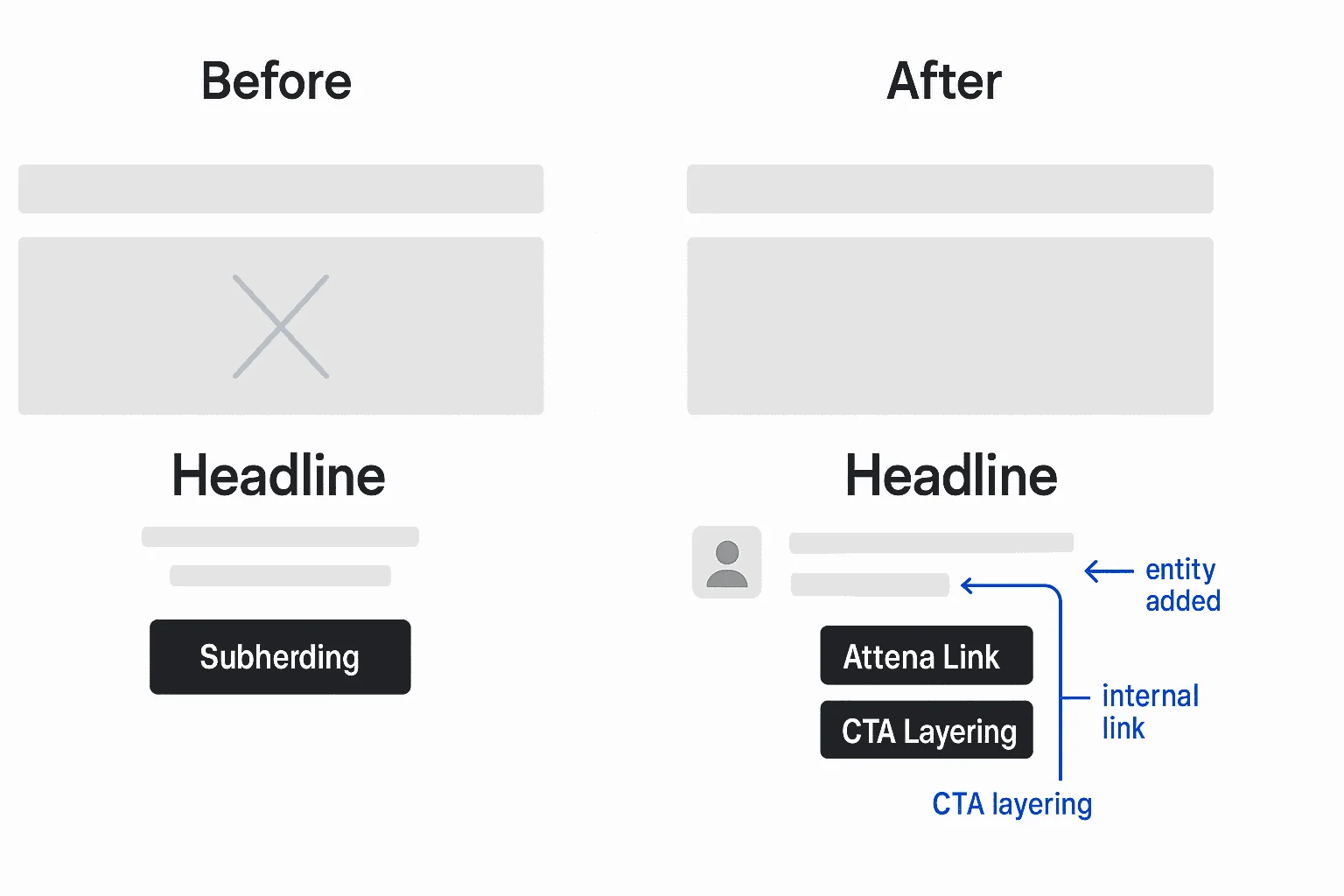
Semantic copywriting is not a rewrite — it is a reframe of user context into structured, connected meaning.
Semantic Copywriting Checklist: 10 Rules Before Publishing
Quick checklist for writers, SEOs, and CRO teams
Semantic copywriting isn’t about creativity alone — it’s about precision, alignment, and structure. Before publishing or delivering any copy, use this 10-point semantic audit to ensure your content is meaning-dense, conversion-aligned, and algorithm-resilient.
1. Every H2 Solves a Sub-Intent
Each heading must address a distinct user concern, not just organize space.
Example:
❌ “Features”
✅ “What Workflow Tasks Can You Automate With This Tool?”
2. Each Paragraph Teaches Standalone Value
Remove bridge phrases and repetition. Every block should deliver unique, query-fulfilling information.
Test: If you remove all other paragraphs, does this one still teach something valuable?
3. At Least 3 Entity References Per Section
Google understands and ranks through entity relationships.
Embed:
Product types
Use cases
Industry references
Tools, standards, certifications
4. Internal Link From at Least 2 Contexts
Use internal links as semantic bridges — not SEO decorations.
Link:
Within main solution discussion
At follow-up question points
Example: “This is exactly how we apply our Semantic SEO strategy for service businesses to scale relevance.”
5. CTA Matches Micro-Intent
CTAs must be based on the last cognitive step solved by the paragraph or section.
Bad CTA: "Sign up now"
Semantic CTA: "See how this workflow applies to your team role"
6. Meta Title and Meta Description Reflect Search Phase
Meta tags must reflect intent layer:
Informational? → Question-driven
Navigational? → Brand trust
Transactional? → Solution framing
7. Visuals Add Semantic Clarity
Design isn’t just for beauty — it must reinforce meaning.
Use diagrams to show flow
Use icons to clarify entities
Use screenshots to ground abstract benefits
8. Language Reflects Searcher’s Mental Model
Use terms your audience actually uses in queries, emails, or customer chats.
Review Google autosuggest, Reddit, or support tickets
Mirror phrasing, not jargon
9. No Redundant Statements or Keyword Padding
Each sentence must add new meaning. No echoes. No filler.
Check for:
Repetitive modifiers
Keyword duplication
Introductory fluff
10. Answer at Least 2 Next-Step Questions in Every Section
Before publishing, ask:
“If I were the user, what would I ask next?”
“Is that answer here or logically linked?”
If not, the copy is incomplete semantically.
Summary:
Semantic copywriting is a system, not just a skill.
If your content follows these 10 rules, it:
Teaches faster
Connects deeper
Converts better
Survives longer
🧠 Bonus Tip: Use this checklist during editing, not just drafting — semantic clarity increases in revision, not in ideation.
Conclusion: Build Copy That Connects, Converts, and Compounds Authority
Why semantic copywriting is the only scalable, update-proof, conversion-first approach
In a landscape where Google evolves daily, algorithms shift, and user expectations rise, traditional copywriting tactics no longer scale. Businesses that cling to emotional headlines, keyword-stuffed paragraphs, or vague calls to action find themselves invisible in search — and irrelevant in conversion.
Semantic copywriting is not a trend.
It is the structural foundation for content that wins long-term.
By integrating search intent, entity relationships, and contextual CTA logic, semantic content transforms every webpage into a meaning-driven experience. This approach doesn’t just improve clarity — it drives ROI:
Higher rankings through content structured the way Google understands
Faster conversions by solving real user questions at the right depth
Lower bounce rates because every section adds value, not filler
More authority because users and search engines recognize content built with intent, not volume
Recap of What Semantic Copywriting Delivers:
Benefit | Semantic Mechanism |
Better Rankings | Entity-first structure + layered intent |
Higher Conversions | CTA alignment + trust-building flow |
Stronger Authority | Contextual linking + topical depth |
Google Update Resilience | Meaning-based architecture, not keyword dependency |
Semantic copywriting brings together what marketers need (conversion), what users want (clarity), and what search engines reward (relevance).
It’s not an SEO hack.
It’s not a copy trick.
It’s a system.
Ready to Build Copy That Converts With Meaning?
Whether you need to rewrite your landing pages, design your next blog series, or build a full-scale semantic SEO strategy, we help businesses create content that’s built to rank — and built to convert.
🔗 Work with us — or explore our full guide on
🔗 Semantic SEO Strategy for Service Businesses
📥 Want the full Semantic Copywriting Checklist as a downloadable PDF?
DM us.