
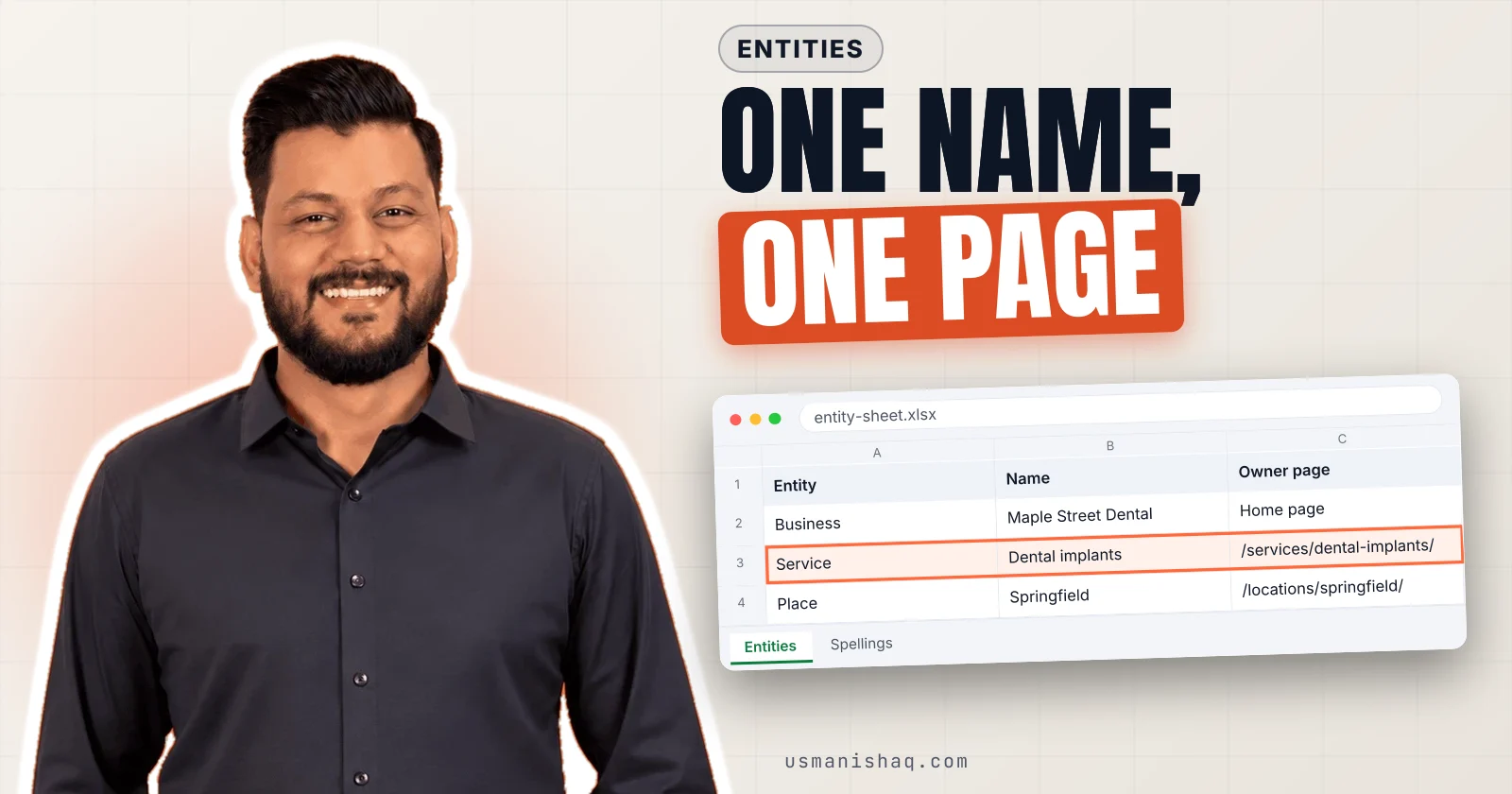
Entities on a business website are the things it names, such as the business, its services, people, towns and offers.
A reader sees one service. Software that matches strings may see three if the site spells it three ways.
I treat entity work as a naming job before it is a markup job. You list what the business is, fix one exact name for each item and give each item one page that owns it. Traditional SEO starts from the words people type, and entity work starts from the things those words point at.
What are entities on a business website?
Entities on a business website are named things a page can be about, such as a service, person, place or offer.
A dentist in Springfield has a practice, a set of treatments, a few dentists and a town. Every one of those has a name on the site, and each name shows up on many pages.
Trouble starts when the names drift. A page says "Maple Street Dental", the footer says "Maple St Dental" and an old post says "MSD". A reader knows these are one practice. A system that matches strings may have to guess.
You do not need to build anything new. You need to read what the site already says about itself, page by page, menu by menu and footer by footer.
The entities a business website names
A business website names five kinds of entity, and each kind needs one exact string and one owning page.
The table shows the five kinds for a sample dental practice in Springfield.
| Kind | Sample | Owning page | String rule |
|---|---|---|---|
| Business | Maple Street Dental | Home page | One spelling in the header, footer and every page title |
| Service | Dental implants | /services/dental-implants/ | Same words in the menu, heading and links |
| Person | Dr. Alma Reyes | /team/alma-reyes/ | Name and title written the same way everywhere |
| Place | Springfield | /locations/springfield/ | Town, not "the area" or "your city" |
| Offer | New patient exam | /new-patients/ | One name for the offer on every page that mentions it |
Each row has an owner. That page holds the fullest description, and every other page that mentions the thing links to it with the same words.
The sample practice is made up. Its town comes from the usual Riverton, Springfield and Franklin set, and your list will differ in length, not kind.
How is entity optimization different from traditional SEO?
Entity optimization differs from traditional SEO in what it checks first, which is names and relationships instead of phrases and counts.
Both approaches want the same result. They differ in the first question each one asks about a page, and that question decides what you check next.
| Check | Traditional SEO asks | Entity work asks |
|---|---|---|
| First question | Which phrase does this page target? | Which thing is this page about? |
| Repeated words | How often does the phrase appear? | Is the name spelled the same everywhere? |
| Links | Does the anchor carry the phrase? | Does the link point at the page that owns the thing? |
| Gaps | What phrases do rivals use that we lack? | What facts about this thing do rivals state that we skip? |
| Report | Rankings per phrase | Pages that agree about each thing |
Ahrefs's entity SEO guide says you do not have to do entity SEO, because you are probably already doing it. A site with clean phrases and clear pages is halfway there. Entity work adds the naming check and the owner-page rule.
The two approaches share one plan. A Semantic SEO Architecture entity plan records the list and the owner pages before anything is written.
The entity sheet test, step by step
The entity sheet test lists every entity on a site, counts its spellings and gives each entity one owner page.
Here is how I run it on a small site. It takes one sitting and needs no tool beyond a search box.
- Write the entity list for the five kinds in the table above.
- For each entity, write every spelling you can think of, including old names and abbreviations.
- Search the site for each spelling in Google with the site: operator and count the pages returned.
- Pick the spelling you want and mark the rest as fixes.
- Name the owner page for each entity and check that the other pages link to it.
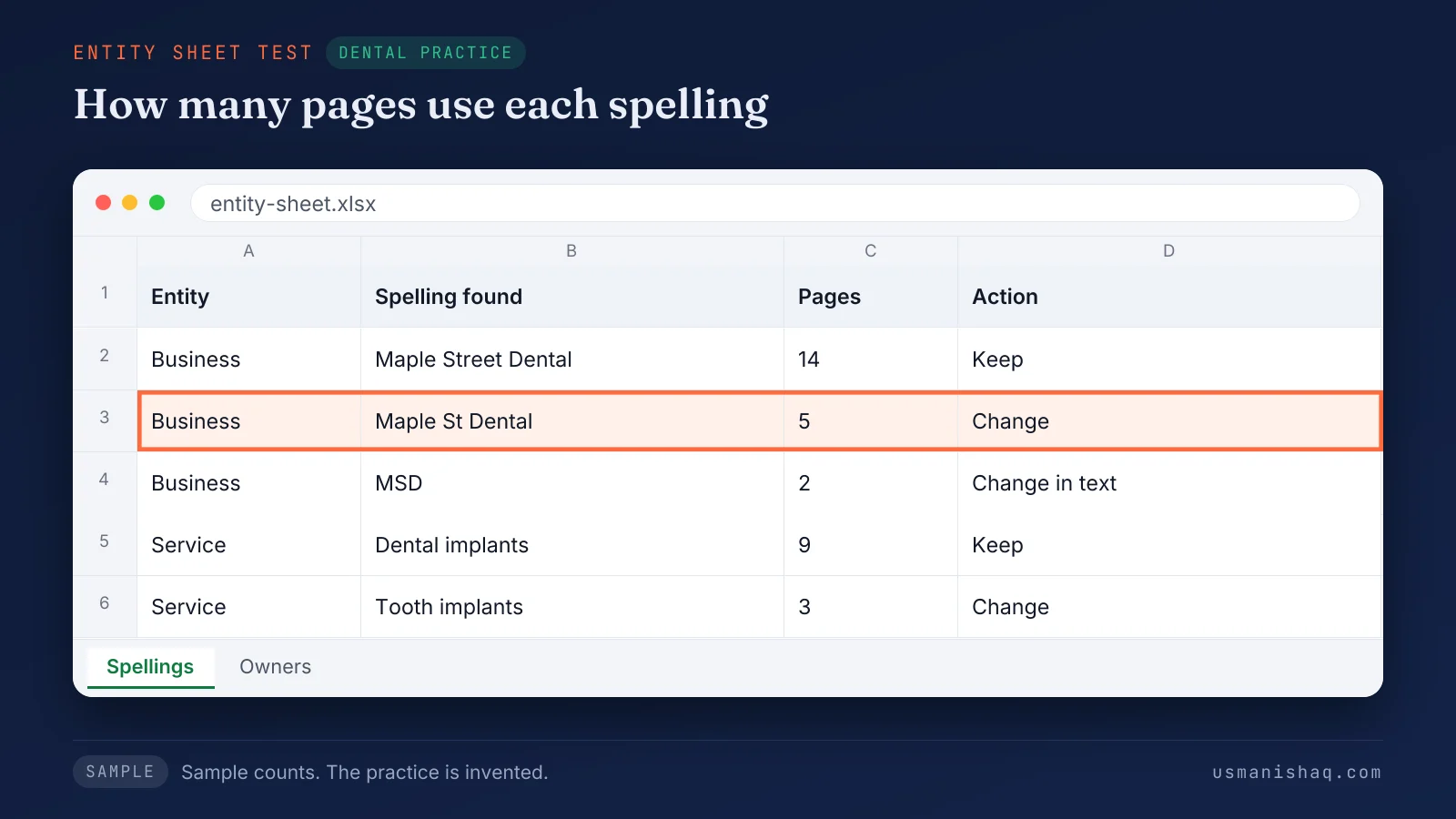
The sample dental practice gave this result. The sheet is a sample, and the counts show how the test reads.
| Entity | Spelling found | Pages | Action |
|---|---|---|---|
| Business | Maple Street Dental | 14 | Keep |
| Business | Maple St Dental | 5 | Change to the kept spelling |
| Business | MSD | 2 | Change in body text, keep in logo file name |
| Service | Dental implants | 9 | Keep |
| Service | Tooth implants | 3 | Change to the kept spelling |
The test has limits. A site: search shows indexed pages, not every page, and its counts are rough. It also cannot tell you which spelling people search for, so check your top queries in Search Console before you choose.
Where does structured data fit?
Structured data fits after the names are fixed, because markup repeats a page and cannot fix one that disagrees with itself.
Google documentation says structured data gives it explicit clues about the meaning of a page. Google's organization markup page says it can help Google understand your organization's administrative details and disambiguate it in search results.
That wording describes help with understanding. It does not promise a knowledge panel, a ranking or a citation in an AI answer.
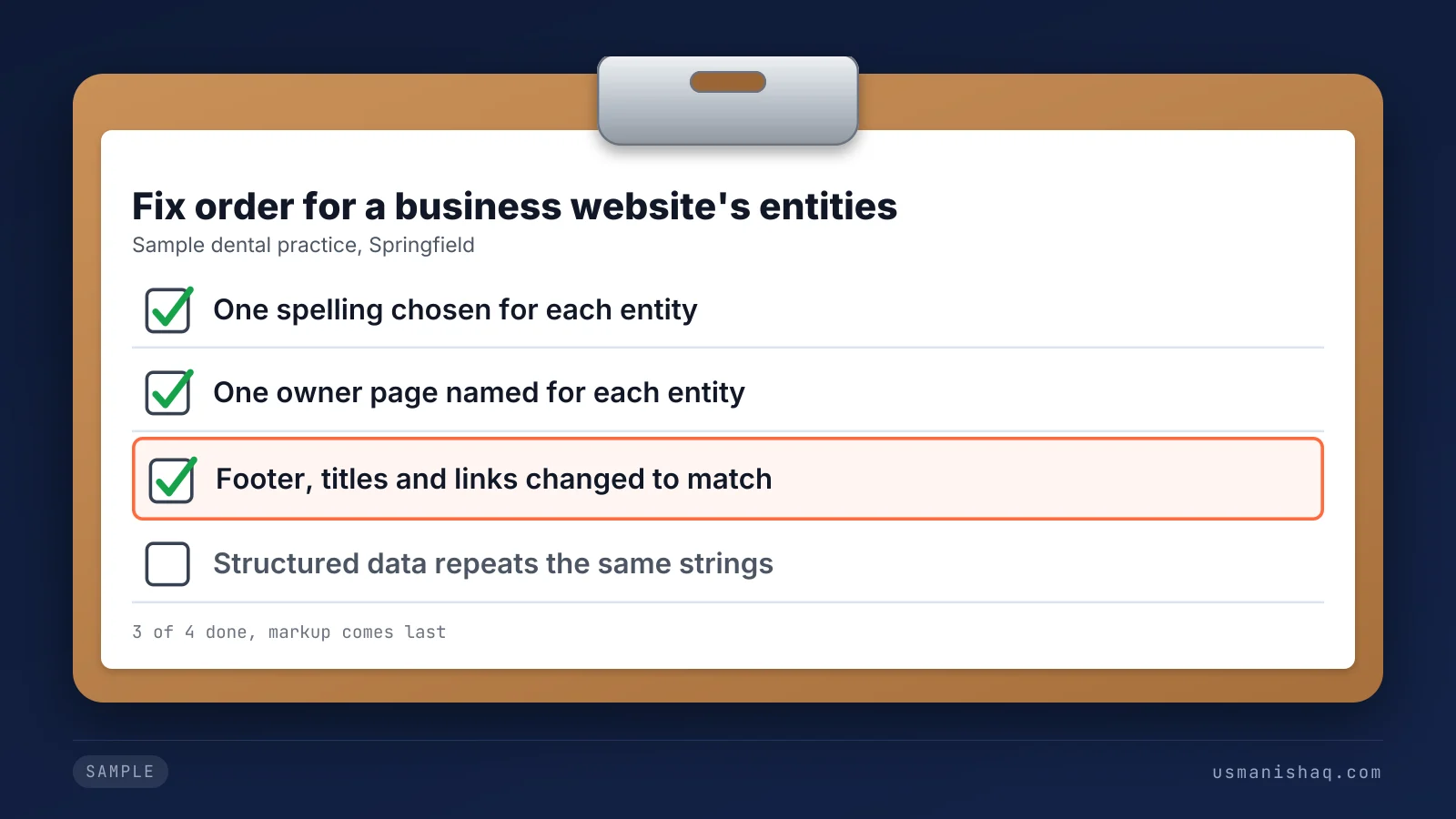
So the order matters. You fix the strings, then the owner pages, then the markup that repeats them. If the footer says "Maple St Dental" and the markup says "Maple Street Dental", you have added a second spelling.
The sample practice sits at three of four steps. It has chosen one spelling and one owner page for each entity, and it has changed the footer, titles and links. The structured data that repeats the same strings is still to do.
What owners ask after fixing their entity names
After the names are fixed, owners ask about site size, keyword research and their Google Business Profile.
Do I need entity SEO if my site has only ten pages?
Yes, a ten-page site needs entity work, because one spelling drift touches a large share of its pages.
A small site has less room for contradictions to hide. The entity sheet for ten pages should take under an hour. Which entity sits at the centre of the site is a separate decision, covered in the central entity of a business website.
Does entity work replace keyword research?
No, entity work does not replace keyword research, because searches still arrive as words and pages still need them.
What changes is the order. You choose the thing first and then the phrases that point at it. The full comparison, page by page, is in semantic SEO against traditional SEO on structure and authority.
How does this connect to my Google Business Profile?
Your Google Business Profile and your website should name the business, its services and its town in the same words.
A mismatch gives the same drift as an old footer, only outside your site. The checklist of what has to agree is in what must match between the website and the profile.
Entities on a business website in short
Entities on a business website are its named things, and each needs one exact name and one owning page.
List them, count the spellings, fix the strays and let structured data repeat what the pages already say. Keep keyword research, because people still search in words.