

A semantic SEO consultant fits a business with someone to write pages, and an agency fits one that needs a team.
Semantic SEO organises a website around entities and their attributes, so search engines and AI systems read what each page means. A semantic SEO consultant is one person who plans and directs that work. A semantic SEO agency is a team that plans the work and then delivers the pages.
The deciding question is who will do the work after the plan. Owners call the first option "my SEO guy" and the second "an SEO company". Both start from the same kind of plan.
The sections below compare the two roles, then set out how contact, price and proof differ. The last main section shows which one fits a business that wants to build semantic SEO into its website.
What is the difference between a semantic SEO consultant and an agency?
A semantic SEO consultant is one person who plans and directs the work, while an agency also writes and publishes.
Both roles can plan a topical map, audit existing pages and write page briefs. The split shows in who carries the plan onto the website. The two sections below cover what a consultant does and what an agency does.
The table sets the two roles side by side on six attributes.
| Attribute | Semantic SEO consultant | Semantic SEO agency |
|---|---|---|
| Who you talk to | The consultant who plans the work | An account manager or project lead |
| Who plans the work | The consultant | A strategist inside the team |
| Who writes and publishes pages | Your writer, web designer or staff | The agency's writers and developers |
| What you buy | Documents: topical map, audit, page briefs | Documents plus pages written, published and reported each month |
| Price shape | Fixed fee per document, or hourly | Monthly retainer |
| Proof to ask for | Documents the consultant wrote | The people and sample pages behind the account |
The row that decides is the third one: who writes and publishes the pages. Comparison guides written by agencies and by consultants agree on the core split. One person brings depth, and a team brings capacity.
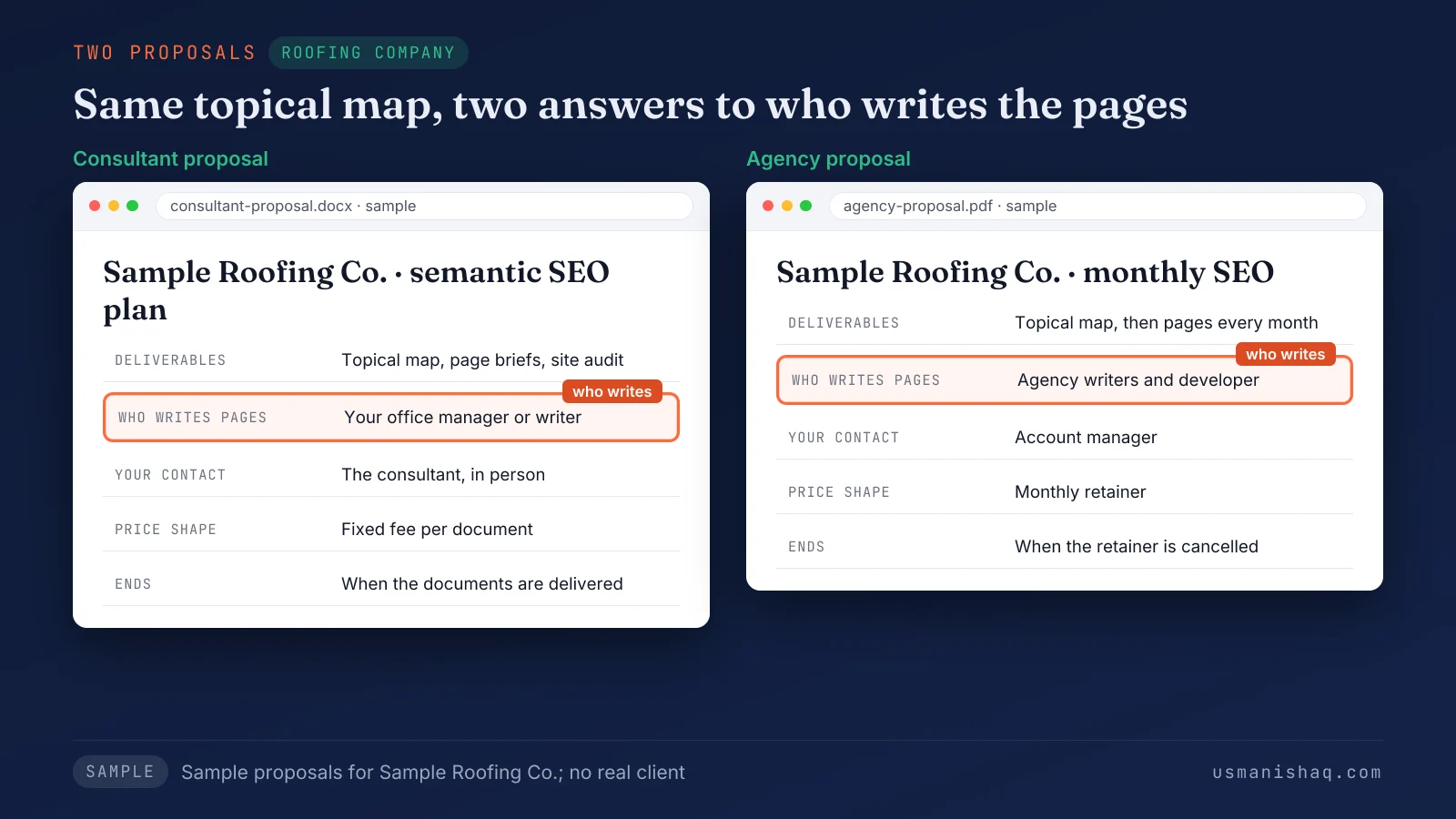
The sample consultant proposal for a roofing company lists a topical map, page briefs and a site audit. The owner's office manager or writer produces the pages, and the fee is fixed per document. The sample agency proposal adds pages written every month by agency writers, with an account manager and a monthly retainer.
What does a semantic SEO consultant do for a business?
A semantic SEO consultant plans the pages a website needs, audits the existing pages and writes the page briefs.
A topical map plans every entity, attribute and question a website must cover, and gives each one a page, section or sentence. A page brief tells a writer what one page must answer and in what order. The consultant also reviews drafts against those briefs and names the schema each page type needs.
The planning half of the work is usually sold as a fixed-scope project. Semantic SEO Architecture is one such project: a topical map and a roadmap, priced once. A Semantic SEO Architecture engagement ends with documents the owner keeps.
A generic SEO consultant holds the same role without the entity method. The semantic SEO consultant plans by entities and pages, not by a keyword list.
What does a semantic SEO agency do for a business?
A semantic SEO agency plans the work and then delivers the pages with its own writers, developers and an account manager.
The agency writes and publishes pages each month, fixes technical issues and sends a report. Some agencies resell work from another firm under their own name, which the trade calls white-label.
Owners on forums complain that some providers "just outsource their clients to upwork or even fiverr". An owner should ask who will touch the site, by name, before signing with any semantic SEO agency.
How do a semantic SEO consultant and an agency differ in contact, price and proof?
A semantic SEO consultant usually answers in person and charges per document; an agency adds an account manager and a monthly fee.
The three sections below cover contact, then price, then proof.
Who does an owner talk to with a consultant and with an agency?
A semantic SEO agency usually puts an account manager between the owner and the people doing the work.
A semantic SEO consultant answers the owner in person, because the consultant is also the person doing the planning. Google's guide "Do you need an SEO?" lists a question to ask any provider: "How can I expect to communicate with you?"
One person is a single point of contact and also, in the words of Digitaleer's comparison table, a "single point of failure". An owner should ask who answers during holidays and sick days.
How is the price of a consultant shaped compared with an agency?
A semantic SEO consultant usually charges a fixed fee per document or an hourly rate; an agency charges a monthly retainer.
The price shape follows what is bought. A topical map or an audit is finished once, so a fixed fee fits the work. Pages written and published every month repeat, so a monthly fee fits them.
Published rates differ widely between vendor guides, so none of them is quoted here. Owners feel the gap, and one plumbing owner wrote that "every agency prices it like I'm competing globally". A monthly retainer for semantic SEO is judged by the booked jobs it pays for, not by its size.
What proof should a consultant and an agency each show?
A semantic SEO consultant should show documents the consultant wrote; an agency should show its team and sample pages.
Three kinds of proof separate a real plan from a sales pitch:
- Sample semantic SEO documents: a topical map, a page brief or an audit, with the client name removed.
- A Search Console report: the business type, the metric and the date range stated beside the chart.
- Named people: who plans, who writes and who publishes on the account.
Google's guide also advises read access only to Search Console while a provider audits the site. Write access waits until the owner has seen the work.
Which one fits your business: a semantic SEO consultant or an agency?
A semantic SEO consultant fits your business when someone can write and publish pages, and an agency fits when nobody can.
The sections below cover when one consultant is enough, when a delivery team is needed, and whether the two can work together.
Four questions decide between a semantic SEO consultant and an agency:
- Who will write and publish the pages decides between a consultant and an agency first.
- The number of new pages the plan needs each month shows whether an agency team is needed.
- An owner who wants to keep and steer the semantic SEO plan leans toward a consultant.
- An owner who wants one contact for writing, fixes and reports leans toward an agency.
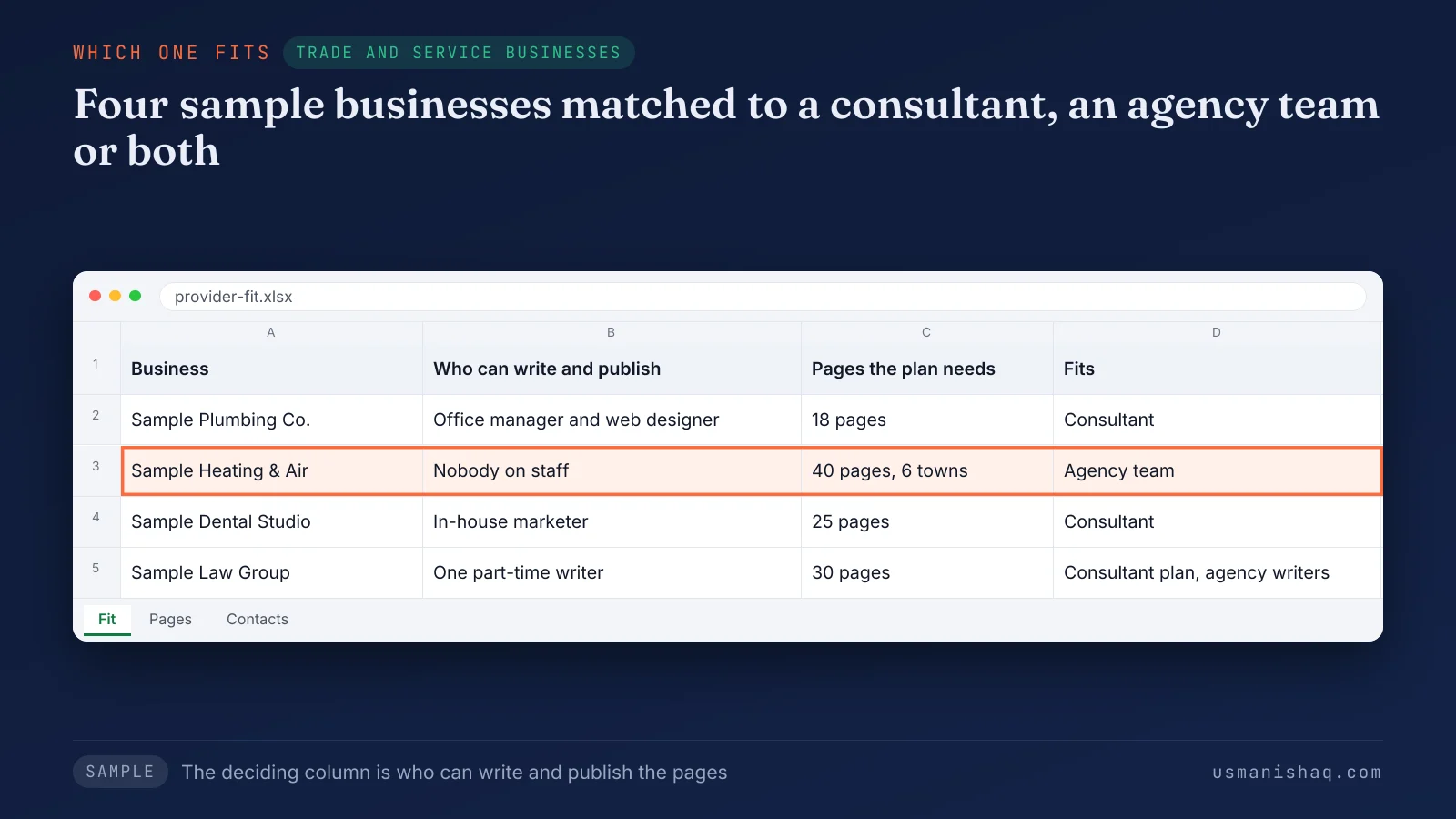
The sample sheet matches four businesses to a role. A plumbing company with an office manager and a web designer, needing 18 pages, fits a consultant. A heating and cooling company with nobody on staff and 40 pages across six towns needs an agency team.
A dental clinic with an in-house marketer, needing 25 pages, fits a consultant. A law firm with one part-time writer and 30 pages fits a consultant plan with agency writers.
When is one semantic SEO consultant enough?
One semantic SEO consultant is enough when a writer, web designer or office manager can already publish the pages.
Some owners put the need plainly: "point me in the right direction and I can do the leg work myself." That owner needs a plan and a reviewer, not a team.
Most of my planning work reaches a website through the owner's own people. I hand them the map and the briefs, then check each draft against its brief. A semantic SEO consultant alone stops being enough when the plan asks for more pages than those people can write.
When does a business need an agency's delivery team?
A business needs an agency's delivery team when the plan calls for more pages each month than anyone on staff can write.
A heating and cooling company that serves several towns may need a page for each service in each town. An owner who spends the day on jobs has no hours left to write those pages.
One owner whose hired help never acted wrote: "None of them have been able to take the lead." A semantic SEO plan with nobody to carry out the work changes nothing on the website.
Can a semantic SEO consultant direct an agency or in-house writers?
Yes, a semantic SEO consultant can direct an agency or staff writers, because the briefs tell each writer what to answer.
The owner keeps the plan in that setup. A change of writers then leaves the semantic SEO plan in place.
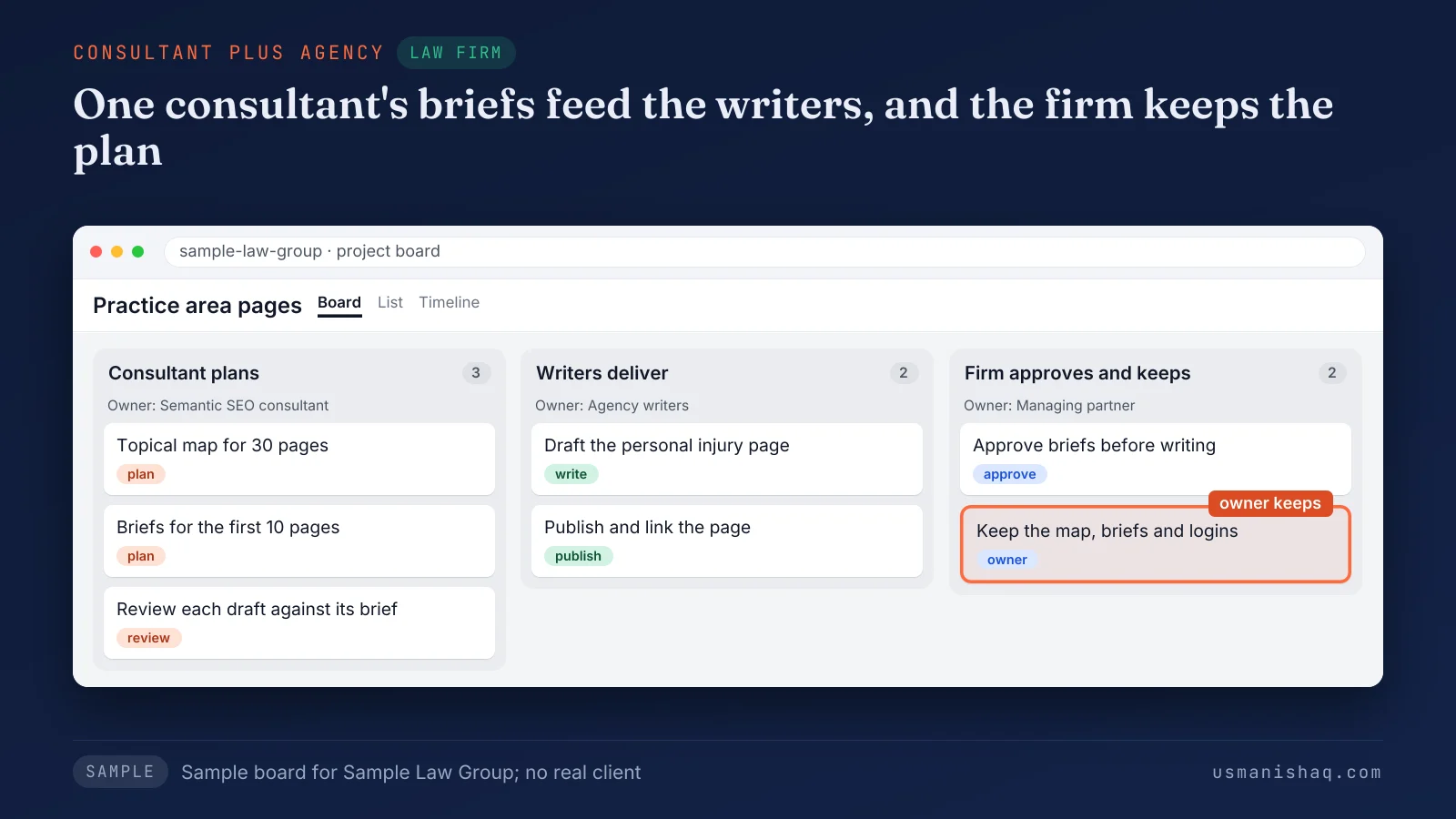
The sample board for a law firm has three columns. The consultant plans a topical map for 30 pages and briefs for the first 10. The agency writers draft and publish each page, and the managing partner approves the briefs and keeps the map and logins.
What should an owner check after choosing between a consultant and an agency?
A semantic SEO consultant or agency still has to be compared and tested before any contract is signed.
The sections below cover comparing consultants, testing a provider, freelancers and doing the work without a provider.
How do you compare semantic SEO consultants with each other?
Semantic SEO consultants are compared on method, proof, scope and who does the work, set side by side in writing.
A ranking list of names says nothing about fit for one business. The written criteria are set out in the guide on how to compare semantic SEO consultants.
How do you test a provider before signing a contract?
A semantic SEO provider is tested with one small paid task on the owner's own site, before any monthly contract.
An owner can test an SEO consultant or an agency the same way and judge the returned document. The steps are in the guide to test an SEO consultant with one paid task.
Is a freelancer the same as a semantic SEO consultant?
No, a freelancer is anyone selling SEO hours alone, while a semantic SEO consultant plans with one documented method.
An owner should ask any freelancer which method the work follows and which documents the owner receives.
Can a small service business do semantic SEO without hiring anyone?
Yes, a small service business can do much of the work itself, and Google's own hiring guide says so.
Google's guide, Do you need an SEO?, tells small local businesses: "you can probably do much of the work yourself." The semantic SEO plan is the hardest part to do alone, because the plan decides which pages exist.
Questions owners ask about choosing a consultant or an agency
A semantic SEO consultant or an agency still leaves owners three questions: guarantees, time to calls and what to keep.
Can a consultant or an agency guarantee first place on Google?
No, neither a semantic SEO consultant nor an agency can guarantee first place on Google.
Google's guide is direct: "If they guarantee you that their changes will give you first place in search results, find someone else."
How long does a consultant or an agency take to bring calls?
The provider role does not set the timeline; the pages, the competition and the starting state of the site set the timeline.
Owners on forums advise asking for the "expected turn around time for rankings" before signing. A useful answer names the semantic SEO pages involved.
What should an owner keep when changing SEO provider?
An owner should keep the topical map, the page briefs, the content and every account login when changing a semantic SEO provider.
Logins for Search Console, Google Business Profile and the website host should sit in the owner's name from the first day.
What decides between a semantic SEO consultant and an agency?
A semantic SEO consultant or an agency is decided by who will do the work after the plan.
A consultant fits a business with people who can write and publish. An agency fits a business that needs those people supplied.
Both roles build semantic SEO into a website from the same kind of plan. An owner who understands that split can judge either offer.