
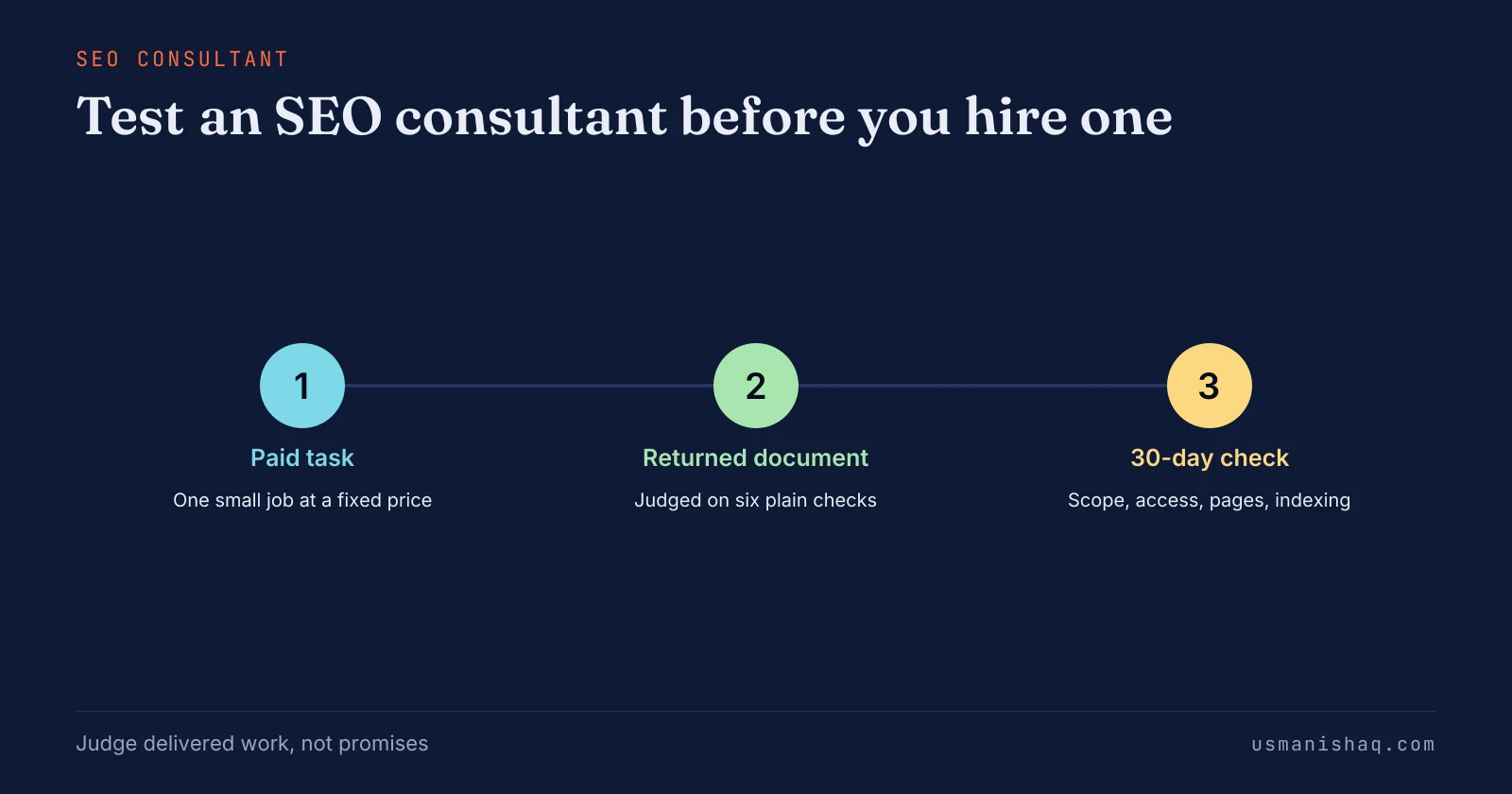
An owner tests an SEO consultant before hiring with one small paid task on the business website, then judges the document the consultant returns. The same test fits a semantic SEO consultant, whose audit or page brief shows how the consultant understands the business.
A fair paid test task is one small piece of SEO work on the business website, at a fixed price, with a written result. An audit suits most first tests, such as a paid Semantic Content Audit that returns a written issue map.
An owner judges the document a paid SEO test returns on six plain checks, and none of the six needs SEO knowledge. A sample SEO report from a consultant should show the work done and the pages changed, in plain words.
A 30-day check after hiring an SEO consultant compares the delivered work with the written scope, the access, the changed pages and their indexing.
A paid test shows the consultant's work, and first-call questions show how the consultant explains the work, so the two answer different doubts. Owners without a shortlist compare semantic SEO consultants on written criteria before choosing which one to test.
How do you test an SEO consultant before hiring?
An owner tests an SEO consultant before hiring with one small paid task on the business website, then judges the document the consultant returns.
Owners ask how to know if an SEO consultant is "really good", or "the real deal", before they hire. A paid test is one small piece of real SEO work on the owner's own site, at a fixed price. The test is for an owner hiring an outside consultant, and skills tests for job candidates are a separate subject.
The four steps of a paid test are listed below:
- Commission one small task from the consultant at a fixed price, agreed in writing.
- Judge the returned test document on plain checks that need no SEO knowledge.
- Read one sample report from the consultant's past work.
- Set a check 30 days after hiring the consultant, against the written scope.
Consulting based on testing rather than guesswork means the owner judges delivered work, not promises. The same four steps answer how to vet or evaluate an SEO consultant.
A semantic SEO consultant is tested the same way, with an audit, a page brief or a website topical map row. Forum answers on hiring point owners to case studies and references instead.
Why does a paid test show more than case studies and references?
A paid test shows the consultant's work on the owner's own site, while case studies and references show results on other sites.
Owners judge consultants today on samples, case studies, reviews and references. A case study shows the result a consultant chose to share, on a site the owner has no access to.
Google's hiring guide "Do you need an SEO?", last updated on 5 June 2026, still advises a reference check: "Ask past clients if they felt that this SEO provided useful service, was easy to work with, and produced positive results."
The paid test shows how the consultant reads the owner's site, writes and explains, which no case study shows. One Reddit reply on hiring reads: "I would test any SEO expert before hiring them, even if it required paying for their work to complete the test."
A semantic SEO test task shows whether the consultant plans pages around the services and towns the business serves.
What makes a fair paid test task for an SEO consultant?
A fair paid test task is one small piece of SEO work on the business website, at a fixed price, with a written result. Two questions follow from the task: free audits and access.
The qualities of a fair paid test task are listed below:
- Small scope: the test task returns one document, such as a content audit or one page brief for one service page.
- Fixed price: the task carries one flat fee, agreed in writing before any access is granted.
- The owner's own site: the task reads the business website, never a sample site.
- A written result: the test returns a document the owner keeps, hired or not.
- A delivery date and a review call: the written scope names the day the document arrives and a call on the findings.
The written result is what practitioners call the "deliverable". The price of the test task belongs in the written scope, and the price of a consultant is a separate question.
An audit suits most first tests, because an audit reads the whole site. A Semantic Content Audit is a flat-fee audit of the content on a website. A paid Semantic Content Audit returns a written issue map of the site, ranked by the cost of each fix.
A semantic SEO consultant's natural test tasks are a content audit, one page brief and one row of a website topical map. Some consultants offer a free audit instead.
Is a free SEO audit a fair test of a consultant?
No, a free SEO audit is a weak test of a consultant, because free audits are usually tool scans written to open a sale. Some sellers admit a free audit is a tool run and a quick look, aimed at a sales conversation.
Google's hiring guide warns: "Be wary of SEO firms and web consultants or agencies that email you out of the blue." A free audit shows sales skill, and a paid test shows the work the owner will get.
The paid test document stays with the owner after the test ends. A free semantic SEO audit rarely reads the pages one by one, which is the work an owner needs to see. A paid task still needs the right access.
What access should an SEO consultant get during a paid test?
An SEO consultant should get read access to Google Search Console during a paid test, while the business keeps the Owner role. Google Search Console is Google's free report on how a website appears in Google Search.
Google's hiring guide advises, for the audit stage: "only grant read access to Search Console (at this stage, don't grant them write access)." The Search Console Help page "Managing owners, users, and permissions" names three roles.
An Owner "Has full control over properties in Search Console." A Full user "Has view rights to all data and can take some actions." A Restricted user "Has simple view rights on most data."
The owner should add the consultant as a Full user or a Restricted user, never as an owner. The written scope says which reports the test task needs. A test audit also needs read access to analytics and a view-only website login.
A semantic SEO audit reads Search Console page by page, so read access covers the whole test. The owner should remove the user once the returned document arrives and the test ends without a hire.
How do you judge the document a paid SEO test returns?
An owner judges the document a paid SEO test returns on six plain checks, and none of the six needs SEO knowledge. "I know very little about SEO" is the worry the checks answer. The checks also sort audits from tool exports.
The checks for a paid SEO test document are listed below:
- The business: the document reflects the owner's services, towns and customers. Google's guide sets the standard: "Your SEO should ask questions about what makes your business unique, who your competitors are, how search results can help, and how your customers find you."
- Named pages and searches: every finding names a page and the search the page affects.
- An order of work: the findings are ranked, with the first fix and why the fix comes first.
- Estimates: the document meets Google's line: "An SEO audit should be about giving you realistic estimates of improvement, and an estimate of the work involved."
- Reasons and sources: each finding gives "detailed information about your recommendations and the reasoning behind them", in Google's words. The guide also asks: "Do they cite official Google documentation as supporting evidence for their recommendations?"
- No ranking promise: Google's guide is direct: "If they guarantee you that their changes will give you first place in search results, find someone else."
A document that passes the six checks can be acted on the next day. One that fails is a report the owner files away: "sold a report instead of a result", in one owner's words.
Five checks read the content of the test document, and the sixth reads any promise.
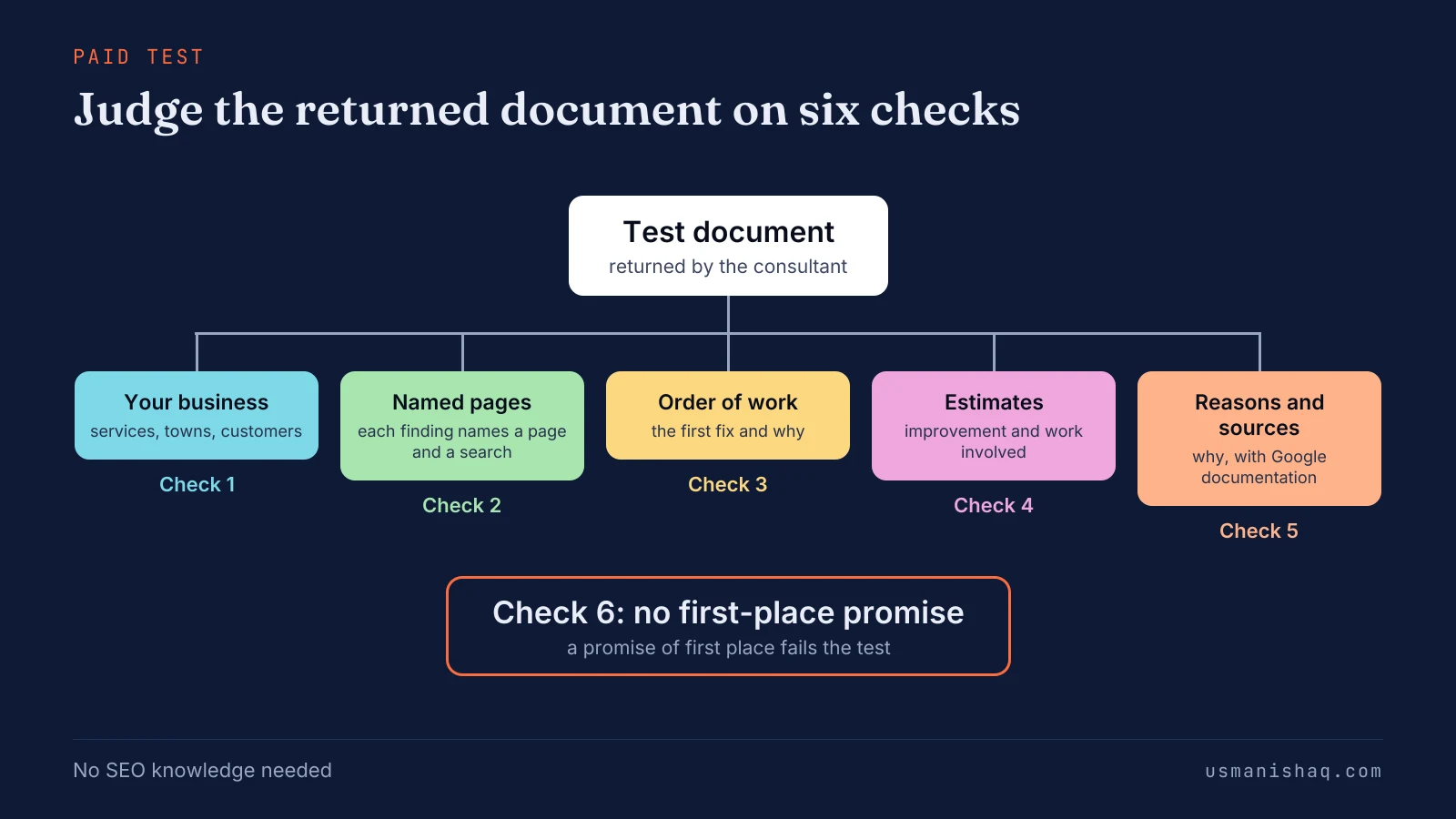
A semantic SEO document passes check 2 when every finding names the page that should answer the search. A paid test document can still turn out to be a tool export.
How do you tell a consultant's audit from an SEO tool export?
A consultant's audit ranks a few named fixes for one business, and an SEO tool export lists every error the software detects. A tool sorts by error type and count, and a consultant sorts by the services and searches that bring the business work.
Google's hiring guide advises: "Before making significant changes to your site based on a third-party tool's audit, be sure to check their recommendations against official guidance from Google Search". Both documents can find the same broken pages. The order and the reasons differ between the two documents.
A thicker PDF is not a better document. A long tool export is still a generic report, with the same sections for every site. One practitioner admits that software audit reports "are pretty much useless without" an expert reading the reports.
An AI chat tool can list errors too, and the order of work still needs a person who knows the business. Semantic SEO findings name the page that should own each search, which no error count shows. A plumbing company's test shows the difference.
What does a strong test finding look like for a plumbing company?
A strong finding in a plumbing company's test names one page, the search the page should answer and the reason the fix comes first. The example is a plumbing company based in Springfield that also serves Franklin and pays for a small audit.
A weak finding reads: "Add more keywords to the service pages." The weak finding names no page, no search and no order.
A strong finding reads: "Searches for repiping in Franklin land on the Springfield repiping page. Build one Franklin repiping page first, before any new blog post."
The strong finding names the page, Franklin repiping, and the search, repiping in Franklin. The same finding names the order, first. The finding sizes the effort at one page.
The strong finding carries four parts, and the weak version carries none.
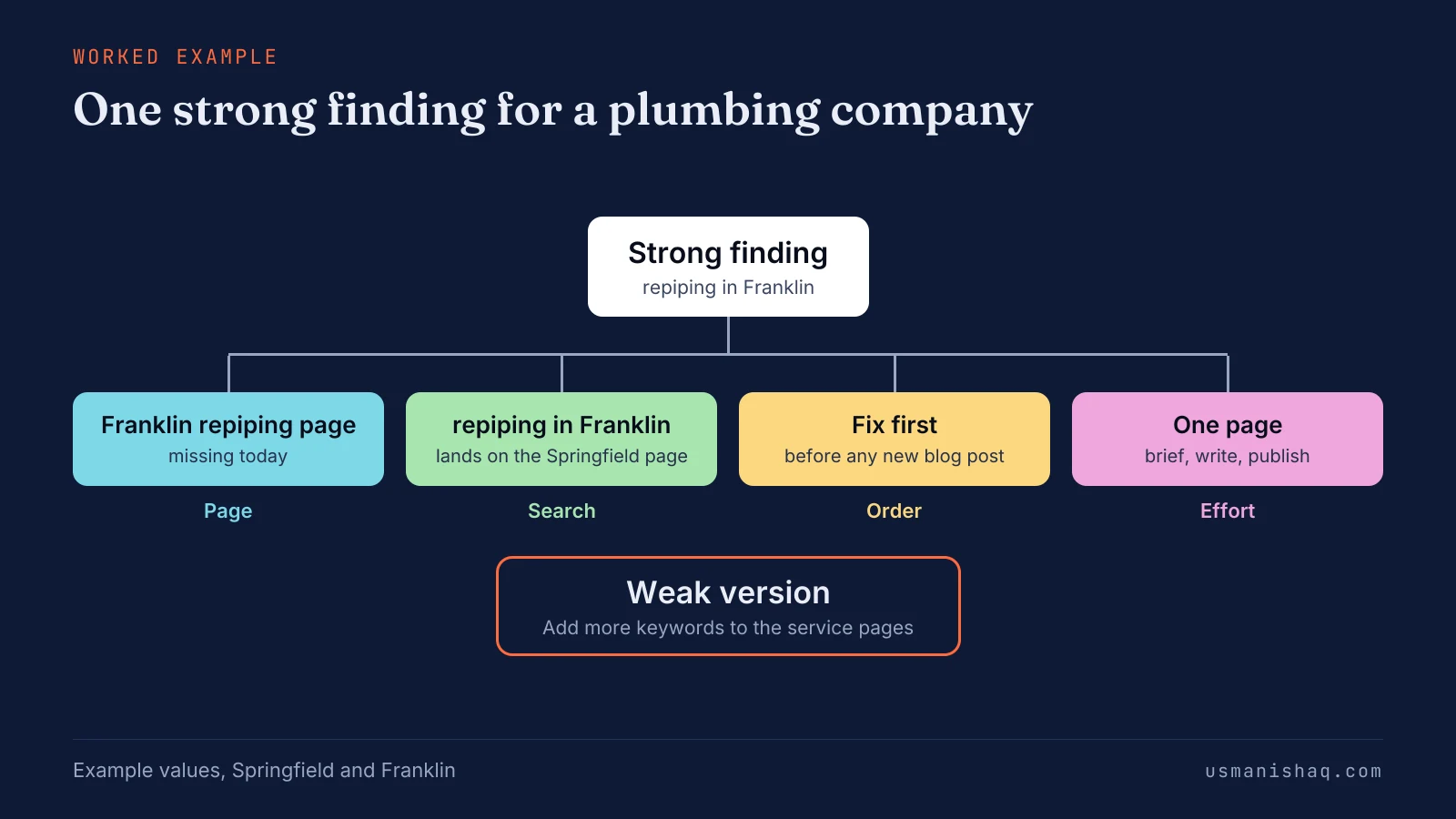
Semantic SEO plans one page for each service in each town, which is why the Franklin finding names a page. A strong test finding shows how a consultant plans, and a sample report shows how the consultant reports.
What should a sample SEO report from a consultant show?
A sample SEO report from a consultant should show the work done, the pages changed and what changed in Search Console, in plain words. The owner should ask for one past monthly report, with the client's name hidden.
CO, the small business guide of the US Chamber of Commerce, advises an owner to request a sample report. The same guide advises asking how the report's numbers would differ for the owner's business goals.
A sample report that shows charts and rankings with no list of work done fails the test. One owner described the doubt as not knowing whether the site was getting healthier or "just getting a fancy PowerPoint".
The measure owners care about is calls and booked jobs, with Search Console clicks to service pages as the signal. A semantic SEO report lists each page by the search the page was built to answer. The sample shows the reporting habit before hiring, and the first real check comes 30 days after.
What should an owner check 30 days after hiring an SEO consultant?
A 30-day check after hiring an SEO consultant compares the delivered work with the written scope, the access, the changed pages and their indexing. The check answers the owner's question "is my SEO guy doing anything" in month one. Ranking movement sits outside the month-one check, for the reason the next answer gives.
The four checks at 30 days are listed below:
- Work against scope: each line of the written scope is delivered or carries a date.
- Access: the business is still the Owner in Search Console, and the consultant is a user.
- Changed pages: the consultant names each page changed and what changed on the page.
- Indexing: the page indexing report in Search Console shows if the changed and new pages are indexed.
The first report from the consultant should say what was done and what changed. Four checks read the work in month one, and rankings wait for later, as the figure below shows.
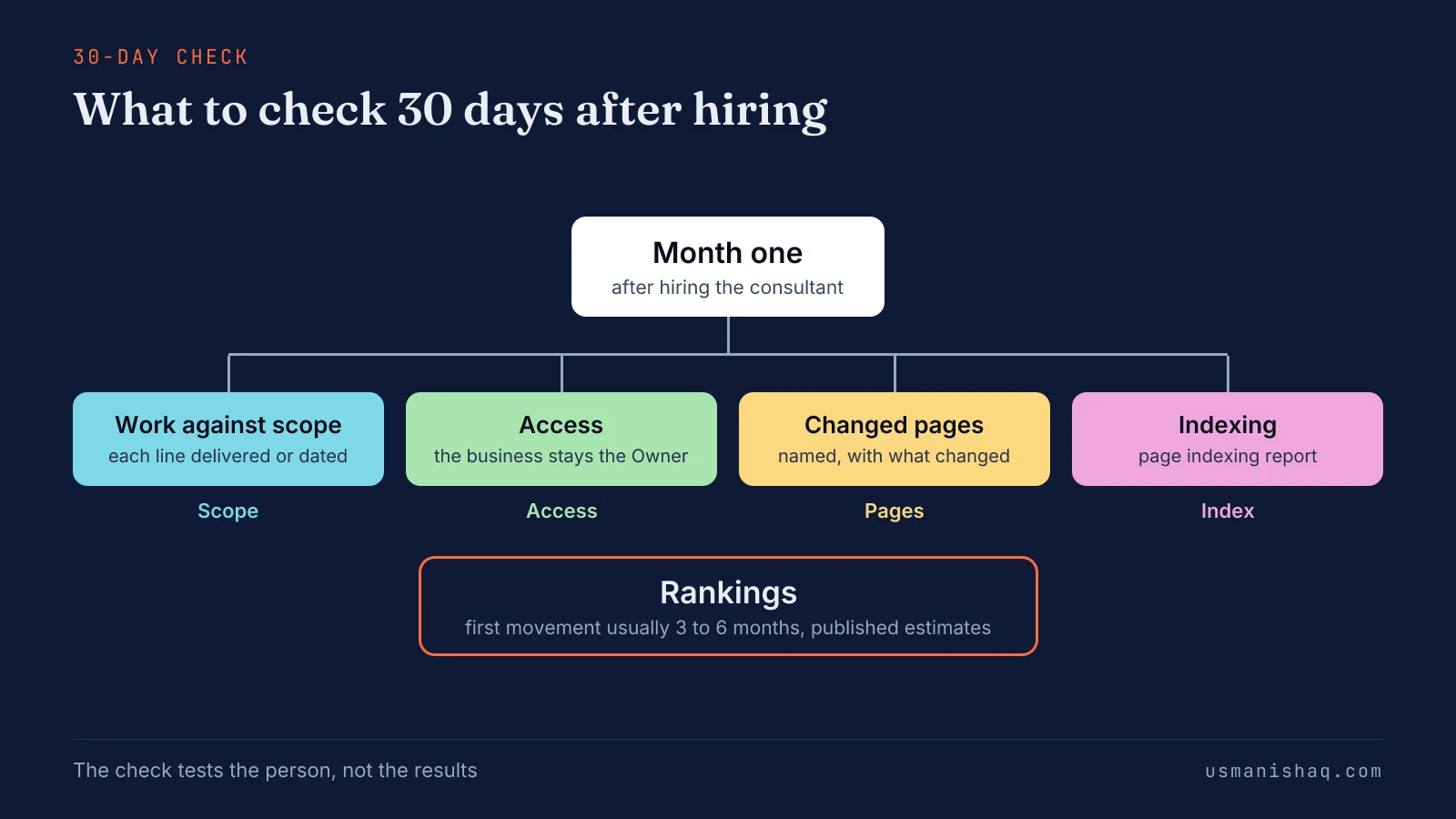
A semantic SEO plan names the pages for month one, so the 30-day check has a list to compare. Owners still ask about rankings at the 30-day mark.
Should rankings change within 30 days of hiring an SEO consultant?
No, rankings usually do not change much within 30 days of hiring an SEO consultant, so the check measures delivered work. The US Chamber of Commerce's CO hiring guide for small businesses, updated in July 2026, places the first gains in months three to six. SEO providers who publish timelines usually put first ranking movement at three to six months.
Each provider behind that estimate sells SEO work. Google's hiring guide "Do you need an SEO?" gives no timeline. One owner recalls a sales pitch that promised a phone "flying off the hook".
The 30-day check tests the person, not the results, from the owner's point of view. Semantic SEO pages need time to be crawled and indexed before rankings can move. First-call questions are another way to judge a consultant.
Is a paid test better than first-call questions for choosing an SEO consultant?
A paid test shows the consultant's work, and first-call questions show how the consultant explains the work, so the two answer different doubts. First-call questions are quick to ask.
First-call questions are judged by ear. A paid test costs a fee and is judged on paper.
Both methods judge the same person. Each method should turn to the owner's business.
The call comes first in practice. The paid test goes to the one or two consultants who pass the call.
An owner short of time should start with the call. An owner burned before, "really disappointed after spending tons of money", should test before signing.
A separate guide sets out the questions to ask a semantic SEO agency on the first call. A semantic SEO consultant can answer first-call questions with the same documents a paid test returns. Both steps start with knowing which consultant to test.
How do you choose which SEO consultant to test?
An owner chooses which SEO consultant to test by comparing two or three consultants on written criteria, then testing the strongest one. One owner on a Reddit thread had spoken to three providers and asked how to choose between them.
Owners who compare semantic SEO consultants on written criteria have a shortlist of consultants worth hiring before any test. The price of a consultant is a separate question, answered on the same comparison page.
Some consultants answer a request for a test with an offer of a trial month instead.
Is a paid test the same as a trial month of SEO work?
No, a paid test is one document at a fixed price, while a trial month buys a month of ongoing SEO work. Some consultants offer a trial period or month-to-month terms, and others ask for a minimum term of several months.
A trial month tests delivery speed, and a paid test tests judgement on paper. Rankings rarely move in month one. One owner feared having to "commit to months of work" up front.
An owner holding a monthly SEO retainer quote judges the quote by whether booked jobs cover the fee. Semantic SEO work starts with fixed documents, so a paid test fits the first step better than a trial month. A website topical map is one fixed document.
How do you check a topical map delivered as a paid test?
An owner checks a website topical map from a paid test by finding the page the map assigns to each search the business wants. The services and towns of the business set the sample: three services in two towns give six searches to look up.
A hand-built SEO topical map gives every search one owning page, and an AI-generated map gives a list of topics.
The map row and the page brief are the documents that show semantic SEO capability, or semantic search optimization in the query's own words. The evidence after the hire moves from test documents to monthly reports.
How do you read an SEO consultant's reports after the 30-day check?
An owner reads each SEO report after the 30-day check in calls and booked jobs, with Search Console as the record of searches. A guide on how to read an SEO report separates the Search Console numbers that show demand from the numbers that show progress.
Google's hiring guide Do you need an SEO? advises: "Ask for explanations if something is unclear." An owner seeing higher rankings without extra calls should ask the consultant for the reason. The Owner role kept in Search Console keeps every report checkable after the consultant leaves.
A semantic SEO report ties each new page to its own clicks, which makes the monthly reading short. The remaining questions owners ask concern the test itself.
Questions owners ask about testing an SEO consultant
Owners testing an SEO consultant ask five further questions, about paying twice, free test work, two consultants, who does the work and weak results.
Does paying for a test mean paying twice for SEO?
No, a paid test pays for the findings, and the later SEO work pays for the fixes those findings name. A semantic SEO audit names the fixes in order, so the later work starts at the first fix instead of a second audit.
Is it fair to ask an SEO consultant for free test work?
No, free test work asks the consultant for unpaid labour, and a paid task gets the full work the owner wants to judge. A fixed price also fixes the scope, so both sides know what the test covers.
Can an owner give the same test task to two SEO consultants?
Yes, the same task given to two consultants returns two documents the owner can compare on the same six checks. The scope, the price and the delivery date stay the same for both consultants.
Should the consultant who did the test do the paid work?
Yes, the written scope of the paid work should name the person who did the test as the person doing the work. Practitioners note that the person on a sales call is not always the person who does the work.
What should an owner do when the test document is weak?
An owner should not hire on a weak test document, and the fee has still bought a written view of the site. A second consultant can take the same test task.
What is the next step before hiring an SEO consultant?
The next step before hiring an SEO consultant is one small paid test, judged on the returned document and checked again at 30 days.
An owner who understands the six checks can judge a test document without SEO knowledge. Semantic SEO builds the pages the strongest findings name, one service and one town at a time. The test judges delivered work, not promises.