
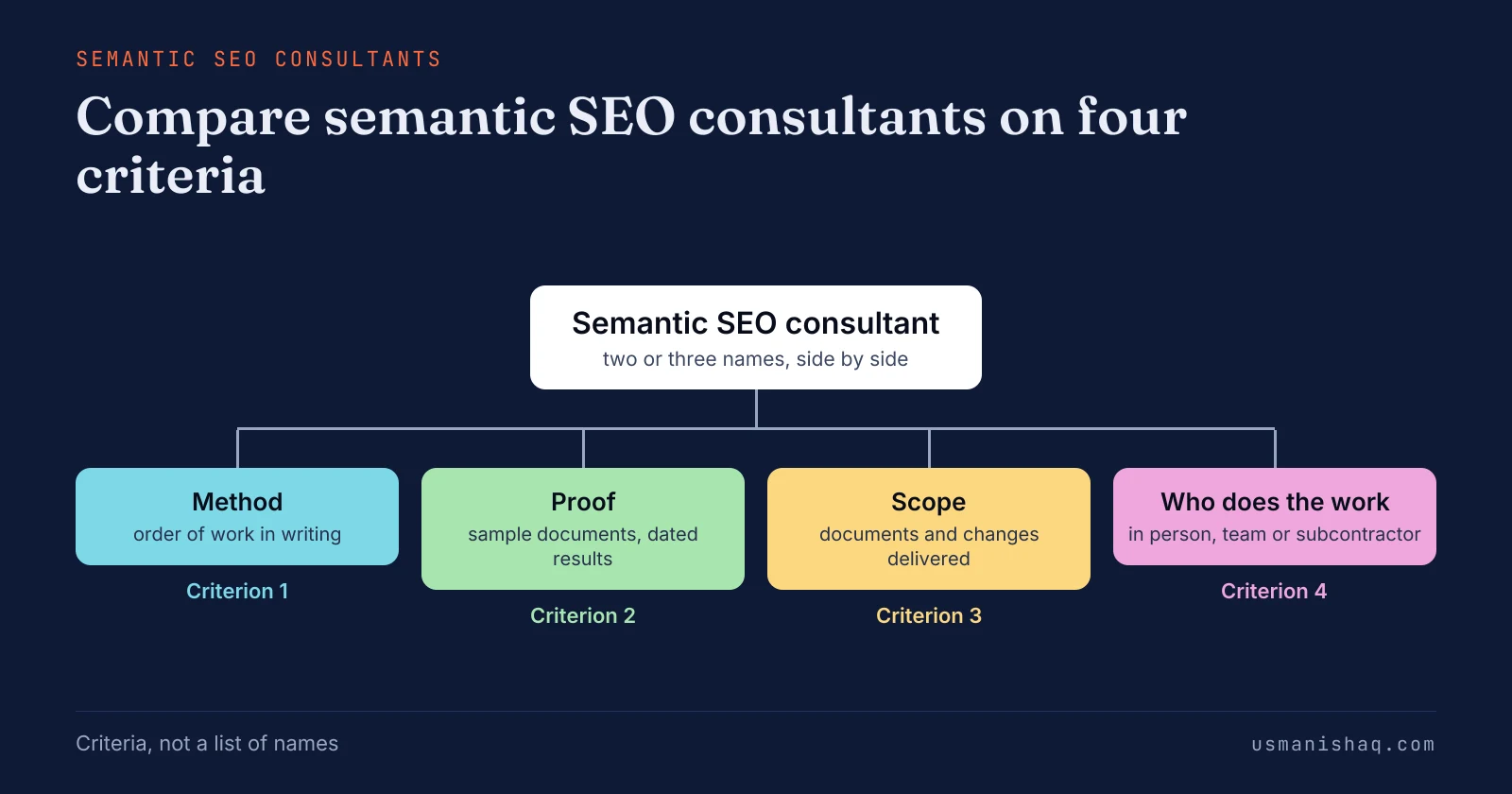
The semantic SEO consultants who are best for a business score highest on four written criteria for its problem: method, proof, scope and who does the work. A semantic SEO consultant is an SEO consultant who decides which entities, pages and questions a website covers, and hands those decisions over as written documents.
Four criteria separate semantic SEO consultants: the method they follow, the proof they show, the scope they deliver and the person who does the work. An owner compares semantic SEO consultants side by side by filling the same four criteria for two or three names, using each consultant's own site and documents, before any call.
A semantic SEO consultant's cost is set after a diagnosis of the site, so most consultants publish no rate and quote a fixed price for a written scope.
Which semantic SEO consultants are best?
The semantic SEO consultants who are best for a business score highest on four written criteria for its problem: method, proof, scope and who does the work. No single semantic SEO consultant suits every business, since the right choice depends on the problem, the industry, the business size and its goals.
The four written criteria for comparing semantic SEO consultants are given below:
- Method: the order of work the consultant follows, stated in writing.
- Proof: sample documents and dated results on sites like the buyer's.
- Scope: the documents and changes the consultant delivers.
- Who does the work: the consultant in person, a delivery team or a subcontractor.
The same four criteria apply to an entity SEO consultant, because entity SEO names the same work as semantic SEO. Written criteria let an owner tell good from generic before a single call.
Lists of named consultants rarely state their criteria, and some are written by a firm that places itself first. A list of names written by a consultant places its own author on the list, so the comparison here places no consultant on a list and hands the criteria to the reader.
Each criterion judges what a semantic SEO consultant does, so the role comes first.
What does a semantic SEO consultant do?
A semantic SEO consultant is an SEO consultant who decides which entities, pages and questions a website covers, and hands those decisions over as written documents.
The consultant organises a website around topics, search intent and entity relationships, rather than isolated keywords. The work uses entities, structured data and internal links, so search engines and AI systems read what each page means.
The written documents a semantic SEO consultant delivers are given below:
- Topical map: the plan of every entity, attribute and question a website must cover, with one owning page, section or sentence for each.
- Content brief: the heading-by-heading instruction a writer follows for one page.
- Audit: a written issue map of the existing site, ordered by the cost of each fix.
- Schema plan: the structured data that states what each page shows.
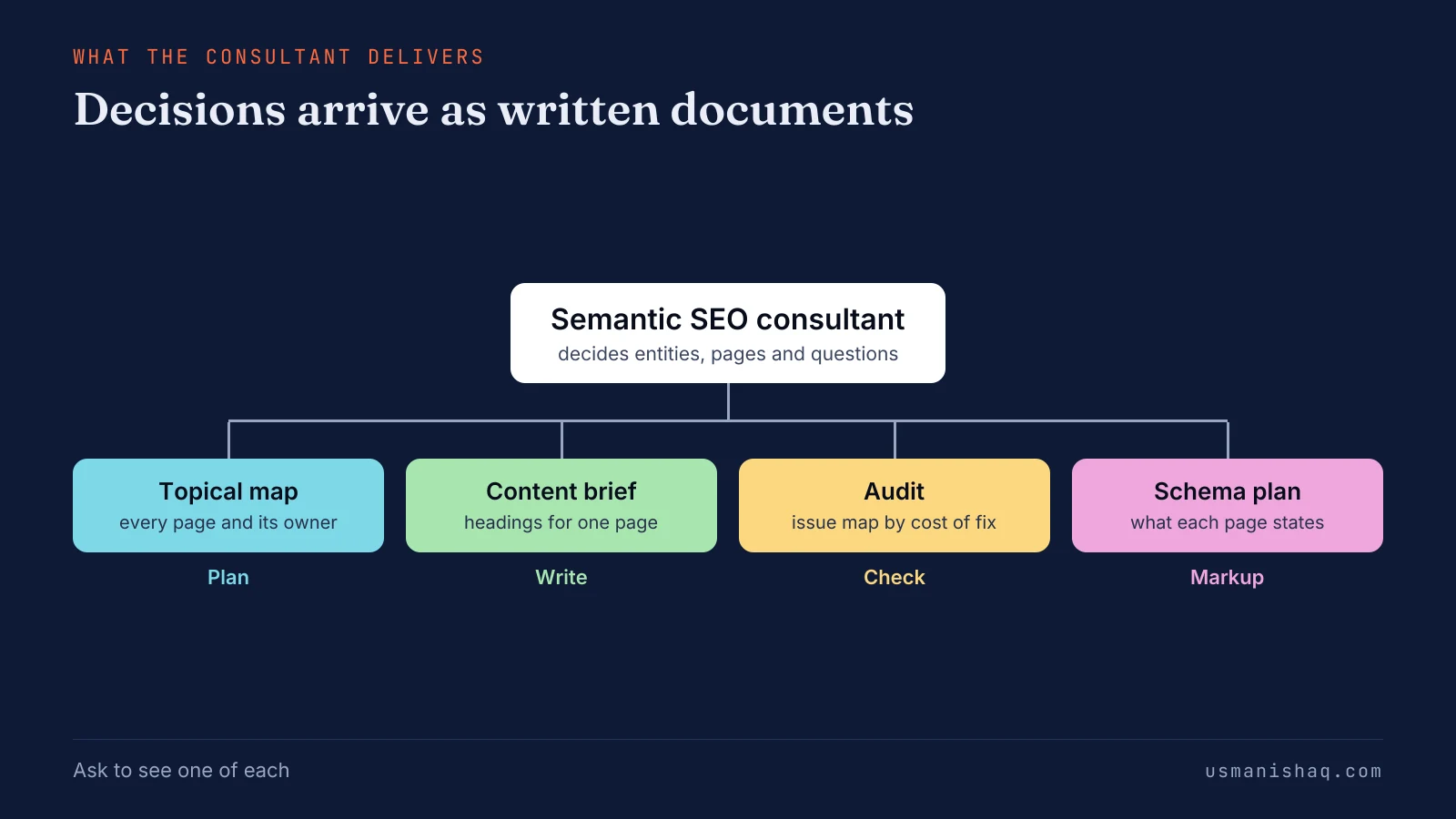
A buyer can ask to see each document in the figure before hiring. Owners also search for a semantic SEO expert or a semantic SEO specialist for the same role.
A consultant who sets the strategy and then advises on each page works as a semantic SEO strategist and consultant. The work of a semantic SEO strategist and consultant starts with understanding the business and ends with pages the owner can build from the documents.
Holistic SEO & Digital, the firm of Koray Tuğberk Gübür, defines holistic SEO as technical, semantic, local, programmatic, on-page and off-page SEO together. A holistic SEO consultant therefore covers semantic SEO as one part. Semantic SEO vs traditional SEO differ in the unit of planning: entities and questions against single keywords.
The word "semantic" also names semantic search, a different job.
How is a semantic SEO consultant different from a semantic search consultant?
A semantic SEO consultant changes how search engines and AI systems read a business website, while a semantic search consultant builds meaning-based search inside a company's own software. Google Cloud defines semantic search as "a data searching technique that focuses on understanding the contextual meaning and intent behind a user's search query, rather than only matching keywords."
A semantic search consultant builds that technique into a product, such as a catalogue search or an internal knowledge base. An owner who wants a website found in Google and named in AI answers needs a semantic SEO consultant.
Both roles share a word, so an owner checks the role before comparing on the four criteria.
Which criteria separate semantic SEO consultants?
Four criteria separate semantic SEO consultants: the method they follow, the proof they show, the scope they deliver and the person who does the work. Every provider repeats one "context and intent" definition, so the four criteria separate good from generic.
The table below sets each criterion against what a strong consultant shows, the document to ask for and the weak sign.
| Criterion | What a strong consultant shows | Document to ask for | Weak sign |
|---|---|---|---|
| Method | The order of work in writing, starting from the business and its customers | A method outline or one sample topical map row | "Semantic SEO" with no order of work |
| Proof | Dated results on sites like the buyer's, with business type and period | An anonymised topical map, brief or audit, plus Google Search Console results with their period | A rank on a list; charts with no period or business type |
| Scope | A written list of documents and changes, with what is excluded | The written scope | "Full semantic SEO" with no document named |
| Who does the work | The person who plans and the person who writes, named | Named roles in the written scope | Work handed to people the buyer never meets |
A buyer copies the four rows into a blank sheet, one column per consultant, and fills each cell from that consultant's site. Method comes first, since the other criteria follow from the order of work.
How do you judge a semantic SEO consultant's method?
A semantic SEO consultant's method is judged by whether the consultant states the order of work in writing, from the business and its customers to the pages and their links.
Google's hiring guide "Do you need an SEO?" puts the business first: "Your SEO should ask questions about what makes your business unique, who your competitors are, how search results can help, and how your customers find you."
A written method lists its steps in order: the business, its customers' searches, the topical map, the page briefs and the links. The Koray Tuğberk Gübür framework is one published method with that order.
Semantic SEO is not writing more content, because the method decides what to cover and in which order. Selling "more blog posts" as the method is the weak sign. A consultant with a written method can take the lead.
A method on paper still needs proof that the method works.
What proof should a semantic SEO consultant show?
A semantic SEO consultant shows proof through sample documents and dated results on sites like the buyer's, not through a rank on someone else's list.
The proof a buyer can ask a semantic SEO consultant to show is given below:
- A sample topical map: a few anonymised rows showing pages, questions and owners.
- A sample content brief: one page's headings and instructions.
- A sample audit: findings that name a page, a search and an order of work.
- Search Console results: the business type, the country, the metric and the period.
Google's guide adds a check on references: "Ask past clients if they felt that this SEO provided useful service, was easy to work with, and produced positive results." Results count in calls, demos and booked jobs, not in "beautiful dashboards" while the phone stays silent.
Proof shows past work, and the scope shows what the next project will deliver.
What scope does a semantic SEO consultant cover?
A semantic SEO consultant's scope is the list of documents and changes the consultant delivers, from a topical map alone to briefs, writing, schema and page builds. A planning-only scope fits an owner who says "point me in the right direction and I can do the leg work myself".
A wider scope adds briefs, writing, entity coverage and structured data, also called schema markup, on the pages. Entity optimization and structured content sit inside a scope only when the scope names the pages that receive them. The written scope also names what is excluded, such as link building or ads.
A deliverable named in the scope can be checked, while "full semantic SEO" leaves nothing to check. A clear scope still leaves one question open: who does the work.
Who does the work after you hire a semantic SEO consultant?
The work after hiring a semantic SEO consultant is done by the consultant in person, by a delivery team or by a subcontractor, and the buyer should know which before signing. Buyers on forums report consultants who "outsource their clients" to freelance marketplaces. The written scope should name who plans, who writes and who publishes.
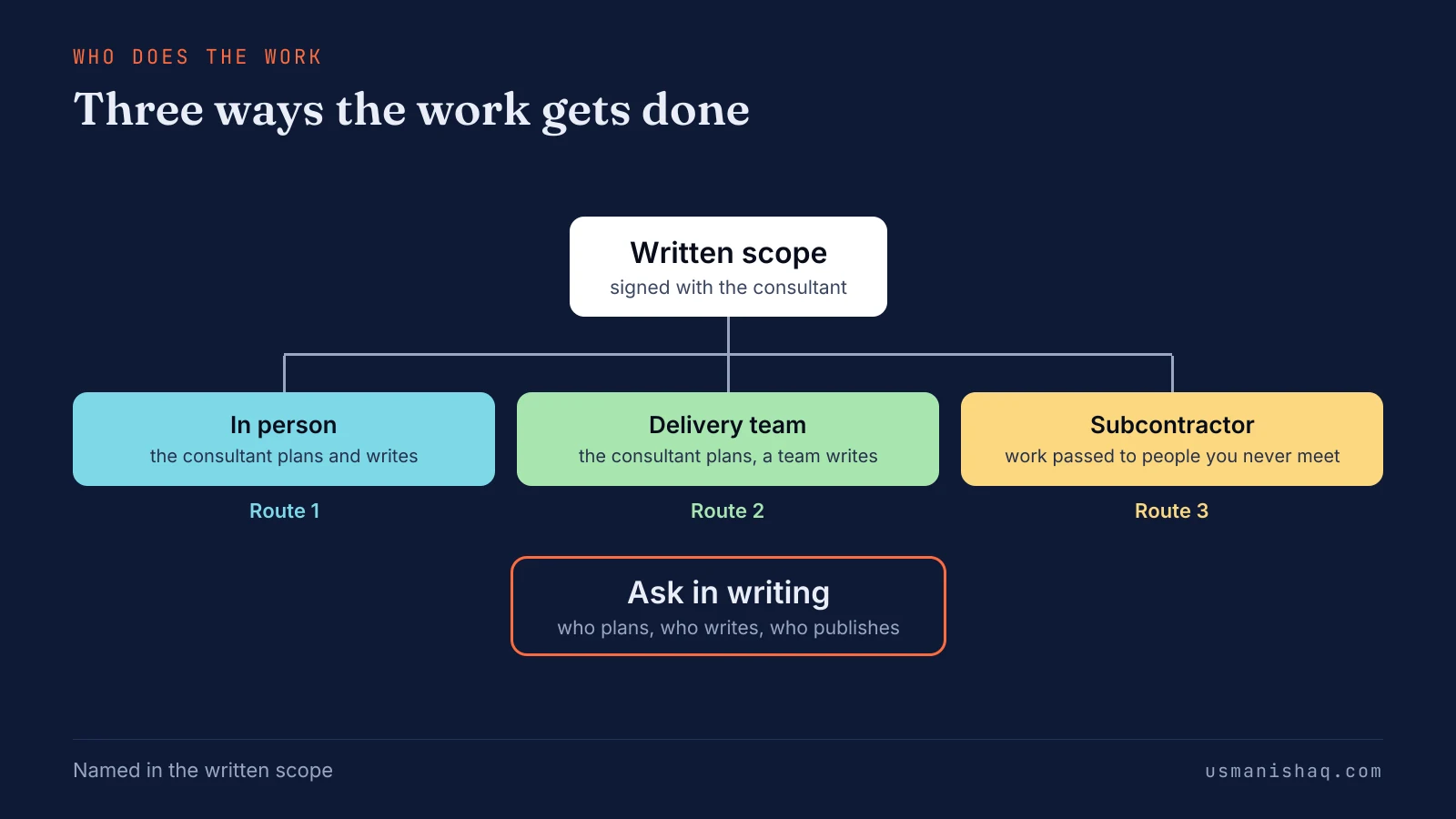
The figure shows the three routes, and a signed scope names one of them. An agency brings a team that does the work, so the delivery route matters most when the buyer hires a consultant.
A consultant with a delivery team is compared on the delivery column the way an agency is. Digital Vikingz publishes a guide on how to choose a semantic SEO agency. The four criteria now let an owner set consultants side by side.
How do you compare semantic SEO consultants side by side?
An owner compares semantic SEO consultants side by side by filling the same four criteria for two or three names, using each consultant's own site and documents, before any call.
The steps to compare semantic SEO consultants side by side are listed below:
- Write the problem in one sentence, in calls or booked jobs.
- Shortlist two or three consultants from any list or referral, and drop names that take no clients.
- Fill the four criteria for each name from the consultant's own site and published work.
- Ask each consultant for one sample document and the name of the person who does the work, in writing.
- Test the strongest consultant with one small paid task before a larger project.
None of the five steps needs a sales call. Some well-known names in semantic SEO teach and publish but take no client work, so the shortlist checks availability first.
A plumbing company based in Springfield that also serves Franklin writes the problem as "no calls from Franklin". The owner keeps the consultants whose sample map gives Franklin its own service pages.
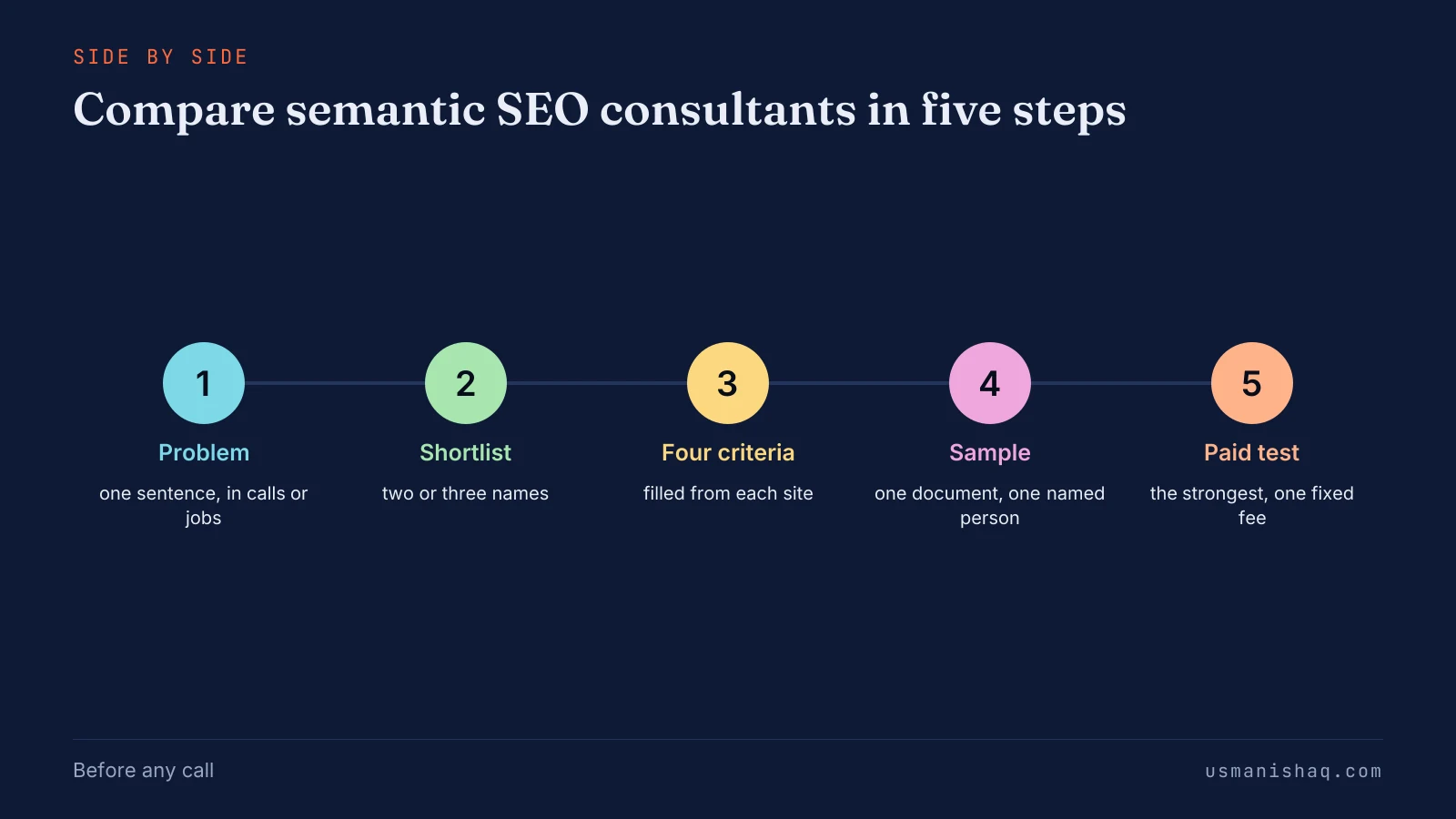
The figure lays out the five steps in the order the owner runs them. Owners often add one more check: the consultant's own website.
Does a semantic SEO consultant need to rank their own website?
A semantic SEO consultant does not need to rank first for "SEO consultant", but the consultant's own website should follow the method the consultant sells. Ranking for "SEO consultant" shows skill at one query, while proof on sites like the buyer's shows skill at the buyer's problem.
The consultant's own site should show one page per service and one definition per term. A consultant whose client work sits under confidentiality shows anonymised documents instead.
A consultant's own website rarely answers the next question a buyer asks, which is cost.
What does a semantic SEO consultant cost?
A semantic SEO consultant's cost is set after a diagnosis of the site, so most consultants publish no rate and quote a fixed price for a written scope. Searchbloom's 2026 comparison of ten SEO consultants found that none of the ten publishes a rate or a price tier.
The price follows the scope, the number of services and towns, and the starting state of the site. One consultant's fee buys planning time, judgement and written documents.
The semantic SEO cost of a whole project grows when writing and publishing at volume add a team and a monthly fee. Digital Vikingz breaks down semantic SEO cost by the shape of the work.
A fixed-fee audit gives a buyer one fixed price before any larger scope.
Why does a fixed-fee audit come before a larger project?
A fixed-fee audit comes before a larger project because the owner pays one price, quoted before access is granted, and judges a real document about the site. A paid test is one small piece of real SEO work on the owner's own site, at a fixed price.
A fixed-fee Semantic Content Audit returns a written issue map, ordered by the cost of each fix, and a review call. The fixed-fee Semantic Content Audit is one such first step for a semantic SEO project.
Work that continues after the audit raises a different question: a monthly retainer or a fixed scope.
Is a monthly retainer better than a fixed-scope project?
A fixed-scope project suits documents that are finished once, such as a topical map or an audit, while a monthly retainer suits work that repeats each month, such as writing and publishing pages. A retainer for a document that is finished once keeps billing after the document is delivered.
Owners complain that "they get you with 6 month contract", and a fixed scope first avoids that lock-in. A monthly SEO retainer quote is judged against booked jobs. A monthly SEO retainer for a trade and service business pays when the fee is covered by booked jobs.
The same booked-jobs test decides whether a semantic SEO consultant is worth paying for.
Is a semantic SEO consultant worth paying for?
A semantic SEO consultant is worth paying for when the site's problem is which pages to build and how to connect them, and when the owner can act on written documents. The result counts in "calls, not vanity traffic", so the documents should lead to pages that bring calls and booked jobs.
A site with fewer than ten indexable pages and no content history holds too little to plan from. An audit answers the question in writing first. The audit page states the condition plainly: "The answer is sometimes no, and the report says so."
A few narrower questions remain for owners at the comparison stage.
Questions owners ask about semantic SEO consultants
Owners comparing semantic SEO consultants ask five further questions, about agencies, experts to follow, guarantees, location and competitors.
Should I hire a semantic SEO consultant or an agency?
A semantic SEO consultant fits an owner who wants one person to plan the work and direct the owner's own writers, and an agency fits an owner who wants a team to deliver the work. The Digital Vikingz guide on how to choose a semantic SEO agency covers the agency side of the semantic SEO consultant or agency choice.
Which semantic SEO experts are worth following?
The semantic SEO experts worth following publish their method, their documents and dated evidence for anyone to check. The framework behind the method used here was published by Koray Tuğberk Gübür at Holistic SEO & Digital.
Can a semantic SEO consultant guarantee rankings?
A semantic SEO consultant does not guarantee rankings, and Google's hiring guide tells owners to "find someone else" when a provider guarantees first place. The guide, Do you need an SEO?, states: "If they guarantee you that their changes will give you first place in search results, find someone else."
Does location matter when hiring a semantic SEO consultant?
Location matters less than market knowledge, because a semantic SEO consultant works remotely but should know the language, searches and competitors of the buyer's market. The searches that matter are the ones customers run in the buyer's own towns, wherever the consultant lives.
Can a semantic SEO consultant work for my competitors?
A semantic SEO consultant should say in writing, before work starts, whether the consultant works for a direct competitor in the same service and town. One topical map plans pages for the same searches, so two rivals in one town end up sharing one plan.
What is the next step in choosing a semantic SEO consultant?
The next step in choosing a semantic SEO consultant is to compare two or three names on the four criteria, then test the strongest with one fixed-fee audit. An owner who understands the four criteria reads any list of names on the owner's own terms.
The steps to test an SEO consultant before hiring cover the task, the returned document and the 30-day check. The consultant who passes builds semantic SEO into the website through written documents, one service and one town at a time.