
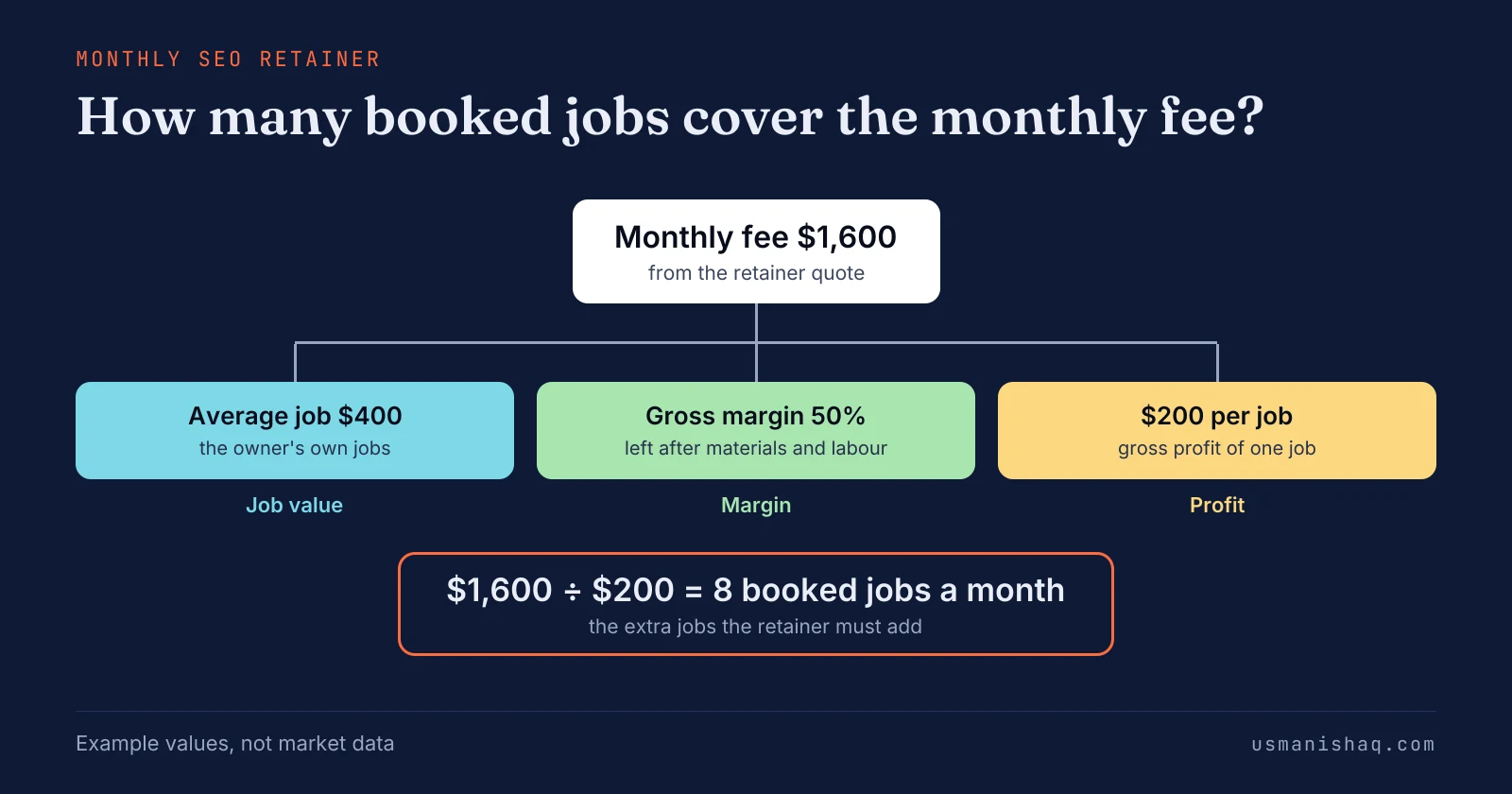
A monthly SEO retainer is worth it for a trade and service business when the gross profit from extra booked jobs covers the fee. Semantic SEO plans each page around a service and a town, so a retainer quote can name the page every line changes.
A monthly SEO retainer quote should list countable work, the page each line changes, the month each output lands, the measure and the terms. An owner judges a monthly SEO retainer quote in six steps, from the booked jobs the fee needs to the terms for leaving.
A monthly SEO retainer pays for itself at the number of extra booked jobs whose gross profit equals the monthly fee.
Is a monthly SEO retainer worth it for a trade and service business?
A monthly SEO retainer is worth it for a trade and service business when the gross profit from extra booked jobs covers the fee.
A monthly SEO retainer is a fixed monthly fee for an agreed amount of SEO work. The fee buys work each month, not a ranking. The work counts in calls and booked jobs under semantic SEO, never in rankings alone.
Four conditions decide the verdict. The business has room to take on more jobs. Customers search for the trade in the towns the business serves.
The owner can wait months for the first results. The last condition sits in the quote, which names countable work that the owner checks each month.
Owners call the same arrangement "paying monthly for SEO" or an "SEO package". Paying someone for local SEO is worth it for any small business on the same four checks.
Is SEO worth it for a plumbing business? SEO is worth it for a plumbing business on the same test: gross profit from extra booked jobs against the monthly fee. The same test shows when a monthly SEO retainer is not worth it.
When is a monthly SEO retainer not worth it?
A monthly SEO retainer is not worth it when the quote buys hours without countable work, or the business needs calls this month.
The conditions that make a monthly SEO retainer not worth paying are listed below:
- Hours without output: a quote that lists hours or activity with no page, count or month.
- Urgent need: a business that needs booked jobs within weeks, because retainer results take months.
- A rankings-only report: a retainer measured by rankings and traffic, never by calls.
- Thin demand: a trade with too few searches in the towns served to add the booked jobs the retainer fee needs. Search demand in each town is checked under semantic SEO before any page is planned, which tests thin demand first.
- A ranking promise: a provider whose quote promises a first place on Google. Google's hiring guide "Do you need an SEO?" states: "No one can guarantee a #1 ranking on Google."
Owners holding a quote ask "Is this fair?", and the answer sits in what a monthly SEO retainer quote should list.
What should a monthly SEO retainer quote list?
A monthly SEO retainer quote should list countable work, the page each line changes, the month each output lands, the measure and the terms.
Practitioners call the lines of a quote "deliverables" and the whole document a "proposal". Two lines decide what the business keeps when a retainer ends: ownership and the term.
The lines a fair monthly SEO retainer quote holds are listed below:
- Countable output: the pages written or rebuilt each month, named by service and town.
- The page: the URL or page name each line changes, never "on-page optimisation" alone. Every page is planned in semantic SEO before the monthly work starts, so each quote line can name its page.
- The month: the month each line of output goes live.
- The measure: the numbers the monthly report counts, named in the quote.
- Ownership: the quote line on who holds the website, the content and the accounts.
- Terms: the monthly fee, the minimum term, the notice period and any setup or exit fee, with the quote's date.
Typical retainer services each belong on one of the six lines. Google's hiring guide "Do you need an SEO?" warns: "Be careful if a company is secretive or won't clearly explain what they intend to do."
Owners ask what the monthly fee pays for. A six-line quote answers in writing. Two of the six lines need a closer look, starting with who should own what the fee builds.
Who should own the website and accounts under a monthly SEO retainer?
The business owner should own the website, the content, the Google Business Profile and Google Search Console, with the provider added as a user.
Google Search Console is Google's free report on how a website appears in Google Search. Owners ask what happens "if I cancel". The pages and the content should stay with the business.
Ownership of the pages and the page plan decides what the business keeps, because semantic SEO work lives in both. Google's hiring guide "Do you need an SEO?" covers the audit stage. The guide says to "only grant read access to Search Console (at this stage, don't grant them write access)".
The quote settles ownership with one clause: pages and content written under the retainer stay on the owner's site when the retainer ends. Agency hiring guides give the same answer: the owner holds the accounts, with the provider added as a user.
Ownership protects the exit. The term decides when the exit comes.
How long should a monthly SEO retainer term run?
A monthly SEO retainer term should cover the months the work needs, and the notice period should let the owner leave without a penalty.
Terms on published agency pages run from month to month to twelve months or more. Some providers ask for twelve months because the work compounds. Other providers bill month to month after a first period.
The risk, from the owner's point of view, is a term that outlasts the work. A minimum term shorter than the time to first results gives the work no fair test. A long term with an exit fee keeps a retainer running after the work stops.
A third check is billing that starts before any page is live. Each month of semantic SEO work is set against the pages planned for that month, which gives the owner a fair point to decide. Ownership and term complete the lines an owner needs to judge the quote.
How do you judge a monthly SEO retainer quote?
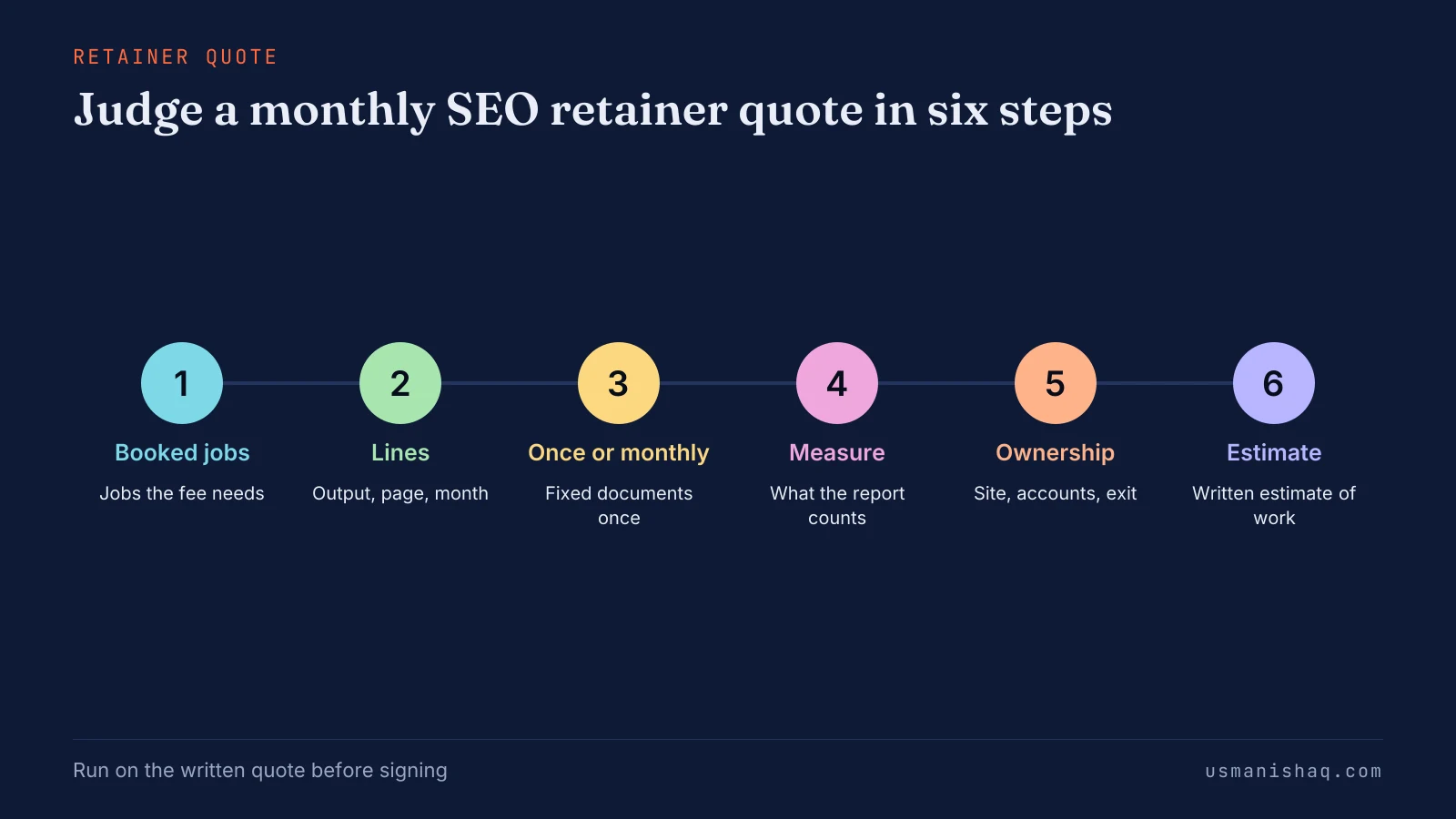
An owner judges a monthly SEO retainer quote in six steps, from the booked jobs the fee needs to the terms for leaving.
The six steps answer the owners' question "Is this fair?".
The steps to judge a monthly SEO retainer quote are listed below:
- Count the extra booked jobs the monthly fee needs.
- Mark each line of the quote with its countable output, its page and its month.
- Mark the lines that produce a fixed document once, such as an audit or a page plan.
- Check what the monthly report counts.
- Check who owns the site and the accounts, and how the term ends.
- Ask the provider for a written estimate of the work and of the expected improvement.
None of the six steps needs SEO knowledge, only the written quote. Google's hiring guide "Do you need an SEO?" suggests two questions for any provider: "What kind of results do you expect to see, and in what timeframe? How do you measure your success?"
The same guide states: "An SEO audit should be about giving you realistic estimates of improvement, and an estimate of the work involved." The figure below sets the six steps in the order of the list.
An audit before the retainer turns step 6 into a written document. A flat-fee Semantic Content Audit returns an issue map of the site's semantic SEO, ranked by the cost of each fix.
Step 1 comes first, because every other line is measured against the booked jobs the fee needs.
How many booked jobs does a monthly SEO retainer need to pay for itself?
A monthly SEO retainer pays for itself at the number of extra booked jobs whose gross profit equals the monthly fee.
Owners put the question as "how many extra jobs pay for the fee". Practitioners call that number the break-even point. Booked jobs needed each month equal the monthly fee divided by the gross profit of one average job.
Average job value is the owner's own average price for one job. Gross margin is the share of the job price left after materials and labour. Semantic SEO ties each planned page to one service, so each page can be checked against that service's job value.
The break-even of a monthly SEO retainer with example values is worked out below:
| Line | Example value | How the value is found |
|---|---|---|
| Monthly fee | $1,600 | The retainer quote |
| Average job value | $400 | The owner's own jobs |
| Gross margin | 50% | The owner's books |
| Gross profit per job | $200 | $400 x 50% |
| Booked jobs needed each month | 8 | $1,600 ÷ $200 |
| Calls needed each month | 16 | 8 jobs at 1 booked job in 2 calls |
The values are an example, not market data, and every owner replaces the example values with the business's own numbers. The retainer must add 8 booked jobs a month with the example values. The same sums work in any currency.
Close rate is the share of calls that become booked jobs. The 8 booked jobs need 16 calls a month from search at a close rate of 1 booked job in 2 calls. The cost per booked job is the fee divided by the extra booked jobs.
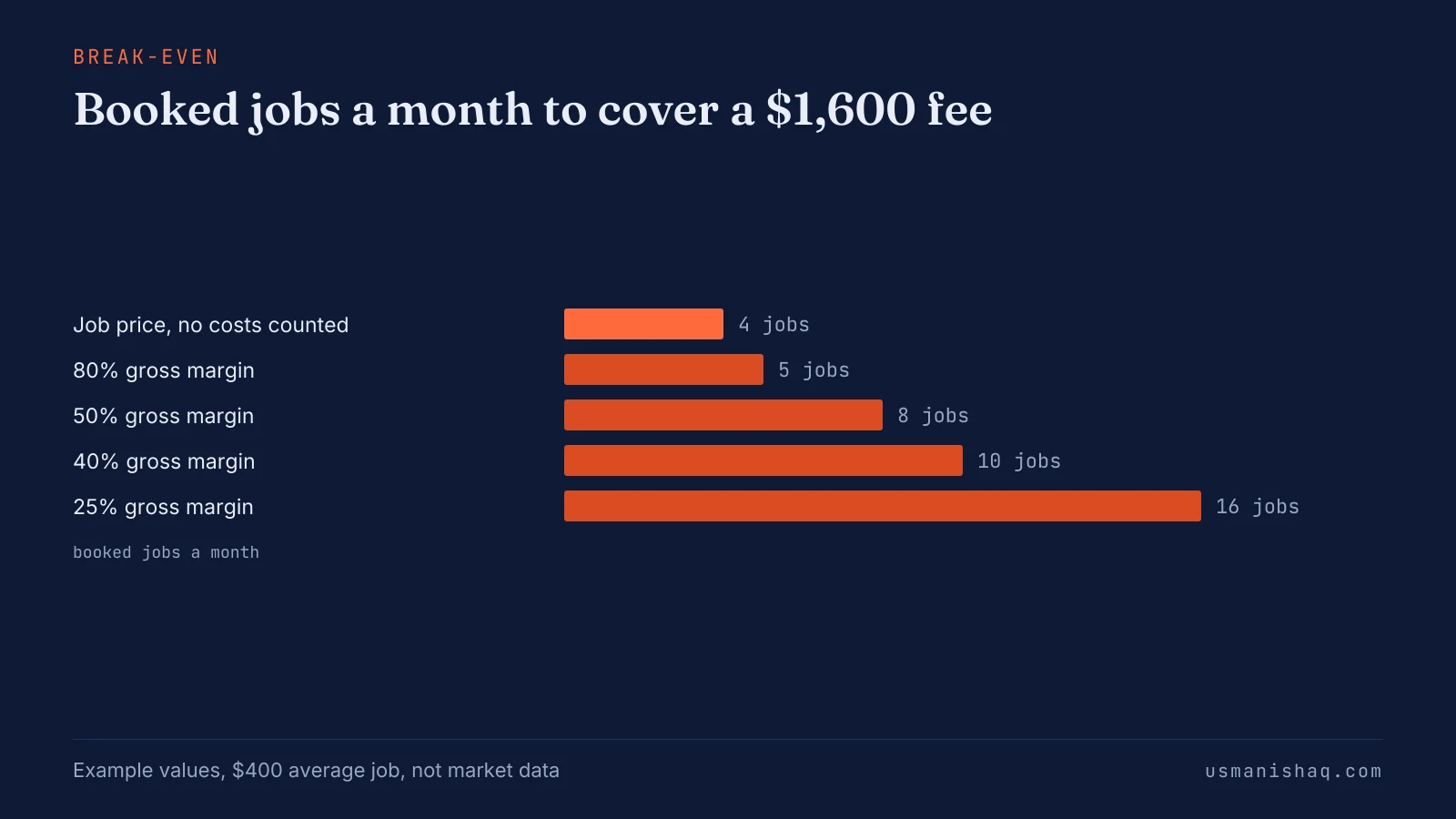
Why use gross profit and not the job price? Gross profit counts the materials and labour each job costs, which the job price leaves out. The job price alone puts the same fee at 4 booked jobs, half the true number.
The same fee needs 5 booked jobs at 80 percent gross margin, 10 at 40 percent and 16 at 25 percent.
Jobs the business booked before the retainer stay out of the count. An owner whose customers return can add repeat jobs, as long as the same rule is used every month.
Step 2 reads each line of the quote. The line owners meet most often in seller packages is link building.
How should a link building line on a retainer quote be judged?
A link building line passes the quote test when the line names the sites, the count and the pages each month.
A link building line fails when the line promises a number of "backlinks" with no named site, no page and no owner. Google's hiring guide "Do you need an SEO?" states: "Avoid SEOs that talk about link popularity schemes or submitting your site to thousands of search engines."
Links the provider controls should be listed, so the owner can see each one. Internal links between the owner's own pages are a countable line any quote can name. The page plan in semantic SEO sets those links between service pages and town pages.
A plumbing company's quote puts the link building line next to three others.
What does the quote test show on a plumbing company's retainer?
The quote test shows a Springfield plumbing company that a retainer with four blog posts a month names no page that adds booked jobs.
The example is an illustration, not a real client: the site's worked plumbing company, based in Springfield and serving Franklin. The quote asks $1,600 a month for four blog posts, link building, a monthly ranking report and a twelve-month term with an exit fee. The break-even from the example values stays the same: 8 extra booked jobs a month.
Four blog posts a month are easy to count and hard to tie to a booked job. The four lines of the example quote, the test question and a rewritten line are set out below:
| Line as quoted | Test question | Rewritten line |
|---|---|---|
| "4 blog posts a month" | Which page and which booked job? | One repiping page for Franklin in month 2 |
| "Link building" | Which sites and which pages? | Links from the repiping page to each town page |
| "Monthly ranking report" | Does the report count calls? | Calls and booked jobs from search, against month 1 |
| "12-month term, exit fee" | Can the owner leave? | Notice period stated, no exit fee, site and accounts in the owner's name |
The new repiping page answers the search "repiping franklin". Franklin repiping gets one page before any blog post, the order semantic SEO gives the work.
The quote as written gives the owner no way to check the 8 booked jobs. The rewritten lines give the owner that check. One question stays open after the rewrite: what the retainer brings in the first month.
Does a monthly SEO retainer bring booked jobs in the first month?
No, a monthly SEO retainer usually brings no extra booked jobs in the first month, because changed pages take months to show results.
Semantic SEO puts the pages closest to booked jobs live first. Providers who publish timelines put first movement at three to six months. The same providers put steady results in a competitive trade at six to twelve months.
Providers' ranges are estimates, not a rule. Owners report months of invoices with no new calls, the point to run the six steps again. The first months can be a cost carried before the booked jobs start.
Part of the early work is a document billed once.
Should SEO work be a monthly retainer or a one-time project?
A one-time project fits SEO work that produces a fixed document, and a monthly retainer fits work that recurs each month.
An audit, a topical map of the pages the site needs, page briefs and page templates are made once. The page plan and the briefs in semantic SEO are made once, before the monthly writing starts. New pages written to the plan, pages updated after results, and the monthly report recur.
Monthly SEO beats one-time SEO services only for the recurring half of the work. Every line of a retainer quote sits on one of two sides in the figure below: a document billed once, or work billed monthly.
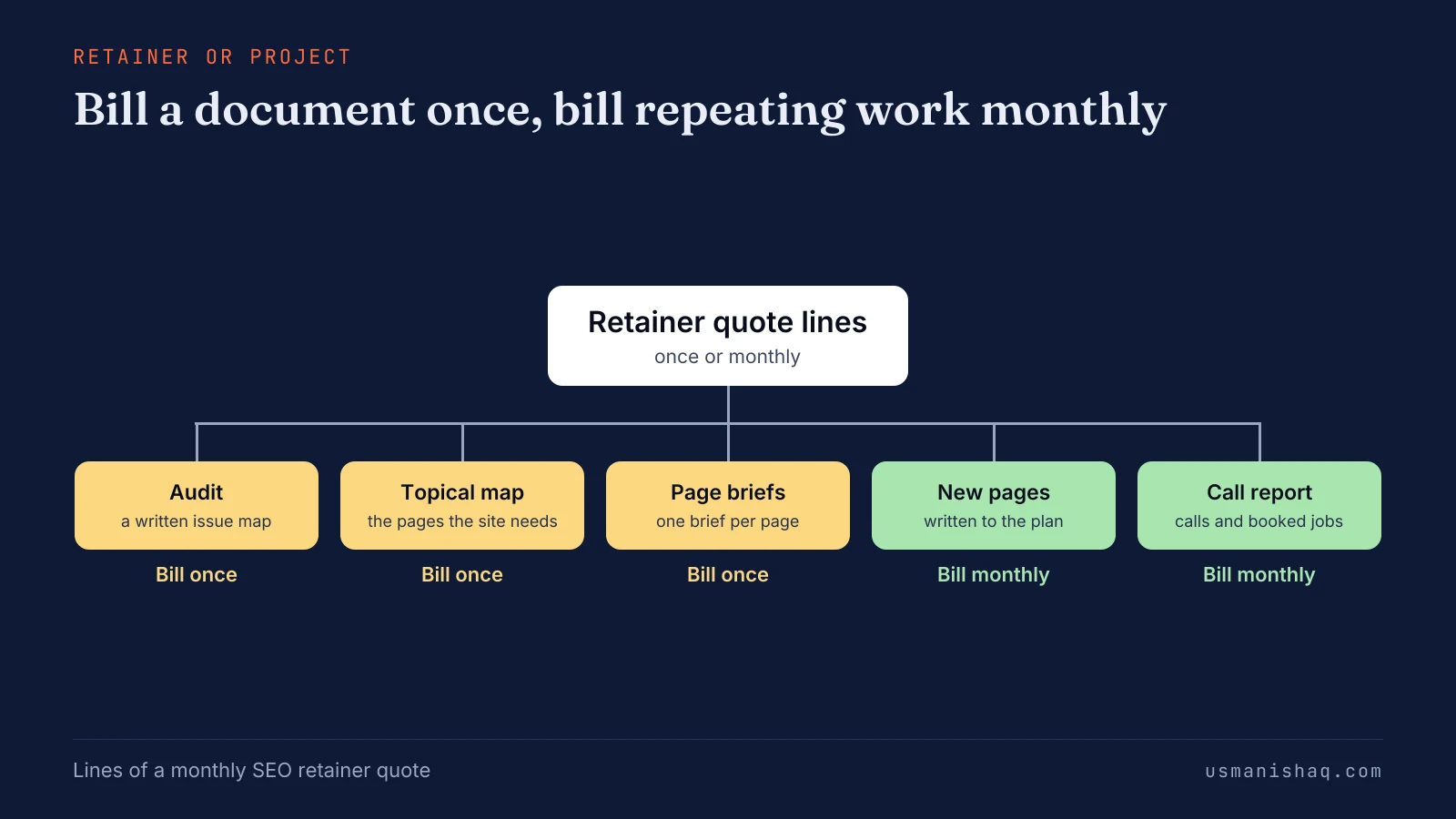
A quote that bills a fixed document every month bills the same document again, with no new output to count. The audit is the first fixed document most sites need. A fixed document also works as a small paid task before any retainer starts.
Why test a provider with a small paid task before a monthly SEO retainer?
A small paid task shows how a provider works before the owner signs a monthly SEO retainer that runs for months.
One small paid task, such as a flat-fee audit, is judged on the document the provider returns. One returned document is the core of any plan to test an SEO consultant before hiring. One such task is a semantic SEO audit: a fixed document for a fixed fee.
The price of one consultant is a separate question from the value of a quote already in hand. Owners with no provider yet can compare semantic SEO consultants on written criteria before any test.
Some owners skip the provider and do the work without a retainer.
Can an owner do the monthly SEO work without a retainer?
Yes, an owner of a small local business can do much of the monthly SEO work without a retainer.
Google's hiring guide Do you need an SEO? states: "If you run a small local business, you can probably do much of the work yourself." An owner can write a page for each job type from real jobs and answer customer questions on the site. The same owner can keep the Google Business Profile current and read Search Console.
AI writing tools write text, and the owner still supplies the jobs, the photos and the facts. An owner who writes alone can still hire for the page plan and the site structure, made once. A semantic SEO page plan tells that owner which page to write next.
Owners who keep a retainer still need a monthly report that counts the right things.
What should the monthly report show under a retainer?
The monthly report under a retainer should show calls, booked jobs and Search Console clicks to the service pages, against the first month.
The report should name the pages that went live that month. Named pages tie the report to the lines of the quote. Semantic SEO reads Search Console page by page against the plan, so each new page shows its own clicks.
Rankings and traffic are signals. Calls and booked jobs are the result. Owners ask for a breakdown of the work done each month.
A report built on the quote lines gives that breakdown. An owner who knows how to read an SEO report reads every number in calls and booked jobs. The questions owners ask about a retainer quote beyond the report have short answers.
Questions owners ask about a monthly SEO retainer quote
Owners holding a monthly SEO retainer quote ask five further questions, about low fees, second quotes, seasons, referrals and falling rankings.
Is a low monthly SEO fee a red flag?
No, a low monthly SEO fee is not a red flag by itself, because the quote's lines decide what the fee buys. A low fee and a high fee pass or fail the same six steps.
Should an owner get more than one monthly SEO retainer quote?
Yes, a second monthly SEO retainer quote gives the owner a line-by-line comparison for the same work. Asking each provider to rewrite vague lines with a page and a month makes the two quotes comparable.
Does a seasonal trade business need a retainer all year?
No, a seasonal trade business should pay monthly only for months with recurring work, and the quote should say what happens off season. Pages for the busy season should go live before the season starts.
Is a monthly SEO retainer worth it when most jobs come from referrals?
A monthly SEO retainer can still be worth it for a referral business when the extra jobs from search cover the fee. Referral jobs stay out of the break-even count, which leaves the jobs from semantic SEO pages for each service to cover the fee.
Can rankings fall during a monthly SEO retainer?
Yes, rankings can fall during a monthly SEO retainer while the pages change. A fall is a reason to ask the provider, in writing, which pages changed in the months the rankings dropped.
What is the next step with a monthly SEO retainer quote?
The next step with a monthly SEO retainer quote is the six-step test, run on the written quote before signing. An owner who understands the break-even reads each line as a share of the booked jobs the monthly fee needs.
Semantic SEO builds the pages a quote should name, one service and one town at a time. The quote is worth it when the gross profit from extra booked jobs covers the monthly fee.