
Yes, SEO is still worth it for a small service business, because people still search Google when they need a job done.
AI answers changed which searches send visitors to a website. Google's AI Overviews now sit above the links on many how and why questions, and those questions send fewer clicks.
Seer Interactive's 2026 update found AI Overviews on 36% of informational searches and on 5% of transactional searches. Seer's data ran from January 2025 to February 2026.
Semantic SEO organises a website around entities, their attributes and the relationships between them. Search engines and AI systems then read what each page means.
The type of search decides what SEO is worth to a small business. Question searches lose clicks to AI answers, while searches for a job in a town still end in a call.
What changed for small business SEO when AI answers arrived?
AI answers changed which searches send clicks to a website, and searches for a job near the buyer changed least.
AI Overviews are the AI summaries Google shows above the usual links. AI Mode is Google's separate conversational search, where a buyer asks follow-up questions.
Both features run on Google's core ranking systems, according to Google's guide to generative AI features in Search. The systems retrieve pages from the Search index and show links to the pages they used.
Clicks fell first on questions. Seer Interactive's September 2025 study tracked 3,119 informational queries from June 2024 to September 2025. Organic click-through rate on queries with an AI Overview fell from 1.76% to 0.61% over that period.
The fall did not continue in a straight line. Seer's 2026 update found click-through on AI Overview queries rose from 1.3% in December 2025 to 2.4% in February 2026. Searches with no AI Overview reached 3.8% in February 2026 in the same study.
Seer's 2026 update used 5.47 million queries across 53 brands and every search intent. The two Seer studies use different query sets, so their figures are not one trend line.
Google's guide asks whether SEO is still relevant for generative AI search, and answers "In short, yes!" The same guide treats work for AI features as ordinary SEO work.
A plumber sees the change in two searches on the same afternoon. The question search shows an AI Overview above the links, and the job search shows a map of three plumbers.
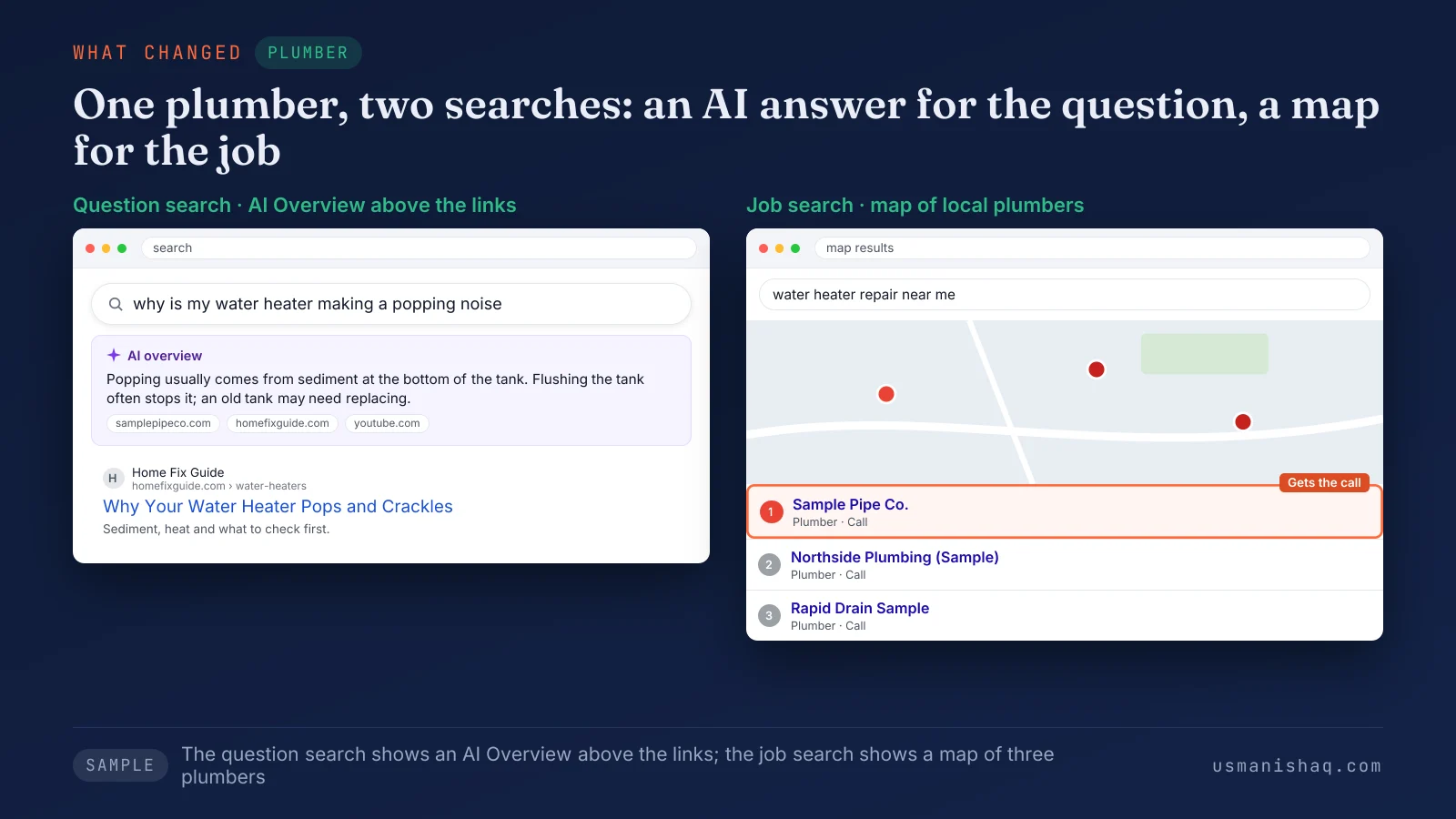
Semantic SEO treats each kind of search as a separate job for a separate page. What SEO is worth now depends on which kind of search a business needs.
Which searches still bring calls to a small service business?
Searches for a job, a town, a price or a business name still bring calls to a small service business.
How and why questions are where AI answers take the clicks. The searches that still bring calls to a small service business are listed below:
- Job and town searches, such as "roof repair in Mesa": Seer's 2026 update found AI Overviews on 5% of transactional searches. The buyer sees a map, a listing and a call button.
- Urgent job searches, such as "emergency plumber": urgent searches sit in the same transactional class. Seer's report notes that a map result answers a search for a local plumber.
- Price and comparison searches, such as "tankless water heater cost": Seer found AI Overviews on 8% of commercial searches. Buyers at this stage are close to booking.
- Business name searches: buyers look up a name on Google Maps before they call, to check the business is real. Owners on trade forums describe the same habit.
- Question searches, such as "why is my AC freezing up": Seer found AI Overviews on 36% of informational searches. A brand cited inside the AI Overview earned 120% more clicks per impression than an uncited brand in Seer's 2026 update.
Four of the five end in a phone call. The fifth still pays when the business is the one the AI answer cites.
A roofer's sample shows the same split. The job and urgent searches sit in the 5% band, the price search at 8% and the question search at 36%.
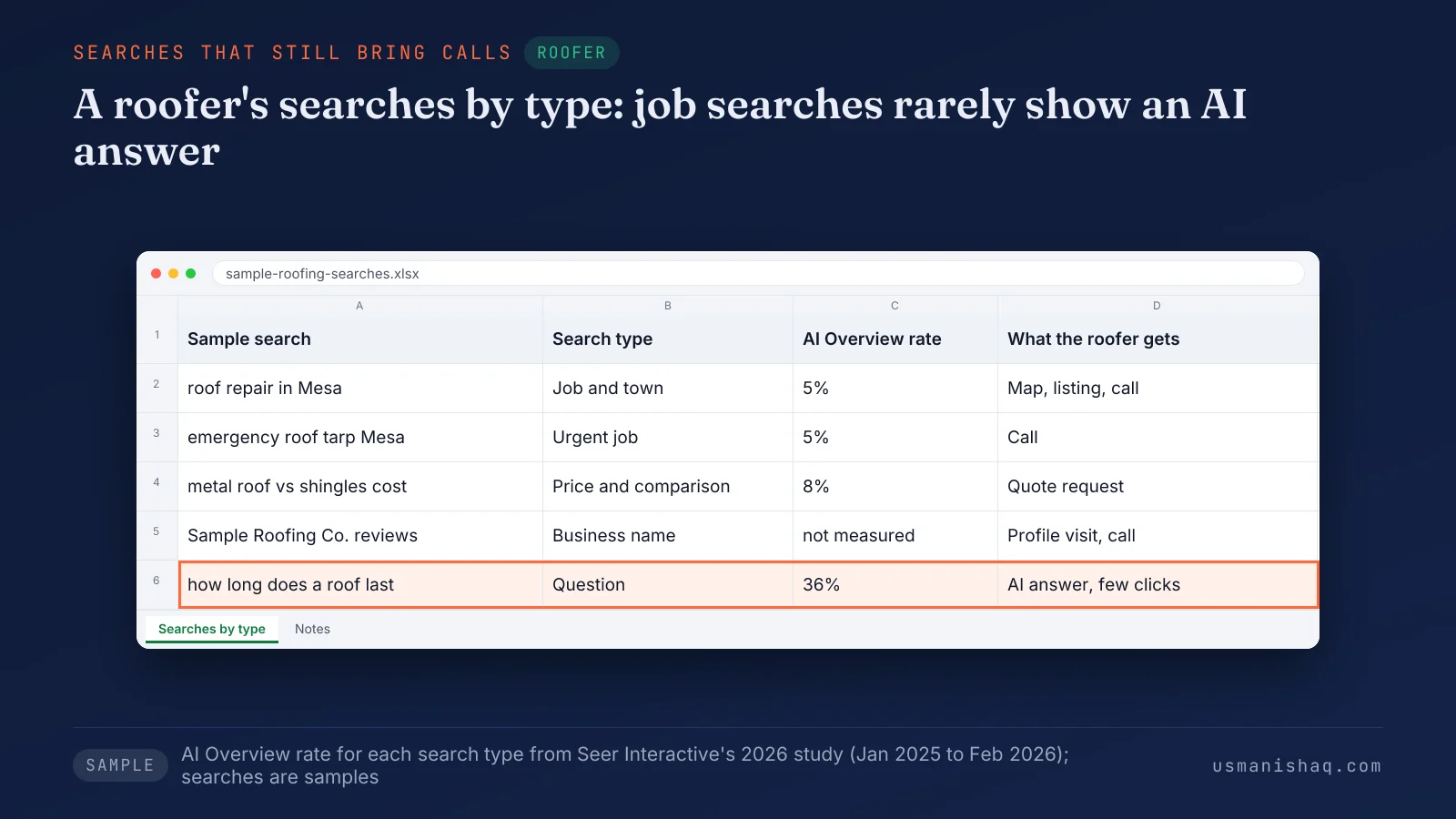
Semantic SEO gives each of these searches its own page or its own answer on a page.
Is SEO worth it for plumbers, roofers and other trades?
Yes, SEO is worth it for plumbers, roofers and other trades when customers search for the job in the towns served.
The same test fits a dental clinic or a law firm with semantic SEO pages for each service.
What SEO work still pays when AI answers come first?
SEO still pays when it builds a page for each service, each earned town and each question customers ask.
The site under those pages also has to be easy for Google to read. The SEO work that still pays for a small service business is listed below:
- Service pages: one page for each job the business wants more of, such as drain cleaning or water heater repair.
- Town pages: a page for a town only when the business works there and the town has searches of its own.
- Google Business Profile: the profile matches the site's services, towns and hours. Google's guide names Business Profiles as one way services appear in AI responses.
- Answer pages: answers to the questions customers ask, written from real jobs. Google's guide says such first-hand content likely matters more for AI features than any other step it lists.
- A clean technical base: pages Google can crawl, index and load fast on a phone.
None of that is new work. AI answers raised the price of skipping it.
Semantic SEO puts that work in one order: services first, then towns, then the questions around them. The architecture of a semantic SEO site is that order written down as a plan. A Semantic SEO Architecture plan fixes the order before any page is written.
Google's guide also lists work a small business can skip. An llms.txt file, content cut into small chunks and pages rewritten for AI do not help in Google Search.
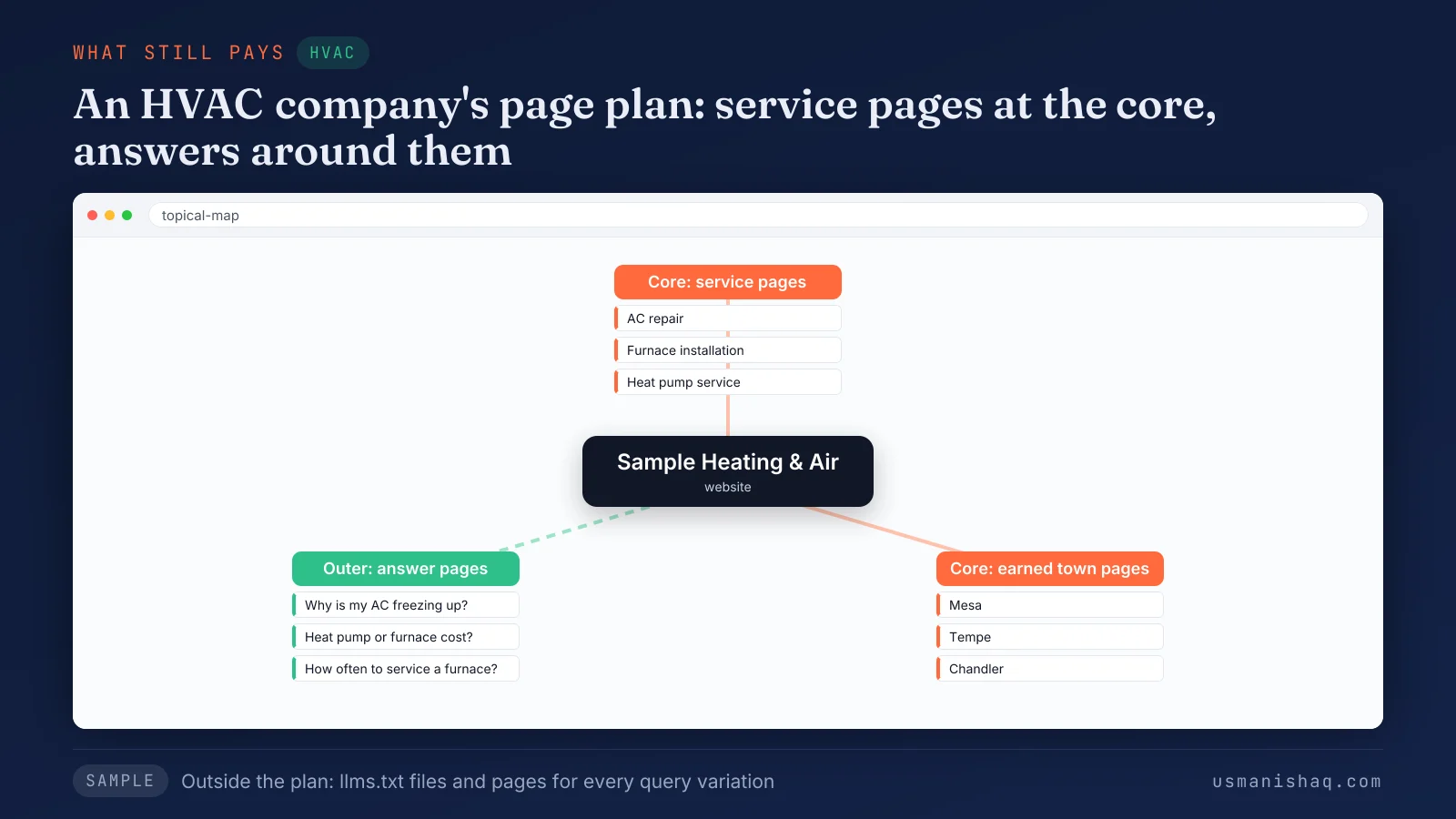
An HVAC company's sample plan shows the order. The core holds three service pages, AC repair, furnace installation and heat pump service, plus three earned town pages.
Three answer pages sit around them. Llms.txt files and pages for every query variation stay outside the plan.
The same work stops paying in a few clear cases.
When is SEO not worth it for a small business?
SEO is not worth it for a small business when nobody searches for the service or the diary is already full.
The conditions that make SEO not worth it yet are listed below:
- No search demand: nobody searches Google for the service, the first test in the Ahrefs flowchart on SEO's worth.
- A full diary: referrals already fill every week, so extra calls from search have nowhere to go.
- No time to wait: SEO pages take months to bring calls, and some owners need calls this month. One plumber on a small business forum said he had neither a year nor tens of thousands of dollars to test it.
- A site nobody can change: a locked template or a lost login stops every page the work needs.
I tell owners the same thing every time. SEO works if the phone can take more calls and someone can wait a season.
SEO falls apart when the owner wants a promised number of jobs by next month. Semantic SEO does not change those conditions, and no honest provider claims it does.
Is SEO better than paid ads for a small business?
No, SEO is not better than paid ads in every case, because ads bring calls within days and SEO pages take months.
Ads stop when the spend stops, while semantic SEO pages keep working after the work is paid for.
How do you check whether SEO is worth it for your business?
SEO is worth it for your business when the calls and booked jobs from search cover what the work costs.
The checks that show whether SEO is worth it for a business are listed below:
- Sort last quarter's searches in Google Search Console into job, price, name and question searches.
- Count the calls and booked jobs that came from Google, including calls from the Business Profile.
- Open the Generative AI performance report in Search Console to see where pages appeared in AI Overviews and AI Mode.
- Compare the profit from those jobs with what the SEO work cost over the same months.
Google's guide, Optimizing your website for generative AI features on Google Search, points owners to that report for AI visibility. The report shows where pages appeared, and call tracking still shows which searches turned into jobs.
The advice in Seer Interactive's 2026 click-through study is the same: read your own query data before changing plans.
Semantic SEO pages are judged on the same counts as any other page. The same counts belong in every monthly report.
A guide on how to read an SEO report in calls and booked jobs shows where each count comes from.
How long does SEO take to bring calls?
SEO takes months, not weeks, to bring calls from a new service page or town page.
The guide to how long a new town page or service page takes to bring calls sets out each stage.
How much should a small business pay for SEO?
A small business should pay no more for SEO than the gross profit from the extra booked jobs it brings.
Owners holding a quote can judge a monthly SEO retainer quote line by line against that test.
Does showing up in ChatGPT replace SEO?
No, showing up in ChatGPT does not replace SEO, because AI assistants answer from web pages and listings that already exist.
Google's guide says its AI features retrieve pages from the Search index before writing an answer. A ChatGPT business listing is one more listing to keep accurate, beside the website and the Business Profile.
The steps to claim your business listing in ChatGPT sit beside semantic SEO work, not in its place.
Questions owners ask about SEO and AI answers
Owners weighing SEO against AI answers ask three more questions, about websites, Business Profiles and GEO services.
Is a website still useful for a plumber?
Yes, a website is still useful for a plumber, because each service page can rank and be cited for its own job.
A Business Profile holds categories and a service list, but no full page for each job.
Is a Google Business Profile enough without a website?
No, a Google Business Profile is not enough without a website for a business that serves several jobs or towns.
The profile and the site work best when their services, towns and hours match.
Should a small business pay for a separate GEO or AEO service?
No, a small business does not need a separate GEO or AEO service, because Google treats that work as SEO.
GEO, AEO and LLM SEO name the same work, and Google's guide calls optimizing for AI search still SEO.
What should an owner do next about SEO?
SEO stays worth it for a small service business that builds pages for the searches that bring calls.
AI answers took clicks from questions, not calls from people who need a job done. Semantic SEO covers both: service pages for the calls and clear answers for the AI citations.