
A ChatGPT Business Agent is a chat assistant that an eligible US online business builds in Business Hub to answer buyer questions.
The agent answers from the business's own product and policy information, inside a labelled chat.
A Business Agent is worth setting up when the business qualifies and buyers ask many questions before they buy. The agent does not sell, book or check orders, so the sale still happens on the website.
Only eligible ecommerce and online service businesses in the United States can publish an agent today. OpenAI's policy sets what the agent may say and ask. The answers depend on the product feed, the policies and the instructions the business supplies.
A business can also sponsor the agent as the landing point of a ChatGPT ad. Local service businesses, order-heavy stores and teams with no time for upkeep should skip the agent for now.
What is a ChatGPT Business Agent?
A ChatGPT Business Agent is a chat assistant a business builds in Business Hub to answer buyer questions, separate from ChatGPT agent.
OpenAI opened Businesses in ChatGPT in beta on 10 November 2026. The beta has three parts: Business Hub for the profile, insights, and Business Agents.
A buyer meets the agent only after ChatGPT names the business in an answer. The buyer opens the business profile and taps "Start chat", the button label Search Engine Roundtable reported. The agent chat is labelled and kept separate from the buyer's original ChatGPT conversation.
Getting named in that answer depends on AI search visibility, not on the agent. Being named first is the work of AI Search Visibility for online businesses. Semantic SEO builds the website facts that ChatGPT reads and cites before any agent opens.
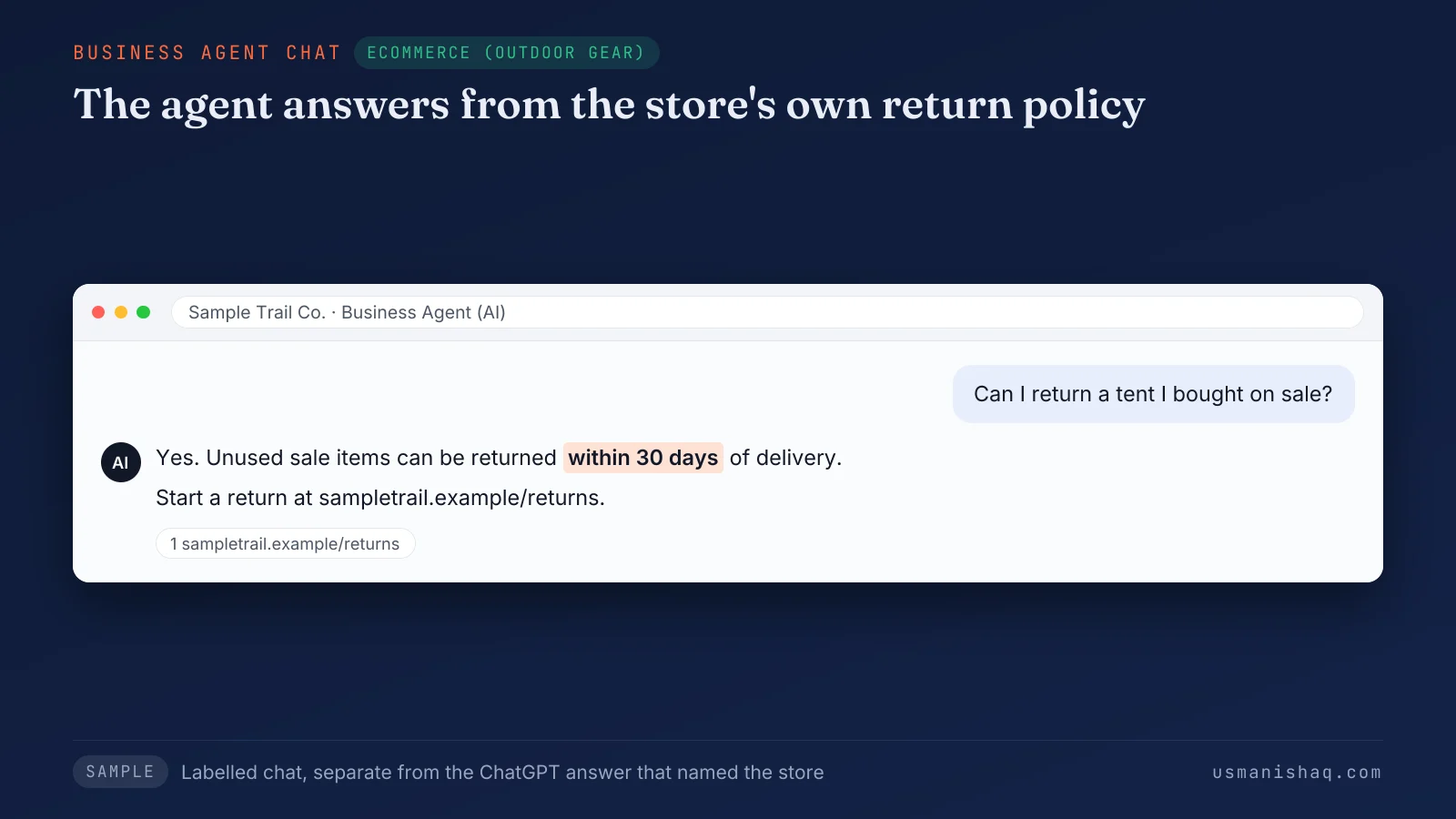
The sample agent gives the store's 30-day return window for unused sale items and sends the buyer to the returns page. Every line of the reply comes from information the store entered in Business Hub.
Is a Business Agent the same as ChatGPT agent?
No, a Business Agent speaks for one business, while ChatGPT agent carries out tasks for the person using ChatGPT.
Workspace agents are a third OpenAI product, built for a company's own staff. The shared word "agent" explains why search results mix the three products.
Who can set up a ChatGPT Business Agent?
A ChatGPT Business Agent is open to eligible US ecommerce and online service businesses, and not yet to local service businesses.
OpenAI names the eligible business types in its launch post. The conditions a business must meet before publishing a Business Agent are given below:
- Location: the business operates in the United States, where the beta started.
- Business type: the business sells products online or delivers an online service through its own website.
- Approved claim: OpenAI has approved the owner's claim of the business profile in Business Hub.
- Identity check: the owner has passed Persona verification, which can ask for ID, registration details and proof of authority.
The Persona check compares names, addresses and registration numbers with official records. Semantic SEO keeps those same facts consistent across the website and every listing.
Access is still rolling out. Search Engine Roundtable reported on 16 November 2026 that some accounts saw the notice "Agent builder isn't available yet." OpenAI plans more markets and categories but has given no date.
Can a local service business set up a Business Agent?
No, a local service business has no Business Agent option today, because the beta limits agents to ecommerce and online service businesses.
A plumber, an HVAC company or a dental clinic can still claim a profile. OpenAI's help article says local stores and restaurants can currently claim only an existing US listing.
I opened Business Hub on 11 November 2026 for a business I manage outside the US. The claim stopped at a waitlist.
What can a ChatGPT Business Agent do and not do?
A ChatGPT Business Agent answers product and policy questions, but takes no orders or bookings and shares no chats with the business.
The agent answers from the information and guidelines the business sets, then links buyers to the website. Search Engine Roundtable reported a Wayfair agent that showed product cards drawn from a catalog feed.
OpenAI's help article states the limits plainly. The agent does not complete purchases, make bookings or check orders.
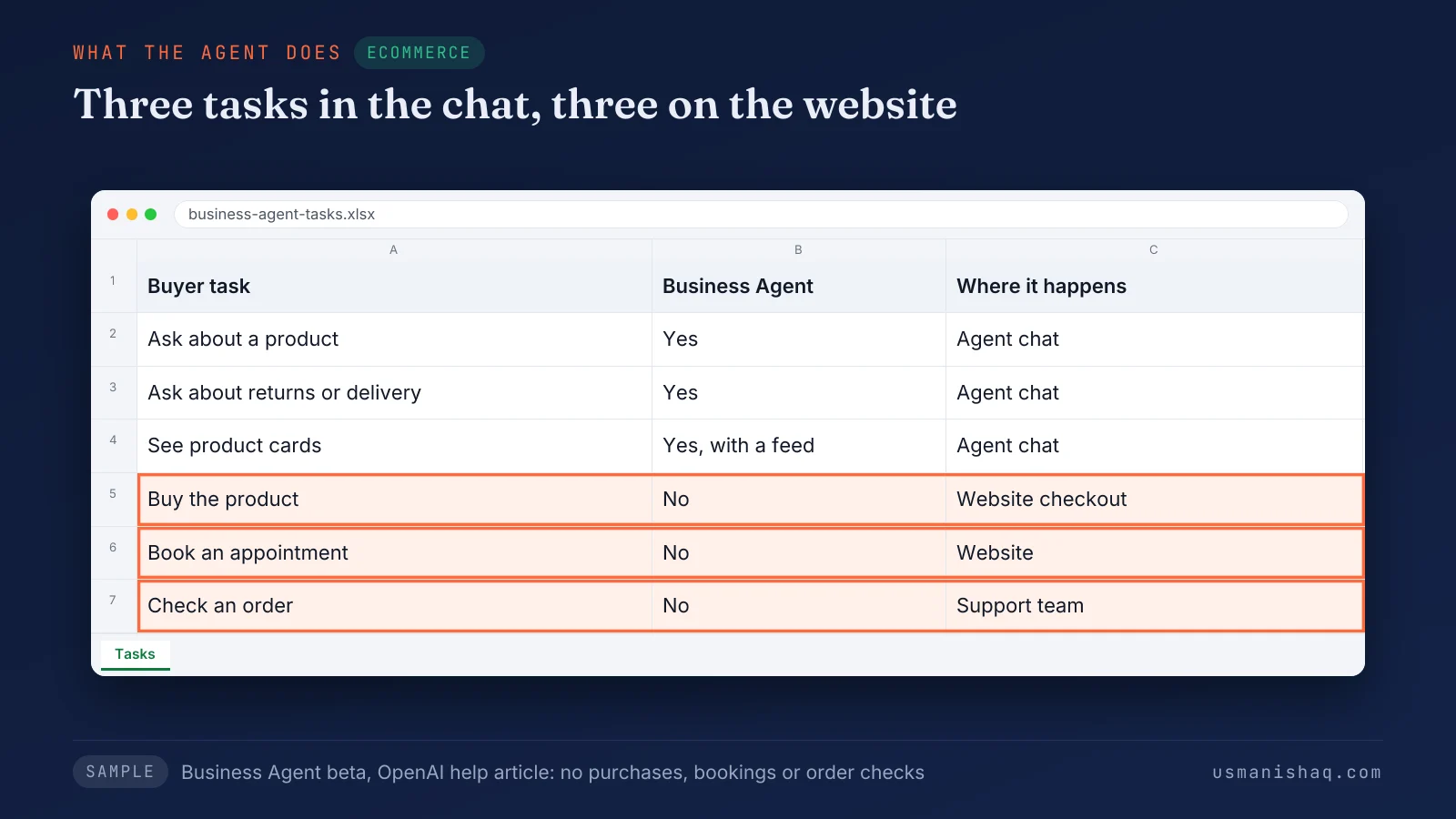
The table marks product questions, policy questions and product cards as yes. Purchases, bookings and order checks are marked no, and each one moves to the website or the support team.
The Business Agents Policy, updated 10 November 2026, sets the five rules below, as CASRAI reported:
- AI disclosure: the agent identifies itself as AI representing the business.
- No false identity: the agent never poses as a human, an independent adviser or an OpenAI-endorsed representative.
- No pressure: the agent never pushes buyers or invents urgency.
- Limited data: the agent never asks for unneeded or high-risk personal data, such as health details or authentication credentials.
- Permission first: the agent shares buyer data or acts for a buyer only with explicit permission through an approved feature.
OpenAI can limit features, pause an agent or remove one under the same policy. Semantic SEO reads these limits as a boundary: the agent explains, and the website sells.
Can a Business Agent take orders or bookings?
No, a Business Agent does not take orders or bookings, because OpenAI limits the agent to explaining products and policies.
The sale happens on the business's website, through the link the agent gives. Questions about an order already placed still reach the business's own support team.
Can a business read its Business Agent chats?
No, a business does not receive its Business Agent chats, because OpenAI shares only aggregated insights.
The business sees mentions, website clicks and discovery topics for the past 28 days instead. The numbers appear only when activity passes OpenAI's reporting thresholds.
What information should a business give its Business Agent?
A Business Agent answers only from the information a business gives the agent, so the feed, policies and instructions decide every answer.
The information a business should give its Business Agent is listed below, most important first:
- Product feed: products, prices and availability, kept as current as the store itself.
- Return policy: the return window, the conditions and any exceptions, such as sale items or opened products.
- Delivery policy: costs, free-delivery thresholds and delivery times, written as the website states them.
- Business details: website, description, category, logo and cover photo, edited after verification.
- Instructions: how the agent should answer, written inside the Business Agents Policy.
The feed matters most for stores. Search Engine Roundtable reported a Chewy agent that answered a product request with "I don't have a live Chewy product catalog connected." An agent with no feed has no products to show.
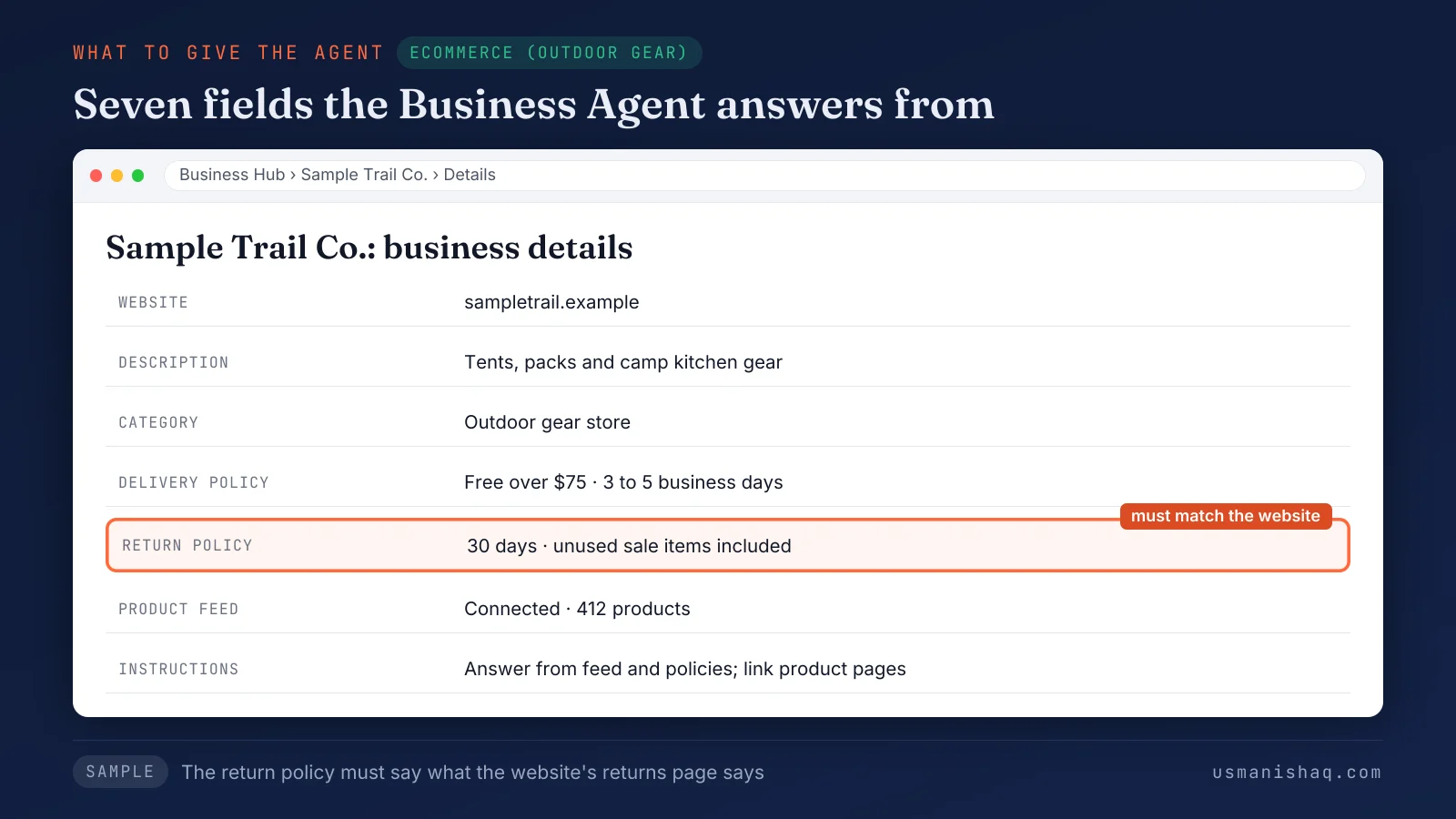
The sample profile lists seven fields: website, description, category, delivery policy, return policy, product feed and instructions. The return policy row is marked, since the policy must match the returns page word for word.
The return policy is the field I would write first. Buyers ask about returns before paying, and a vague policy gives the agent a vague answer.
The agent should be previewed with the questions buyers ask most before it goes live. OpenAI reviews profile changes before they appear, so updates take time. Semantic SEO keeps the same facts on the website, so the agent and the site never disagree.
How does sponsoring a Business Agent through ChatGPT Ads work?
A Business Agent can be sponsored as the landing point of a ChatGPT ad, and sponsoring leaves ChatGPT's own answers unchanged.
OpenAI's launch post says a business can sponsor its agent as the destination for ChatGPT Ads. A buyer who taps the ad lands in a chat with the agent. Sponsored placements are labelled and kept apart from ChatGPT's answers.
The format grew out of a test. OpenAI announced Sponsored Agents with select US advertisers on 16 September 2026, as CASRAI also reported.
The paid route makes sense only after the organic agent answers well, because an ad sends buyers into the same chat. Semantic SEO still works on the unpaid answers that name the business.
Does sponsoring a Business Agent change ChatGPT's own answers?
No, sponsoring a Business Agent does not change ChatGPT's own answers, because OpenAI states that advertising does not influence them.
Claiming follows the same rule. OpenAI says claiming a business does not promise higher placement or more sales.
When is a Business Agent not worth setting up?
A Business Agent is not worth setting up when the business is ineligible, buyers mostly ask about orders, or nobody owns upkeep.
The five situations where a Business Agent is not worth the setup work are given below:
- Not eligible: the business is local, a trade, or based outside the US, so no agent option exists.
- Order-heavy questions: most buyer messages ask about orders already placed, which the agent does not check.
- Unwritten exceptions: return or delivery rules carry exceptions that nobody has written down.
- Thin product data: no feed exists, or products lack prices, sizes and availability.
- No owner for upkeep: nobody updates the agent when prices or policies change, though the policy expects current information.
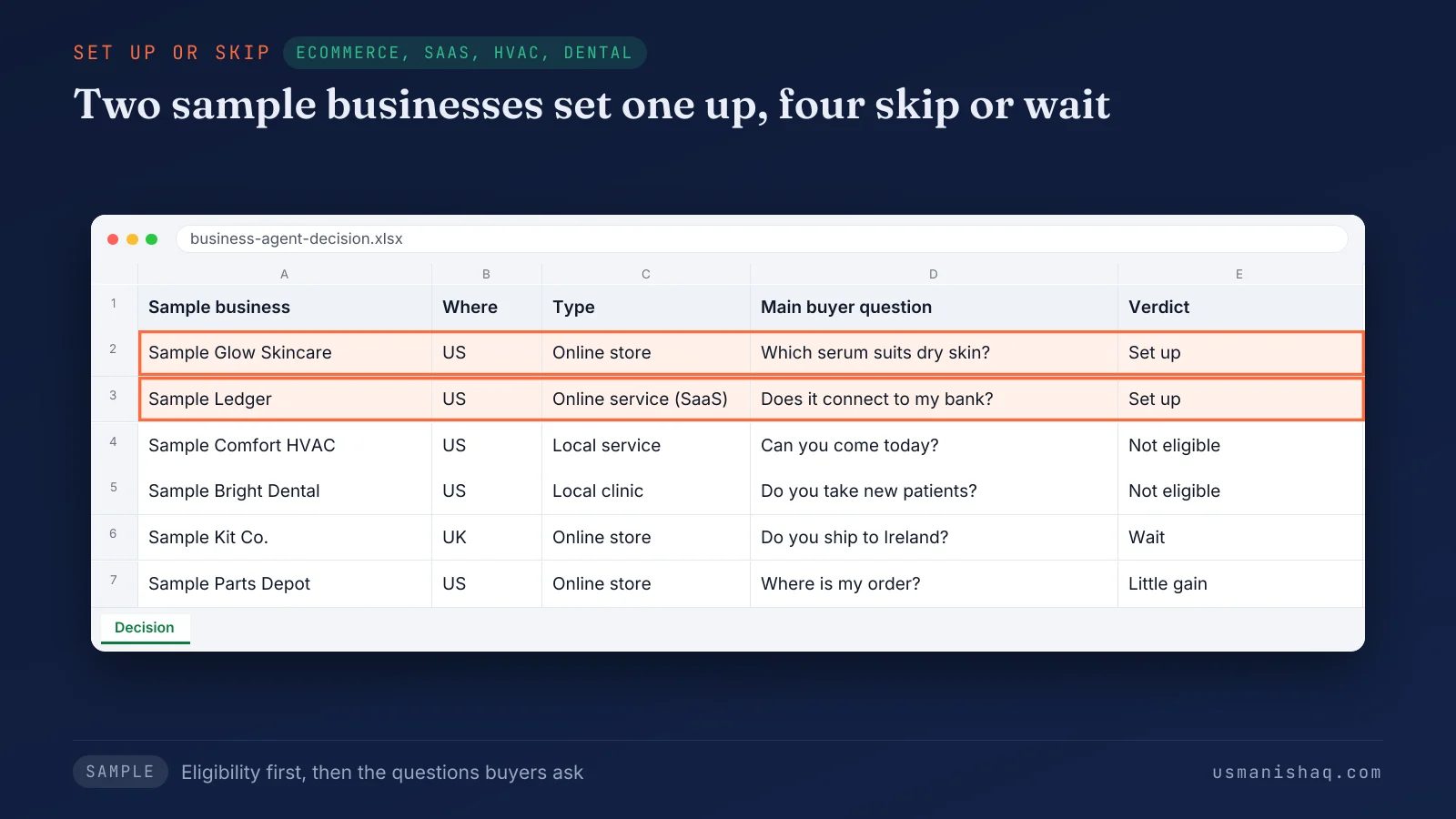
The US skincare store and the US bookkeeping software company should set one up. The HVAC company and the dental clinic are not eligible, and the UK store waits. The parts store gains little, because its buyers ask about orders.
The reverse case is short. An eligible business with frequent questions before purchase and clean product data should set up an agent and test the answers. I would rather see a store fix a vague returns page than publish an agent that repeats the vague policy.
Every one of the five cases leaves the website as the record that semantic SEO keeps accurate.
How does a Business Agent relate to semantic SEO?
Semantic SEO decides whether ChatGPT names the business, and a Business Agent opens only after that answer appears.
ChatGPT builds its answers from the website and other sources it reads. The agent adds a conversation after the answer, not visibility. Two steps sit around the agent: a claimed profile before the agent, and website pages that match what the agent says.
How is a business claimed in ChatGPT before the agent is built?
A business is claimed in ChatGPT through Business Hub, where the owner finds the listing, proves ownership and waits for review.
OpenAI offers four ownership checks: business phone, business email, website domain or Shopify store. Each verification method is explained in the guide to claiming a business in ChatGPT. The agent becomes available only after the claim and the Persona check pass.
Which website pages should match what the Business Agent says?
The returns page, delivery page, product pages and FAQ page should state the same facts the Business Agent gives.
OpenAI's help article notes that ChatGPT may also use sources other than the profile. A buyer who reads one return window in the chat and another on the site has a reason to doubt both.
Product FAQs written for AI answers carry those facts in a form an assistant can lift. An audit of product FAQs for AI answers is shown in the Shopify FAQ SEO case study on a skincare store. OpenAI's Business Agents Policy gives the full rules for the agent itself.
Questions about ChatGPT Business Agents
Two more Business Agent questions come up often: the price, and whether Shopify is required.
Neither answer changes the semantic SEO work on the website.
Does a ChatGPT Business Agent cost anything?
OpenAI's pages list no price for claiming a business or publishing a Business Agent.
No Ads account or Enterprise agreement is needed to claim. Sponsoring the agent through ChatGPT Ads is the paid option.
Does a business need Shopify to set up a Business Agent?
No, a Business Agent does not need Shopify, because an eligible business can upload a product feed as a CSV file.
Connecting a Shopify store verifies the claim, shares the products and can create a draft agent to review.
What should an online business do about a Business Agent now?
An eligible online business should claim its profile, write its policies clearly, then test a Business Agent on buyers' most common questions.
The agent answers product and policy questions inside ChatGPT and sends the sale to the website. Businesses outside the beta lose little by waiting, because the agent adds no visibility of its own.
Semantic SEO keeps the website facts right, so ChatGPT names the business and the agent repeats the same facts.