
Kalicube's three pillars of semantic SEO are Understandability, Credibility and Deliverability, Jason Barnard's model of what an algorithm needs.
It is Kalicube's model. It is not a Google system, and I found no mention of it in Google's documentation on AI features. Kalicube's own glossary calls it the three pillars of SEO. I tie it to semantic SEO below.
Even so, the three questions are useful for a business owner. Can a system tell who you are? Can it trust you? Can it hand you to the right person in the right form?
What are Kalicube's three pillars?
Kalicube's three pillars are Understandability, Credibility and Deliverability, written as U, C and D.
Kalicube says Jason Barnard first gave the framework as a talk in 2019. He called the pillars Understanding, Credibility and Suitability then. Understanding became Understandability, and Suitability became Deliverability.
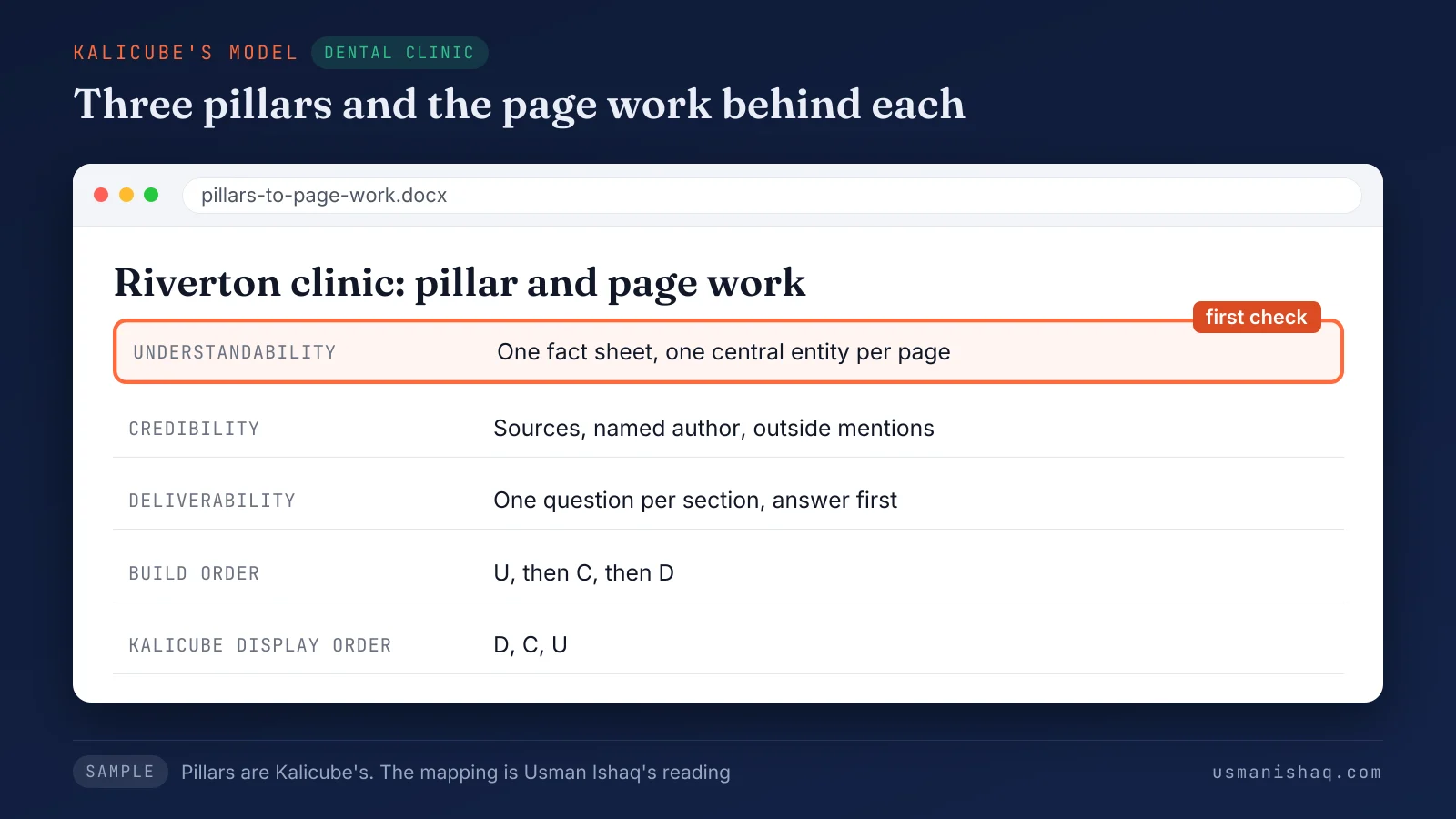
Kalicube describes the framework as the backbone of its own method, The Kalicube Process. The page says you build in the order U, C, D. You cannot build credibility for an entity the algorithm does not understand.
This table sets out what Kalicube says each pillar means.
| Pillar | The question Kalicube asks | Where Kalicube places it in the funnel | Early name |
|---|---|---|---|
| Understandability | Does the system know who you are and what you offer? | Bottom | Understanding |
| Credibility | Does it trust you over the others that offer the same thing? | Middle | Credibility |
| Deliverability | Can it hand you to the right person, in the right format? | Top | Suitability |
Kalicube displays them in reverse, D, C, U, because a customer meets the brand at the top of the funnel first. That is a Kalicube choice of presentation, not a rule about how algorithms work.
Whose model is it, and how far can you trust it?
It is a practitioner model from one company, so use it to ask questions about your site, not to explain Google.
Kalicube states that every algorithm must understand before it can trust and trust before it can recommend. Kalicube calls that a structural constraint. I could not find the same claim in Google's documentation, so I label it Kalicube's view.
Kalicube also uses its own terms, such as the Doubt Tax and the Ghost Tax. They describe revenue it says is lost at each pillar. I could not check any figure for them, so I do not repeat one.
Google's page on AI features says there are no additional requirements to appear in AI Overviews or AI Mode. That is documentation. The pillars are a framework someone built on top of the same problem.
How do the three pillars map to semantic SEO work?
Each of the three pillars maps to a different piece of semantic SEO work on a business website.
Kalicube's page on semantic SEO says the company implements it most heavily in the Understandability phase of its process. I read it more widely, because page plans touch all three pillars.
Here is how I map them for a business with a site and a Google Business Profile. The work is mine, and the mapping is my reading, not Kalicube's.
| Pillar | Semantic SEO work on the site | A check you can run yourself |
|---|---|---|
| Understandability | One central entity per page, one fact sheet for name, address and services | Search your business name and read what comes back |
| Credibility | Evidence on the page: who wrote it, what was tested, outside mentions | Open one service page and look for a source for every claim |
| Deliverability | One question per section, answer first, page type that matches the search | Search five real queries and note which of your pages appears |
Take a sample dental clinic in Riverton. Its home page says "Riverton Smiles" while the profile says "Riverton Smiles Dental". The system has two names to reconcile. That is an Understandability fault, and the fix is one name everywhere.
The same clinic has an implants page with no author and no source. A system comparing it with another clinic's page has little to weigh. That is a Credibility fault.
Last, its whitening and veneers answers share one long page. A person asking about veneers only gets a section buried halfway down. That is a Deliverability fault, and a separate page answers it.
Whether ChatGPT or Gemini name the clinic at all is a separate check, run over repeated queries. AI Search Visibility measurement and fixes covers that scope.
A sheet for scoring the three pillars on your own site
You can score the three pillars on your own site in about an hour, with three yes or no checks per pillar.
Use this sample for the clinic. The scores are made up to show the format.
- Understandability: name matches on site and profile (no), service list matches (yes), city stated on home page (yes).
- Credibility: author named on service pages (no), a source for each claim (no), reviews that name a service (yes).
- Deliverability: one search per section (no), answer in the first sentence (yes), a page per main service (yes).
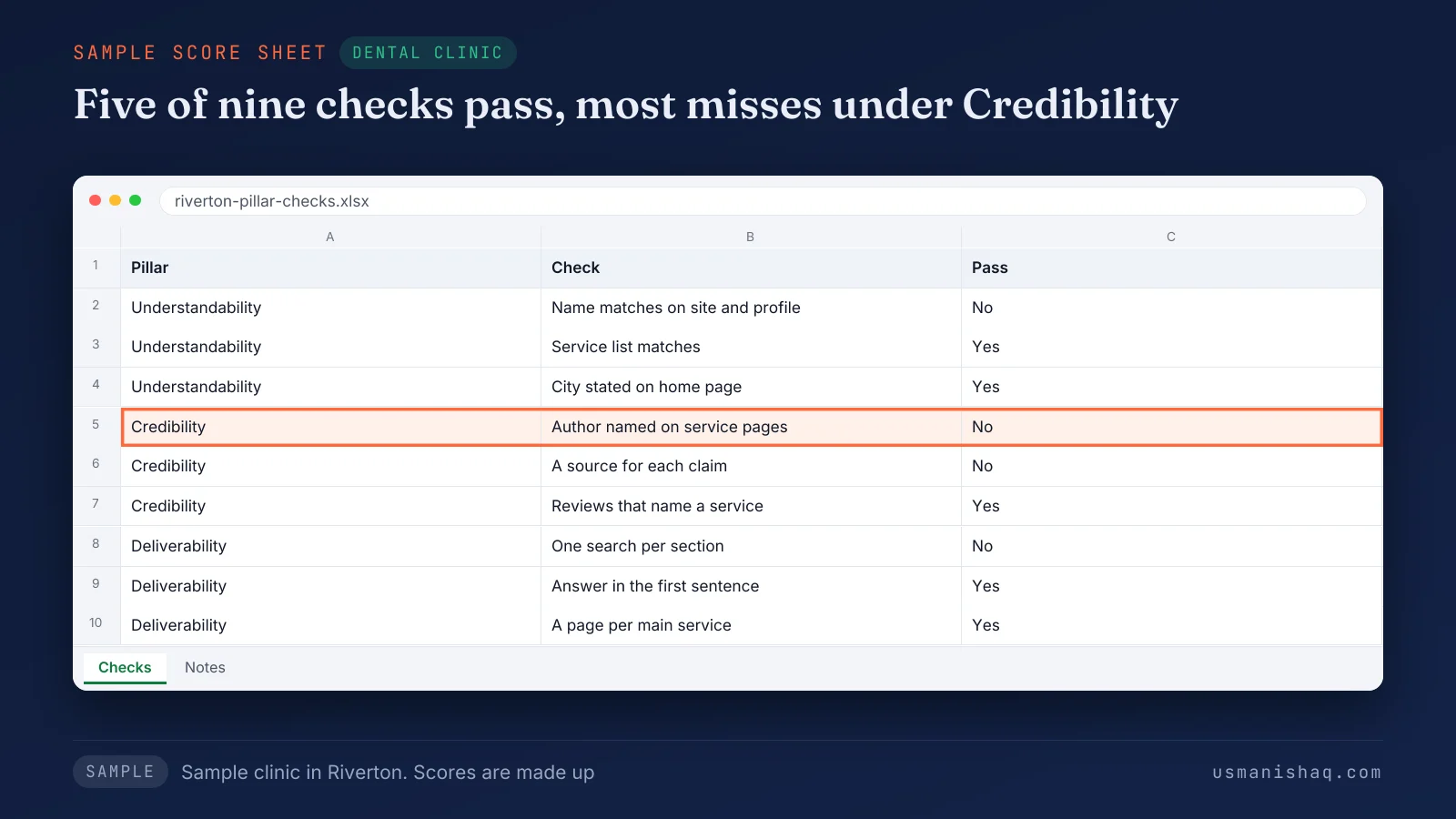
Five of nine passes. Credibility has the most misses. I would still fix the name mismatch first, because it takes minutes and the other checks lean on it. That matches Kalicube's build order.
Do not read the score as a ranking. It is my sample sheet, and it sorts your own to-do list.
Where Kalicube's model stops for a small business
Kalicube's model stops short of a local business that has few searches for its own name.
The Kalicube pages I read centre on the brand search results page, the results for your brand name. A trade business may get few of those searches. I would expect most of its enquiries to start with a service and a town.
For that business the page-level work matters more. Kalicube says Schema markup serves all three pillars. I treat structured data as a way to state facts clearly, not as a lever for AI citations. The page itself has to answer the question.
What do people ask next about the three pillars?
People ask next where Kalicube publishes the pillars, how they differ from a topical map and where semantic SEO sits among them.
Where Kalicube publishes the three pillars
Kalicube publishes the three pillars on its own site in a glossary article by Jason Barnard.
Its article, Understandability, Credibility and Deliverability on Kalicube, is my main source. It says the framework "is now the backbone of The Kalicube Process". The older names appear in a clip transcript, The Three Pillars of SEO and Brand SERP Management, published in 2022.
The three pillars and a topical map
No, a topical map plans which pages a site needs, and the three pillars ask what a system needs from a brand.
A topical map comes from source context and the searches around it. The pillars sit one level up. I use the pillars as a checklist and the map as the plan. The layers are set out in the definition and layers of semantic content.
Does semantic SEO sit inside Understandability?
Kalicube puts semantic SEO mostly in Understandability, while page-level semantic SEO also serves Credibility and Deliverability.
Kalicube describes this on its semantic SEO page. Writing one answer per section is a Deliverability job. Showing sources is a Credibility job. For how the labels GEO, AEO and SEO relate to this, read how the GEO, AEO and SEO labels overlap.
Kalicube three pillars, short answer
Kalicube's three pillars are Understandability, Credibility and Deliverability, a framework from Jason Barnard that Kalicube builds its method on. Treat them as three questions about your own site and not as a Google rule.