
A business website earns topical authority, as practitioners use the term, by covering one subject with one page for each customer search.
Topical authority is a practitioner term. Google documents a system called topic authority for news queries, with local news as its stated example. Everything sold under the name for business websites is practitioner work.
That does not make the work useless. You judge it by what you can do and measure, because an owner cannot check a claim about Google.
What is topical authority for a business website?
Topical authority is the practitioner idea that a site covering one subject in depth gets treated as the place for it.
Three agency pages I read on 24 November 2026 describe the same plan. You pick a narrow core subject and build one main page for it. Then you add pages for customer questions and link them together.
I read that as a way to organise a site, not as a score. Google's help page on the Performance report lists impressions, clicks, click-through rate and position. No topical authority number appears among them.
What does Google document about topic authority?
Google documents topic authority as a system for news queries, and its post names local news as the main example.
The post is "Understanding news topic authority" on the Search Central blog, dated 23 May 2023. It says Google built the system to find expert sources for newsy queries in areas such as health, politics or finance. It lists three signals. One is how notable a source is for a topic or place. Another is how often others cite its original reporting. The third is its history of high-quality reporting.
The post adds that topic authority has been an important signal for local news queries. Its example is a flood, where regional publishers that cover your town rise to the top. It says nothing about service business websites.
Knapsack Creative, one of the three pages, says Google reads a whole site as an ecosystem and rewards expertise. That is a practitioner reading, and the Google post does not say it.
Another Google page sits closer to your site. The helpful content page asks whether your site has a primary purpose or focus. It also asks whether your content shows first-hand expertise and depth of knowledge. Those are questions to answer, not a score.
What can an owner do to build topical authority?
You can choose one core subject, give each search one page, keep facts identical and link pages where readers need them.
- Choose one core subject, the service that brings in the most work.
- Assign each search to one page only, so two pages never compete for it.
- Keep every fact identical on every page, from opening hours to the services you offer.
- Link pages in the sentence where the reader needs the next answer, with an anchor that names the target.
Google's link page backs the last action. It says links are a signal of relevance and help Google find new pages.
Giving each search one page is the work of a Semantic SEO Architecture topic plan, written for the whole site.
A coverage sheet for a sample estate planning firm in Franklin
In a sample sheet for a Franklin estate planning firm, four of ten core searches show and six need work.
The firm is a sample, and the table is made up for illustration. I picked ten searches around one core service. A search counts as shown when one of the firm's pages has impressions for it in the Performance report of Search Console.
| Search | Page today | Shows in Search Console | Next move |
|---|---|---|---|
| estate planning lawyer Franklin | Home page | Yes | Keep |
| will vs living trust | Blog post | Yes | Keep |
| how to choose an executor | Blog post | Yes | Keep |
| what is probate | Blog post | Yes | Keep |
| power of attorney | Service page | No | Add the missing facts and a link from the home page |
| living trust lawyer Franklin | Service page | No | Match its facts to the home page |
| do I need a will | Old blog post | No | Merge into the will service page |
| estate planning checklist | None | No page | New page |
| update a will after moving | None | No page | Section on the will page |
| trust funding steps | None | No page | New page |
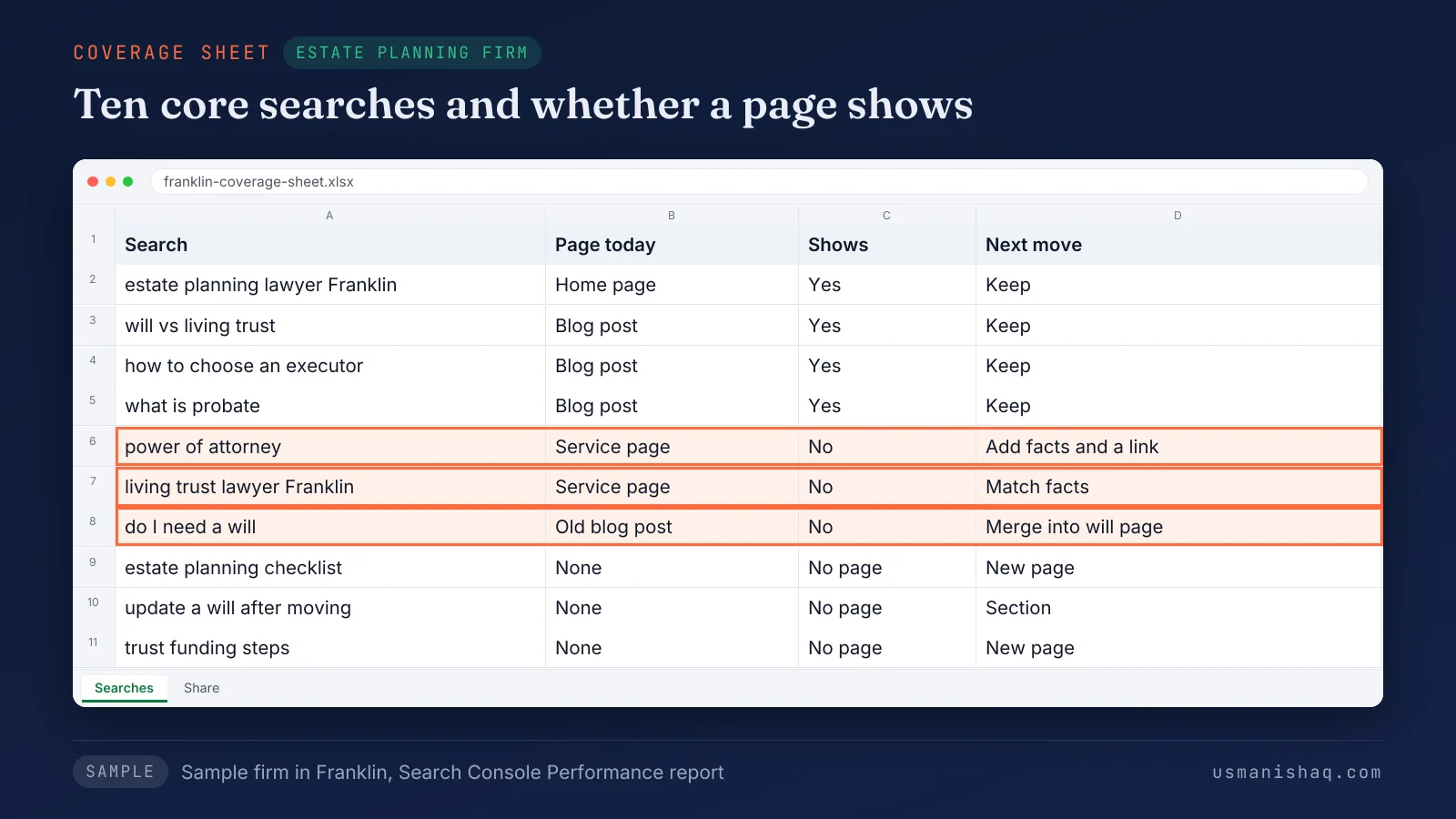
Four searches show, three have a page that does not show, and three have no page. Only two of the last three need a new page. Moving a will is a section on a page the firm should already have.
Measuring the shown share in Search Console
The shown share is the searches on your list where a page of yours shows, out of the whole list.
It is my own measure, not a Google metric. For the sample it is 4 of 10, or 40 percent.
- Write ten searches around your core service, in the words customers use.
- Next to each, write the page you want to own it, or "none".
- Open the Performance report in Search Console, filter by that page and check whether the search appears.
- Mark each row as shows, page not shown or no page.
- Divide the shown rows by ten and write down the date.
- Change one batch of rows, then check the same list after eight to twelve weeks.
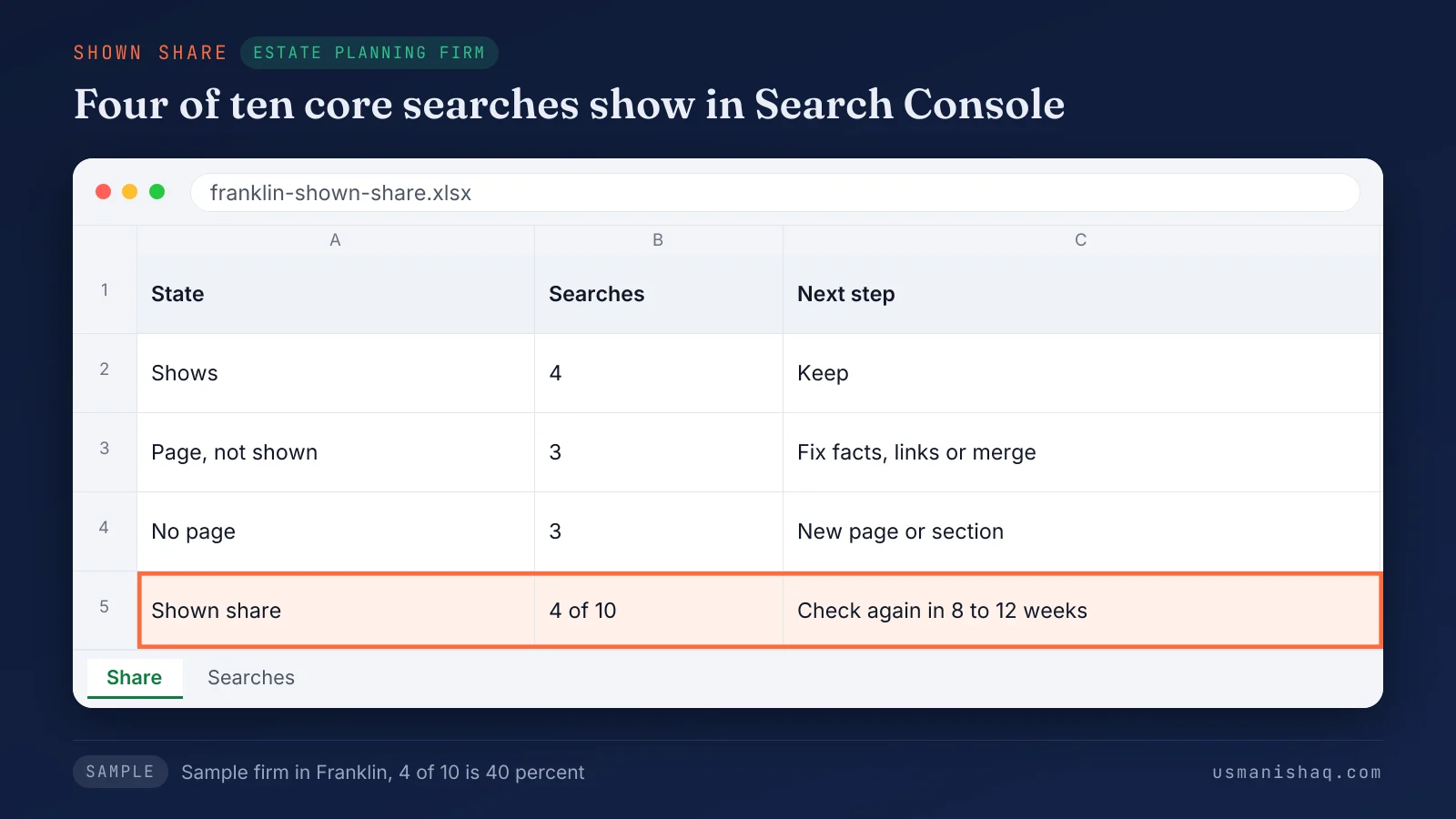
The share has limits. The list is yours, not Google's, so it measures your list and nobody else's. A search with no impressions may simply have no demand. A page that shows at a low position still counts as shown. Use the share to see gaps, not as a topical authority score.
Habits that stall topical authority
Off-topic posts, repeated pages and facts that differ from page to page stall topical authority.
One agency page I read says unrelated posts weaken a content strategy. I cannot confirm that from Google. A post on a different subject gives your reader no next step, though, and that is reason enough to leave it out.
Repeated pages are the second habit. Two pages for one search split whatever you can measure, and row 7 in the sample is that case.
Then there are facts that differ. A page that says you open on Saturdays and a profile that says you do not hand a reader two answers.
Questions owners ask about topical authority
Owners ask three questions about topical authority, and each one has a short answer.
How long does topical authority take?
Nobody outside Google can give a fixed time, so plan checks at eight to twelve weeks and judge by the shown share.
I change one batch of rows at a time so a change can be traced to a result. A batch that leaves the share flat after twelve weeks points to the page facts or the links, not more posts.
Does a business need a blog to build topical authority?
A business needs a blog only for searches that a service page cannot answer, such as a question or a comparison.
The guide to which pages a topical map gives a business website shows how those searches are sorted. Pages that answer the same kind of search are best built from one layout, as the semantic content network page templates show.
Will topical authority get a business cited in AI answers?
Topical authority has no documented effect on AI answers, because Google's AI features page does not mention it.
That page also lists no extra requirements for AI Overviews or AI Mode, and it covers Google only. For other AI assistants, any claim that topical authority drives citations is practitioner opinion, and I treat it that way.
Topical authority for a business website in short
Topical authority is a practitioner idea, and Google documents topic authority for news queries only. The rest is work you can do, namely one page per search, identical facts and links where readers need them. Track the shown share every eight to twelve weeks.