
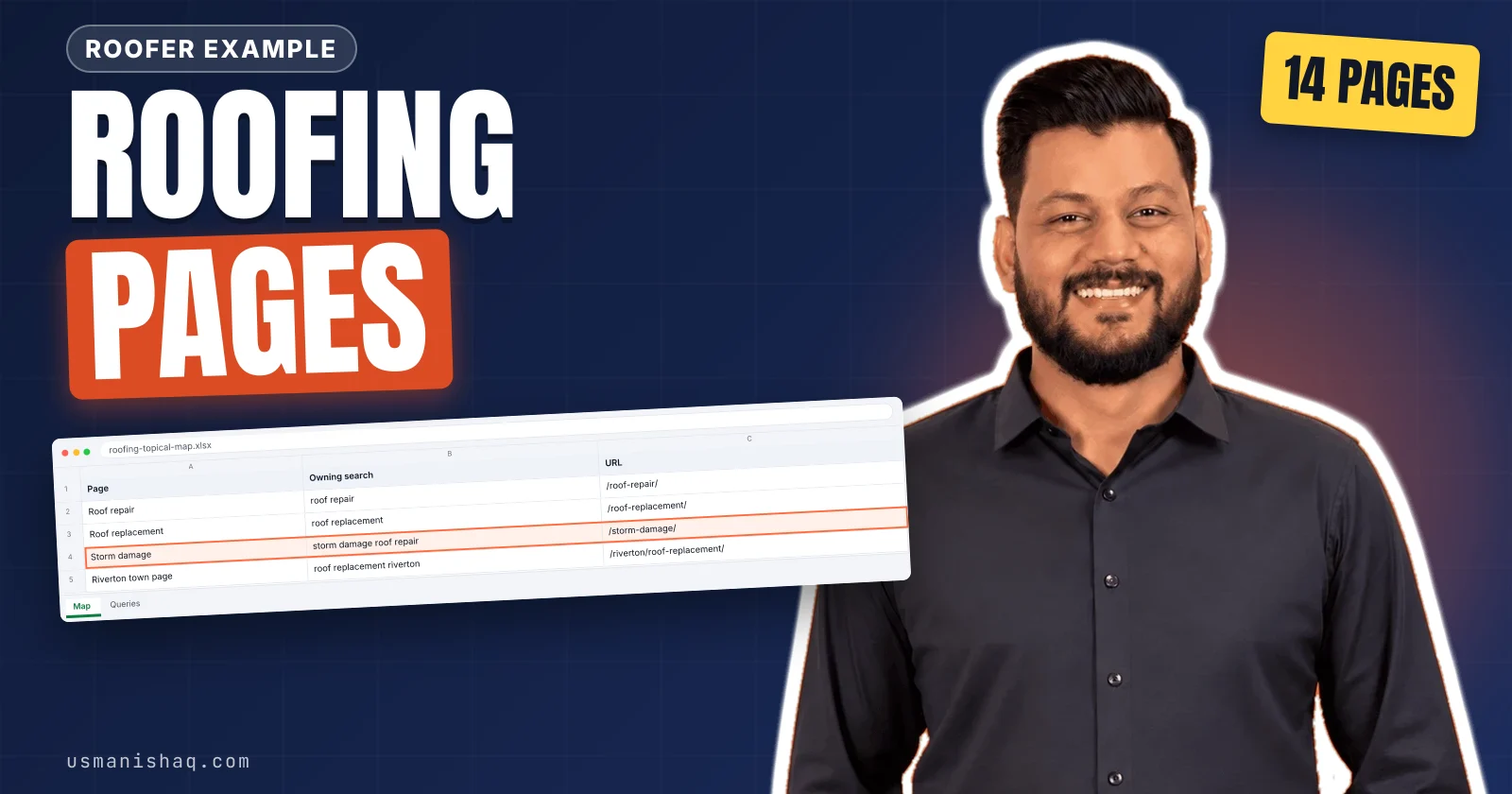
A topical map for a roofing company website is the plan of service, town and question pages, with one owner per search.
Semantic SEO plans the map so search engines understand which page answers each roofing search. A roofing company website needs a page per service, separate repair and replacement pages, question pages, a claim page and town pages.
A roofing company website is structured in service and town folders, linked to each service page and published in a set order. A roofing company's topical map is measured per page in calls, signed jobs and booked inspections, which decides its worth. A roofing company's topical map breaks on five faults: one services page, competing posts, unsold work, mixed trades and copied towns.
What is a topical map for a roofing company website?
A topical map for a roofing company website is the plan of service, town and question pages, with one owner per search.
A roofing company needs pages for the jobs homeowners call about, the towns the crews cover and the questions homeowners ask first. Service pages name the job, such as "roof repair", "roof replacement" or "storm damage roof repair". Town pages name one service in one town.
Question pages answer what homeowners type before they call a roofer. The plan gives every search one owner, so no two pages of the website answer the same search.
Roofing company owners search "what pages should a roofing website have" and rarely use the words "topical map". The topical map for a roofing company website answers that question page by page.
Semantic SEO keeps the map as rows, one row per page with its owning search, intent and URL. The rows together name every page a roofing business website needs.
What pages does a roofing company website need?
A roofing company website needs a page per service, separate repair and replacement pages, question pages, a claim page and town pages.
Trust pages complete the site: the home, about, reviews and contact pages. Trust pages own no search beyond the company name, so the table lists only pages that own a search.
The table below is an example of a topical map for a roofing company website with six services in two towns.
| Page | Section | Owning search | Intent | URL |
|---|---|---|---|---|
| Roof repair | Core | roof repair | Transactional | /roof-repair/ |
| Roof replacement | Core | roof replacement | Commercial | /roof-replacement/ |
| Roof replacement cost | Core | how much does a new roof cost | Commercial | /roof-replacement/cost/ |
| Metal roofing | Core | metal roof installation | Commercial | /roof-replacement/metal/ |
| Storm damage repair | Core | storm damage roof repair | Transactional | /storm-damage/ |
| Roof inspection | Core | roof inspection | Transactional | /roof-inspection/ |
| Gutter installation | Core | gutter installation | Commercial | /gutters/ |
| Roof replacement in Riverton | Core | roof replacement riverton | Transactional | /riverton/roof-replacement/ |
| Roof repair in Maple Grove | Core | roof repair maple grove | Transactional | /maple-grove/roof-repair/ |
| Roof insurance claim | Outer | how to file a roof insurance claim | Informational | /storm-damage/insurance-claim/ |
| Hail damage signs | Outer | signs of hail damage on a roof | Informational | /storm-damage/hail-signs/ |
| Metal roof vs shingles | Outer | metal roof vs shingles | Informational | /roof-replacement/metal-vs-shingles/ |
| Signs you need a new roof | Outer | signs you need a new roof | Informational | /roof-replacement/signs/ |
| Roof leak after rain | Outer | why is my roof leaking after rain | Informational | /roof-repair/leak-after-rain/ |
No two rows share an owning search. The rows are a worked example, not a client result. Each owning search is confirmed in Google Search Console or search suggestions before a page is built.
An informational intent is to learn, a commercial intent is to compare or to price, and a transactional intent is to book. Semantic SEO treats each row as one page decision, so the table is also the build list. The core rows of a roofing company map start with the service pages.
Which roofing services earn their own service page?
A roofing service earns a service page when the job, the price, the proof or the next step differs from other services.
The roofing services that most roofing company maps hold as service pages are listed below:
- Roof repair: the page for leaks, missing shingles and failed flashing that need a visit soon.
- Roof replacement: the page for a tear-off and a new roof, priced in a written estimate.
- Storm damage repair: the page for roofs hit by hail or high wind, with the roofer's inspection.
- Roof inspection: the page for owners, buyers and sellers who want the roof checked before a decision.
- Material pages: a page such as metal roofing, only for a material the company installs.
- Gutter installation: a page only for a roofing company that installs gutters.
The services the roofing company performs decide the rows. Semantic SEO names each service page by the job homeowners type, not by a label such as "Exteriors". Roof work then splits once more, into repair and replacement.
Why do roof repair and roof replacement get separate pages?
Roof repair and roof replacement get separate pages because the homeowner, the price and the next step differ.
A roof repair homeowner has a leak or missing shingles and wants a visit soon, a transactional intent. A roof replacement homeowner compares shingle and metal roofs, prices, financing and dates, a commercial intent. The storm damage page owns the call that comes after hail or wind.
The sample figure below sets two searches for one roofing company's town side by side. The search "roof repair riverton" shows repair pages, and "roof replacement riverton" shows replacement and cost pages.
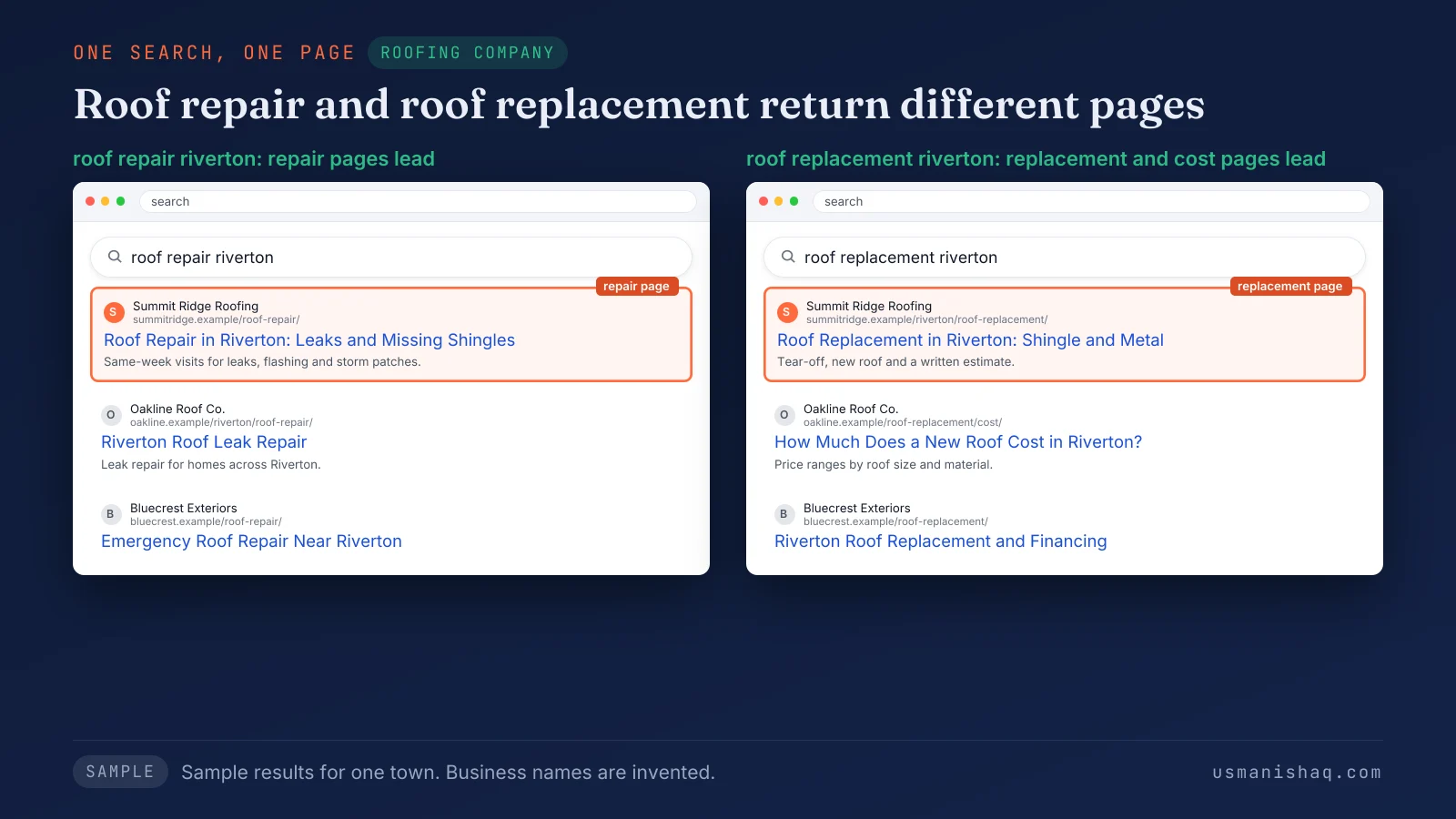
One merged page answers both searches and owns neither. The same split applies to roof inspection when its search shows different results from the repair search.
Semantic SEO splits a service family where the searches split, and keeps one page where the searches agree. Homeowner questions follow a separate test.
Which roofing questions earn a question page?
A roofing question earns a question page when its search differs from the search the service page owns.
A search earns a page when customers type the search and the search names a different service, town or thing. The search also shows different results in Google from the searches other pages own.
The search "metal roof vs shingles" earns a question page. The search "how long does a roof replacement take" stays a section of the replacement page. The searches "signs you need a new roof" and "why is my roof leaking after rain" each earn a question page.
Does a cost question earn a question page? A cost question earns a price page in the core section, such as roof replacement cost.
A free inspection offer stays a section of the contact and estimate page. Every question page on a roofing company website links to its service page. Semantic SEO keeps question pages in the outer section, each one feeding a service page.
Storm work adds one more question page to the map: the insurance claim page.
Does a roofing company need an insurance claim page?
Yes, a roofing company that does storm work needs an insurance claim page, because the claim search differs from the repair search.
The insurance claim page explains the claim steps and the roofer's part, such as the inspection, the photos and the damage report. The claim itself stays between the homeowner and the insurer.
Roofing software guides often list storm damage and insurance claims as one item. The claim page sits in the storm folder as an outer page and links to the storm damage page. A roofing company without storm work leaves the claim page out of the map.
Semantic SEO adds the claim page only for work the roofing company takes. Each kept page then takes a place in the site structure.
How is a roofing company website structured?
A roofing company website is structured in service and town folders, linked to each service page and published in a set order.
The six parts of a roofing company website structure are listed below:
- Service folder: one folder for each service page, such as /roof-replacement/.
- Pages inside the service folder: the price page /roof-replacement/cost/, the material page /roof-replacement/metal/ and question pages such as /roof-replacement/signs/.
- Storm folder: the storm damage page /storm-damage/, with the insurance claim and hail damage pages inside it.
- Town folder: one page for one service in one town, such as /riverton/roof-replacement/.
- Links: each price, question and town page links to its service page. Each service page links to its town pages, and the home page links to every service page.
- Schema: RoofingContractor, Service and areaServed on each town page, stating only what the page shows.
Some guides place every service under a city page. The map in the table keeps the service page as the hub, so one service page owns the service in every town.
The sample figure below shows the roof replacement folder with its price, material, question and town pages. Solar panels and siding sit outside the border, because the sample roofing company does not sell them.
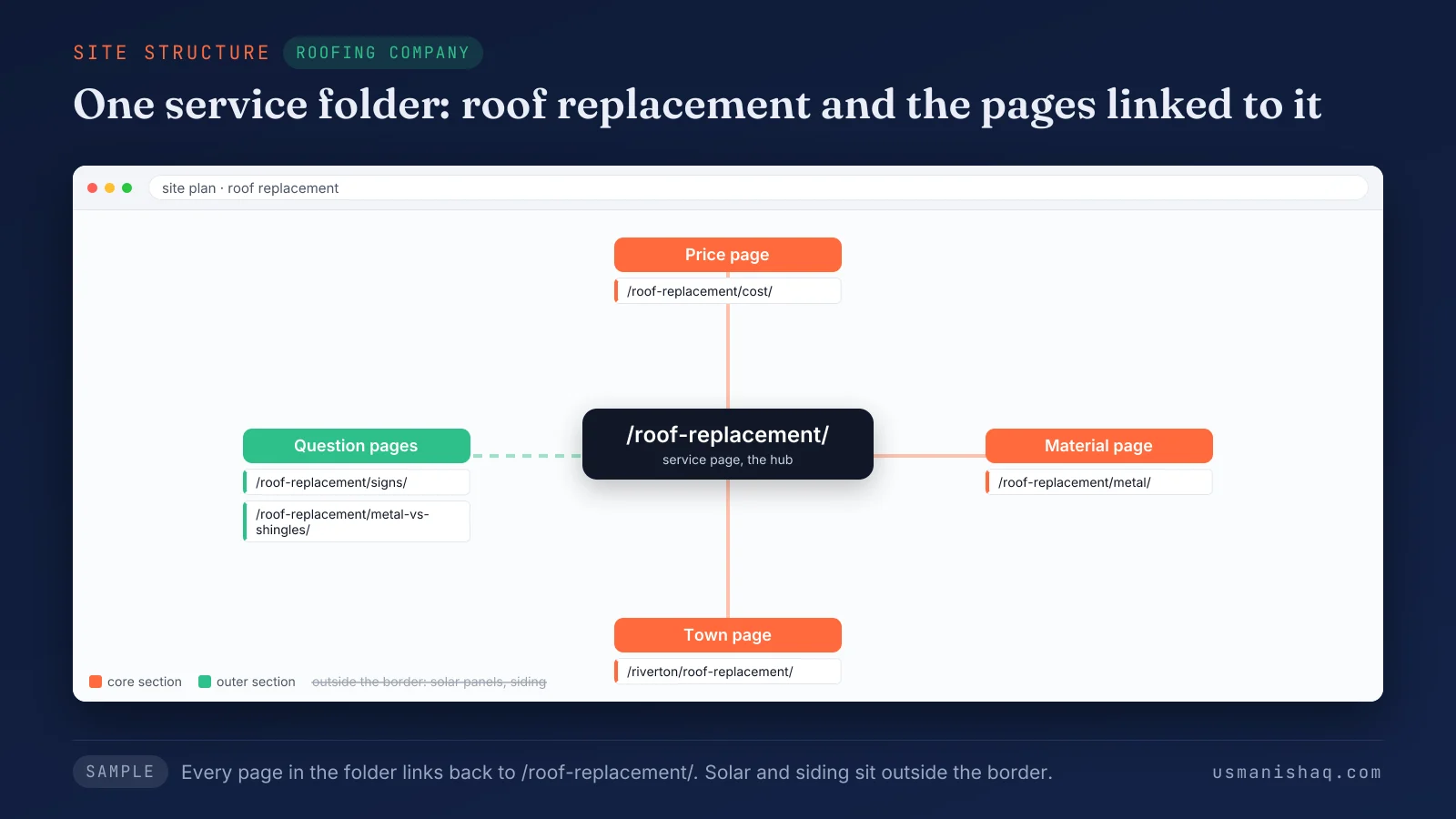
Semantic SEO sets the folders before the pages, so every URL follows its row. The folders come first, and the pages then go live in a set order.
In what order should a roofing company publish its pages?
A roofing company should publish roof repair and storm damage pages first, then replacement, price, town and question pages.
The steps to publish the pages of a roofing company website are listed below:
- Publish the roof repair and storm damage pages first, since the intent to call is highest.
- Publish the replacement, inspection and material pages in the order of the jobs the company wants more of.
- Add the roof replacement cost page, since homeowners search the price of a new roof.
- Add a town page for each town that earns one.
- Add the question pages, each linked to its service page.
A roofing company's semantic SEO architecture sets the publication order in the topical map before the first page. One business can have that topical map and a 12-month roadmap planned through a Semantic SEO Architecture engagement. Each published page is then judged by the calls the page brings.
How is a roofing company's topical map measured?
A roofing company's topical map is measured per page in calls, signed jobs and booked inspections, which decides its worth.
The roof repair and storm damage pages should bring calls. Replacement and material pages should bring estimate requests and booked inspections. Town pages should bring calls and jobs from that town.
Question pages should bring clicks to the service page, not calls. The sample sheet below sets each roofing page type beside the action it should bring and where that action is counted.
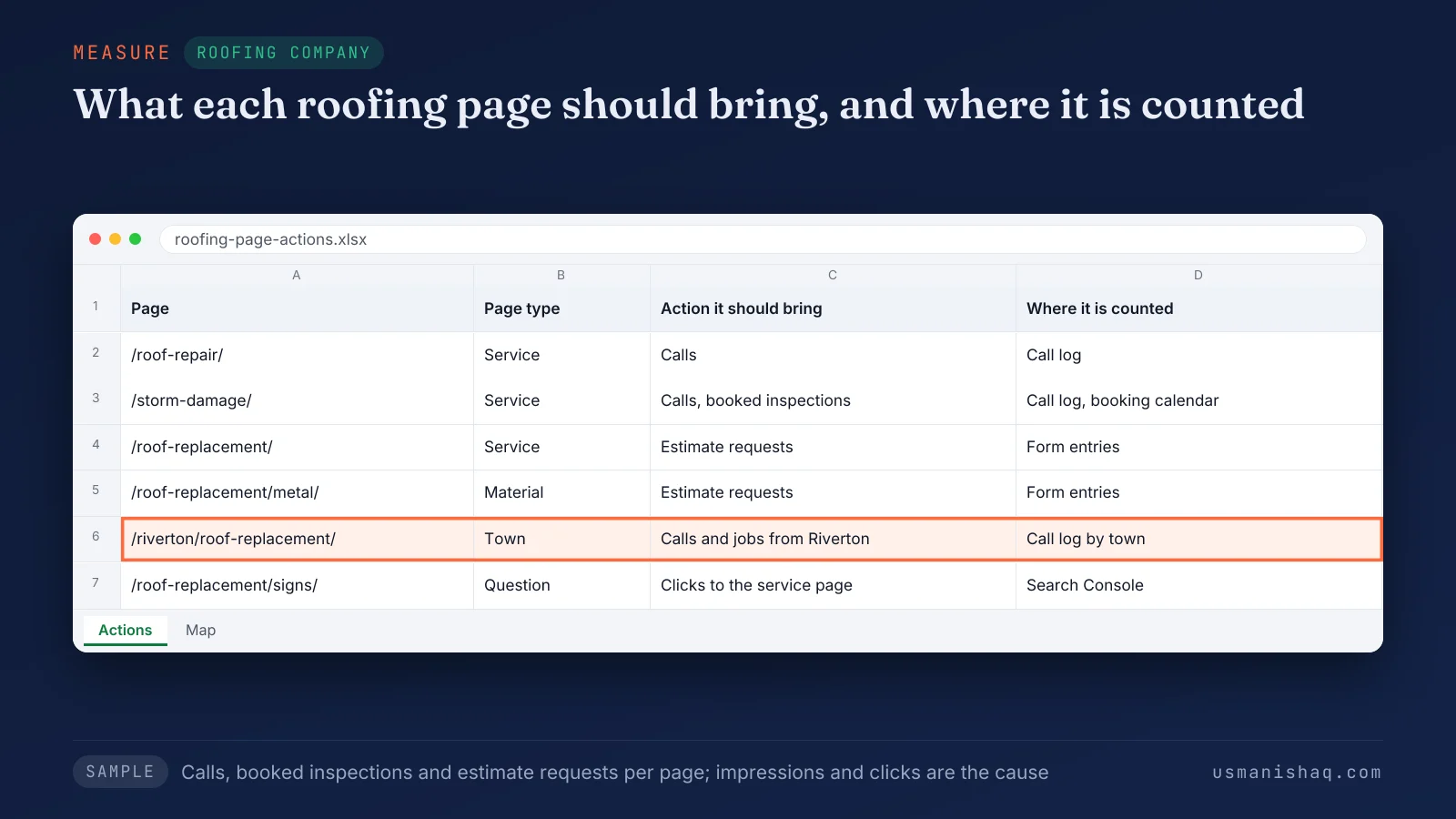
The calls come from the call log, the inspections from the booking calendar and the estimate requests from the form entries. Search Console shows the impressions and clicks of each page.
The roofing company records which page each call, inspection or estimate request came from. A town page with impressions and no calls needs a better answer on the page, not more pages.
Semantic SEO reads each row of the map against the calls the page brings. The same per-page reading tells a roofing company owner if the topical map is worth the work.
Is a topical map worth it for a roofing company?
Yes, a topical map is worth it for a roofing company that sells several roofing services or serves several towns.
The Google Business Profile covers the map results, and the website covers the searches the profile has no room for. The profile carries the roofing company's categories and service areas.
The website carries one page per service, town and question. The website's service list mirrors the categories of the Google Business Profile. A roofing company with one service in one town needs a few rows only.
Semantic SEO builds the pages a Google Business Profile has no room to hold. The worth holds only while the website avoids five faults.
Which faults break the topical map of a roofing company website?
A roofing company's topical map breaks on five faults: one services page, competing posts, unsold work, mixed trades and copied towns.
The five faults that break the topical map of a roofing company website are listed below:
- One services page: repair, replacement, storm work and gutters share one page, so no job owns a search. The fix is a service page for each job.
- Competing posts: a blog post targets "hail damage roof repair", the search the storm damage page owns. The fix is one owner, with the post turned into a section or a link.
- Unsold work: pages for solar panels or skylights the company does not install bring calls the company turns away. The fix is a border around the services sold.
- Mixed trades: siding and window pages sit inside the roofing folders. The fix is a separate folder for each trade.
- Copied towns: town pages repeat one text with the town name swapped. Google's "Spam policies for Google web search" name pages for cities that "funnel users to one page" in the doorway section. The same policy names "substantially similar pages" as a second example. The fix is content that exists only for that town, such as roofs finished there.
Semantic SEO checks the map for all five faults before a page is written. The same checks run again when the roofing company adds a new trade or a new town.
How does a roofing company's topical map change for a new trade or town?
A roofing company's topical map keeps its columns for a new trade, a new town or another service business; only rows change.
Every trade needs a different topical map, since the services, the towns and the customer questions differ. A roofing company is one kind of local service business, and the same five columns serve any of them.
Five steps plan any topical map: describe the business, collect searches, decide owners, set page types and order the pages. The steps are set out in the guide to planning a topical map for a business website.
The topical map as a planning method comes from the framework of Koray Tuğberk Gübür. Semantic SEO keeps the columns fixed so maps of different trades compare row by row.
A plumbing company website shows the same method in another trade. The topical map for a plumbing company website fills the same columns with drain, water heater and repiping rows.
The site structure, the page order and the measure in calls hold for any service business. All three are set out in the guide on semantic SEO for trade and service businesses with several towns. The rows of a roofing company map also answer the further questions owners ask about website pages.
Questions roofing company owners ask about website pages
Roofing company owners ask five further questions about website pages: page count, small sites, prices, project galleries and commercial work.
How many pages does a roofing company website need?
A roofing company website needs one page for every search that passes the page test, so no fixed number applies.
The semantic SEO example above holds 14 pages: six service pages, one price page, two town pages and five question pages.
Is a five-page website enough for a roofing company?
No, a five-page website gives every roofing job one shared Services page, so no single job owns a search.
A roofing company with one service in one town is the exception.
Should a roofing website show roof prices?
Yes, a roofing website should show price ranges on a cost page, because homeowners search the price of a new roof.
NRCA, the National Roofing Contractors Association, shared U.S. Chamber of Commerce advice in July 2024 to include pricing information.
Should a roofing website have a project gallery?
Yes, a roofing website should have a project gallery as a trust page, and finished roofs give each town page its proof.
Each gallery entry should name the town, the material and the job, so the matching town page can link to it.
Does a roofing company need separate commercial roofing pages?
Yes, a roofing company that takes commercial work needs separate commercial roofing pages, because the buyers and the searches differ.
Flat roof repair and roof coating are typical commercial rows, kept in a commercial folder apart from the homeowner pages.
The topical map for a roofing company website and the next step
A roofing company website takes its next step from a topical map that gives each service, town and question one owning page.
Search engines understand a roofing company through pages that each name one job, one town or one question. The owner builds the pages in the map's order, roof repair and storm damage first. A semantic SEO topical map lists the pages a roofing company website needs before the first page is written.