
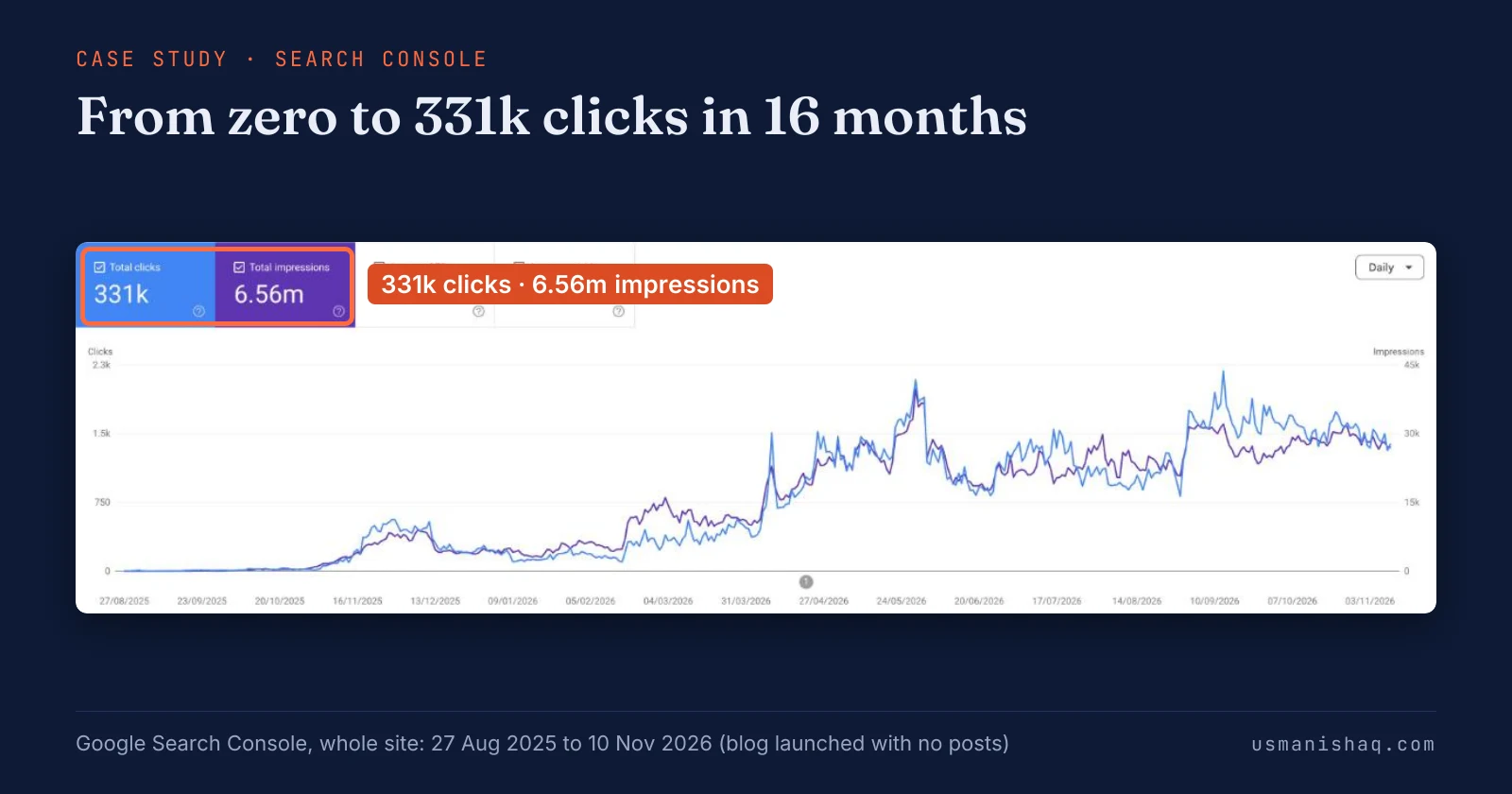
This software SEO case study follows the blog of a desktop and mobile video downloader app with a global audience, from no posts in late August 2025 to November 2026. Google Search Console's 16-month view shows 331k clicks for the domain.
Results at a glance
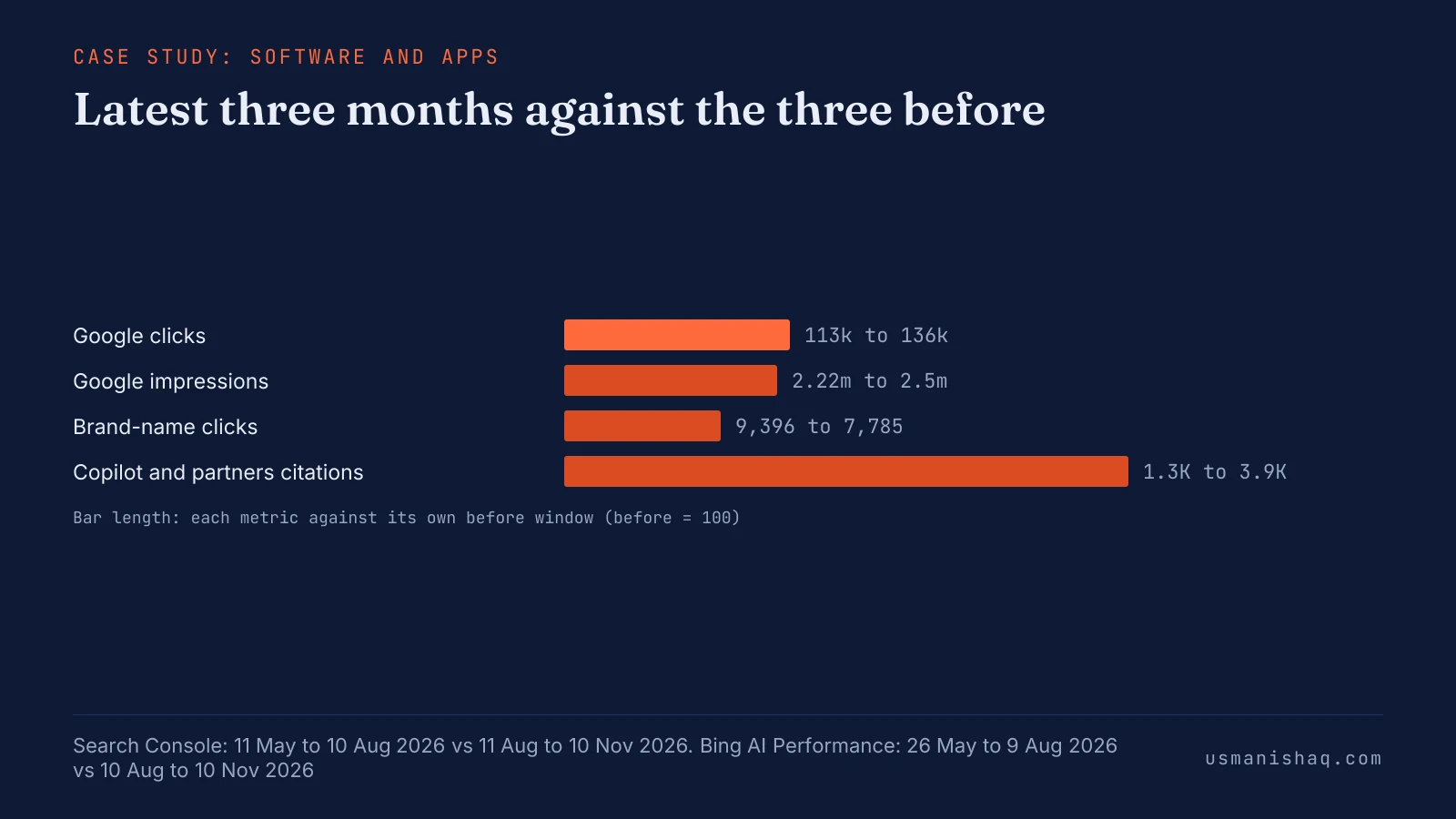
Clicks, average position and Microsoft Copilot citations all improved in the latest three months, and the click gain came from non-brand searches.
| Metric | Before | After | Change |
|---|---|---|---|
| Google clicks | 113k | 136k | about +20% |
| Google impressions | 2.22m | 2.5m | about +13% |
| Average position | 11.6 | 8.9 | 2.7 places higher |
| Brand-name clicks | 9,396 | 7,785 | 1,611 fewer |
| Citations, Microsoft Copilot and partners | 1.3K | 3.9K | about 3x |
Search Console rows compare 11 May to 10 August 2026 with 11 August to 10 November 2026, for the whole domain. The citation row is Bing Webmaster Tools AI Performance, 26 May to 9 August 2026 against 10 August to 10 November 2026.
The starting point: video downloader app SEO from scratch
The blog had no posts, and the app's landing page did not say what the app is for. The blog was a fresh install under the app's domain. The landing page was a separate static page whose title, H1 and copy left out the main query terms for a video downloader.
The whole domain had 8 clicks in the last five days of August 2025. A keyword tool scored the niche's head term at 27 for difficulty. That looked reachable for a new blog, once the site made clear what it is about.
What I did, in order
I set the central entity first, then published on a fixed cadence and fixed the technical faults that showed up. The order was:
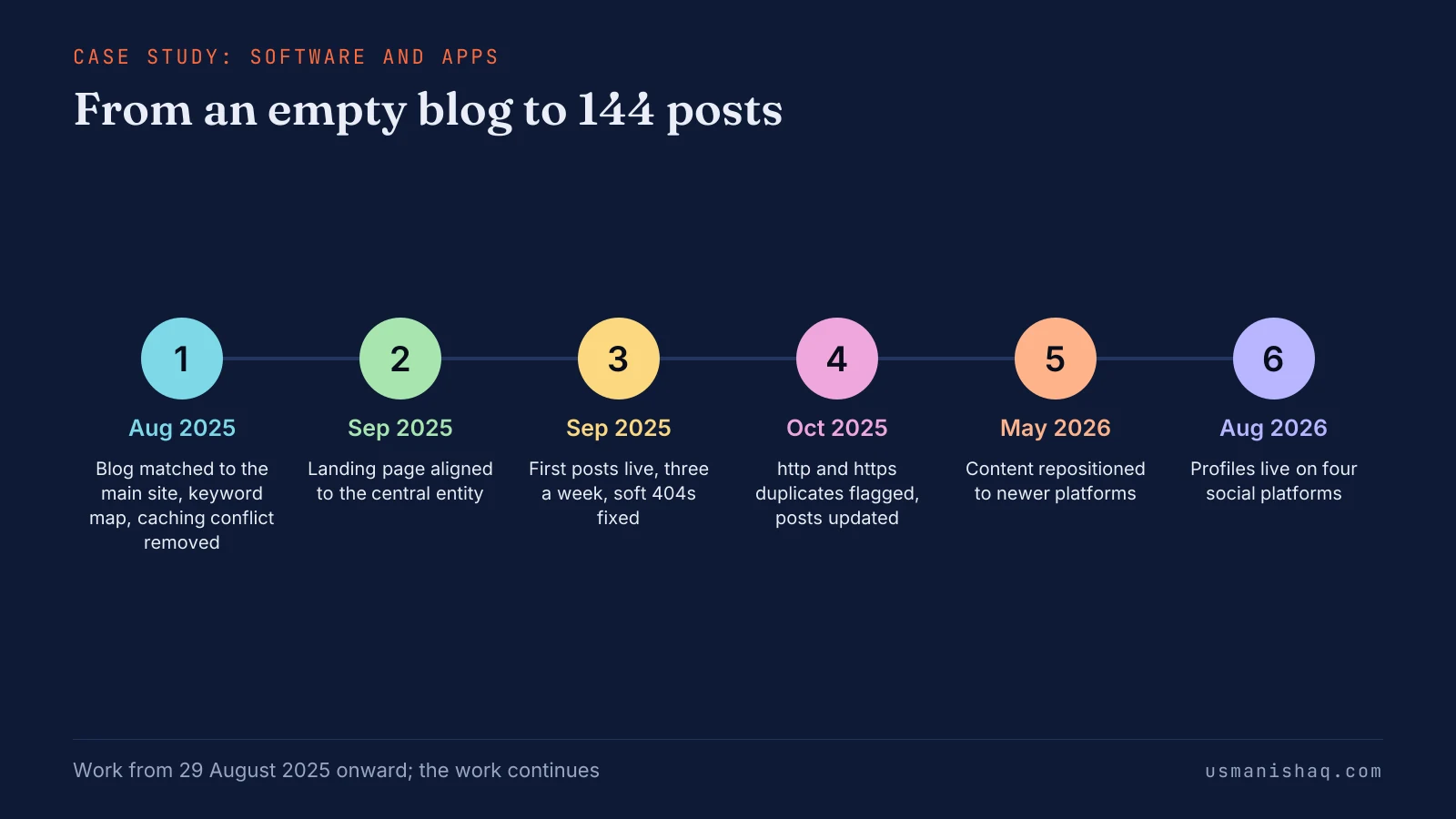
- August 2025: a blog built to match the main site. I matched the blog's theme to the landing page so the two read as one site. I also removed a caching plugin conflict.
- August 2025: a keyword map and a semantic content plan. The first plan held 10 posts around the app's central entity.
- September 2025: a landing page aligned to the central entity. I rewrote the title, meta description and H1, and added sections that name the main query terms. Duplicate heading and footer elements went, and links to the blog came in.
- September 2025: first posts and a fixed cadence. The first 3 posts went live on 4 September. A cadence of three posts a week was set on 18 September.
- September 2025: real 404s. Missing URLs loaded the homepage, a soft 404. I fixed it so they return a real 404.
- October 2025: duplicate signals and a second platform. Google crawled both the http and the https homepage, and I flagged the duplicate. When the app added a second platform, I updated the posts to cover it.
- May 2026 onward: content repositioned to newer platforms. About 70 earlier posts had focused on two platforms. New and updated posts covered the app's macOS and Linux versions and newly supported video sites.
- August 2026 onward: profiles on four social platforms. I set up the profiles, wrote the bios and ran the posts.
The landing page work is where source context sets the central entity in practice: the main page names the product and links to the blog. The keyword map grouped the posts into one semantic content network around that entity.
The blog held 144 posts by 7 November 2026. Most months carried 10 to 14 of them.
What changed: from zero traffic to a 44.4k-click month, a dip and a recovery
Clicks grew to a May 2026 peak, dipped through the summer and rose above that peak in September.
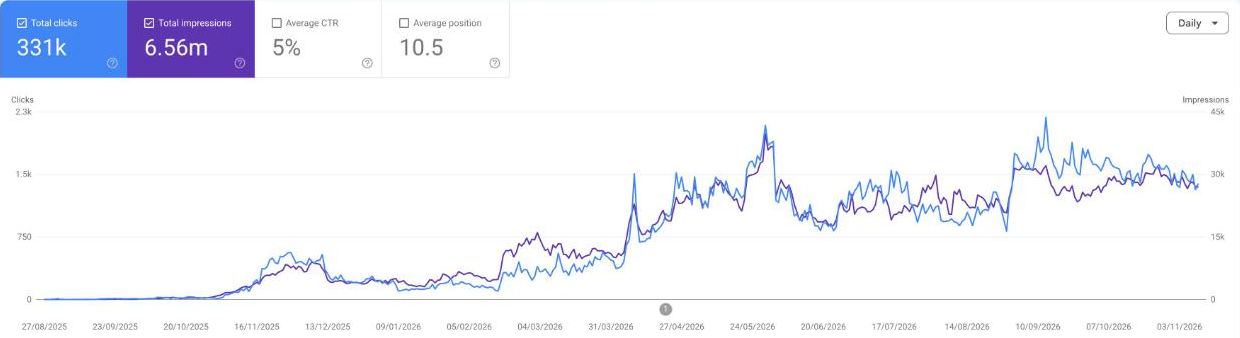
September 2025 brought 141 clicks. November 2025 reached 7,902. April 2026 reached 27,219, more than double March.
May 2026 was the first peak, with 44.4k clicks. June fell to 32.4k.
July came back to 39.1k. August was the low point after the peak, at 32.2k.
Over those months, the content was being repositioned toward the app's newer platforms. The site also had no external profiles. I count that as a gap, not as a proven cause of the dip.
The four social profiles went live from late August 2026. September brought 50.5k clicks, 18.4k more than August. October brought 48.6k.
That rise came after the profiles went live, but also after the repositioned content settled and a summer of steady publishing.
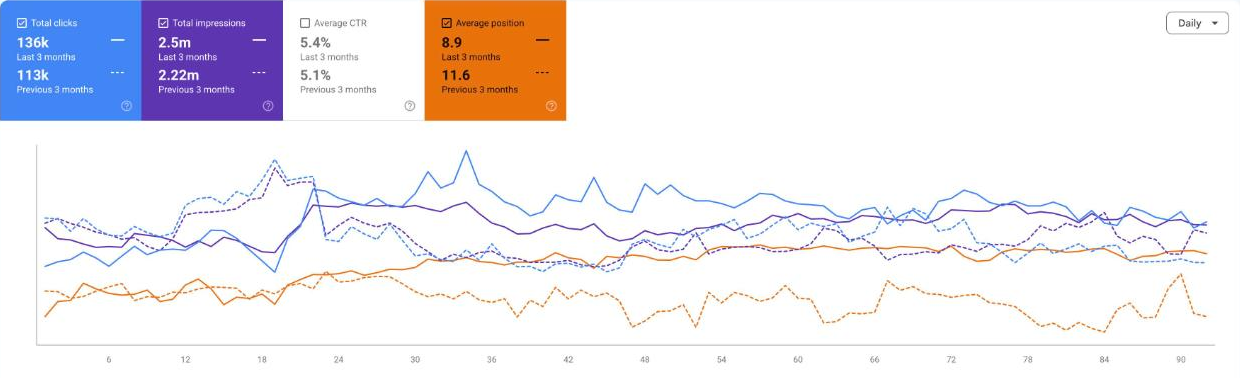
Brand-name clicks fell between those two windows, so the gain came from non-brand searches. The query groups that grew are how-to searches.
"download youtube video to phone gallery" went from 187 clicks to 620. "save youtube video to camera roll iphone" went from 79 to 407. "youtube playlist downloader app android" went from 190 to 510.
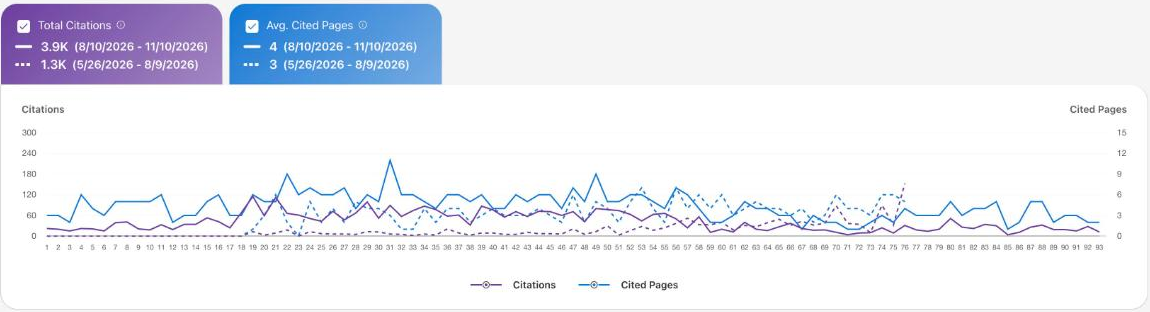
The AI Performance report in Bing Webmaster Tools counts citations by Microsoft Copilot and partners. The average number of cited pages rose from 3 to 4.
The most cited non-brand queries are practical questions. "where do youtube downloads go" went from 0 citations to 456. Questions about age-restricted and unlisted videos came next, and "download unlisted youtube videos" rose from 14 to 169.
What did not move
Brand searches fell, the growth was not a straight line, and the data does not show what ended the summer dip.
January 2026 slipped to 5,087 clicks, down from 9,913 in December. Search Console doesn't say why.
No posts went live in April 2026. Only 3 went live in May. Clicks still rose in both months, so most of that growth came from pages already live.
Three things came before September: the profiles went live, the repositioned content settled, and publishing went on all summer. The data can't separate them, and I credit none of them alone with the recovery.
The figures cover the whole domain, so they mix the landing page with the blog. I have no comparable count for ChatGPT, Gemini or Perplexity, and a citation is not a click.
What this software SEO case study means for your site
A new blog can reach steady search demand when the central entity is set first and publishing keeps going. Five points carry over to most software and app sites:
- Say what the product is for on the main page. The landing page here left out its own query terms. Fixing that before the first post is the core of Semantic SEO Architecture.
- Publish on a cadence you can keep. The blog here reached 144 posts at about three a week in most months. A planned, steady flow of posts is what Semantic Content Production delivers.
- Fix the faults that confuse crawlers early. Soft 404s and http and https duplicates are cheap to fix in month one.
- Expect a wobble when the product changes. Repositioning the content toward new platforms coincided with a summer dip. A Semantic Content Audit shows which posts need the update first.
- Read brand and non-brand clicks apart. Total clicks rose while brand clicks fell here. Tracking both, plus AI citations, is part of AI Search Visibility work.
The work continues.