
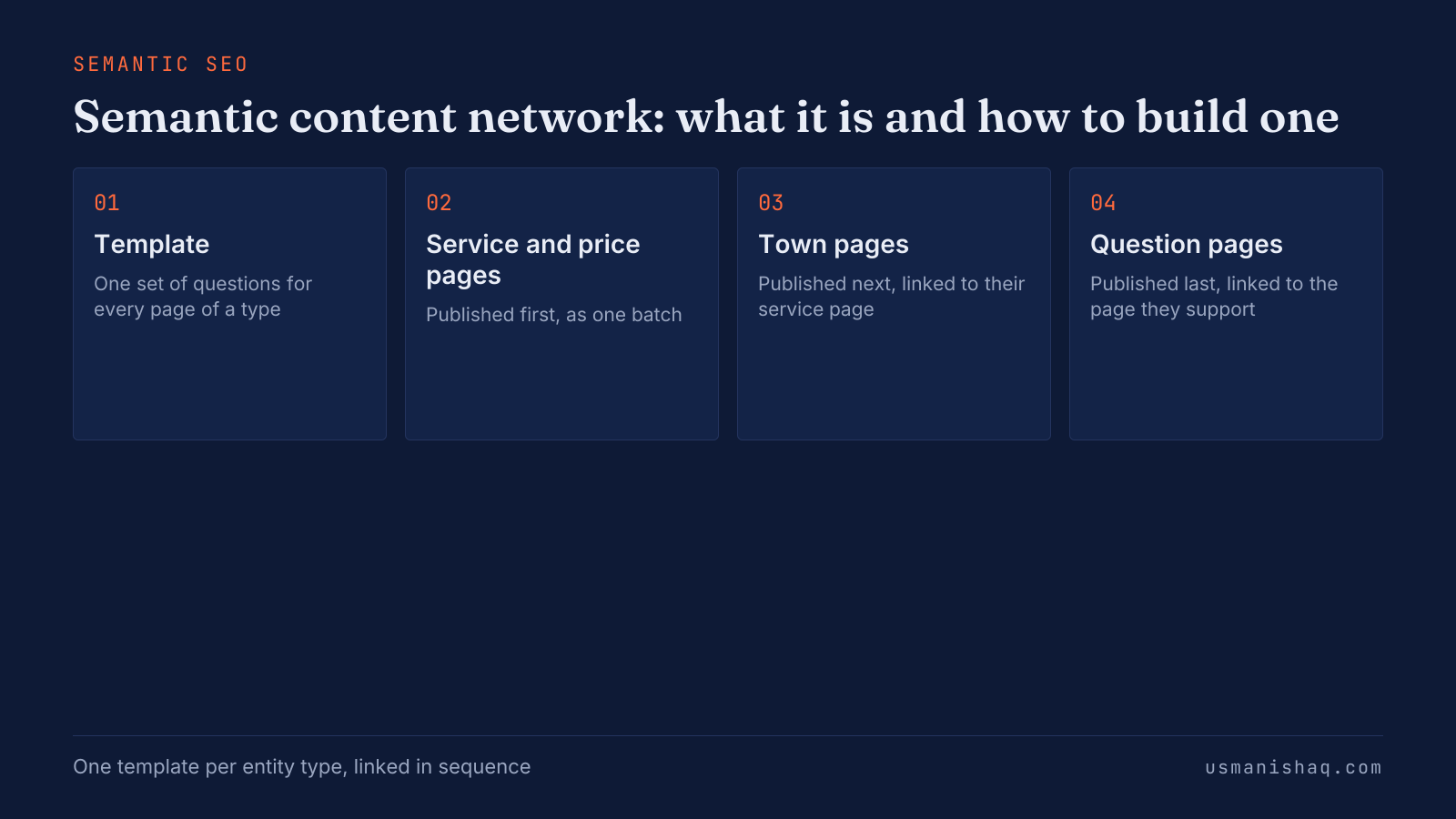
A semantic content network in SEO is a set of pages on one website that are built from one template per entity type and linked in sequence. A semantic content network has five parts: entity types, templates, pages, internal links and a publishing sequence. A semantic content network for a business website is built from scratch in six steps, from the topical map to the measure. A small website launches a semantic content network in a fixed order: service and price pages first, town pages next and question pages last, with each link added after its target page is live. Five mistakes break a semantic content network: posts with no template, pages with no links, a blog post that competes with a service page, pages published in no order and pages split across several websites.
What is a semantic content network in SEO?
A semantic content network in SEO is a set of pages on one website that are built from one template per entity type and linked in sequence. An entity type is a kind of page subject, such as a service or a town. A template is the list of questions every page of one type answers, in one order. The sequence is the order of publishing and linking. A search engine can read pages that share a template and interlink as one body of answers on one subject. SEO practitioners call that standing topical authority. The opposite structure is a blog of unrelated posts. Each post picks its own questions, links to no service page and supports nothing. Owners describe the result as many posts and no traffic. The semantic content network belongs to semantic SEO, the practice of organising a website around entities, their attributes and the relationships between them. A semantic content network is not a semantic network, the concept graph of psychology and artificial intelligence, nor a group of separate websites. The concept is a method of work from one semantic SEO framework, not a statement by Google. Every semantic content network has the same parts.
What are the parts of a semantic content network?
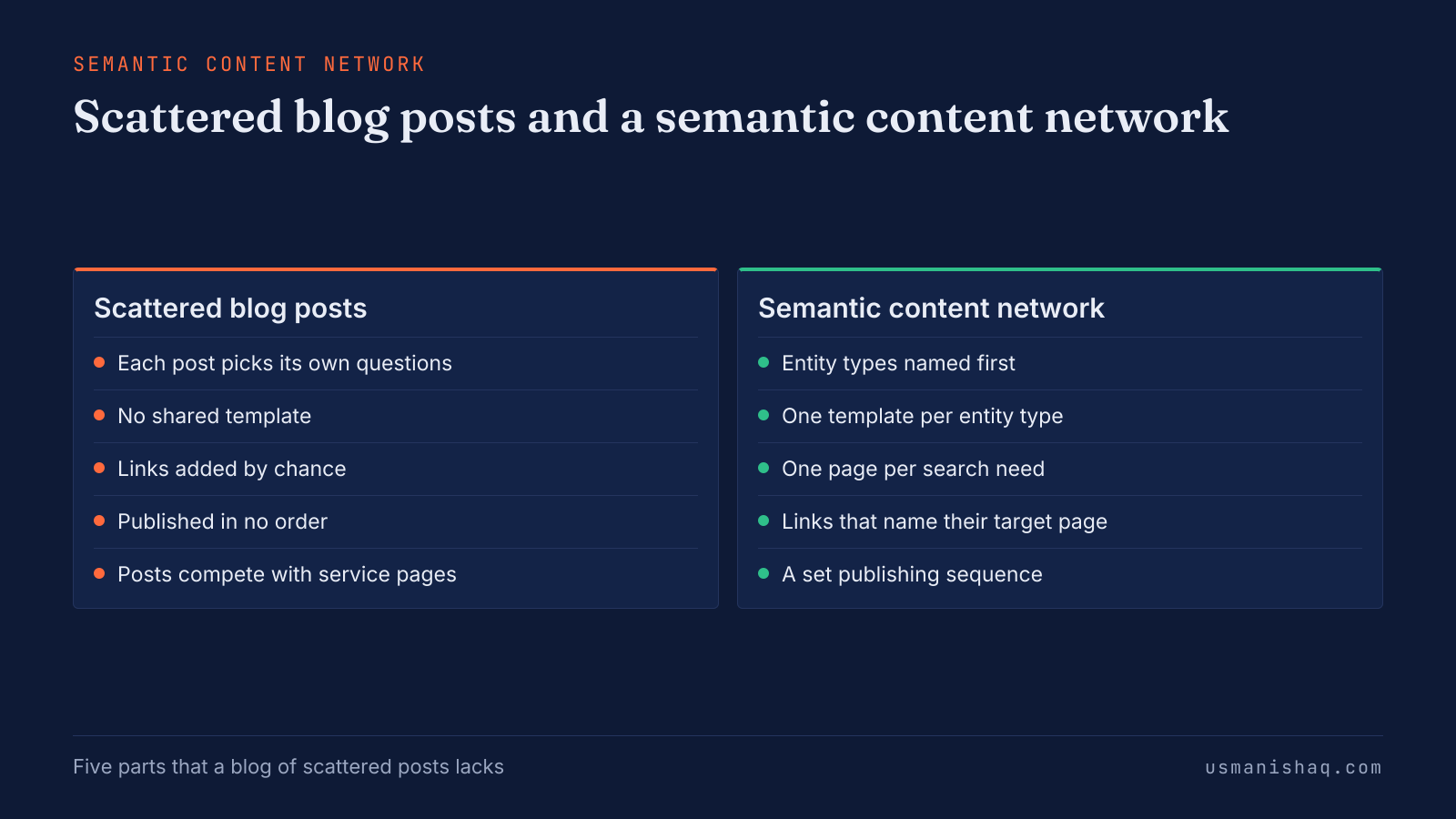
A semantic content network has five parts: entity types, templates, pages, internal links and a publishing sequence. The five parts of a semantic content network are listed below:
- Entity types: the kinds of page subject on the website. An entity is a thing the business sells or serves, such as a service or a town. The plumbing example below has two entity types, the service and the town. The two entity types give four page types: service page, price page, town page and question page.
- Templates: one template for each page type of an entity type. The template turns the attributes of the entity into questions in one order. An attribute is a detail of that thing, such as a price, a material or a time.
- Pages: each page answers one search need and follows the template of its type. A question page answers one customer question, and owners usually publish such a page as a blog post. Service, price and town pages form the core section, the pages that sell a service. Question pages form the outer section, the pages that answer customer questions and link to the core.
- Internal links: an internal link joins two pages of the same website. The anchor text, the clickable words of a link, names the target page. Every question page links to a service page or a town page.
- Publishing sequence: the order in which the pages go live and the links are added.
The figure below sets a blog of scattered posts beside a semantic content network, part by part.
An owner puts the five parts in place, one after another, to build a semantic content network.
How do you build a semantic content network for a business website?
A semantic content network for a business website is built from scratch in six steps, from the topical map to the measure. The six steps to build a semantic content network for a business website are listed below:
- Plan the topical map. A topical map is the plan of every entity, attribute and question a website must cover, with one owning page, section or sentence for each. The topical map names every page before one is written.
- Group the planned pages by entity type and page type. A plumbing company website holds two entity types, the service and the town, and four groups of pages: service pages, price pages, town pages and question pages.
- Write one template for each page type of an entity type. A content brief sets the headings, the questions and the links of a page before a word is written. The template is the part of the brief every page of one type shares.
- Write each page to its template. The questions and their order stay fixed, and the facts change from page to page. The writing on each page is semantic content.
- Publish and link the pages in sequence. Service and price pages go live first, town pages next and question pages last. A link is added after its target page is live.
- Measure the semantic content network as one group of pages. Google Search Console counts the impressions and clicks of the group. A trade business then counts calls, quote requests and booked jobs.
A website with existing blog posts runs the same six steps. Each existing post is matched to a row of the topical map and is kept, rewritten to its template or merged. The six steps are the semantic content network strategy of a small website. Step five, the launch, follows a fixed order on a small website.
How do you launch a semantic content network on a small website?
A small website launches a semantic content network in a fixed order: service and price pages first, town pages next and question pages last, with each link added after its target page is live. The order suits a small website with a handful of service pages. The steps to launch a semantic content network on a small website are listed below:
- Publish the service and price pages as the first batch. Service and price pages sell the service, and every other page links to the first batch.
- Publish the town pages next. Link each town page to its service page, and add the return link once the town page is live.
- Publish the question pages last. Link each question page to the service page the question supports.
- Add links from older pages once each new page is live. No link points to an unpublished page.
The figure below shows the four launch steps in order.
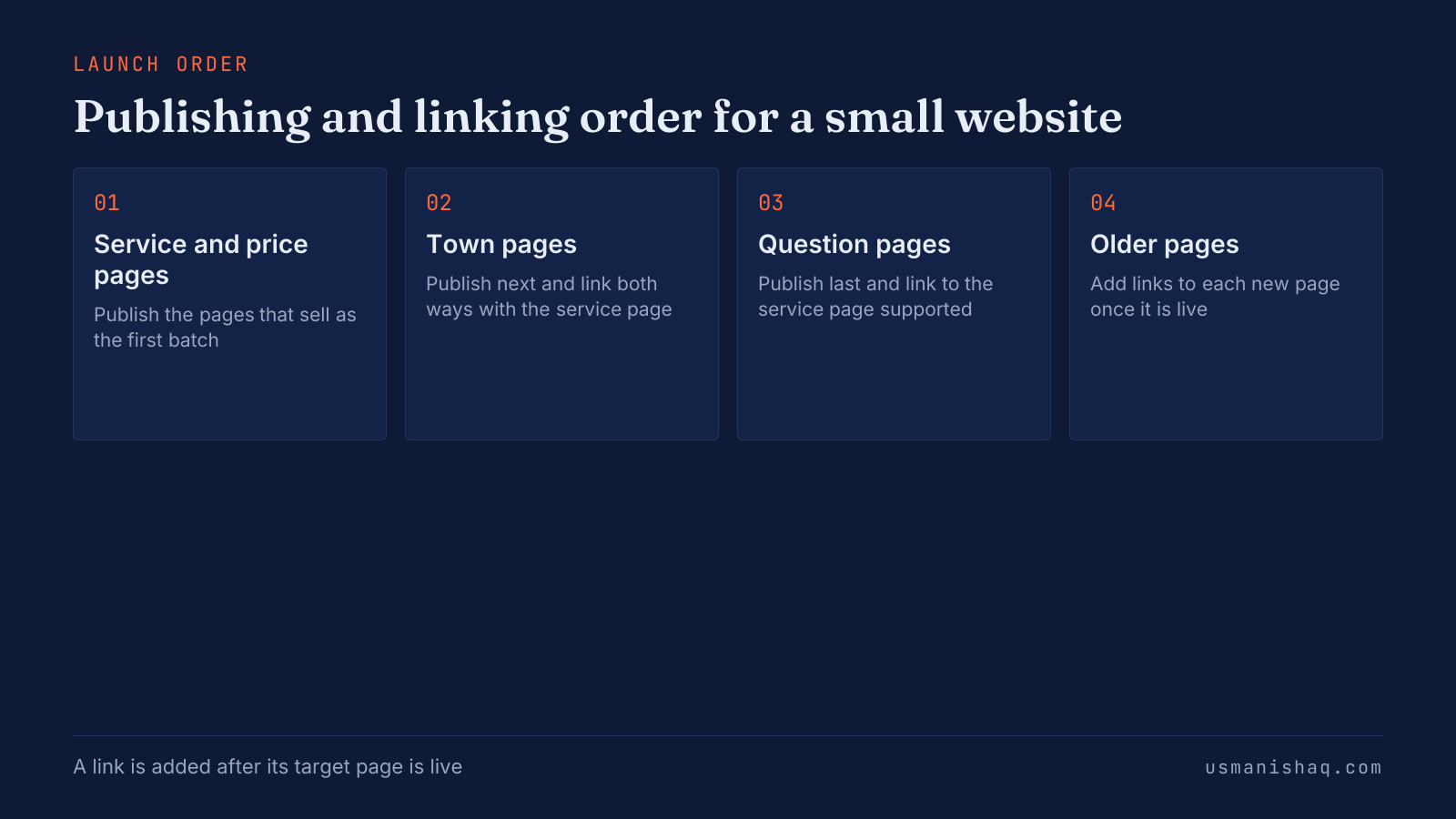
The launch order should follow dependency: a linked page exists before its link, and selling pages come before supporting pages. The framework behind the concept advises a launch outside a Google core update. The framework's reading holds that new pages published during a core update can wait longer for evaluation and indexing. The four steps leave one decision: all pages at once or a launch in batches. We set the publishing order at the architecture stage, before any page is written. The publishing roadmap is the Semantic SEO Architecture roadmap: a 12-month roadmap of pages in dependency order and one of the seven project documents.
Should a small website launch all pages at once?
A small website launches all pages at once only when every page is finished and every link has a live target; otherwise the service and price pages go live first and the other pages follow in sequence. A new website usually has its service pages ready and its articles unwritten. The service pages launch, and the launch does not wait for the articles. An unfinished page should stay unpublished. The sequence of a semantic content network matters more than the speed. The plumbing example below shows the sequence.
What is an example of a semantic content network for a plumbing company?
An example of a semantic content network for a plumbing company is six pages for one service, repiping, in two towns: one service page, one price page, two town pages and two question pages. The table below lists the six pages in publishing order, each with its page type, its owning search and its URL.
| Order | Page | Page type | Owning search | URL |
|---|---|---|---|---|
| 1 | Whole-house repiping | Service page | whole house repipe | /repiping/ |
| 2 | Repipe cost | Price page | how much does it cost to repipe a house | /repiping/cost/ |
| 3 | Repiping in Springfield | Town page | repiping springfield | /springfield/repiping/ |
| 4 | Repiping in Franklin | Town page | repiping franklin | /franklin/repiping/ |
| 5 | PEX vs copper repipe | Question page | pex vs copper repipe | /repiping/pex-vs-copper/ |
| 6 | Signs you need a repipe | Question page | signs you need to repipe | /repiping/signs/ |
No two pages chase the same search. The two town pages share one town page template of four questions in one order. The first two questions ask what a repipe costs in the town and which pipe material suits homes in the town. The last two ask what happens on repipe day and which questions owners in the town ask. The Franklin page answers the same four questions in the same order with Franklin's own facts. The figure below shows the town page template applied to both towns.
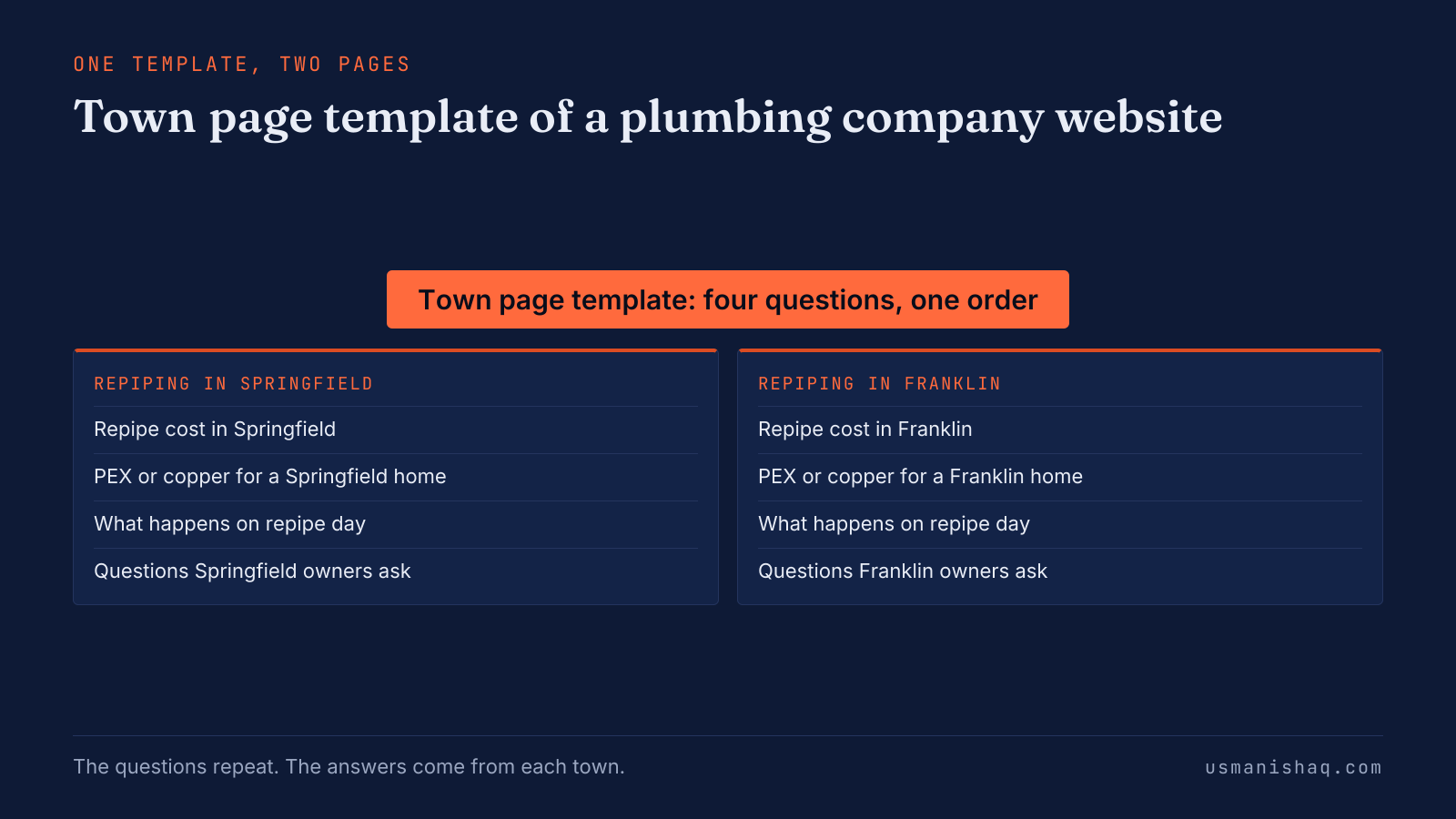
A template repeats the questions, never the text. Google's spam policies for web search list "substantially similar pages" among the examples of doorway abuse. The Springfield page links to the repipe cost page at launch. The links from the Springfield page to the two question pages are added after both question pages go live. The six pages are a worked example, not a client result. The same six pages stop working as a semantic content network when one of five mistakes enters the set.
Which mistakes break a semantic content network?
Five mistakes break a semantic content network: posts with no template, pages with no links, a blog post that competes with a service page, pages published in no order and pages split across several websites. The five mistakes that break a semantic content network are listed below:
- Posts with no template: each post picks its own questions, so no two pages match. Owners call such posts random blog posts. The fix is one template per page type.
- Pages with no links: an unlinked post supports no service page until a link is added. Google's "Link best practices for Google" says every page an owner cares about should have a link from another page.
- A blog post that competes with a service page: both pages answer one search, so the blog post can appear where the service page should. The next section holds the fix.
- Pages published in no order: a question page goes live before its service page and links to no live target. The fix is the publishing sequence.
- Pages split across several websites: a semantic content network sits on one website, so separate websites or blogs form no network. The fix is one website.
The third mistake, competing with a service page, takes five steps to fix.
How do you stop a blog post from competing with a service page?
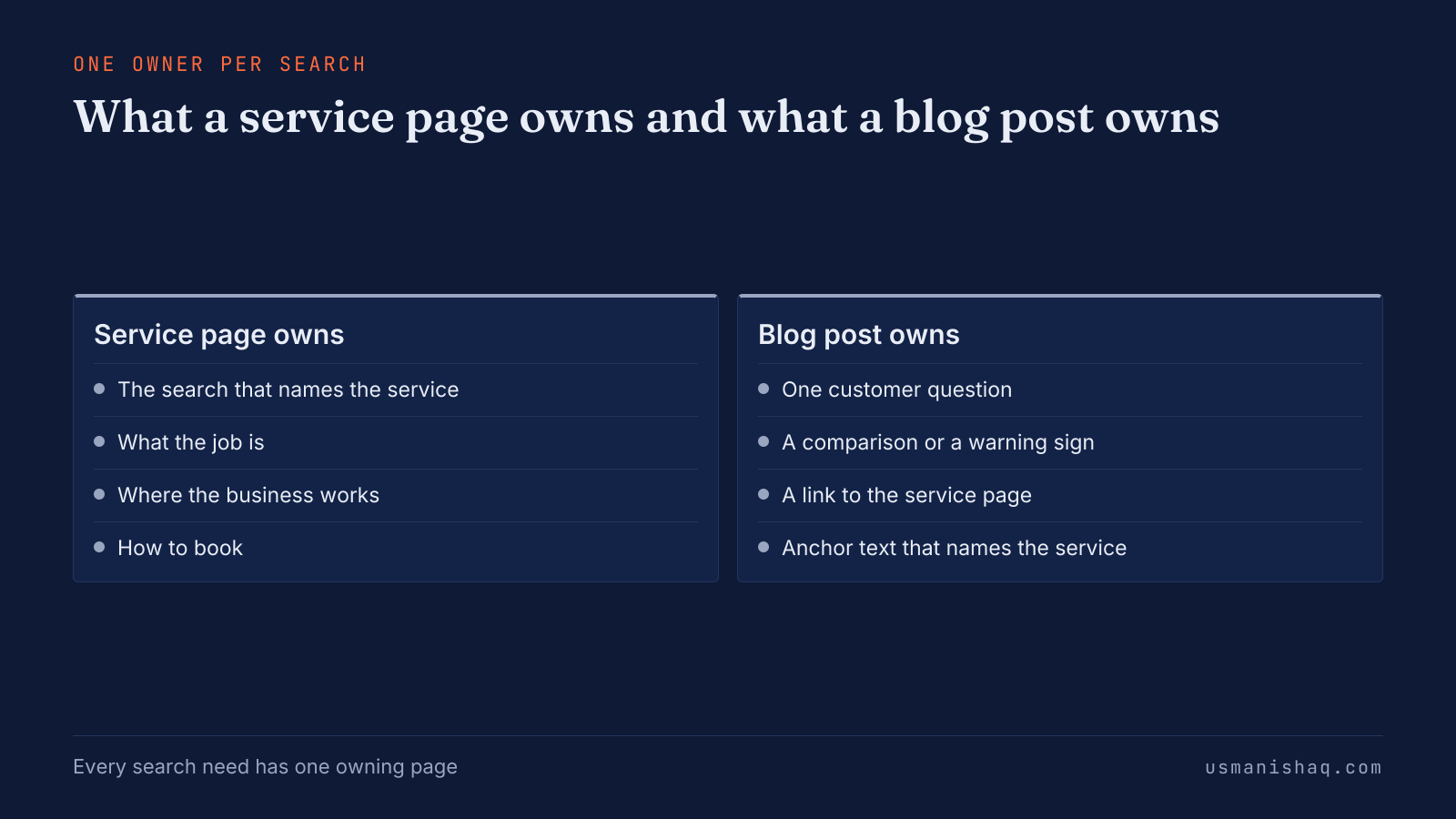
A blog post stops competing with a service page when the service page owns the search that names the service, and the blog post owns one question and links to the service page. Owners describe blog posts that rank for searches that should belong to the service page. SEO practitioners call the problem keyword cannibalization: two or more pages of one website competing for one search. A semantic content network gives every search need one owning page. A page decision is the choice of where a website answers one search: on its own page, in a section of a page or in one sentence. The steps to stop a blog post from competing with a service page are listed below:
- Check which page appears. Two pages for one service search in the Performance report of Search Console is the sign.
- Give the service search to the service page. The service page states the job, the service area and how to book.
- Rewrite the blog post around one question. The page "Signs you need a repipe" owns "signs you need to repipe", and "Whole-house repiping" owns "whole house repipe".
- Link the blog post to the service page. The anchor text names the service.
- Merge the blog post into the service page when both answer the same search. Use a 301 redirect, a permanent redirect, on the old URL and update the internal links. Google's guide to canonical URLs calls a redirect a strong signal and advises against robots.txt for the purpose.
The figure below sets what each page owns side by side.
One case study defined the semantic content network.
Who defined the semantic content network?
The semantic content network was defined by Koray Tuğberk Gübür in the case study "Creating Semantic Content Networks with Query and Document Templates", published by Oncrawl on 11 January 2022. The definition describes a content network prepared on the parts of a semantic network. Such a network covers several attributes of one entity or entities of the same group. The case study names three templates: query template, document template and search intent template. A topical map holds several semantic content networks. Publishing time and order belong to the method. A business website applies the concept as one template per entity type and one publishing sequence, planned in a topical map.
How does a semantic content network connect to the topical map and to content production?
A semantic content network connects to the topical map as its plan and to content production as its build: the topical map names the pages, and content production writes and publishes each page in sequence. The topical map decides the pages first. Content production follows the plan and works through the planned pages one by one. The execution service, Semantic Content Production, turns each page of the topical map into a brief, a written page, a configured page and a published page in roadmap order.
A template also has to exist in the site before pages can fill it. An SEO web developer builds those templates or moves the site onto them. The sections below cover the difference between a topical map and a semantic content network, then semantic content and internal links.
What is the difference between a topical map and a semantic content network?
A topical map is the plan and a semantic content network is the built result: the topical map decides which pages exist, and the semantic content network is those pages written, published and linked. A topical map is a sheet with one row per page, and a semantic content network is live pages. One topical map holds several semantic content networks, one per entity type. The guide to the topical map for a business website shows how the plan is made, row by row, before semantic content is written.
How does semantic content fit into a semantic content network?
Semantic content is the writing on each page, and a semantic content network is the set of pages that the writing fills. Semantic content is writing that organizes information around entities and their attributes and the relationships between them. The template sets the questions of a page, and semantic content answers the questions. The definition, the layers and the examples sit in the guide to semantic content. Linking your own blog posts to each other joins the written pages.
Is there an SEO benefit to linking your own blog posts to each other?
Yes, linking your own blog posts to each other has an SEO benefit: Google uses links to find new pages and as a signal of how relevant a page is. The statement comes from Google's "Link best practices for Google". The same document says anchor text tells people and Google about the linked page. A small website's owner decides every internal link. A blog post in a semantic content network links to its service page before related posts. Internal linking architecture decides which page links to which, with what anchor and from which section. The linked pages carry other names.
Which other names describe a semantic content network?
Three other names appear in searches for a semantic content network: "SEO content network", "compound SEO" and "content-centric SEO". An SEO content network is the general name for connected pages on one website, and the guide to the SEO content network covers the wider phrase. Compound SEO and content-centric SEO are two more search labels for content planned as connected pages. A semantic content network is not a blog network: every page sits on one website, and none exists only to link to another site. Topic cluster is a related term with a different meaning.
Is a semantic content network the same as a topic cluster?
No, a semantic content network is not the same as a topic cluster: a topic cluster is one main page with supporting pages, and a semantic content network adds one template per entity type and a publishing sequence. The main page is often called a pillar page, and the shape hub and spoke. The framework behind the concept also links pages across groups where subjects meet. Both join one website's pages by internal links, and the questions owners ask follow.
Questions owners ask about a semantic content network
Owners ask six further questions about a semantic content network, from blog traffic to AI answers.
Why is my blog getting no traffic even with many posts?
Your blog can get no traffic with many posts when the posts share no template, link to no service page and compete with each other for the same searches. A semantic content network addresses structure only, and the page indexing report in Search Console shows another cause: pages Google has not indexed.
Are blog posts worth it for a local trade business?
Blog posts are worth the time for a local trade business when each post answers one customer question and links to the service page the post supports. A blog post in a semantic content network does not replace a service page, which owns the search that names the service.
How many pages does a semantic content network need?
A semantic content network needs one page for every search the topical map gives a page, and no fixed number applies. The plumbing example holds six pages for one service in two towns.
Does each service need its own semantic content network?
No, each service does not need its own semantic content network: all service pages share one template and belong to one network on one website. A new service adds one service page and the question pages that support the service.
How do you measure a semantic content network?
A semantic content network is measured as one group of pages in Google Search Console: the impressions, the clicks and the searches the group appears for. A trade business then counts the calls, quote requests and booked jobs that follow.
Does a semantic content network make AI answers cite a website?
No, a semantic content network does not make AI answers cite a website. A page that answers one question in a passage that stands alone can be easier for an AI system to quote.
A semantic content network and the next step
A semantic content network is a set of pages on one website, built from one template per entity type and linked in sequence. Search engines and AI systems can understand the pages as one body of answers on one subject. An owner builds the semantic content network in six steps, topical map first.