
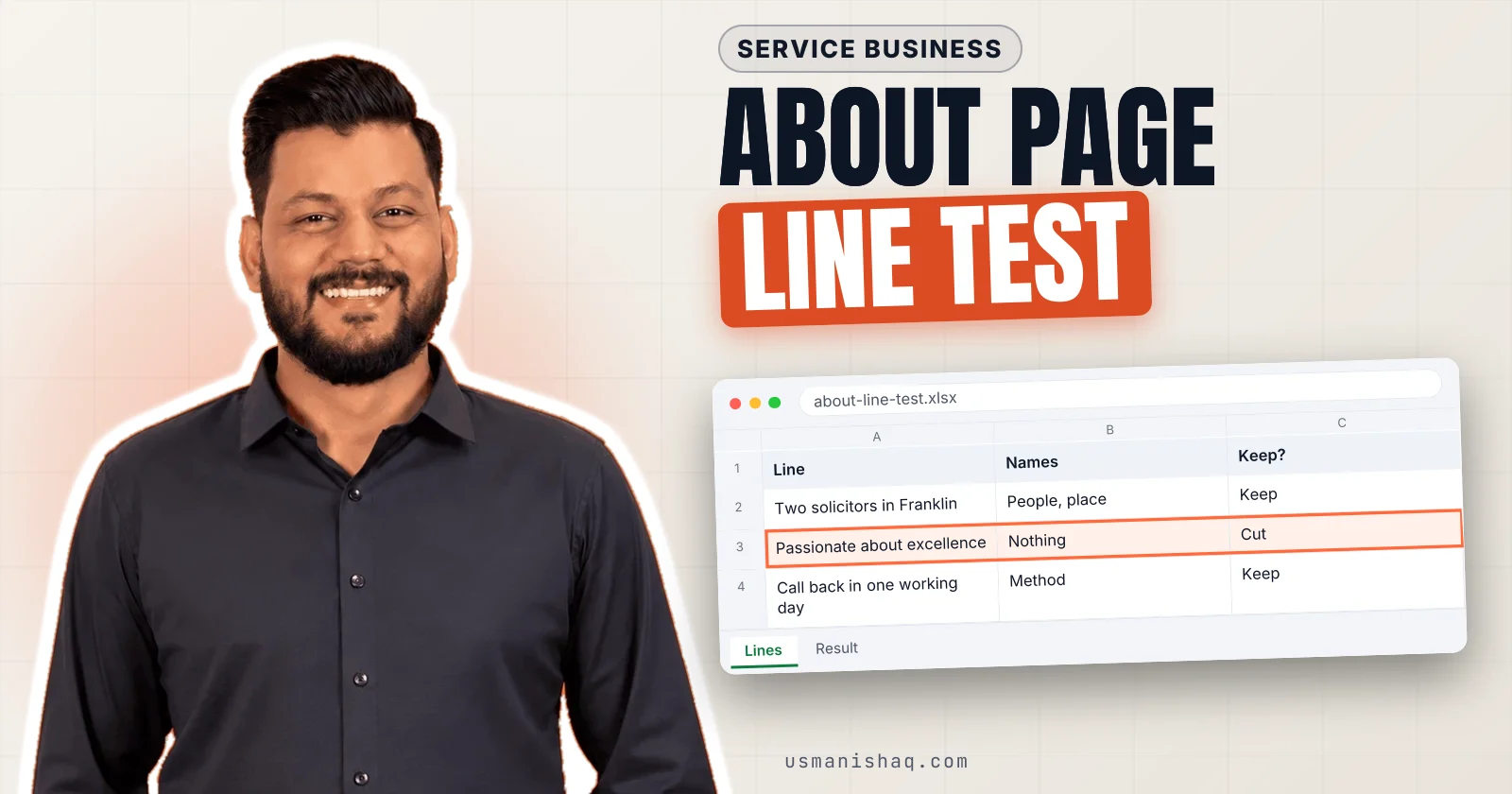
An about page for a service business names who does the work, where, how and how to reach them.
A customer opens the about page to learn who will turn up. Mission talk does not answer that.
A line test checks every sentence against four things a customer can verify. One sample law firm page shows what passes and what goes.
What should an about page for a service business say?
An about page for a service business says who you are, where you work, how you work and how to reach you.
Each one is a plain fact, and "who you are" means the people doing the work. "Where" is the towns and the address. "How" is your steps from first call to finished job. "Reach you" is a phone number and a link.
Salesforce, SearchLab, Vistaprint and WooCommerce lean on the same ideas for this query. They show faces, tell a short story, add proof and keep the page brief. Checking a draft sentence by sentence is missing from all four. Below, the line test does it.
People first: who will do the work
The people block names who does the work, what each person does and what a customer can check about them.
For a service business this block matters more than the story. Someone about to let a stranger into their home or hand over a legal matter wants a face and a name.
Cover four facts for each person.
- Name and role, such as "Dana Reyes, lead electrician" (a sample name).
- What they handle, in words a customer uses.
- A fact a customer can check, such as a licence or a bar registration.
- A photo of the real person, taken where they work.
Each about and service page can start from a content brief with these facts, so every page is checked against one list.
A line test for every sentence
A sentence passes the line test if it names a person, a place, a method or a checkable fact.
It is my own working rule, not a published standard. Use it on a full draft, with the live page open beside it.
- Read the draft one sentence at a time.
- Mark what the sentence names. It may be a person, a place, a step in your method or a checkable fact.
- If it names none of them, cut it or rewrite it with one.
- If it names a fact, check that the fact matches your homepage and service pages.
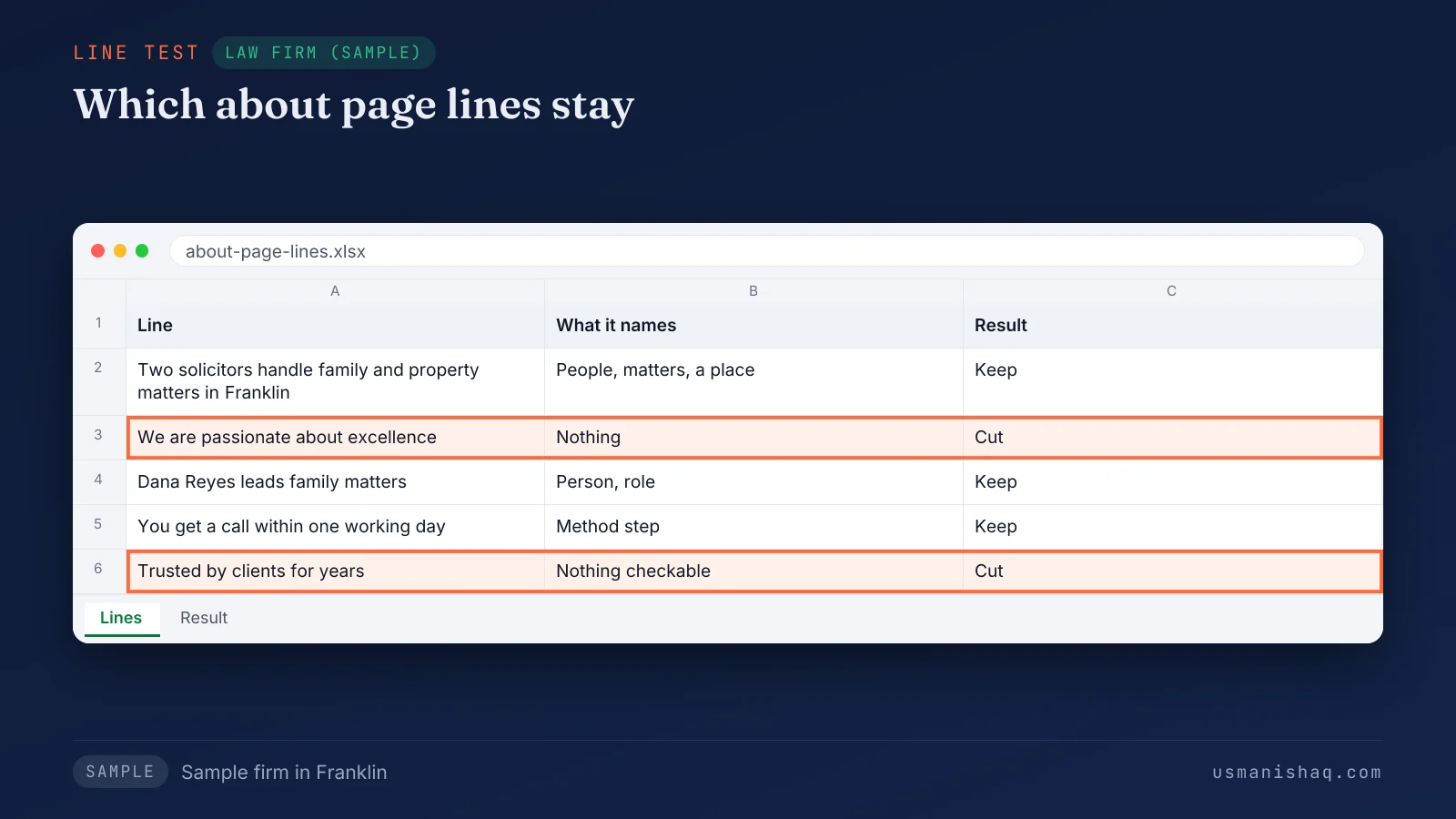
Most cuts are the sentences that open the page. "We are passionate about excellence" names nothing, so it goes. "Trusted by clients for years" names nothing a customer can check, so it goes too. "We have served Franklin since the practice opened" survives only if the year is on the page and true.
A worked about page for a sample law firm
A worked about page lists each block, a sample line and the reason the line passes the test.
Take a sample law firm in Franklin that handles family and property matters. All lines here are samples.
| Block | Sample line | Why it passes |
|---|---|---|
| Opening | "Two solicitors handle family and property matters in Franklin." | Names people, matters and a place |
| People | "Dana Reyes leads family matters. Her registration number is listed on this page." | Names a person and a checkable fact |
| Method | "You get a call within one working day." | Names a step you can be held to |
| Proof | "Two named client reviews, each tied to a matter type." | Checkable and tied to a service |
| Reach | "Phone, address and opening hours, then a link to book a first call." | One next step |
The sample page has no mission statement and no story about why the founder loves the law. A reader can see who, where, how and what to do next.
What to leave off an about page
An about page should leave off slogans, unproven awards, stock photos and extra buttons that compete with the contact page.
Slogans fail the line test. An award with no year and no name fails it as well. Stock photos hide the real people the page should show.
For an award, name the body that gave it and the year, or drop it. A badge a reader cannot verify adds nothing they can check.
Keep the call to action single. One link to the contact page or a booking page is enough, and a row of five buttons sends the reader nowhere.
Length of an about page
An about page should take a minute or two to read and show a person behind each service.
The minute or two is my working target, not a published rule. For a one-person trade that can be a few short paragraphs, but a firm with six people may need a paragraph each. Add length only for facts, never for adjectives.
Watch the order too. Put the people block above the story, because a customer who scrolls on a phone should meet the person before the history. If the page runs long, split a separate page for each person later, and link to it from the people block.
What else do owners ask about an about page?
Owners next ask about the founder story, matching their profiles and whether the page helps them rank.
Should the about page tell the founder story?
Yes, in two or three sentences, and only the part that explains why a customer can trust the work.
A sample trade that began after twenty years in a union job could say so, if it were true. The long version belongs in an interview, not here. Service pages carry the proof the about page points to, as in writing a service page that brings calls.
Should my about page match my Google Business Profile?
Yes, the name, address, phone number and service areas should read the same on both.
Differences make a customer wonder which one is right. The Google Business Profile and website fields that must agree are listed in one place.
Does the about page help me rank?
A service search rarely lands on an about page, because those searches belong to service pages.
It can still show who stands behind the work, though I know of no test that measures it. For a trade, the trust pages in a plumbing company website map show where the about page sits.
About page in short
An about page for a service business names people, places, method and contact, in lines a customer can check.
Run the line test on your draft and cut every sentence that names none of the four. Keep one next step.