
Yes, AI can draft a trade business's website pages when the owner supplies the facts and a person checks them.
An AI-written page is a website page whose first draft comes from a generative AI tool such as ChatGPT, Gemini or Claude. Google judges the page, not the tool, and acts on many pages that add nothing, however they are made.
AI drafts service pages, FAQ answers and page titles well once the facts sit on a sheet. The About page, reviews and copied town pages are where AI-written pages go wrong. Semantic SEO treats the facts as the page, and the wording as the cheaper part.
Does Google penalize AI-written website pages?
No, Google does not penalize website pages for being written with AI; it judges each page, however the page is produced.
Google set out that position in "Google Search's guidance about AI-generated content", a Search Central blog post of 8 February 2023. Danny Sullivan and Chris Nelson wrote it for the Google Search Quality team. The post's first heading reads "Rewarding high-quality content, however it is produced".
Google acts on the purpose behind the pages instead. Automation, AI included, breaks Google's spam policies when its main purpose is manipulating rankings, the same post says.
The post also asks "Should I use AI to generate content?" The answer is no when AI is a cheap way to game rankings.
Google's newer document, "Google Search's guidance on using generative AI content on your website", last updated 1 October 2026, keeps that line. Many AI pages that add no value for users may breach the policy on scaled content abuse.
What is scaled content abuse?
Scaled content abuse is Google's spam policy against many low-value pages made mainly to manipulate rankings, however they are written.
Google's "Spam policies for Google web search", last updated 28 August 2026, lists AI first among its examples. The policy names tools used to "generate many pages without adding value for users".
Google announced the policy on 5 March 2024. The post was "What web creators should know about our March 2024 core update and new spam policies". The policy covers pages made by automation, by people, or by a mix of both.
A trade example is forty town pages with the same text and only the town name swapped. Semantic SEO works the other way, with fewer pages that each hold facts of their own.
Google's generative AI guidance also points to sections 4.6.5 and 4.6.6 of its Search Quality Rater Guidelines. Rater scores do not directly change rankings, the same guidance adds.
Do the 2026 core and spam updates target AI-written pages?
No, Google has not described any 2026 update as aimed at AI-written pages in the reports this guide relies on.
Semrush's log lists the May 2026 core update (21 May to 2 June) and the September 2026 spam update (ended 8 October). Search Engine Journal reported the November 2026 core update from 10 November, and commentators predict a quality focus Google has not confirmed.
Which website pages can AI draft for a trade business?
AI can draft service pages, FAQs, blog answers and titles, but town pages, reviews and the About page need the owner first.
Google's generative AI guidance calls AI useful for research and for adding structure to original content. The word "original" carries the weight: the content comes from the business, and AI arranges it.
The table below sets each common page of a trade website against what AI can draft and what the owner adds:
| Page type | Can AI draft it? | What the owner adds | Main risk |
|---|---|---|---|
| Service page (drain cleaning, furnace repair) | Yes, as a first draft | Prices or ranges, licence, warranty, what a visit includes | Invented facts |
| Town page | Only after town facts exist | Jobs done there, drive time, local permit rules, photos | The same page with the town swapped |
| FAQ answers | Yes | The questions callers really ask, and the owner's answers | Generic answers |
| Blog answers to customer questions | Yes, from the owner's notes | One real job, a photo, a judgement | A summary of what others say |
| Title, meta description, image alt text | Yes, then checked | The right service and the right town | Wrong facts in search results |
| About page, team bios, reviews, guarantees | No | The owner's words, real names, real reviews | Invented people and claims |
AI-written pages come out best where the facts sit on a sheet before the draft starts. I would leave the About page to the owner. Customers read it to judge who will knock on their door.
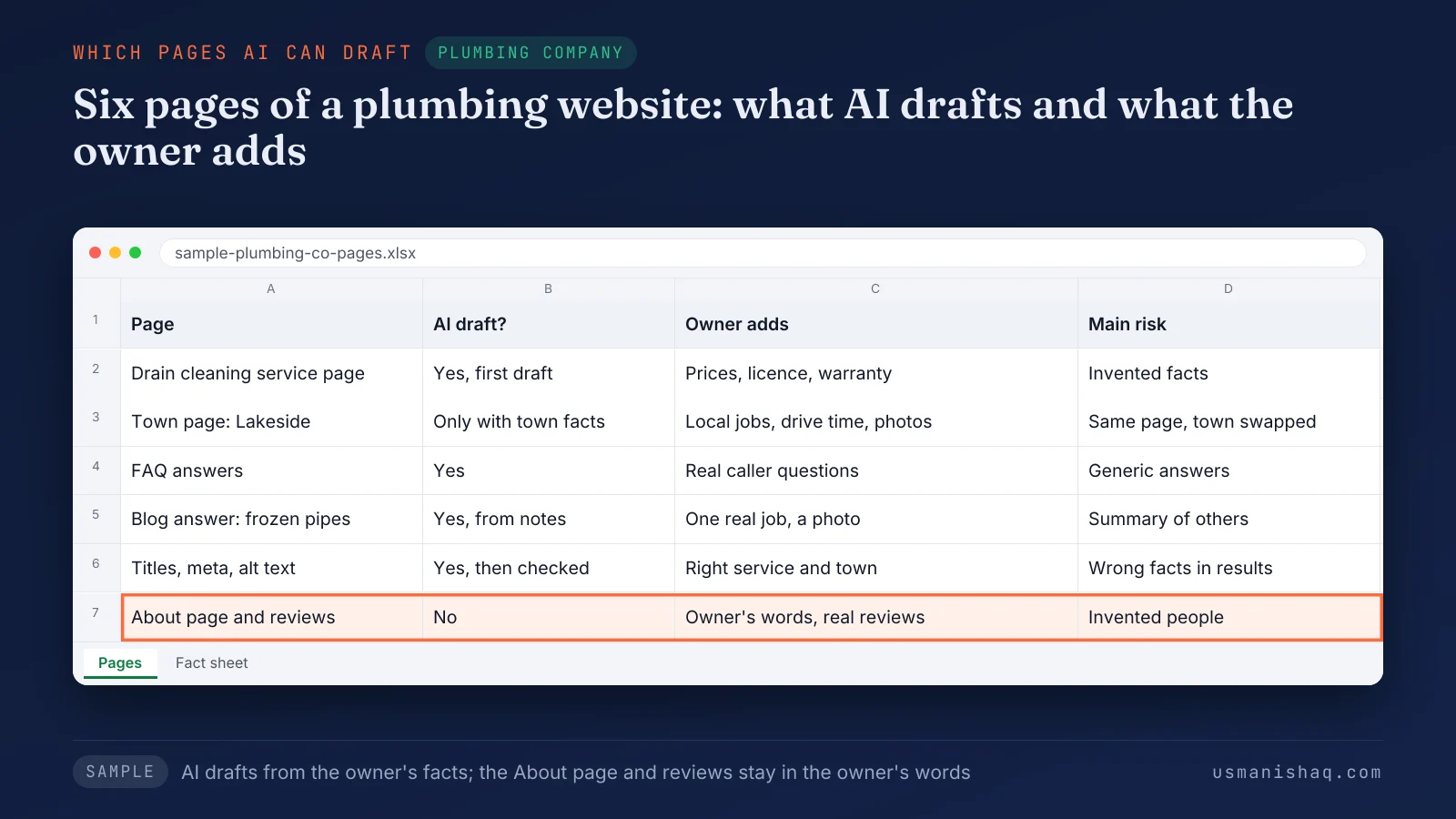
The sample sheet marks service pages, FAQs, blog answers and titles as AI drafts that need owner facts. Town pages are conditional, and the About page and reviews stay the owner's own work.
Is it safe to publish an AI page for every town?
No, one AI page per town is not safe when each page repeats the others with only the town name changed.
A town page earns its place with facts true only for that town. Jobs done there, the drive time, local permit rules and photos from the street all count. People also need a reason to search for that town by name.
Joy Hawkins of Sterling Sky reported such a case on 5 March 2025, in "The Danger of AI-Generated Service Area Pages". A client published over 200 AI-generated service area pages, and traffic barely moved. Google did not index those pages, the article says.
The same article reports a manual action for thin service area pages at another business. A town with no facts of its own belongs as a sentence on the service page.
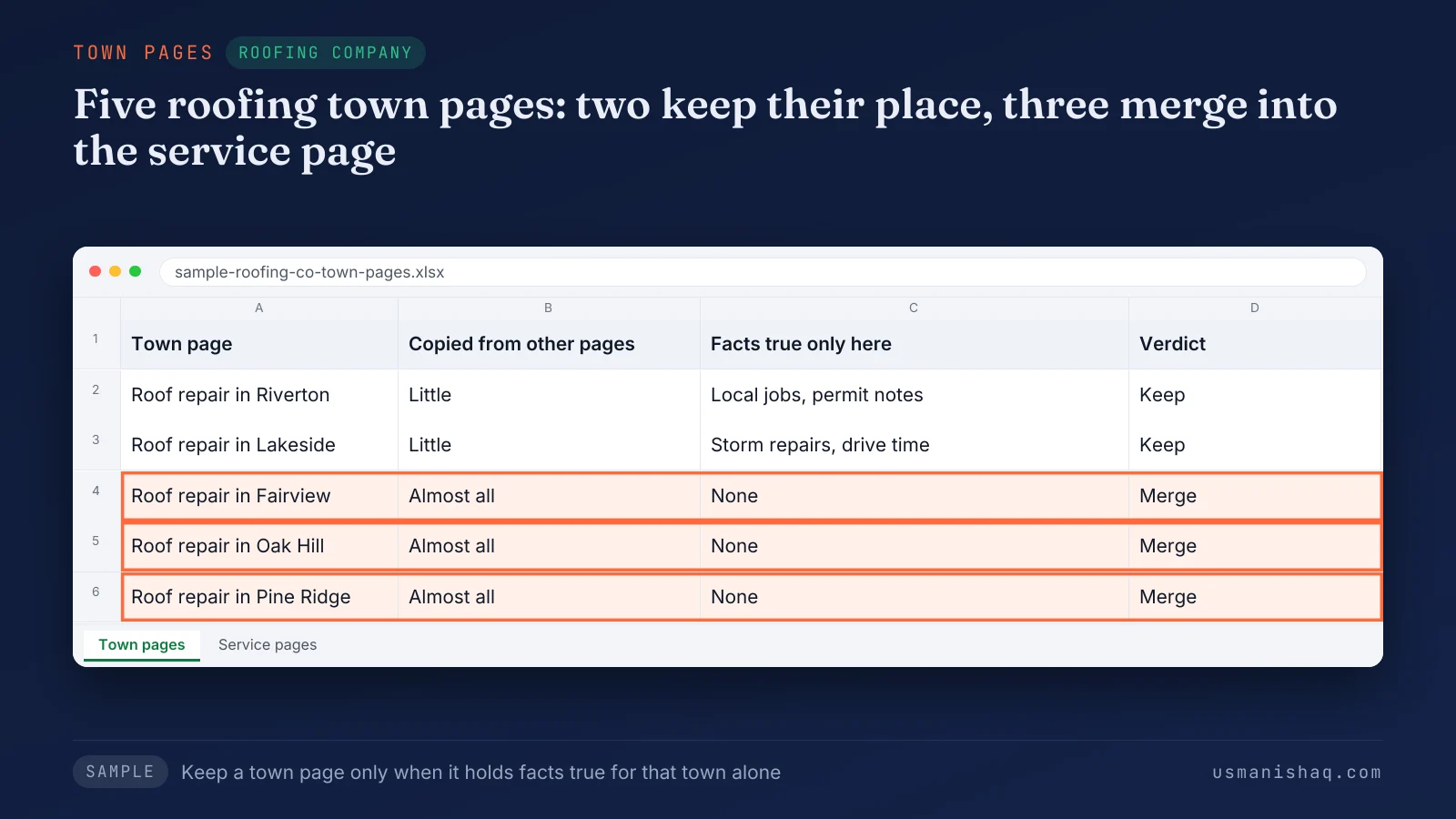
Two sample town pages keep their place with local jobs and permit notes. Three that only swap the town name merge into the roof repair page.
What does AI not know about a trade business?
AI does not know the facts that set one trade business apart: its licence, towns, prices, warranty, brands and real jobs.
Google's generative AI guidance explains the cause. Generative models predict a likely sequence of words rather than retrieve facts, so outputs can contain inaccuracies. An AI tool therefore fills a missing fact with a likely one.
The facts an owner gives the writer, person or tool, before any page is drafted are listed below:
- Licence and insurance: the licence number, the issuing body and the trades it covers. An AI draft writes "fully licensed and insured" with no licence behind the words.
- Towns and response times: the towns the vans reach and the real call-out hours. An AI draft lists towns nobody serves and promises 24/7 service with the phone off at night.
- Prices and call-out terms: price ranges, the call-out fee and the estimate policy. An AI draft invents free estimates or a price nobody quoted.
- Warranty: the written terms on parts and labour. An AI draft adds a satisfaction promise nobody signed.
- Brands and equipment: the brands the business fits and services. An AI draft names brands the crew never touches.
- Real jobs and photos: a recent job, what was found and what was fixed. An AI draft describes a generic job instead.
- Call handling: who answers the phone and how a job gets booked. An AI draft guesses the booking route.
Semantic content is writing that organizes information around entities and their attributes and the relationships between them. The fact sheet is the attribute list of the business, so semantic content starts from that sheet.
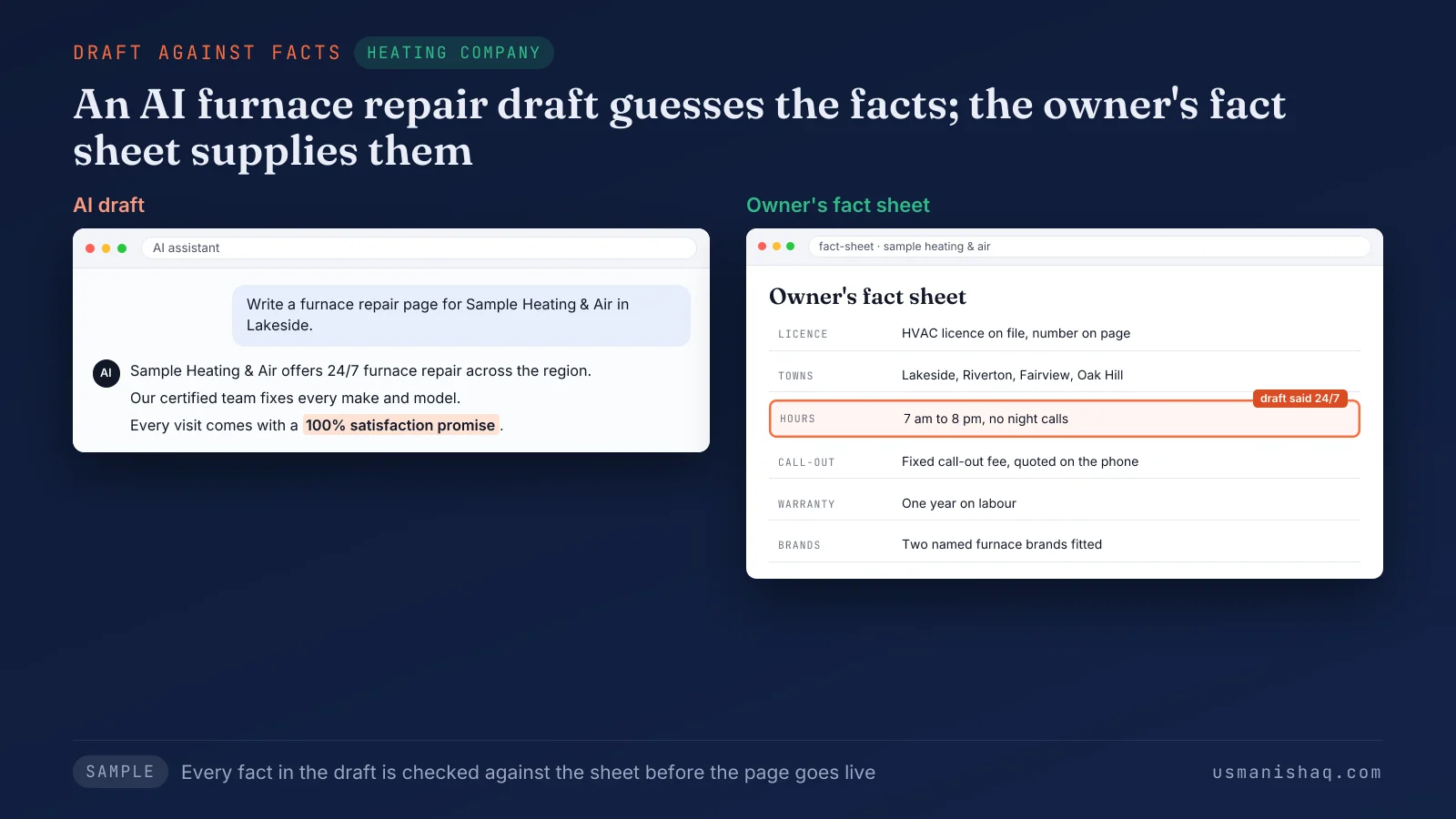
The sample draft on the left promises 24/7 service and a satisfaction promise. The fact sheet's hours row reads 7 am to 8 pm instead.
The sheet also lists the licence, four towns, a call-out fee, a one-year labour warranty and the brands fitted. A person then checks the draft against that sheet.
How should a person check an AI-written page before it goes live?
An AI-written page is ready only after a person checks every fact, plus the title, description, schema and alt text.
Google's generative AI guidance asks for a manual fact check of all AI-generated content before publishing. The same review covers titles, meta descriptions, structured data and image alt text.
The checks, in order, are listed below:
- Match every fact to the owner's fact sheet, and delete any fact the sheet does not hold.
- Cut claims nobody can prove, such as "24/7" with no night cover or "top-rated" with no rating behind it.
- Compare the page with the site's other pages, and rewrite paragraphs that repeat across them.
- Check the title, meta description, structured data and image alt text against the same sheet.
- Add one thing only this business has: a recent job, a photo or a named technician.
- Keep the real author on the page, with no invented name, AI headshot or false credential.
Google's page "Creating helpful, reliable, people-first content", last updated 5 October 2026, treats invented creator profiles as deception. A real name on a checked page is the safer choice.
A content brief is the document that sets the questions, the order, the facts and the links of one page. AI should draft from a brief, not from a one-line prompt.
Semantic Content Production puts a written check at every stage of a page. The Semantic Content Production workflow takes each page from brief to draft, edit, configuration and publication.
How do AI-written pages fit into semantic SEO?
AI-written pages fit into semantic SEO only after a topical map decides which pages exist and a brief fixes each page's facts.
A topical map is the plan of every entity, attribute and question a website must cover, with one owning page, section or sentence for each. The concept is credited to Koray Tuğberk Gübür, who sets the map before any page is written.
The map, not the AI tool, decides which towns get a page. Each town is a query, and the page test decides which query earns a page of its own. The guide on how to decide which query earns a page sets out that test.
Semantic content keeps the same facts in the same words on every page. The guide to what semantic content is shows those facts written as entities and attributes.
Should a trade website say a page was written with AI?
Yes, a trade website should say how a page was made when a reader would reasonably ask, as Google advises.
Google Search's guidance about AI-generated content says an AI author byline is probably not a good way to show AI's role. A service page rarely raises that question, while a long guide built from an AI draft can.
What should an owner do with AI-written pages already live?
An owner with AI-written pages already live should check each one against the fact sheet and merge copied town pages.
Google's spam policies say scaled content of that kind should be excluded from Search. Google's guidance on using generative AI content asks for the same review of titles, descriptions and alt text.
A semantic content audit runs page by page, reading each live page against its query and its facts. The guide to how a semantic content audit runs lists the checks in order.
Questions about AI-written website pages
Two more questions about AI-written website pages come up in search results: detection by Google and ranking.
Can Google detect AI-written content?
No, Google has not said that it detects AI text as such; its systems look for spam, however it is produced.
Google's 2023 guidance names SpamBrain as one of the systems that find spam patterns.
Will an AI-written page rank higher than one a person wrote?
No, Google's 2023 guidance says using AI gives content no special gains in Search.
A page ranks on what it adds for the reader, whoever wrote the first draft.
AI-written pages and the owner's facts
AI-written pages work for a trade business when the owner's facts lead and a person checks each page before it goes live.
Google judges the page, not the tool, and the risk sits in many copied pages. The fact sheet decides the quality; AI only changes how fast the first draft arrives.