

Content-centric SEO runs a website from the customer's question and the page that answers it, with keywords, tags and links in support.
Most pages that rank for the term say the same thing: write good content, keep it useful, add keywords afterwards. That is a fair start. It leaves out the hard part for you as an owner, which is deciding which searches get a page at all.
The part most pages skip is the ledger further down. It lists eight sample customer searches, gives each one a decision, and only two of them earn a new page.
What is content-centric SEO?
Content-centric SEO is a practitioner name for planning search work around what a customer needs to read.
Google's documentation does not use the name. It says its ranking systems prioritise helpful, reliable information made for people, and not content made to manipulate search rankings. That is the nearest official wording, and content-centric SEO is one way of acting on it.
I read four agency and software blogs on 24 November 2026. Three of them treat keywords as support for the content. One says every SEO strategy starts with keywords. The pages disagree on how much keyword work comes first, and I would not argue the point.
How does content-centric SEO differ from keyword-first and technical-first SEO?
Content-centric SEO decides the page and its answer first, where the other two decide the keyword or the crawl.
| Approach | Starts from | First question | Breaks when |
|---|---|---|---|
| Keyword-first | A list of keywords | Which keyword does this page target? | Pages exist to hit a phrase and read thin |
| Technical-first | Crawl, speed and structure | Can Google reach and read this page? | The page loads fast and says nothing new |
| Content-centric | The customer's question | Does a page of ours already answer it? | Nobody checks what the site already says |
You need all three. Fast pages with no answers earn little, and a site with strong answers that Google cannot reach stays hidden from every customer.
The order is the point. I fix reach first when a page is blocked. I plan content first when the pages simply do not exist.
What does a content-centric site decide before it writes a page?
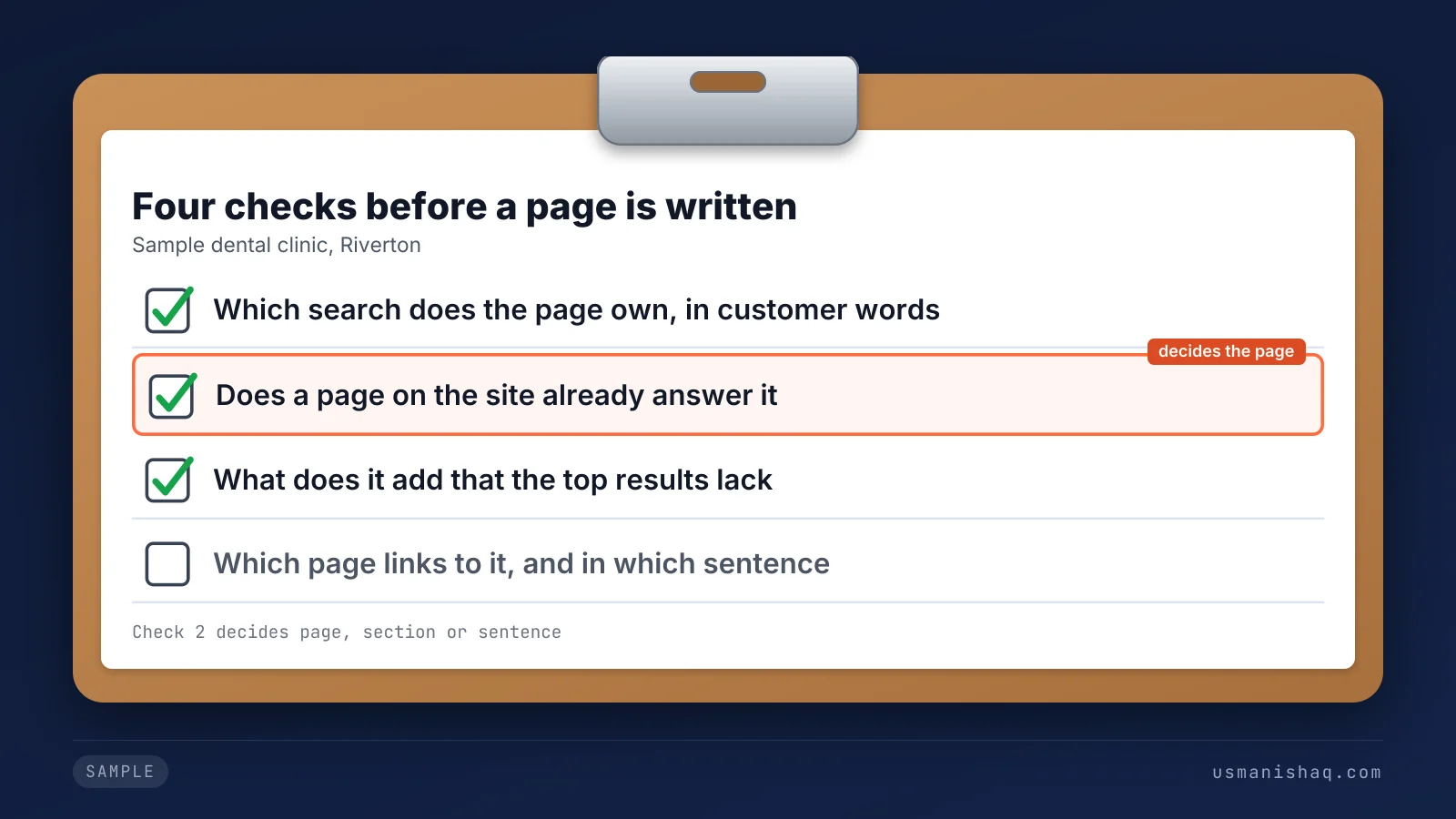
A content-centric site decides four things before writing a page, and each one is a question.
- Which search does this page own, in the words a customer types?
- Does a page on this site already answer it, fully or in part?
- What does the answer add that top results lack, such as a price range, a step or a local detail?
- Which page should link to it, and in which sentence?
The first output of a Semantic SEO Architecture page list is this check run across the whole site. Each search ends up with one page, one section or one sentence.
A sample ledger for a dental clinic in Riverton
For a sample dental clinic in Riverton, eight customer searches need two new pages and six decisions that add no page.
The table is a sample, not a client. Each row holds a search a patient might type, the page that answers it today and the decision.
| Search | Page that answers it today | Decision |
|---|---|---|
| dentist in Riverton | Home page | Keep |
| dental implants Riverton | Implants service page | Keep |
| dental implant cost | None | Section on the implants page |
| how long do implants take to heal | None | Section on the implants page |
| teeth whitening before and after | Whitening page and an old blog post | Merge the post into the whitening page |
| dentist open Saturday | None | One sentence on the home page |
| emergency dentist Springfield | None | New page, because Springfield has its own demand |
| invisalign vs braces | None | New page, because a comparison is a different answer |
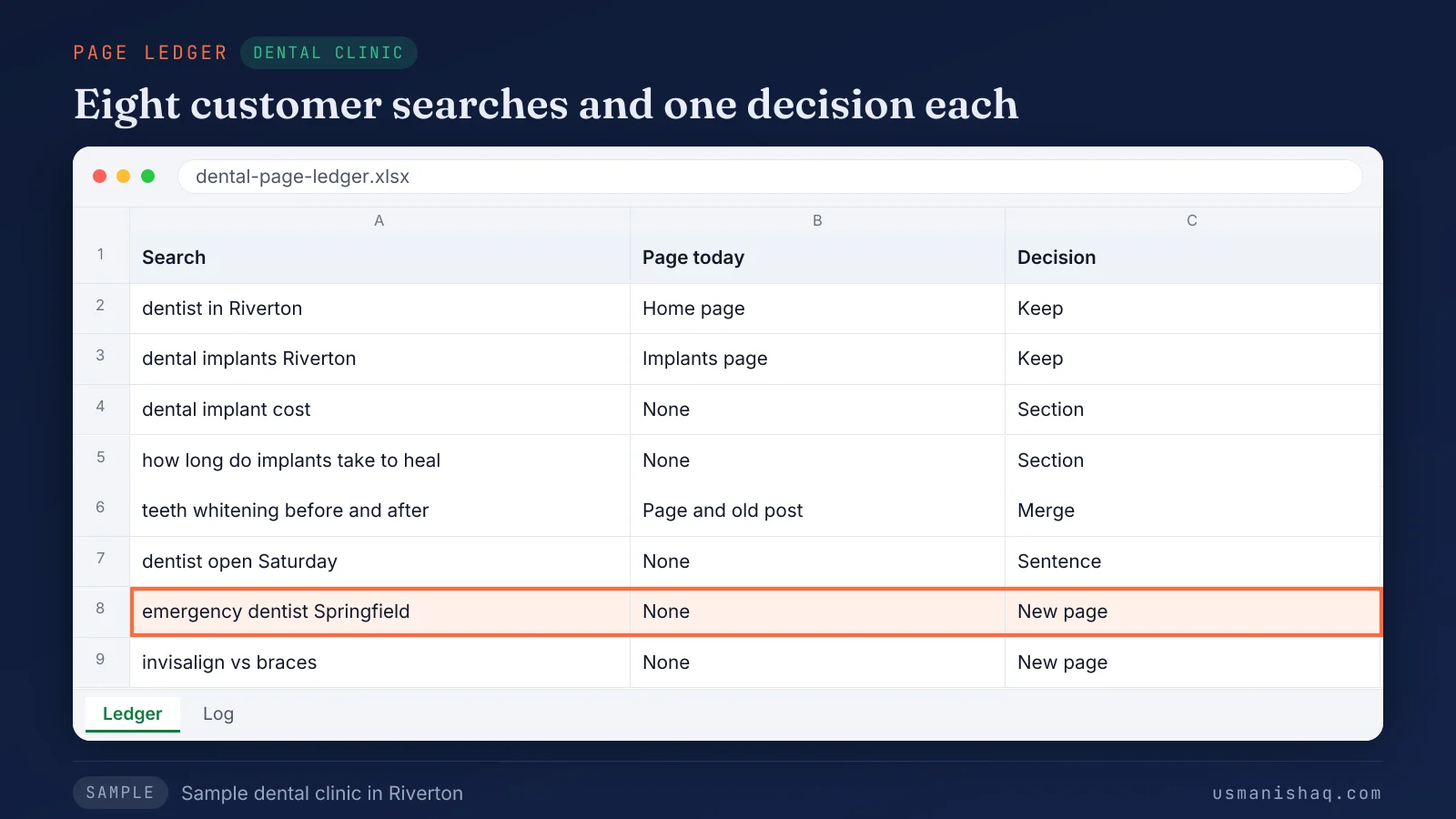
Count the decisions. Two pages stay as they are. Two searches become sections on the implants page. One old post merges into the whitening page, and one search becomes a sentence. Only two earn a new page.
The rule behind the last column is short. A search earns a new page only when customers search for it alone and its answer differs from the existing page.
Take a patient in Springfield. That patient searches for a dentist in their own town, so Springfield passes the first test. The comparison passes the second test because nobody can answer "invisalign vs braces" inside an implants page. Cost and healing time are parts of the implants answer, so they stay sections.
Six of the eight rows need no new page. A calendar that says "four posts a month" would have added posts that compete with pages the clinic already owns. The four pages I read tell you what to write. I found no rule in them for when to stop.
Measuring content-centric SEO in Search Console
You measure content-centric SEO page by page, with one search, one change and one recheck after eight to twelve weeks.
- Open the Performance report in Search Console and filter by the page address.
- Note the search that page should own, with its clicks, impressions and average position.
- Change one thing, such as adding the missing section, merging a competing post or fixing the link into the page.
- Write the date and the change in a plain log.
- Look again after eight to twelve weeks and compare the same search.
I plan the check at eight to twelve weeks and touch one page at a time. Two changes in the same week leave you unable to say which one moved the number.
Some pages will not move. Write that down too, because a page that stays flat tells you as much as a page that climbs. A page that stayed flat after twelve weeks is a finding. It points to the sections or the links, not to more posts.
Where content-centric SEO goes wrong
Content-centric SEO goes wrong when the plan becomes a calendar, posts are thin or posts never link to the service page.
A calendar feels like progress, for example when a post goes out every Tuesday. If no search needs the post, it competes with a page you already have.
Thin posts are the second trap. One of the four blogs I read advises well-researched, expert-written content over thin pages made quickly, and I agree with that.
Then there is the dead end. A post that answers one question and never links to the service page leaves the reader with nowhere to go. Link the post to the service page at the point where the reader would ask what to do next.
Content-centric SEO next to AI answers, networks and blogs
Content-centric SEO touches AI answers, the semantic content network and the blog, and each one gets a short answer here.
Does content-centric SEO help with AI answers?
Google's documentation says AI Overviews and AI Mode need no special optimization, so good pages help the way they always do.
The same Google page says you need no new machine-readable files and no special schema.org markup for those features. A page that answers one question in its first sentence is easier for any reader to lift. That last part is my own reading, not a documented rule.
Is content-centric SEO the same as a semantic content network?
Searchers use both names for the same job, and they differ only in emphasis.
Content-centric SEO names the habit of starting from the customer's question. A semantic content network names the finished set of linked pages.
The guide to the semantic content network build order lists content-centric SEO among the other names. The ledger above is the decision step that comes before the build.
Do you need a blog for content-centric SEO?
You need a blog only when a customer search earns a post, because a service page or a section answers most searches.
In the sample ledger, no row needed a new blog post. The old post merged into a page. The test for how a search earns its own page covers the rare case where a post is right. If the site already has posts, the audit steps for each page show how to run each one through the ledger.
Content-centric SEO in short
Content-centric SEO starts from the customer's question and the page that answers it. You give each listed search a page, a section or a sentence, then check Search Console after eight to twelve weeks. Google documents helpful, people-first content and no special AI optimization, and the name itself is practitioner usage.