

A service business shows a fixed price for set jobs, a "from" price for varied jobs and a quote for custom work.
You do not have to choose one answer for the whole website. Each service gets its own level, and the page says what moves the price.
A five-job scope test sorts each service into a level. A worked sheet shows the result for an HVAC company, and a cost check compares it with what customers search.
Should a service business put prices on its website?
Yes, a service business should show a price wherever it can explain what the price covers.
Where it cannot, it should not invent one.
The pages I read for this question mostly say "it depends". HubSpot's post argues for publishing prices and has a section on the search opportunity. JDR Group's post lists six reasons to show them, including that prices are shareable and searchable.
Those pages argue the principle. They stop before the practical step, which is to decide service by service. That step is the rest of this page.
Three price levels a service page can show
A service page can show a fixed price, a "from" price with its factors or a quote process.
| Level | When it fits | What the page shows |
|---|---|---|
| Fixed price | The job and its scope are the same each time | One price and what it includes |
| From price | Scope varies, and you can name why | A starting price, then the factors that raise it |
| Quote process | Every job is custom | What you need from the customer, how fast you reply and what the quote holds |
The levels describe a page, not a promise, and a "from" price is honest only when most jobs land near it. The page should list the factors that move it.
Wording matters on a "from" line. Compare two versions for the same repair. "Furnace repair from the price shown, plus parts" tells the customer how the total is built. "Prices vary" tells them nothing and sounds like a dodge. Say what the starting price covers, then name the extras that raise it. Parts, a second visit and an out-of-hours call are common ones.
Keep the date of the last price review on the page for any fixed or "from" price. A customer can then judge how current it is.
A scope test that sorts each service
The scope test sorts one service into a price level by comparing the last five jobs of that service.
It is a rule of thumb from my own planning, not a published standard. Run it once per service.
- Write down the last five jobs of the service and what each one cost the customer.
- Look at the spread. If the five are close, the service takes a fixed price.
- If they differ, try to name the reasons in a few words, such as part cost, building age or access.
- If two or three named reasons explain most of the gap, the service takes a "from" price and lists those reasons.
- If you cannot name reasons, the service takes a quote process.
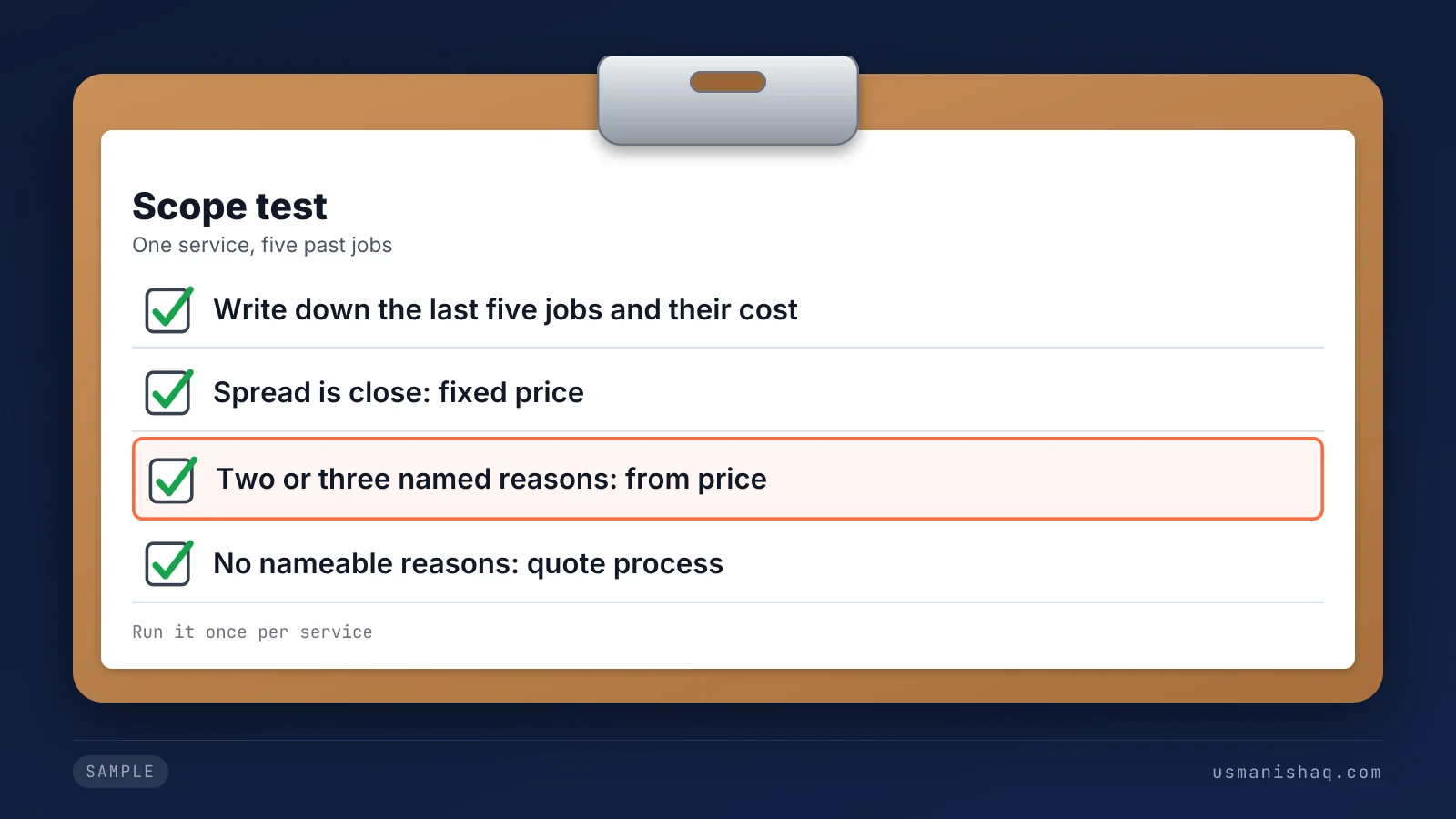
Be honest at step 3. "It depends" is no reason. Pick words a customer could check at their own door. The age of the furnace is one, and an out-of-hours call is another.
Mixed results are normal. They show why one rule for the whole site fails. A repair service may sort into "from" while its tune-up sorts into fixed. Treat each service separately, and write the level in the plan before you write the page.
What a service page can show when the price stays hidden
A service page without a price should still explain how the quote works.
Four facts show how the quote works. A customer comparing three companies can then see which one is clear.
- What moves the price, in plain words.
- How fast a quote arrives, such as the same working day.
- What the quote includes and what it leaves out.
- What the customer sends, such as a photo, the address or the model number.
Skip the phrase "competitive pricing". It tells nobody anything.
One test for the hidden-price page is a stranger's question. Would a customer who reads only this page know what to send you and when to expect an answer? If not, add the missing fact.
A worked price sheet for a sample HVAC company
A price sheet gives every service one level and one line of explanation.
Take a sample HVAC company serving Springfield and Franklin. The sheet is a plan for the service pages.
| Service | Price level | What the page shows |
|---|---|---|
| Furnace tune-up | Fixed price | One price, the visit length, what the check covers |
| Furnace repair | From price | A starting price, then part, furnace age and out-of-hours calls as the factors |
| Furnace replacement | Quote process | A free site visit, the sizes to expect and what the quote lists |
| Emergency callout | From price | Call-out fee and what is billed after |
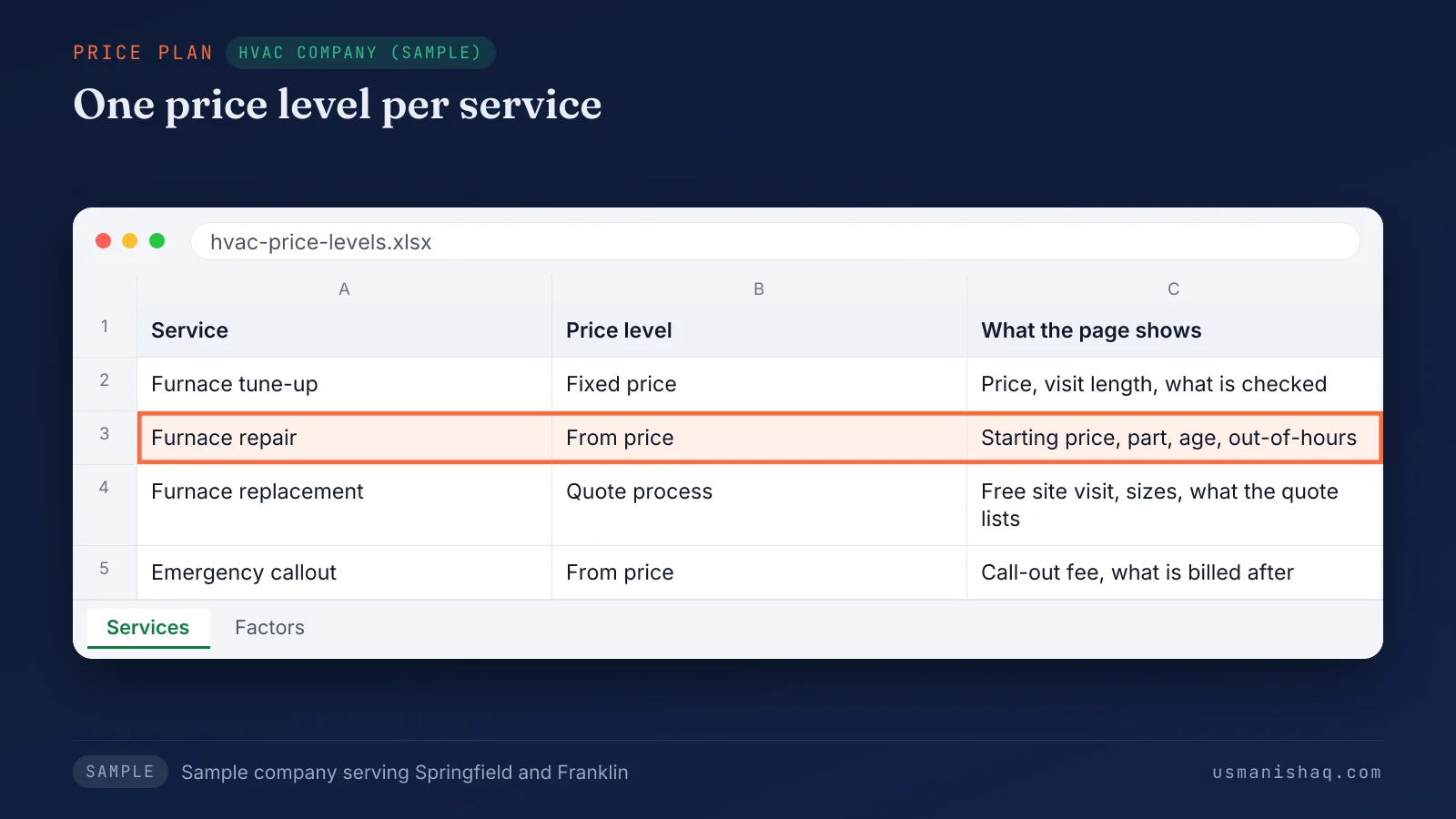
The sheet shows why one rule for the whole site fails. The tune-up can be a flat price. Replacement cannot, so that page spends its words on the quote process instead.
A cost check on competitors and your own searches
A cost check compares what the top results show for a service with what customers search about its price.
One service at a time.
- Search "[service] cost [town]" and open the first three results.
- Note whether each shows a price, a range or nothing.
- Open Search Console and look for queries with "cost" or "price" that already show your page.
- If competitors show prices and customers search for cost, move that service up a level.
If nobody in your town shows a price, you can stay at the quote process and still look clear. If all of them do, a blank page may read as a gap, so move at least to a "from" line. The competitor-gap check in a Semantic Content Audit asks the same question across a whole site.
What else do owners ask about prices on a service website?
Three worries follow: scaring customers, a price page of its own and matching the Google Business Profile.
Will prices scare customers off?
Prices may put off some customers, and JDR Group argues they only deter people who were not going to buy.
That is the first of the six reasons in JDR Group's post. It is an argument, not a measured result. If you are not the cheapest, show what the price includes so the number has context.
Should the prices have a page of their own?
A price page earns its place only when people search for that service's cost and you can answer fully.
Otherwise the price belongs in a section of the service page. The test for this is in deciding which query earns a page.
Should prices match my Google Business Profile?
Yes, any price on your Google Business Profile should read the same as on your website.
A customer who sees a "from" price on Maps and a higher one on your page may stop trusting both. The page on matching your Google Business Profile and website lists the fields.
Prices on a service website in short
A service business should show a price level for each service, fixed, "from" or quote, and say what moves the price.
Run the scope test on the last five jobs of each service. Where the price stays hidden, show how the quote works.