
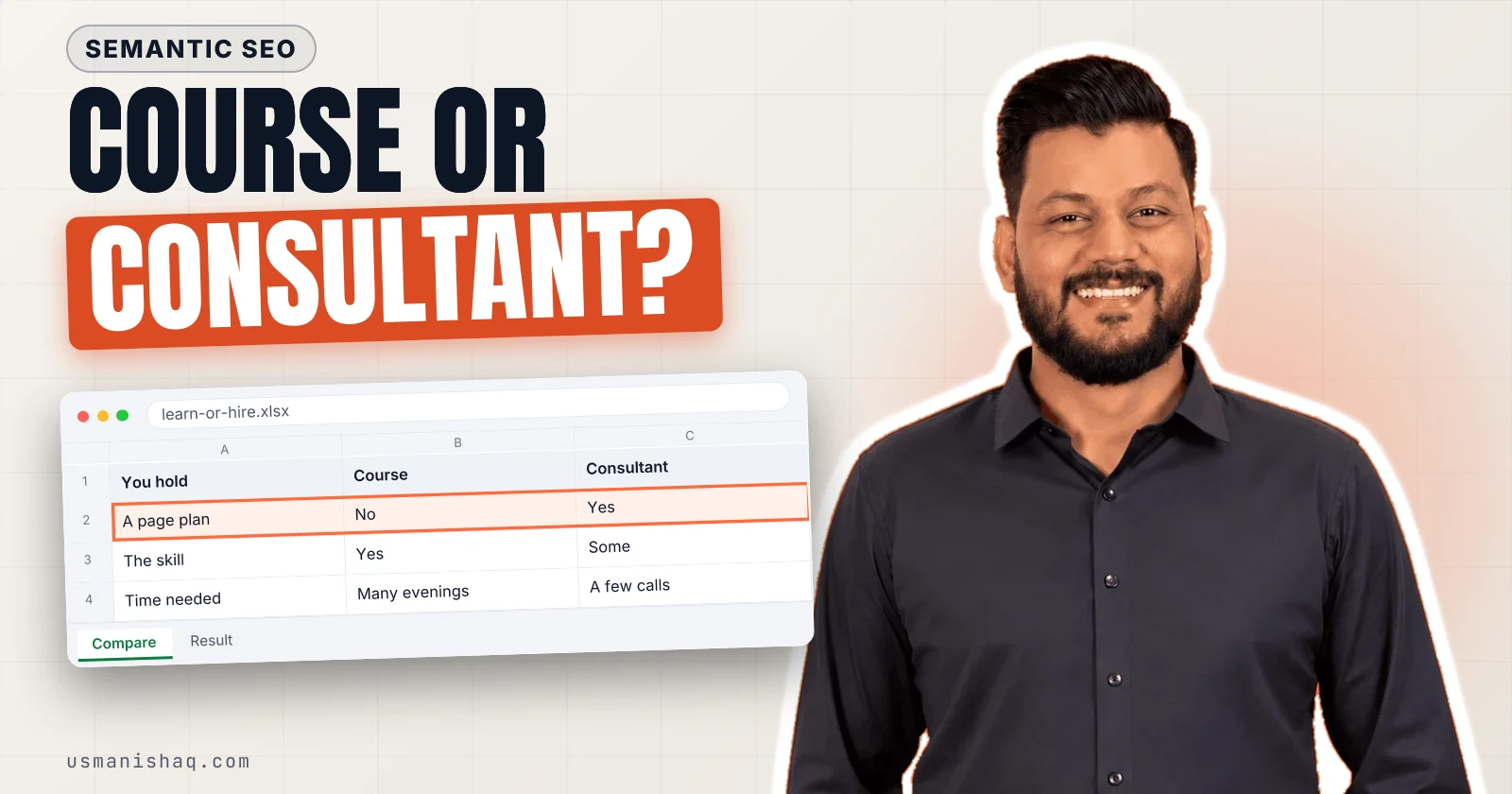
A semantic SEO course teaches you the method, and a semantic SEO consultant applies it to your website and hands you the page plan.
Most owners ask this question when they have a site that should bring in calls and does not. You can learn the method, hire the work, or hire once and learn from the result.
Each route leaves you holding something different. After a course you have notes and skill. After a consultant you have a plan for your services and towns. One test further down shows which you need first.
Learning semantic SEO versus hiring a consultant
Learning semantic SEO versus hiring a consultant comes down to skill against plan, since a course gives you the skill and a consultant gives you the plan for your own site.
Semantic SEO means building a site's pages from the things it talks about, the facts of each one and the searches people make about them. Courses explain that practice in general. Consultants spend the same hours on your business, your services and your towns.
| What you compare | Course | Consultant | Both |
|---|---|---|---|
| What you get | Lessons and exercises | A topical map and a page plan | A plan, plus the reasons behind it |
| What you hold afterwards | Skill you must apply yourself | A written plan for your site | A plan you can extend |
| Your time | Many evenings | A few calls and some files | Calls, then evenings |
| Who answers for the result | You | The consultant, for the plan | Shared |
| Best when | You will run the site for years | The site has gaps now | You want it fixed and owned |
One row decides most cases, and it is "What you hold afterwards". Skill takes months to turn into pages. Hand a plan to a writer and pages start next week. That gap is real.
What you hold when a course ends
What you hold when a course ends is knowledge and your own exercise files, while your website stays as it was.
That is fine if the course had you plan your own site as the exercise. It is a poor deal if the exercises used a made-up business.
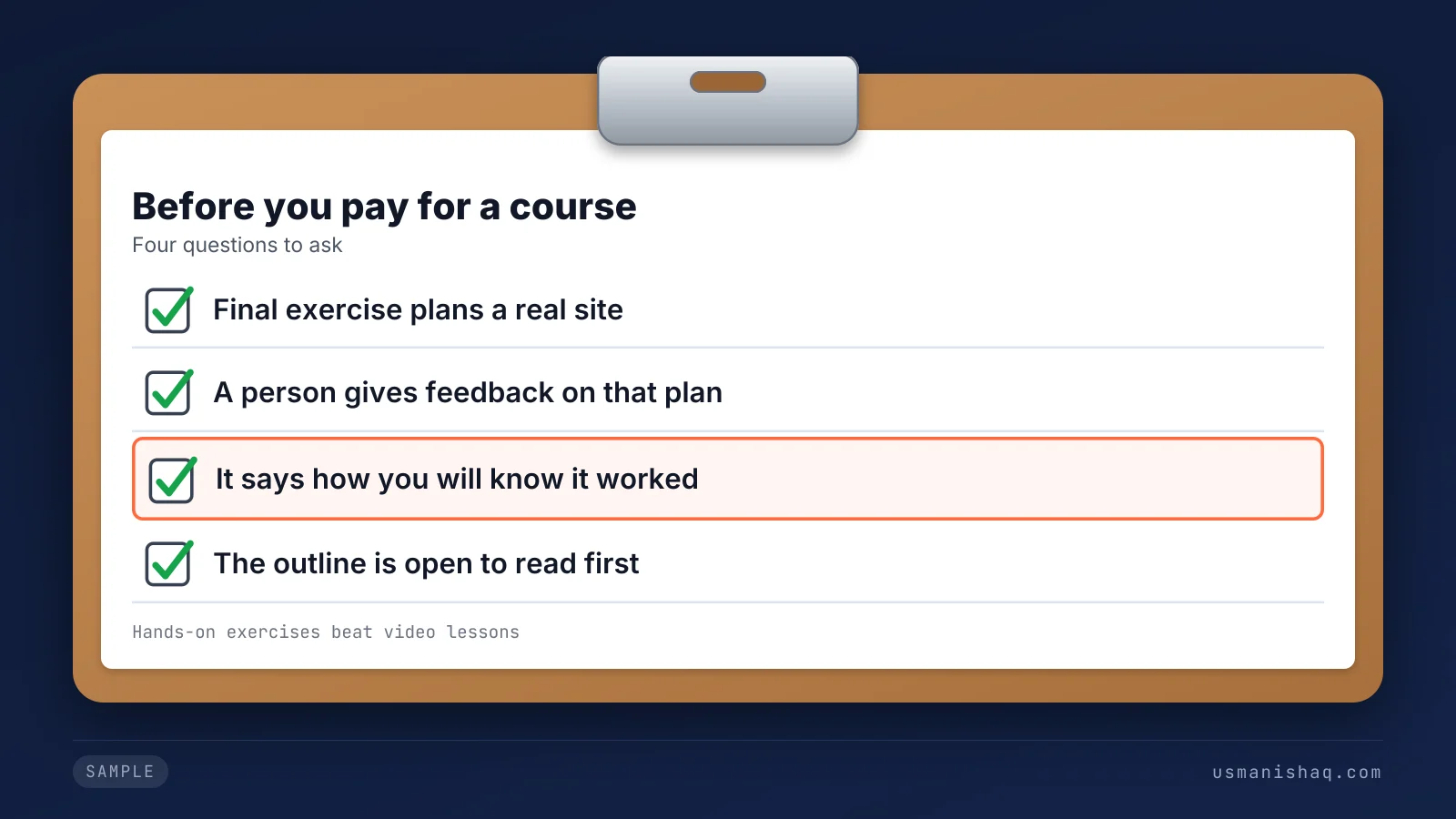
Ask any course four things before you pay.
- Does the final exercise produce a page plan for a real site?
- Do you get feedback from a person on that plan?
- Does it say how you would know the plan worked?
- Can you read the outline before you buy?
What a semantic SEO course teaches
What a semantic SEO course teaches is how to find the entities and searches around a topic and turn them into pages.
I read three public pages on 24 November 2026. Course pages differ a lot, so open any outline yourself and check the final exercise.
The Coursera page for "Search Engine Optimization and Content Strategy" is a broader SEO programme. It lists nine courses and calls the level intermediate. Its own estimate is four weeks at ten hours a week. Tools such as Semrush, Ahrefs and Screaming Frog are part of it. It is not a semantic SEO course, but it shows how much of a paid programme can be tool training.
Ahrefs publishes a free guide to semantic SEO. One of its sections is about closing topic gaps on a page. A free guide is a sensible first step before you pay for anything.
Search Atlas, in its guide to advanced SEO courses, asks why hands-on exercises matter more than video lessons. Its answer is that theory alone does not transfer to a live site. I agree, and it is the first thing I would look for.
When a course is the right choice
A course is the right choice when you will run the website yourself for years and can spare evenings for it.
Picture the owner of a dental clinic in Franklin. Sample Dental Studio has a website with one page for all treatments. The owner enjoys writing, has no staff to hand it to, and plans to publish every week for two years. A course fits that owner, because the skill pays back on every page.
Marketing leads who work beside an agency get value too. You learn the words, so you can read a page plan and question it.
When the site loses calls this month, a course fits poorly. Learning takes the very time those lost calls are costing you.
Which test shows whether to learn or hire?
The one-sheet test shows whether to learn or hire, because it takes an hour and shows where you stall.
Open a blank sheet. Put your five main services down the left side. Across the top go your three main towns. In each cell, write which page should own that search and whether it exists. Then note if it deserves its own page or a section.
Stop the clock at an hour.
- If you filled most cells and only doubted a few, learn it. You already think the right way, and a course will sharpen it.
- If you stalled by the third service, hire. The stall means decisions are missing, and a course will not make them for you.
One limit applies. The test shows whether you can plan the pages, and says nothing about whether you will write them.
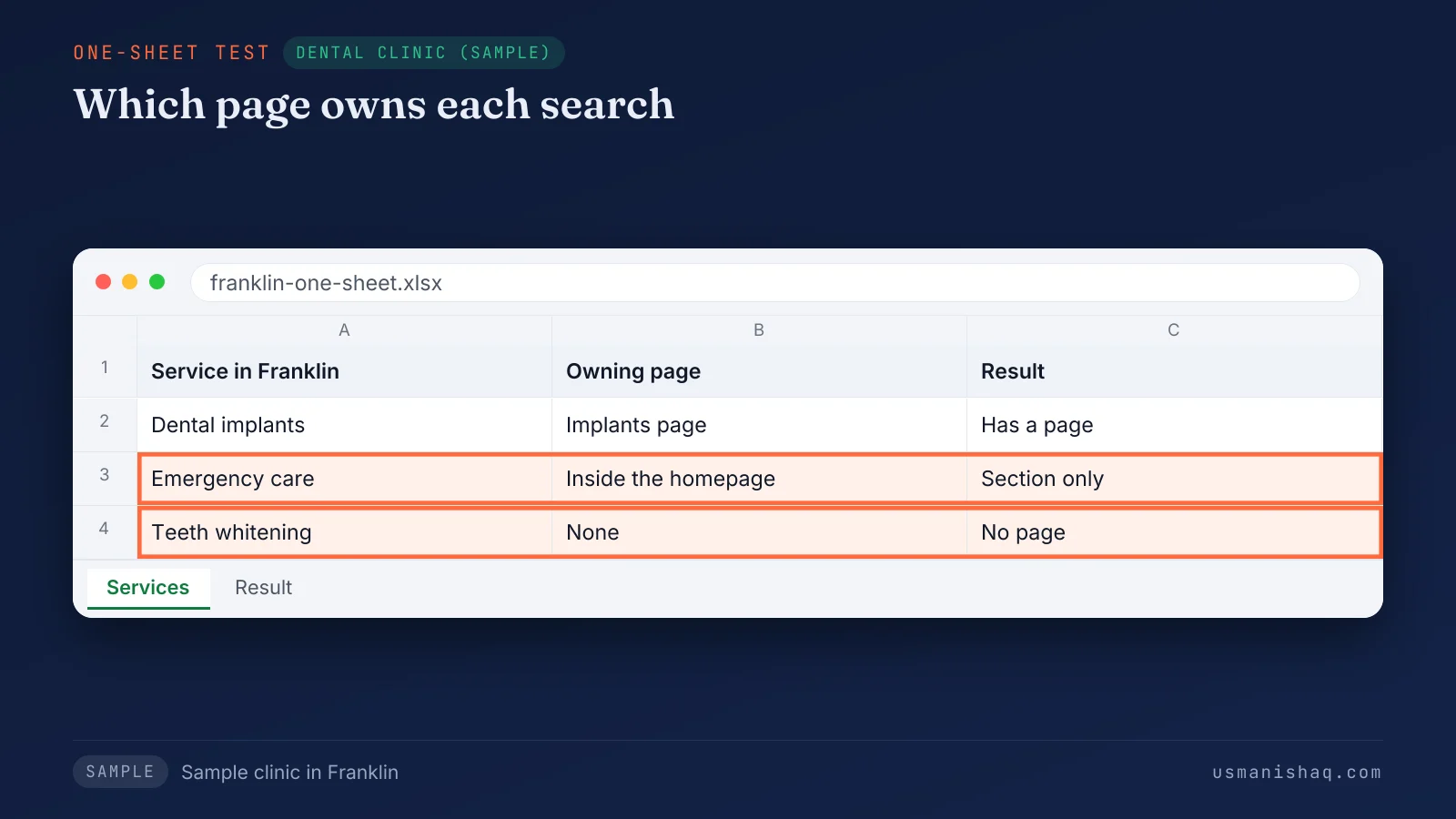
In the sample above, a Franklin clinic lists implants, emergency care and whitening. Implants has a page. Emergency care sits inside the homepage. Whitening has no page at all, and the owner could not say if it should. That owner stalled on the second row, so hiring someone to decide is the faster route.
Hiring a consultant and still learning it
Hiring a consultant and still learning it works, because you can learn the method from the plan itself.
This route suits owners who are short on time but want to stay in charge. The consultant delivers the topical map, one page decision per search, and the reasons. You then run the weekly work.
Ask for the reasons in writing. A plan that says "merge these two pages" should say why. Those reasons are the course, taught on your own site.
The Semantic SEO Architecture topical map and page plan is the kind of deliverable that supports this route. It records each decision where a writer can follow it.
Take a course afterwards and you will judge it better. You will know which lessons match your own site.
Where to go from here
Where to go from here depends on your choice, and three smaller questions usually follow it.
Testing a consultant before you hire one
Testing a consultant before you hire one means giving a short paid task on your own site before any long contract.
A small paid piece of work shows how the person reasons. It costs less than a wrong six-month commitment. The steps are in a paid test before you hire an SEO consultant.
What to send before the first call
What to send before the first call is your service list, your towns, your current page list and Search Console access.
A consultant who gets these files can give a real opinion on the first call. The files an SEO consultant asks for first are listed in one place.
How are semantic SEO consultants compared?
How semantic SEO consultants are compared comes down to the sample plan each one shows, what the fee covers and who writes the pages.
Ask each one for a sample plan. A written comparison of semantic SEO consultants sets out the criteria.
Course or consultant
Take a course if you will run the site yourself for years, and hire a consultant if the site needs a plan now.
Run the one-sheet test first. If you stall early, hire for the plan, ask for the reasons in writing, and learn from them. Fill the sheet and a course will sharpen what you already do.