
An SEO consultant needs three things before the first call: access to your accounts, your business facts and your SEO history.
Semantic SEO is the practice of organising a website around entities and their attributes. The aim is that search engines and AI systems read what each page means. A semantic SEO consultant is the person who plans that work around the services, towns and questions your customers search.
Access goes out by user invite, never by password. The business facts matter most, because no tool shows them to the consultant. The pack is the same for a consultant, a freelancer or the person owners call "my SEO guy".
Consultants call the step onboarding. The owner's side of the job is a short send list. The sections below give the full list, the access to grant, the business facts to prepare and what should come back.
What does an SEO consultant need from you?
An SEO consultant needs ten things from a business owner: four kinds of access and six sets of business facts.
The ten things to send an SEO consultant before the first call are listed below:
- Google Search Console access: the consultant reads which searches already show each page.
- Google Analytics access: the consultant sees which pages visitors land on and what they do next.
- Google Business Profile access: the consultant checks the categories, services, service area and reviews on your Google listing.
- A website login of the consultant's own: the consultant reads page settings without borrowing yours.
- The service list with prices or price factors: the consultant learns which jobs the website must sell.
- The towns you serve: the consultant learns where each service page has to show up.
- Proof: reviews, photos of finished jobs and licences give the pages evidence a customer trusts.
- Past SEO reports and documents: the consultant avoids selling you work an earlier provider already did.
- The competitors you see: the consultant compares your site with the businesses that win your calls.
- The goal in calls and booked jobs: the consultant plans for the jobs you want, not for traffic.
Google's guide for owners, "Do you need an SEO?", sets the same test from the other side. A good SEO, the guide says, asks about "what makes your business unique" and "who your competitors are".
A semantic SEO consultant reads Search Console before any page, so the sample pack below starts there.
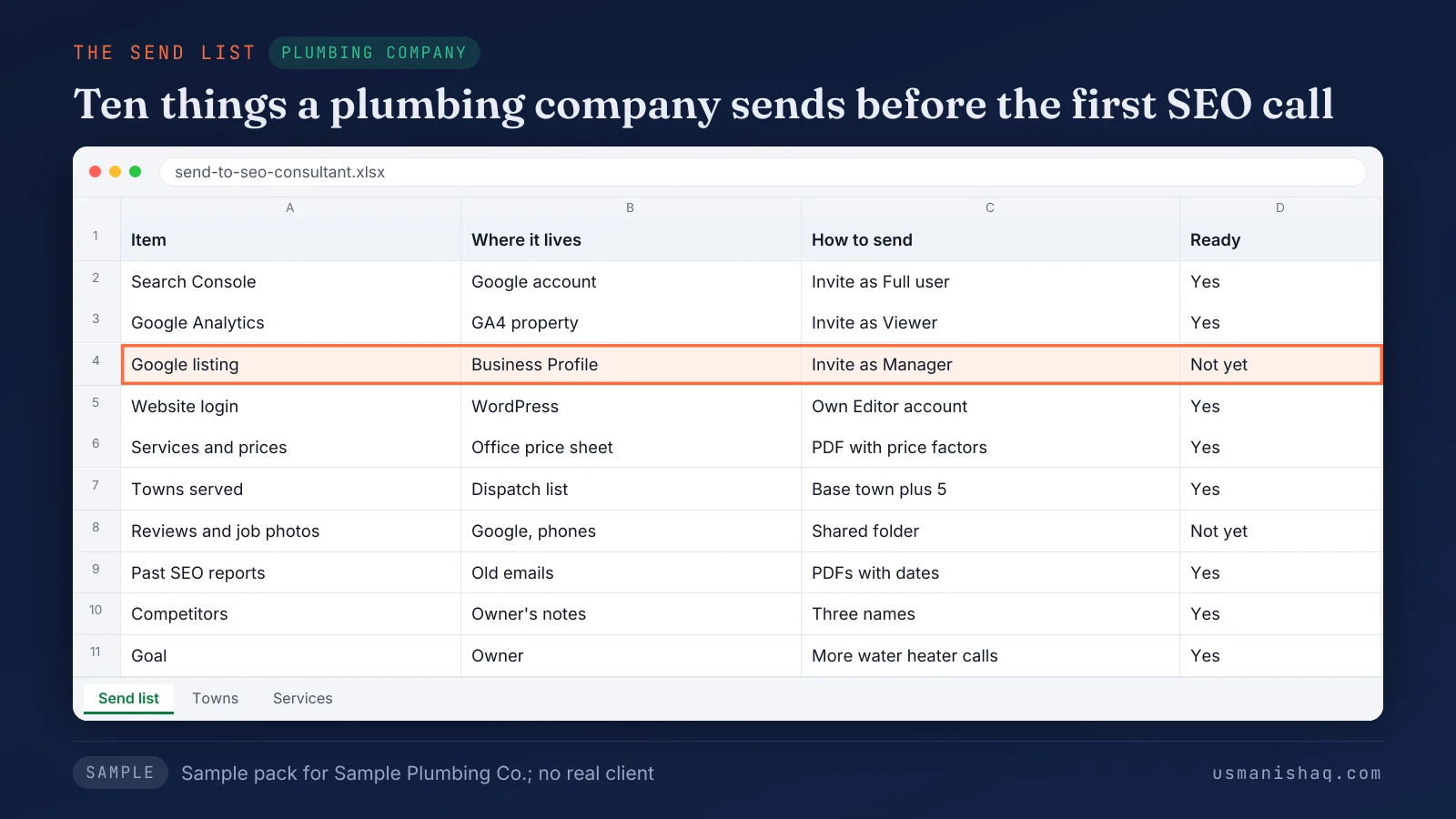
Sample Plumbing Co. invited the consultant to Search Console as a Full user and to Analytics as a Viewer. The website login is an Editor account, and the prices, six towns, reports, competitors and water heater goal are ready. The Google listing invite and the review and photo folder are still "Not yet".
The first four items are access, and access has a safe way to travel.
What access does an SEO consultant need?
An SEO consultant needs read access to Search Console and Analytics, Manager access to the Business Profile and a named website login.
The owner keeps every Owner role. The steps to send each invite and the password question follow the table.
The table lists the role to give in each tool and the role to keep:
| Tool | Role to give | Where to add the user | Role to keep for yourself |
|---|---|---|---|
| Google Search Console | Full user or Restricted user | Settings, Users and permissions, Add user | Owner |
| Google Analytics | Viewer | Admin, Access Management, Add users | Administrator |
| Google Business Profile | Manager | Business Profile settings, People and access, Add | Owner |
| Website (WordPress) | Editor; Administrator only when the written scope includes technical fixes | Users screen, a named account | Administrator |
The role to keep is the one that adds and removes users. An owner who keeps that role can take every other role back.
Google's hiring guide says to "only grant read access to Search Console" at the audit stage. Search Console Help defines a Full user as one who "has view rights to all data and can take some actions". A Restricted user "has simple view rights on most data", and an Owner "has full control over properties".
A semantic SEO consultant reads Search Console page by page, and read access covers that work.
WordPress documentation describes an Editor as "somebody who can publish and manage posts including the posts of other users". The Administrator role waits until the written scope includes technical fixes.
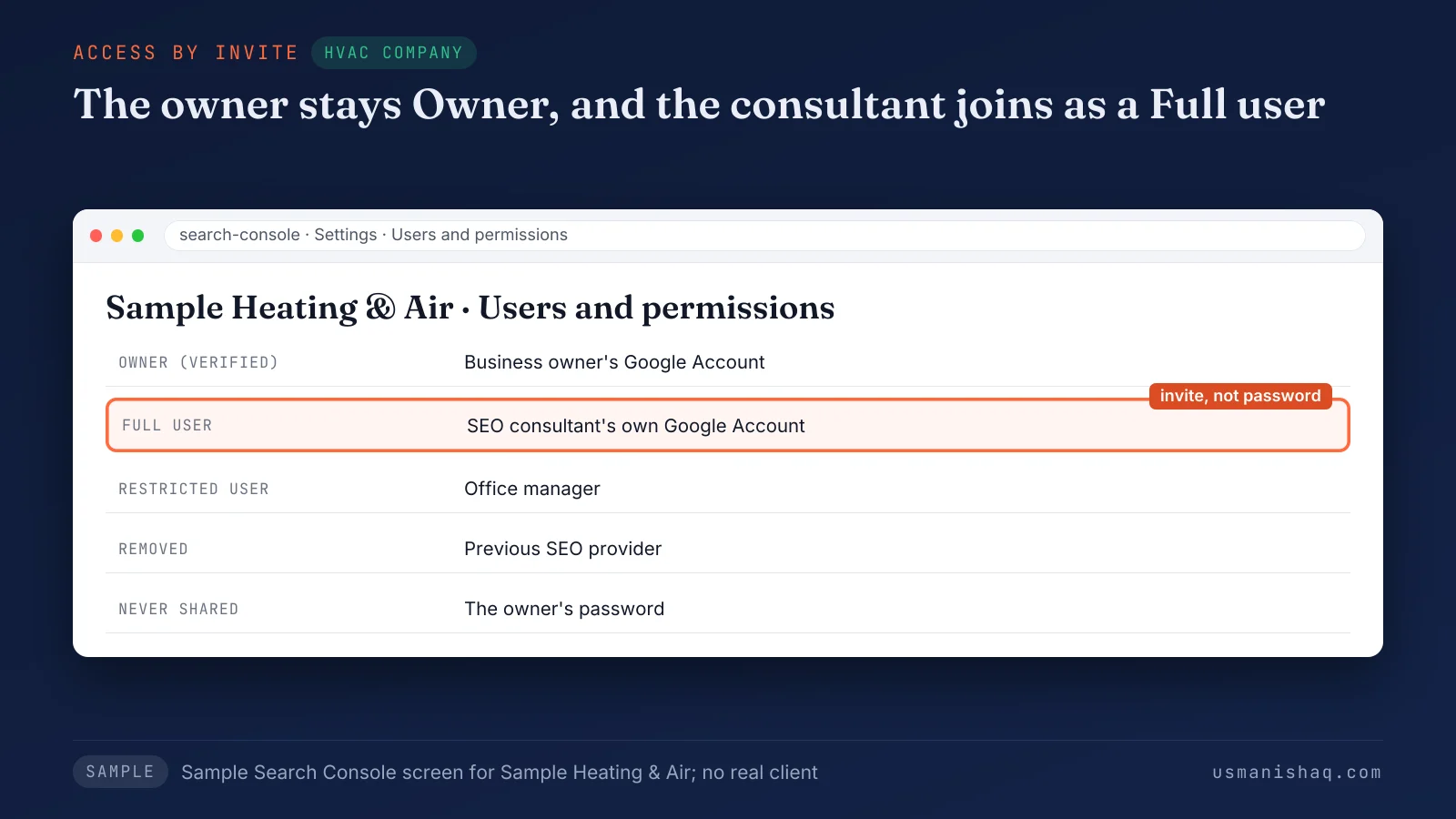
The sample screen for Sample Heating & Air keeps the business owner as the verified Owner. The consultant's own Google Account is a Full user, and the office manager is a Restricted user. The previous SEO provider is removed, and no password was shared.
Each role in the table goes out as an invite to the consultant's own Google Account.
How do you share access without giving away a password?
The owner shares access by inviting the consultant's own Google Account in each tool, so no password leaves the business.
The steps to send access safely are listed below:
- Ask the consultant for the Google Account email that should receive the invites.
- Add that email in each tool with the role from the table.
- Keep yourself as Owner in Search Console and the Business Profile, and as Administrator in Analytics.
- Write down who holds which role and the date each invite went out.
- Remove the user in each tool on the day the work ends.
Business Profile Help says each user "needs their own Google Account" so the password is never shared. Analytics works the same way, with users added by Google Account email under Admin and Access Management. A semantic SEO consultant needs nothing from these tools that an invite does not give.
Should you give an SEO consultant your password?
No, an owner should not give an SEO consultant a password, because each Google tool adds a named user instead.
A consultant who still asks for the password should get the invite instead, since semantic SEO work needs no password. The request is a warning sign, and any password already shared should be changed the same day.
What business information should you prepare for an SEO consultant?
An SEO consultant needs the facts only the owner holds: services and prices, towns, proof, past SEO work, competitors and goals.
The three sections below cover the services and towns, then proof and history, then competitors and goals.
A semantic SEO consultant turns these facts into a topical map for the website. A topical map is the plan of every entity, attribute and question a website must cover. Each item gets one owning page, section or sentence.
Which services, prices and towns should you list?
The service list should name every job the business wants more of, with a price or the factors that move the price.
A plumbing company might list drain cleaning, water heater replacement and sewer line repair. Water heater replacement has no single price, so the list names the factors: tank size, fuel type and access. Sewer line repair moves with the length and depth of the line.
The towns list starts with the base town. Each other town follows in the order the owner wants calls from each. A line such as "We service 5 cities" leaves the consultant guessing which five.
I ask for the jobs worth most first, because those pages get planned first. Each service and town on the list becomes a candidate page in the semantic SEO plan.
What proof and past SEO work should you send?
The proof to send is your reviews, job photos and licences, and the past SEO work is every report, audit and plan.
Reviews tell the consultant which services customers praise by name. Photos of finished jobs show the work a service page describes. Licence and insurance details go in exactly as the business publishes them.
Past SEO work covers monthly reports, audits, keyword lists, content plans and any website rebuild or domain change. Each item should carry its date.
Ahrefs's guide to SEO consultants makes the same point from the hiring side. A good consultant asks whether keyword research, an audit or SEO reports already exist. Nobody should pay twice for the same audit.
A semantic SEO consultant also reads old reports to see which pages once ranked and then slipped.
How should you state competitors and goals?
The goal should be stated in calls and booked jobs for named services and towns, and competitors as the businesses above you.
A heating company might write: more furnace replacement calls from two named towns before winter. Owners on forums say the same thing more bluntly. They want to "get calls (not vanity traffic)".
Three competitor names are enough. Pick the businesses that show above you on Google Maps, or the ones that won quotes you lost. A semantic SEO plan compares your pages with theirs, service by service.
Sending the pack starts the exchange, and the next section covers what comes back.
What should you expect back from an SEO consultant?
An SEO consultant should send back a written scope, a first read of the site and a short list of first fixes.
Access at the end of the work is covered after the figure.
My first reply to a new pack is the scope in writing. The scope says what is included and what is not. The scope also names the pages I will read and the access each step uses.
The first findings follow in order, with the fix that reaches the most pages at the top of the semantic SEO plan.
The scope for a website that already has pages is usually a semantic content audit. The first paid step is then a fixed-fee Semantic Content Audit of an existing website.
The audit reads the site with view-only logins and edits nothing. The audit returns a written issue map and a 45-minute review call.
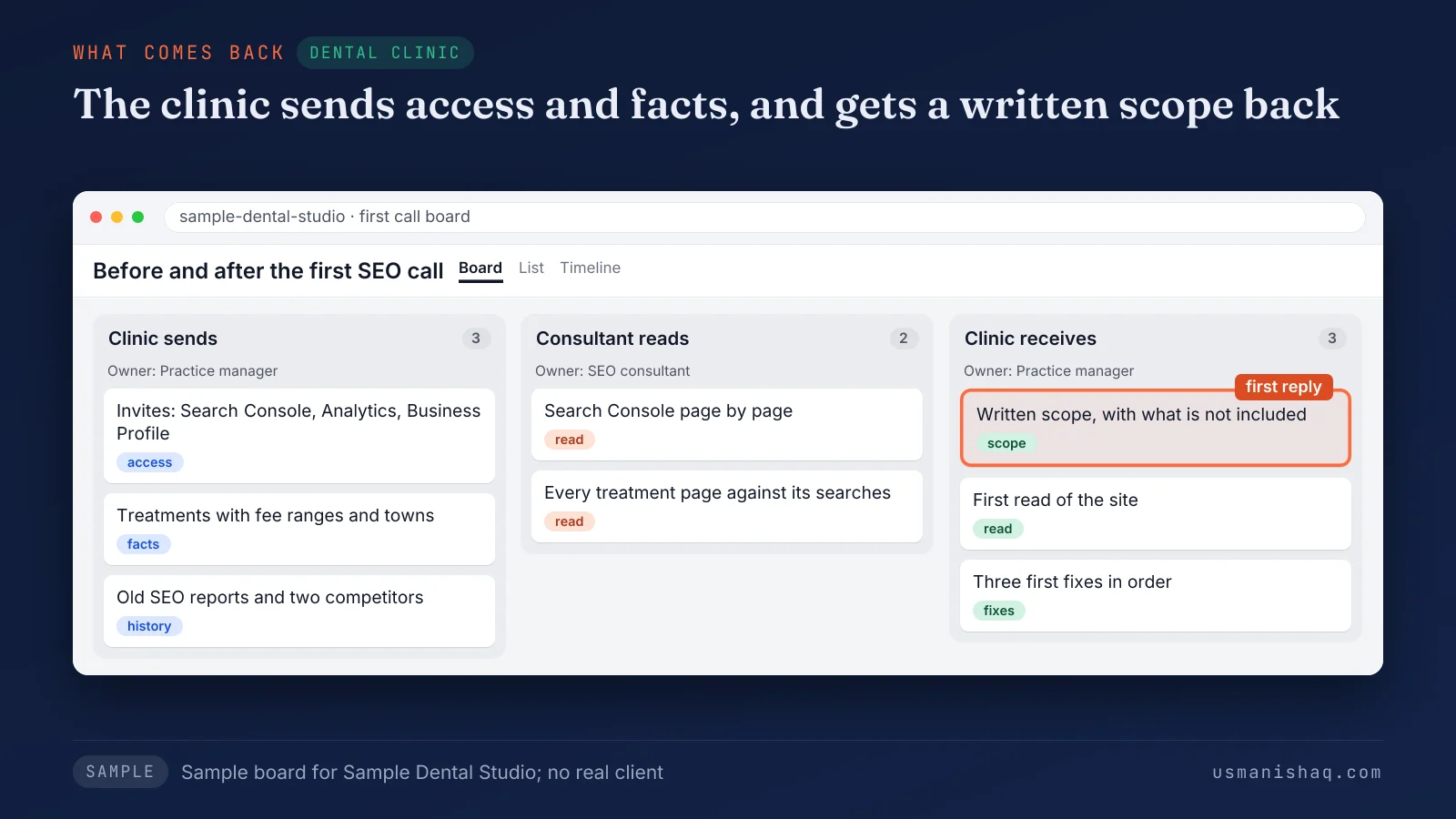
Sample Dental Studio sent three invites, its treatments with fee ranges and towns, old SEO reports and two competitors. The consultant read Search Console and every treatment page against its searches. The clinic received a written scope with exclusions, a first read and three first fixes in order.
The access you granted stays open until the owner closes each invite.
What happens to the access when the work ends?
The owner removes the consultant's user in each tool when the work ends, and the business keeps its accounts and documents.
Search Console Help warns that a removed verified owner can return through an unused verification token, so consultants join as users. The topical map, briefs and reports from the semantic SEO work stay with the business.
What comes after the first call with an SEO consultant?
An SEO consultant with your access and facts can be tested, reported on monthly and checked against your Business Profile.
The three sections below take each step in turn. Each step keeps the semantic SEO work measured against the business, not against the consultant's own words.
How do you test an SEO consultant with the access you prepared?
The access you prepared lets an owner test an SEO consultant on one small paid task before any monthly contract.
Google's guide Do you need an SEO? treats an audit as the first job and keeps Search Console at read access.
A small semantic SEO task, such as one service page read against its searches, shows the method on your own site. The test task reads the same Search Console and Analytics access listed above. The task and its scoring are explained in how to test an SEO consultant before you hire one.
How do you read what an SEO consultant reports back?
An SEO report from a consultant is read in calls and booked jobs, with Search Console as the record of searches.
Impressions show demand, clicks to service pages show progress, and calls show the result. A semantic SEO report also names each page by the search the page was built to answer. The numbers to check first are covered in how to read an SEO report in calls and booked jobs.
Why should the Business Profile and the website show the same facts?
The Business Profile and the website should show the same services, towns and hours, because the consultant checks one against the other.
The towns and services you sent are compared with the profile's categories, service area and hours. Semantic SEO treats both as descriptions of one business, so the two should agree. The checks are listed in how the Google Business Profile and website must match.
Questions owners ask before sending access to an SEO consultant
An SEO consultant hears three more questions from owners before access is sent: a missing Business Profile, hosting logins and Google Ads.
What if the business has no Google Business Profile yet?
The owner should create and verify the profile on a Google Account the business controls, then add the consultant as Manager. A profile created on the consultant's account starts with the consultant as Owner.
Does an SEO consultant need the hosting or domain login?
No, an SEO consultant needs the hosting or domain login only when the written scope includes technical changes such as redirects. Most semantic SEO work reads and rewrites pages, which needs no server access.
Does an SEO consultant need access to Google Ads?
No, an SEO consultant needs Google Ads access only when ads are in scope or the paid search terms matter. Read-only access covers that request.
What is the short list to send an SEO consultant?
An SEO consultant needs access by invite, the facts of the business and the history of past SEO work.
Nothing on the list hands over ownership of an account. An owner who sends the pack by invite and in writing knows what the consultant reads. The business keeps control while semantic SEO is built into the website.