
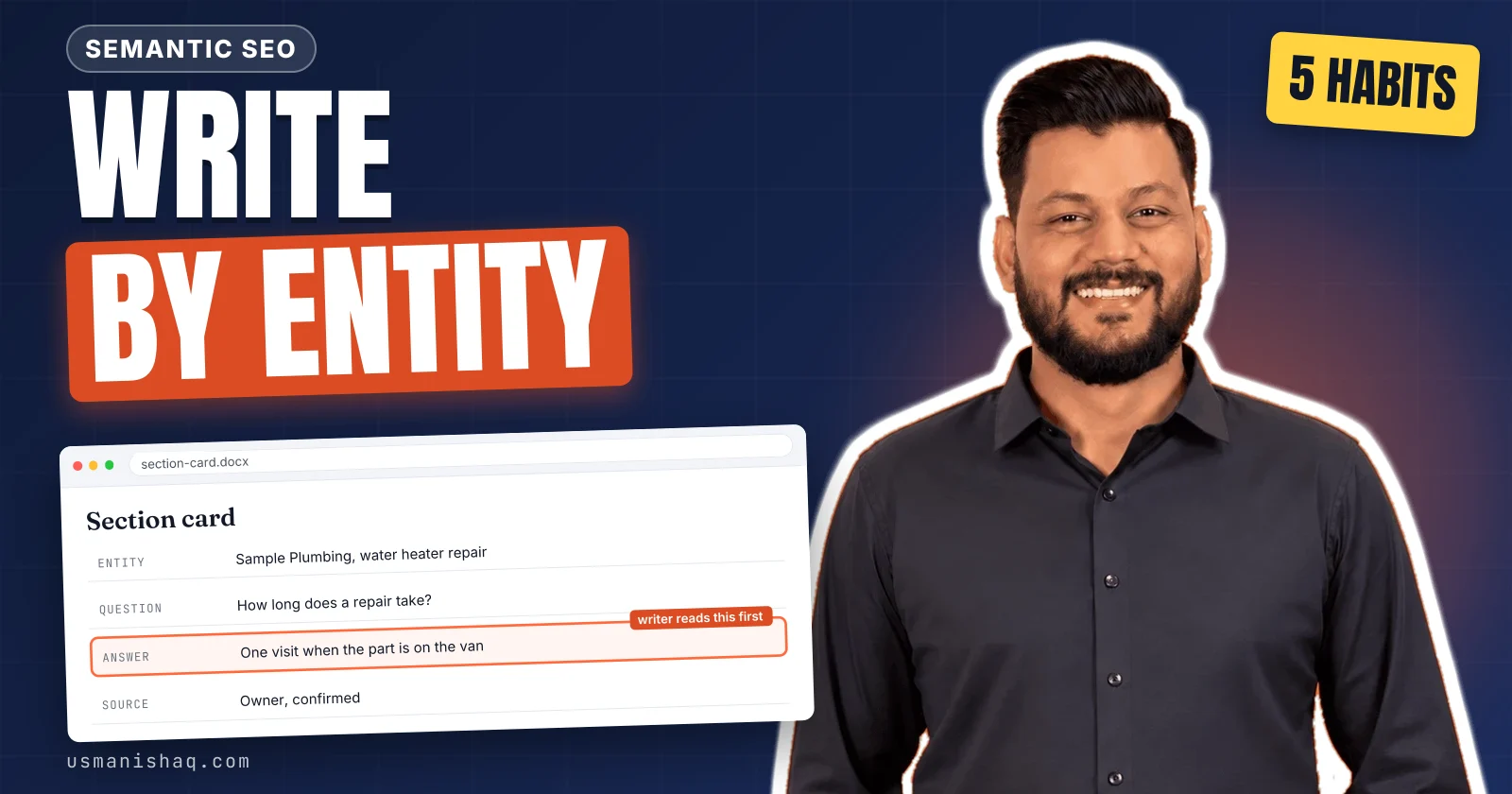
Semantic SEO for writers means one entity per page, one answer under each heading and one fact per sentence.
The top results for this query mostly tell a writer to cover topics and use related terms. That advice is fine. It is hard to act on at the keyboard, where a writer needs to know what to do in the next sentence.
This page gives five habits, a card to fill in before each heading and a test that catches filler. Nothing here needs software. A sample plumber page shows the habits on real sentences.
What does semantic SEO change for a writer?
Semantic SEO changes what a writer decides, which is the wording of each answer.
The brief decides the page, the headings and the links. In keyword-first writing, the writer picks a phrase and works it into the text. In semantic SEO, the writer receives a page with a subject, a question per heading and a list of confirmed facts. The job is to state those facts clearly, in the customer's words, one at a time.
Take a writer handed the phrase "water heater repair". Keyword-first writing asks how often to repeat it. Semantic writing asks who needs a repair, what they want to know and which confirmed facts answer them.
Google documentation says content should be easy to read and well organised, and that headings help people move around a page. A semantic writer takes that further. Each heading is a question, and the first sentence below it answers.
The five habits of a semantic writer
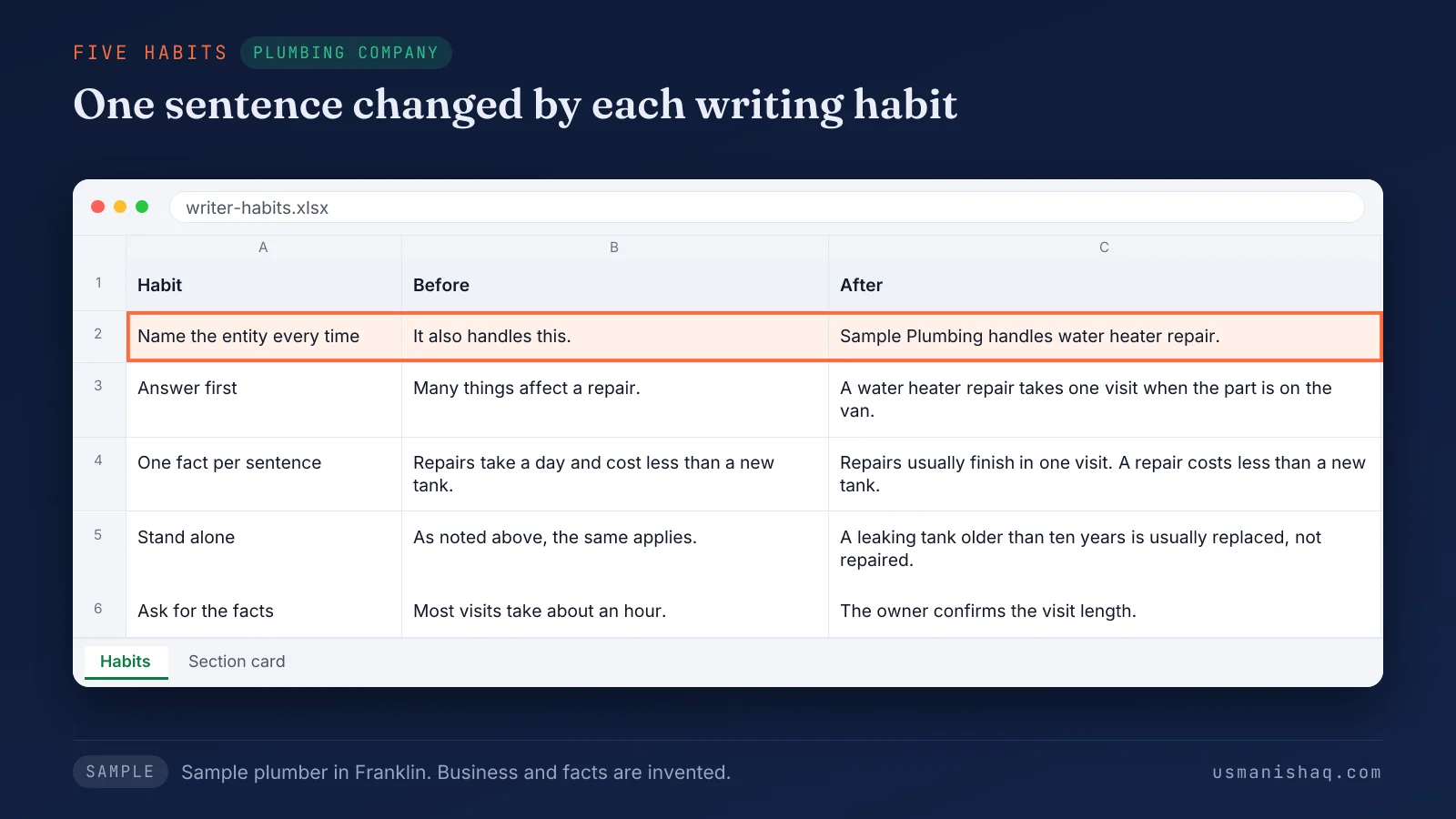
A semantic writer has five habits, and each one changes how a single sentence is written.
| Habit | Before | After |
|---|---|---|
| Name the entity every time | It also handles this. | Sample Plumbing handles water heater repair. |
| Answer first | Many things affect a repair. | A water heater repair takes one visit when the part is on the van. |
| One fact per sentence | Repairs take a day and cost less than a new tank. | Repairs usually finish in one visit. A repair costs less than a new tank. |
| Stand alone | As noted above, the same applies. | A leaking tank older than ten years is usually replaced, not repaired. |
| Ask for the facts | Most visits take about an hour. | The owner confirms the visit length. |
Every line is a sample for a made-up plumber in Franklin. The "ten years" and "one visit" lines would need the owner's confirmation before they ran.
Keep the habits in that order. Naming the entity comes first because every other fix needs a clear subject.
A common slip is naming the business once, then switching to "we" and "it" for the rest of the page. Each switch makes the reader wonder whether the subject changed. Repeat the name, even where it feels stiff, and trim the stiffness in the editing pass.
How do you write a section the semantic way?
You write a section the semantic way by filling in a section card first and writing the answer sentence second.
I plan one card per heading. The card is quick to fill in, and it fixes the answer before any wording starts.
What goes on the section card?
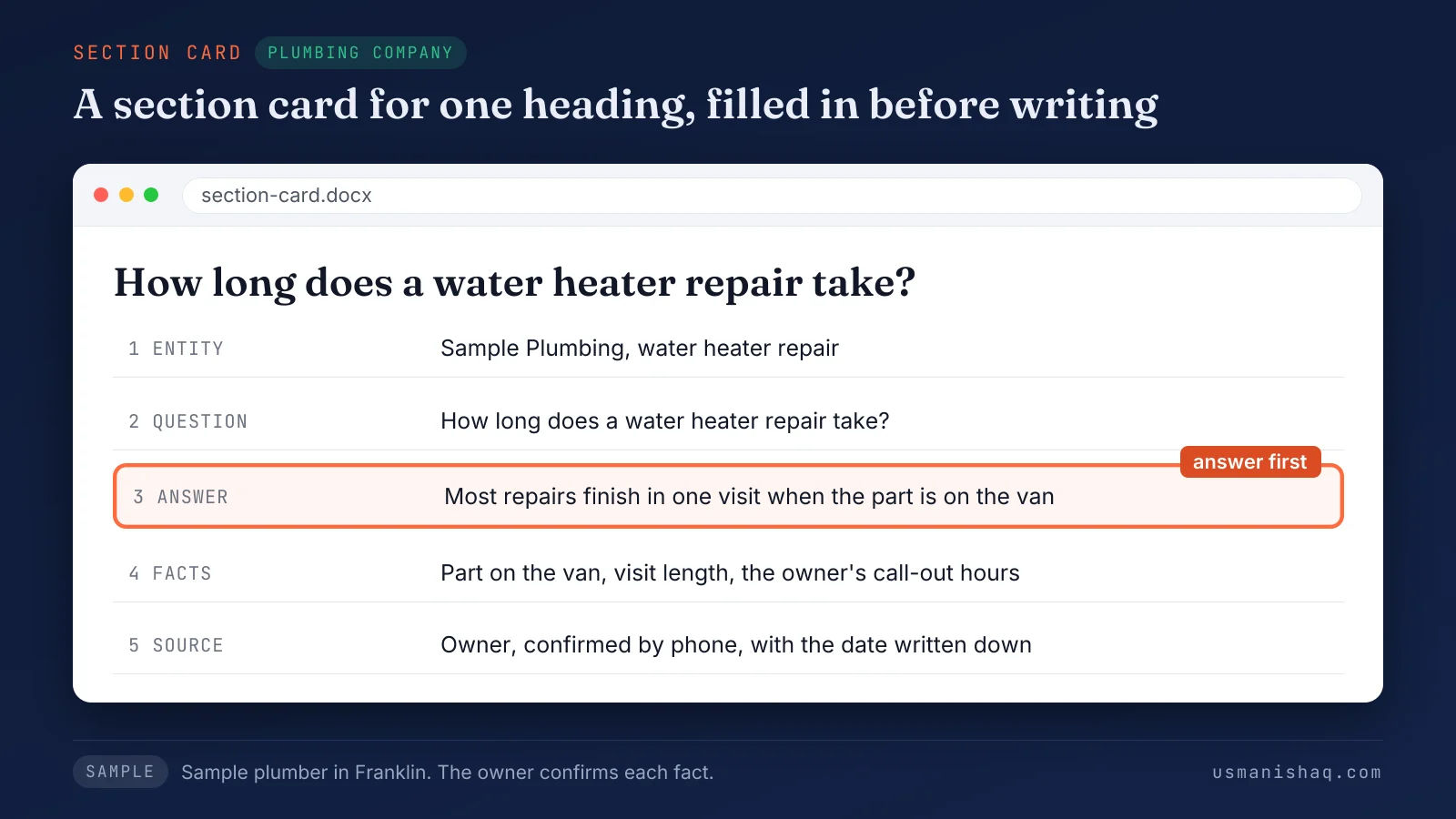
The section card holds five lines, the entity, the question, the answer, the facts and their source.
Here is a sample card for the plumber's repair section.
- Entity: Sample Plumbing, water heater repair.
- Question: how long does a water heater repair take?
- Answer: most repairs finish in one visit when the part is on the van.
- Facts: part on the van, visit length, the owner's call-out hours.
- Source: the owner, confirmed by phone, with the date written down.
A line with no source is a line the writer must not publish as fact. Ask the owner, or leave the line out.
What is the swap test?
The swap test asks whether a paragraph still works when you put a different heading above it.
Lift the paragraph under the repair-time heading and drop it under the cost heading. If it still fits, it says nothing specific to either question. Cut it, or give it one fact that belongs to only one, such as the real visit length from the owner's records.
My swap test is a habit, not a Google rule. It catches the sentence that could sit on any page, which is the one readers skim past.
A Semantic Content Production writer brief has one row per heading, so the writer supplies the sentences.
Worked example for a plumber in Franklin
A worked example for a plumber in Franklin takes one flat paragraph and rewrites it with the five habits.
Every name and fact below is a sample, and the owner would confirm each fact before the page ran.
Picture the flat paragraph a writer might hand in first. "Water heater problems can be stressful, and there are many factors to consider. It is important to work with a professional who understands your needs. Repair can often fix the issue and it is usually cheaper."
Nothing in it names the business, the town or the job. It could sit on any plumber's page in any country, which is the problem. Now the same section after the card.
"Sample Plumbing repairs water heaters in Franklin. A repair usually finishes in one visit when the part is on the van. A tank older than ten years is usually replaced."
Three sentences, one fact each, and the business name once. That is the whole trick. The first sentence answers the heading. Each sentence would still make sense if a search result quoted it alone. One word still needs checking. "Usually" is a claim. The writer asks the owner for the real pattern, such as how many repairs last year needed a second visit.
What a writer should ask for before starting
Before starting, a writer should ask for the brief, the fact sheet, the term list, the questions and the link plan.
- The brief, so the headings and the order are fixed.
- The fact sheet, with the owner's confirmed values.
- The term list, so the entity names stay exact.
- One question for each heading.
- The link plan, so you do not choose targets.
If one is missing, ask. A writer who guesses a price or an opening day writes a page that has to be pulled. Writing around a gap is better than filling it. A note to the editor beats an invented number.
Questions writers ask next
After the habits, writers ask about keywords, AI drafts and where to read more.
Do I still use keywords?
Yes, a writer still uses the customer's phrase, but the phrase sits in an answer and no longer needs repeating.
Use the exact entity name and the words customers type, and use them where they answer the heading. The comparison between the two approaches is set out in how semantic SEO differs from keyword-first SEO.
Can AI write the first draft?
Yes, an AI tool can draft, and the section card and the editor still decide what stays.
A tool can fill a gap with a plausible sentence, and that is how a wrong opening day reaches a page. The risks for a trade business are laid out in whether AI can draft the service pages.
Where can I read more about semantic content?
You can read what semantic content is and what it is made of before you practise the habits.
Definitions come first and habits second, because the habits make more sense once you can say what the page is about. What semantic content is made of covers the layers and gives more examples.
Semantic SEO for writers in short
Semantic SEO for writers is five habits, and the section card is where they start.
Name the entity every time, answer first and state one fact per sentence. Run the swap test on every paragraph, and ask for the facts you do not have.