
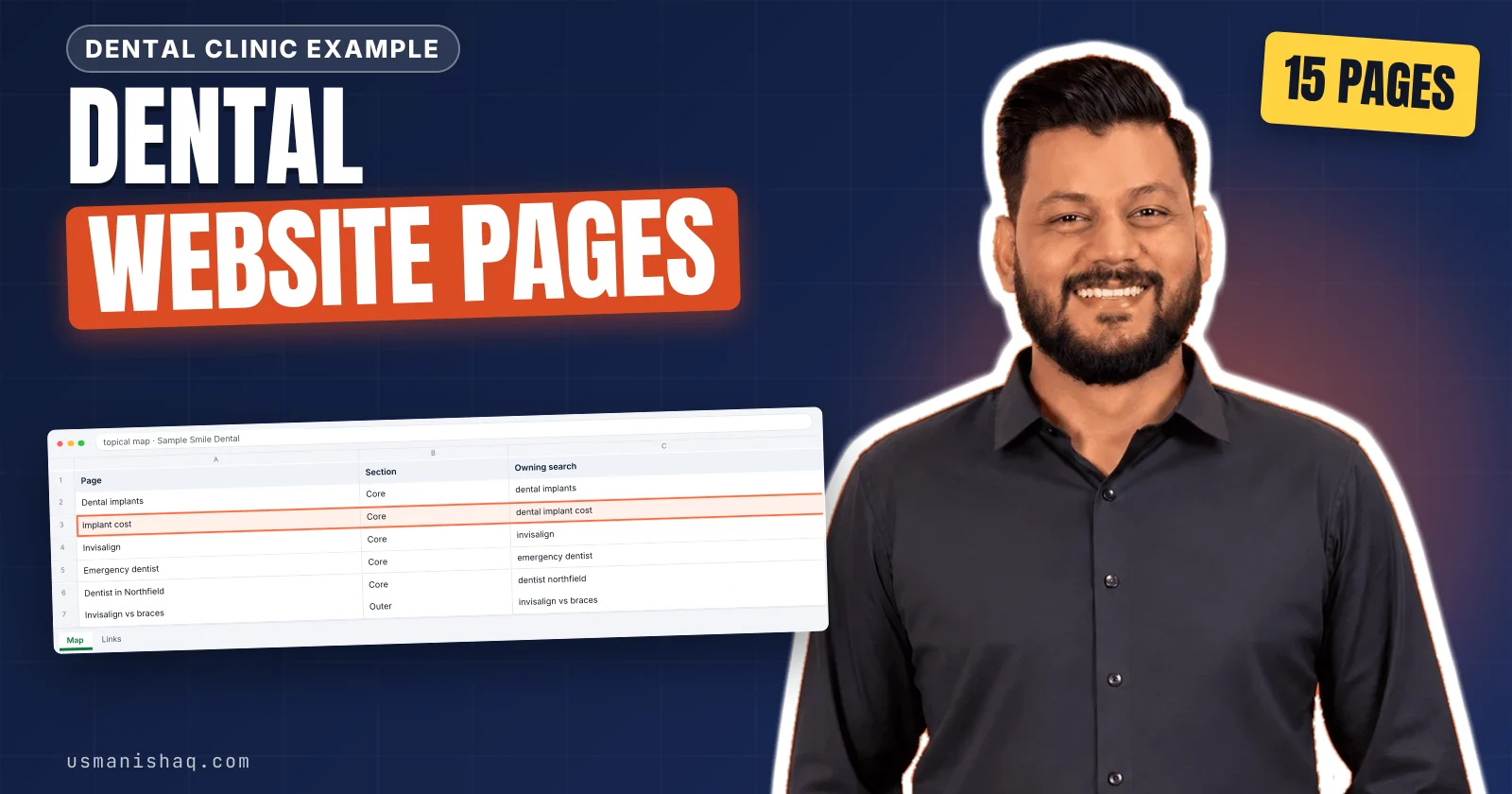
A topical map for a dental clinic website is the plan of treatment, dentist, location and question pages, each owning one search.
Semantic SEO plans the map so search engines understand which page answers each dental search. The first pages are a treatment page for each treatment offered and a page for each real office.
A dental practice website needs treatment, cost, question, dentist and insurance pages, plus one page for each real office. The website is structured as treatment folders and office pages, linked to treatments and published in a set order. A dental practice's topical map is measured in calls, appointment requests and forms per page.
What is a topical map for a dental clinic website?
A topical map for a dental clinic website is the plan of treatment, dentist, location and question pages, each owning one search.
A dental practice needs pages for three things. Patients book treatments, choose the dentist who treats them, and ask questions before they call.
Practice owners ask which pages their dental website needs, and few of them use the term "topical map". The topical map for a dental clinic website answers that question page by page.
Semantic SEO keeps the map as rows: one row per page, with its owning search, intent and URL. One owner per search means no two pages of the website answer the same search. The rows together name every page the practice needs.
What pages does a dental practice website need?
A dental practice website needs treatment, cost, question, dentist and insurance pages, plus one page for each real office.
The home, about, new-patient, reviews, and contact and booking pages are trust and utility pages. The trust and utility pages own no search beyond the practice name. The table lists only the pages that own a search.
The table below is a sample topical map for a dental practice website with two offices and seven treatment lines.
| Page | Section | Owning search | Intent | URL |
|---|---|---|---|---|
| General and family dentistry | Core | family dentist | Transactional | /family-dentistry/ |
| Emergency dentist | Core | emergency dentist | Transactional | /emergency-dentist/ |
| Dental implants | Core | dental implants | Commercial | /dental-implants/ |
| Dental implant cost | Core | how much do dental implants cost | Commercial | /dental-implants/cost/ |
| Invisalign and clear aligners | Core | invisalign | Commercial | /invisalign/ |
| Teeth whitening | Core | teeth whitening | Commercial | /teeth-whitening/ |
| Children's dentistry | Core | children's dentist | Transactional | /childrens-dentistry/ |
| Dentist profile (one per dentist) | Core | [dentist name] dentist | Navigational | /dentists/[name]/ |
| Insurance and payment plans | Core | dentist that takes [plan] | Commercial | /insurance-and-payment/ |
| Dentist in Northfield | Core | dentist northfield | Transactional | /northfield/ |
| Dentist in Eastbrook | Core | dentist eastbrook | Transactional | /eastbrook/ |
| Invisalign vs braces | Outer | invisalign vs braces | Informational | /invisalign/vs-braces/ |
| Chipped tooth: when to call | Outer | what to do about a chipped tooth | Informational | /emergency-dentist/chipped-tooth/ |
| Sensitive teeth: what the visit checks | Outer | why are my teeth sensitive to cold | Informational | /family-dentistry/sensitive-teeth/ |
| A child's first dental visit | Outer | when should a child first see a dentist | Informational | /childrens-dentistry/first-visit/ |
No two rows share an owning search. The rows are a worked sample, and Northfield and Eastbrook are sample towns, not a client result.
Each owning search is checked in Google Search Console or search suggestions before a page is built. An informational intent is to learn, and a commercial intent is to compare or to price. A transactional intent is to book, and a navigational intent is to find a named dentist.
Semantic SEO treats each row as one page decision, so the table is also the build list. The core rows of a dental practice map start with the treatment pages.
Which dental treatments earn their own treatment page?
A dental treatment earns its own page when the cost, the dentist or the next step differs from other treatments.
The treatments that most dental practice maps hold as treatment pages are listed below:
- General and family dentistry: check-ups, cleanings and fillings for patients of every age.
- Emergency dentist: same-day visits for pain, a broken tooth or a lost crown.
- Dental implants: one treatment page, plus a cost page explained in the next section.
- Invisalign and clear aligners: one page while the two searches show the same results.
- Teeth whitening: the in-office and take-home options the practice offers.
- Children's dentistry: a page for a practice that sees children.
- Veneers and other cosmetic work: a page only for a practice that offers veneers.
Each treatment page explains what the treatment involves and which dentist provides the treatment. The page also covers how suitability is assessed, the visit stages and how estimates are prepared.
A services list with implants as one bullet gives no treatment a page of its own. Semantic SEO names each treatment page by the treatment patients type, not by a category label. Implants show why one treatment can need two pages.
Why do dental implants and implant cost get separate pages?
Dental implants and dental implant cost get separate pages because the search, the reader's question and the next step differ.
The reader of the implants page asks what the treatment involves and which dentist provides the treatment. That reader's next step is a consultation request. The reader of the cost page compares prices, insurance cover and payment plans, and wants an estimate first.
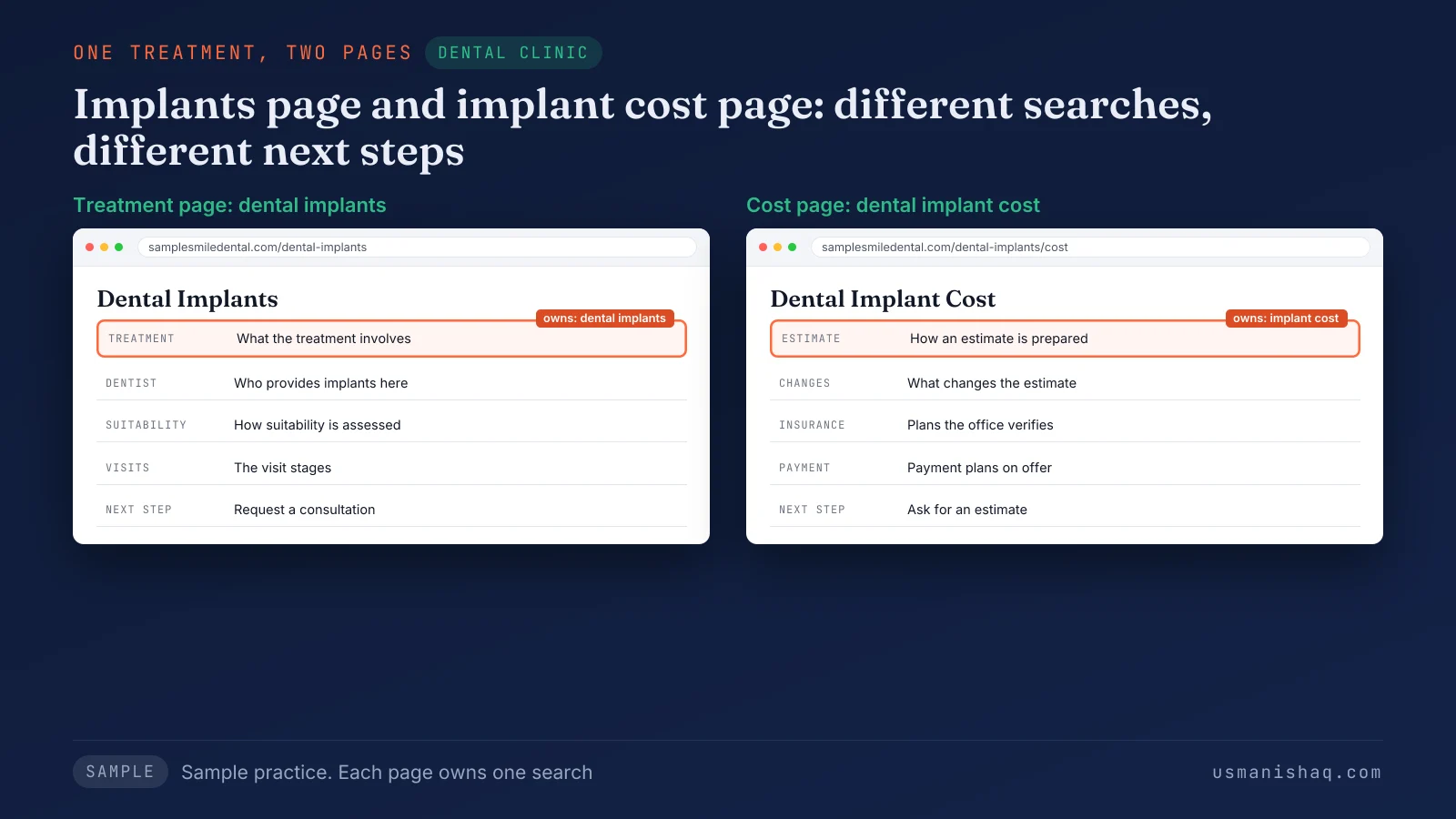
The figure sets the two pages side by side. The implants page holds the treatment, the dentist, suitability and the visit stages. The cost page holds the estimate, what changes the estimate, insurance and payment plans.
One merged page answers both searches and owns neither. All-on-4 or full-arch implants earn a third page only for a practice that offers them. Their searches also need to show different results.
Semantic SEO splits a treatment where the searches split and keeps one page where they agree. Patient questions follow a separate test.
Which patient questions earn a question page?
A patient question earns a question page when the question's search differs from the search the treatment page owns.
Patients type the question, and the question names a different treatment, condition or thing from every other page. The question also shows different results in Google from the searches other pages own.
The searches "invisalign vs braces" and "what to do about a chipped tooth" each earn a question page. The search "why are my teeth sensitive to cold" earns one too.
The search "does invisalign hurt" stays a section of the Invisalign page. The question about the first visit stays a section of the new-patient page.
A cost question earns a cost page in the core section, such as dental implant cost.
A question page explains when to call the practice and what the visit checks. The page never diagnoses the reader or promises an outcome. A qualified dentist reviews every question page before the page goes live.
Every question page links to its treatment page. Semantic SEO keeps question pages in the outer section, each one feeding a treatment page and the dentist who provides the treatment.
Do dentist pages and insurance pages belong in the map?
Yes, dentist profile pages and an insurance page belong in a dental practice map, because patients search dentists and plans before booking.
A dentist profile page holds the dentist's full name, role, qualifications and registration details where they apply. The page also lists the treatments the dentist provides and the offices where the dentist works. Each treatment page links to the dentists who provide that treatment.
Owners then ask whether every insurance plan needs its own page. No, a single insurance and payment page answers most plan searches. A plan earns its own page only with its own searches and its own information.
A dental marketing guide from Geeks for Growth warns against "the same paragraph with a carrier name swapped in". The insurance and payment page names the plans the practice works with and the payment plans on offer.
The page explains that coverage is verified with the carrier or the office, and the page never promises coverage. Every kept row then takes a place in the site structure.
How is a dental practice website structured?
A dental practice website is structured as treatment folders and office pages, linked to treatments and published in a set order.
The five parts of a dental practice website structure are listed below:
- Treatment folder: one folder for each treatment page, such as /dental-implants/.
- Pages inside the treatment folder: the cost page /dental-implants/cost/ and question pages such as /invisalign/vs-braces/.
- Office pages: one page for each real office, such as /northfield/, listing the treatments offered there.
- Links: each question page links to its treatment page. Each treatment page links to its dentists, the insurance and payment page and booking. Each office page links to its treatments, and the home page links to every treatment page.
- Schema: Dentist markup on each office page, stating only what the page shows. Schema.org lists the Dentist type under LocalBusiness, MedicalBusiness and MedicalOrganization.
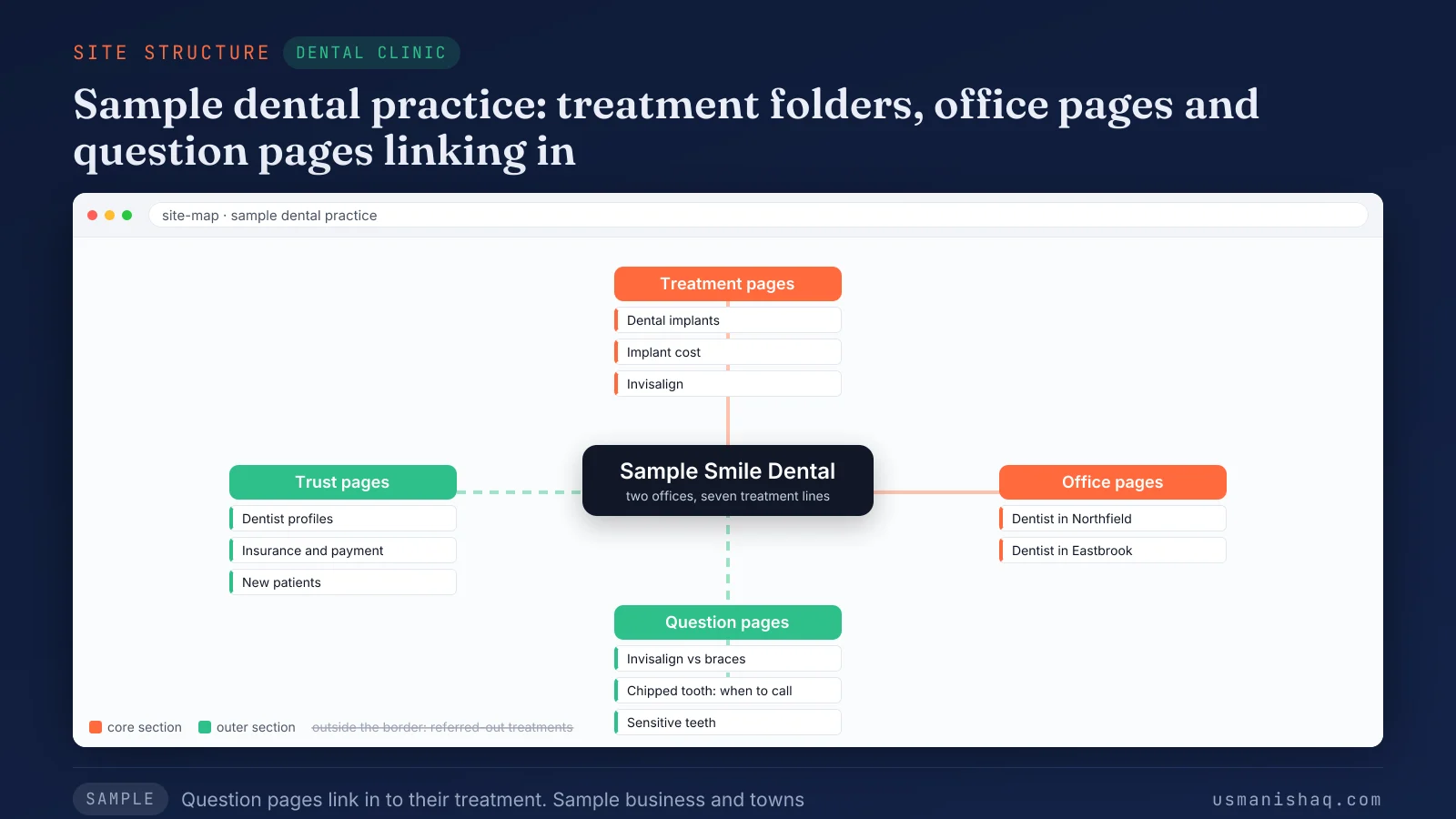
The figure shows the sample practice in four groups: treatment pages, office pages, question pages and trust pages. The question pages link in to the treatments, and referred-out treatments sit outside the border.
Semantic SEO sets the folders before the pages, so every URL follows its row. The pages then go live in a set order.
In what order should a dental practice publish its pages?
A dental practice should publish office pages and the emergency dentist page first, then treatment, cost, dentist, insurance and question pages.
The steps to publish the pages of a dental practice website are listed below:
- Publish each office page and the emergency dentist page first, since patients ready to book land there.
- Publish the treatment pages in the order of the treatments the practice wants more of.
- Add a cost page where patients search the cost of a treatment, such as dental implant cost.
- Add the dentist profile pages and the insurance and payment page.
- Add the question pages, each linked to its treatment page.
Treatment and question pages should go live only after a qualified dentist reviews them. Semantic SEO architecture writes the publication order into the topical map before the first page goes live.
The fixed-scope project that produces the map, folders and order for one business is the Semantic SEO Architecture map and roadmap. Each published page is then judged by the calls the page brings.
How is a dental practice's topical map measured?
A dental practice's topical map is measured in calls, appointment requests and forms per page, which show the map's worth.
Office pages and the emergency dentist page should bring calls. Implant and Invisalign pages should bring consultation requests.
The insurance and payment page should bring calls and appointment requests from patients who checked their plan. Question pages should bring clicks to the treatment page, not calls.
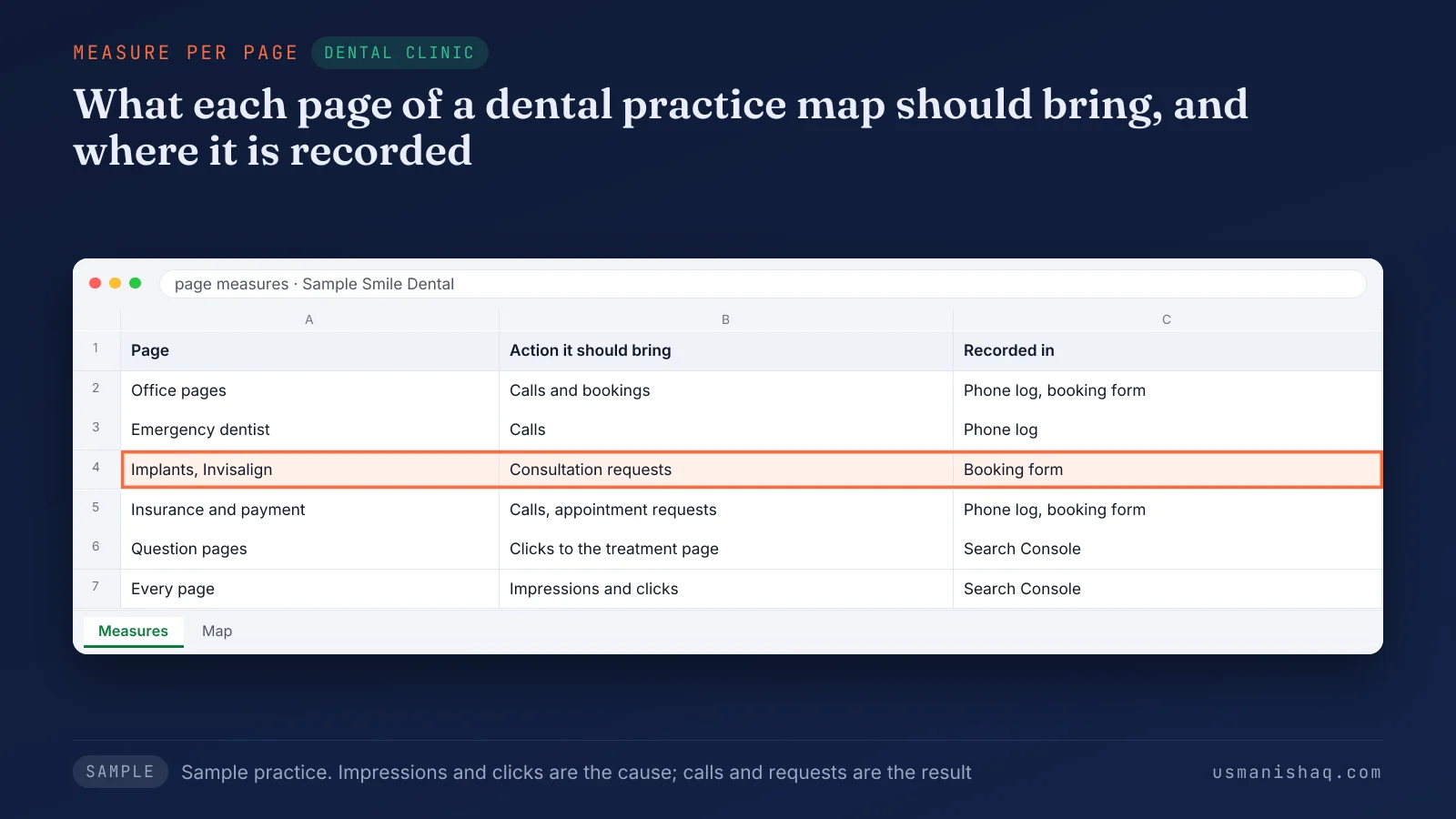
The figure lists each page type, the action each page should bring and where the practice records that action. The records are the phone log, the booking form and Search Console.
Search Console shows the impressions and clicks of each page, and those numbers are the cause, not the result. The practice records which page each call, request or new-patient form came from.
An office page with impressions and no calls needs a better answer on the page, not more pages. The same per-page reading shows whether the map is worth the work.
Is a topical map worth it for a dental practice?
Yes, a topical map is worth it for a dental practice offering more than check-ups or running more than one office.
The Google Business Profile carries the practice's categories, services, hours and reviews, so the profile does not do the job alone. The website holds one page for each treatment, dentist, office and question, and the profile's services list matches the treatment pages.
A one-dentist practice offering general care in one town needs a few rows only. The worth holds only while the website avoids five faults.
Which faults break the topical map of a dental practice website?
Five faults break a dental practice's topical map: one treatments page, competing posts, unoffered treatments, outcome promises and copied pages.
The five faults that break the topical map of a dental practice website are listed below:
- One treatments page: every treatment shares one page, so no treatment owns a search. The fix is a treatment page for each treatment the practice offers.
- Competing posts: a blog post answers the search a treatment page owns, such as Invisalign cost. The fix is one owner, with the post turned into a section or a link.
- Unoffered treatments: pages for treatments the practice refers out bring calls the practice sends elsewhere. The fix is a border, with one referral sentence in place of the page.
- Outcome promises: treatment or question pages diagnose the reader, promise results or show before-and-after images as typical. The fix is a page that explains the treatment, the dentist and the next step. A qualified dentist reviews the page, and every patient image carries consent.
- Copied pages: office or insurance pages repeat one text with the town or plan name swapped. Google's "Spam Policies for Google Web Search" name pages "targeted at specific regions or cities that funnel users to one page". The policies call that doorway abuse. The fix is content that exists only for that office or plan.
Semantic SEO checks the map for all five faults before a page is written. The same checks apply again when the dental practice adds a specialty or a new office.
How does a dental practice's topical map change for a specialty or a new location?
A dental practice's topical map keeps the same columns for a specialty, a new office or another business, and only rows change.
Every practice type needs a different topical map, since the treatments, the dentists and the patient questions differ. A dental practice is one kind of local service business.
Five steps plan any topical map: describe the business, collect searches, decide owners, set page types and order the pages. The steps are set out in the steps behind a topical map for a business website.
The topical map as a planning method comes from the framework of Koray Tuğberk Gübür. Semantic SEO keeps the columns fixed so maps of different practices compare row by row.
A specialist practice, such as an orthodontist or a pediatric dentist, builds its map around specialty treatments, not general dentistry rows. Each specialty row passes the same test for which query earns a page or a section as any other row.
The plumbing company website's topical map holds service pages, town pages and question pages in the same five columns. A dental practice adds three things a trade map lacks: dentist profiles, the insurance and payment page and clinical review.
A new office changes the map in a different way.
How does the map change when a dental practice opens a second office?
A second office enters a dental practice's topical map as an office page with its own address, dentists, hours and searches.
The office page holds the address, hours, parking and access, and the dentists who work there. The page also lists the treatments offered at that office. Each office has its own Google Business Profile.
The office page states the same name, address, hours and services as that office's profile. The rules are set out in the guide to matching the Google Business Profile and website.
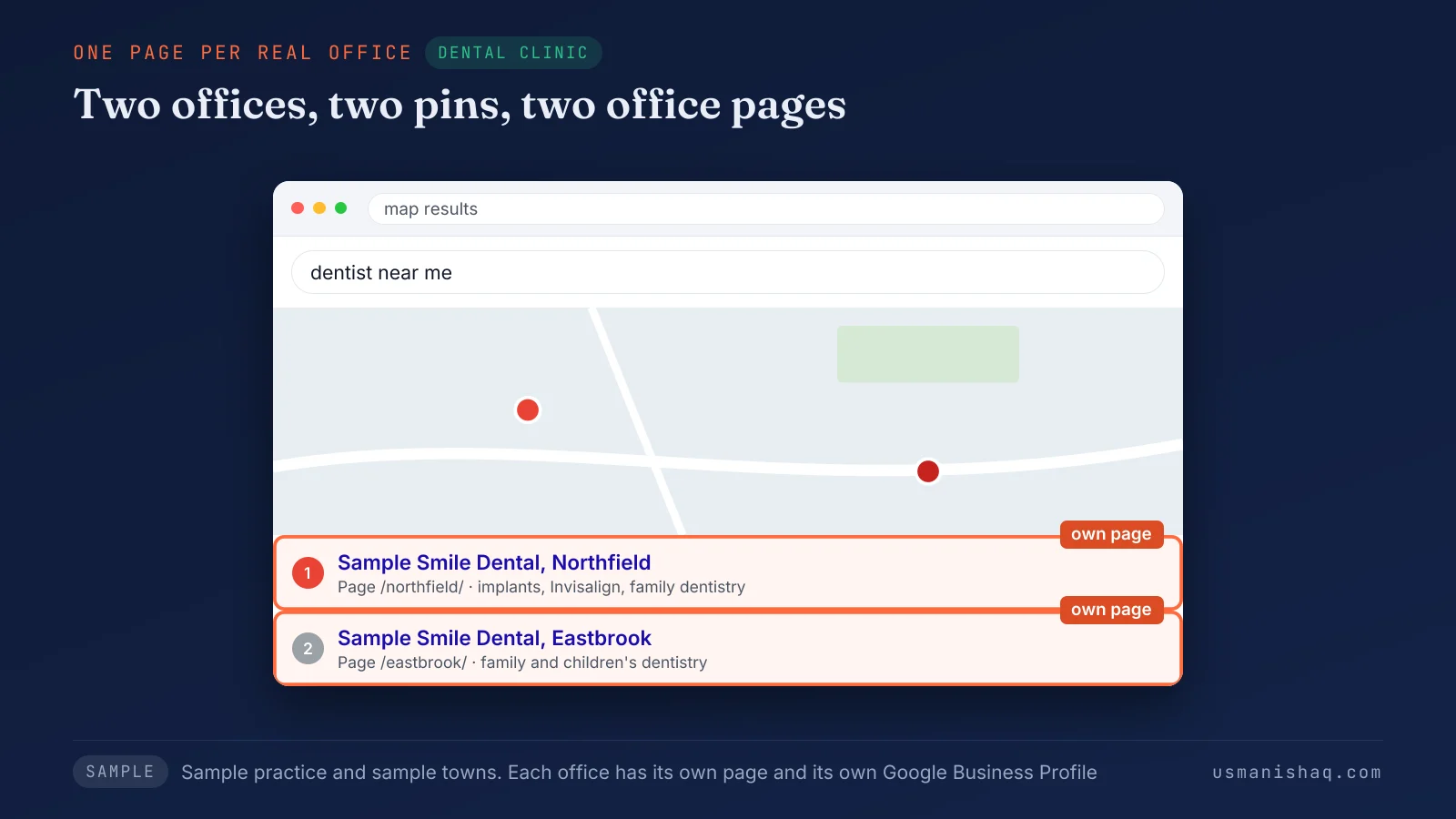
The figure shows the two sample offices, Northfield and Eastbrook, each with its own pin, page and treatments. A suburb with no office stays a sentence on the nearest office page. One website holds every office, the way any service business handles a second site.
Questions dental practice owners ask about website pages
Dental practice owners ask four more questions about pages: the need for a website, page count, one-page sites and carrier lists.
Does a dental practice need a website?
Yes, a dental practice needs a website to hold a page for each treatment, dentist, office and question that patients search.
The website and the Google Business Profile list the same treatments and offices.
How many pages should a dental website have?
A dental website should have one page for every search that passes the page test, so no fixed number applies.
The semantic SEO sample above holds 15 pages: 11 core pages and 4 question pages.
Is a one-page website enough for a dental practice?
No, a one-page website gives every treatment one shared page, so no single treatment owns a search.
A one-dentist practice offering general care in one town is the exception.
Should a dental practice list every insurance carrier?
No, a dental practice should list only the plans the office keeps accurate, since a stale carrier list misleads patients.
The insurance and payment page explains how the office verifies a plan before the visit.
The topical map for a dental clinic website and the next step
A topical map for a dental clinic website is the next step, giving each treatment, dentist, office and question one owning page.
Search engines understand a dental practice through pages that each name one treatment, one dentist, one office or one question. A semantic SEO topical map lists the pages a dental practice website needs before the first page is written.