
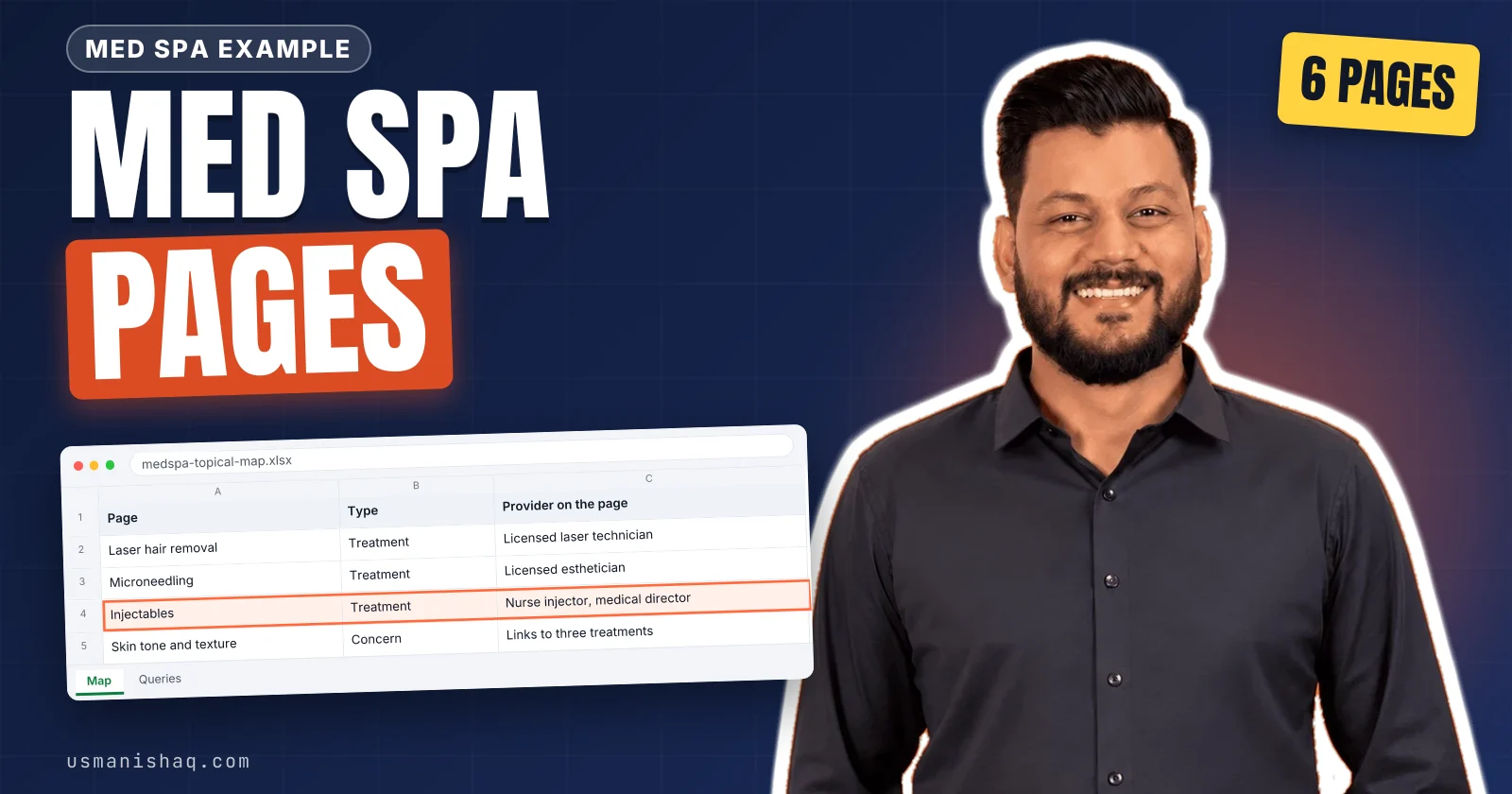
A topical map for a med spa website lists treatment, concern and provider pages, each with one search and one named person.
Your med spa sits between a salon and a clinic. Customers search like shoppers, yet the work involves licensed providers and a consultation. The map has to respect both halves.
Nothing here is medical or legal advice. Your medical director and your state rules decide the wording, and the map only decides which pages exist.
What sets a med spa map apart from a salon map?
A med spa map differs from a salon map because every treatment page needs a named, licensed provider behind it.
Most med spa sites hold one Services page with a long menu. Nobody searches for that page. People search for one treatment or one worry, and your page should be the one that answers.
The map has four kinds of row. Treatment pages name the service. Concern pages start from what a customer wants to change. Provider pages name the person. Question pages cover what people ask before booking.
Each row lists the page, the search it owns, the provider and the consultation step. The provider column is the one that sets this map apart from a salon's.
Treatment pages and concern pages
Each treatment you offer gets a page, and so does each concern customers search by name.
Some customers know the treatment. Others type the worry, such as "uneven skin tone" or "unwanted hair". A concern page lists the treatments you offer for it and links to each one.
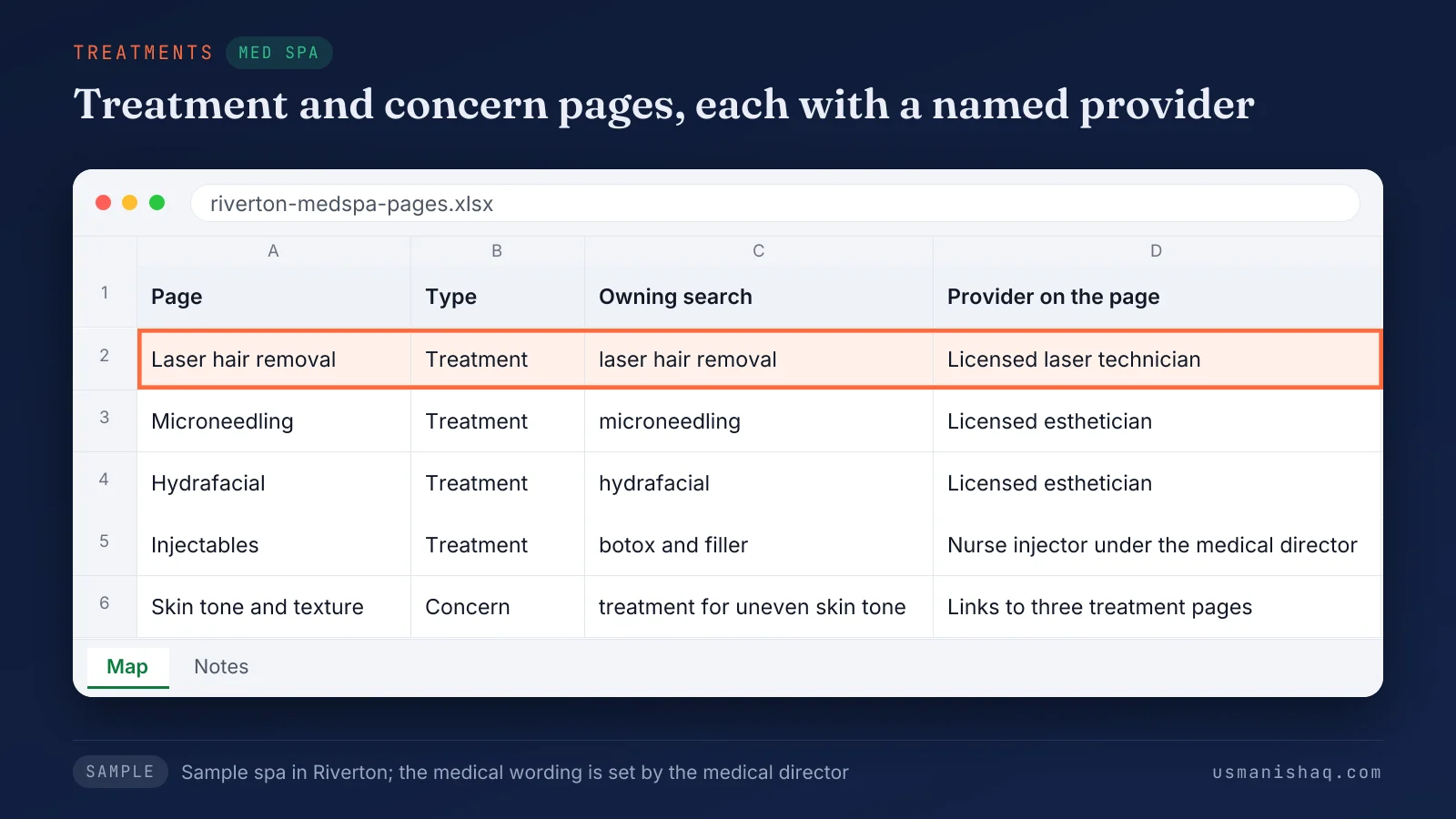
Riverton's spa below is fictional, so treat its rows as a sample.
| Page | Type | Owning search | Provider on the page |
|---|---|---|---|
| Laser hair removal | Treatment | laser hair removal | Licensed laser technician |
| Microneedling | Treatment | microneedling | Licensed esthetician |
| Hydrafacial | Treatment | hydrafacial | Licensed esthetician |
| Injectables | Treatment | botox and filler | Nurse injector under the medical director |
| Skin tone and texture | Concern | treatment for uneven skin tone | Links to three treatment pages |
| Unwanted hair | Concern | unwanted hair removal options | Links to laser hair removal |
A treatment page and a concern page can share a service yet own different searches. One serves someone who already knows the name, and the other serves someone still choosing.
Look up each search in suggestions first. Skip any treatment your providers do not perform today.
Provider pages that hold the credentials
A provider page names the person, the licence type, the treatments performed and any supervising physician the state requires.
Customers want to know who holds the needle or the laser. They also want to know who stands behind that person. Both answers belong on a page you control.
Each provider page lists the treatments the provider performs and links to those treatment pages. The treatment pages link back. For example, the injector's page links to the injectables page and the injectables page links to the injector. That two-way link shows a visitor, and a search engine, who does what.
Check each licence yourself and write the type exactly as the board lists it. If a provider leaves, the page changes the same week. A stale provider page is worse than none.
Medical limits each page keeps
Each med spa page says what the treatment is, who performs it and what the consultation covers. Medical advice stays with the provider.
This is the part owners worry about, and they should. I am not a medical or legal adviser, and neither is a topical map. The limits below are a planning habit, not a legal standard.
Every treatment page keeps four limits. It describes the treatment in plain words and names who performs it. A consultation comes first, and no promise is made about a result.
Before and after photos raise consent and advertising rules that vary by state. Leave them off until your medical director and your lawyer agree on wording.
Keep a short limits line on each page, and have the medical director read it once. Add the date of that review to your sheet.
The provider and treatment matrix
The provider and treatment matrix is a one-sheet grid that names who performs each treatment. No page goes live with a blank cell.
Rows hold treatments and columns hold providers. A cell holds the licence type and the supervising physician. If a treatment row has an empty cell, the page waits.
This catches a common fault, such as a site that lists a service from last year's menu that no current provider performs. The grid shows the gap before a customer finds it.
Review the grid on the first of each month. Someone leaves, someone joins, a device is retired. Each change means a page edit. The grid shows which.
One treatment row from start to finish
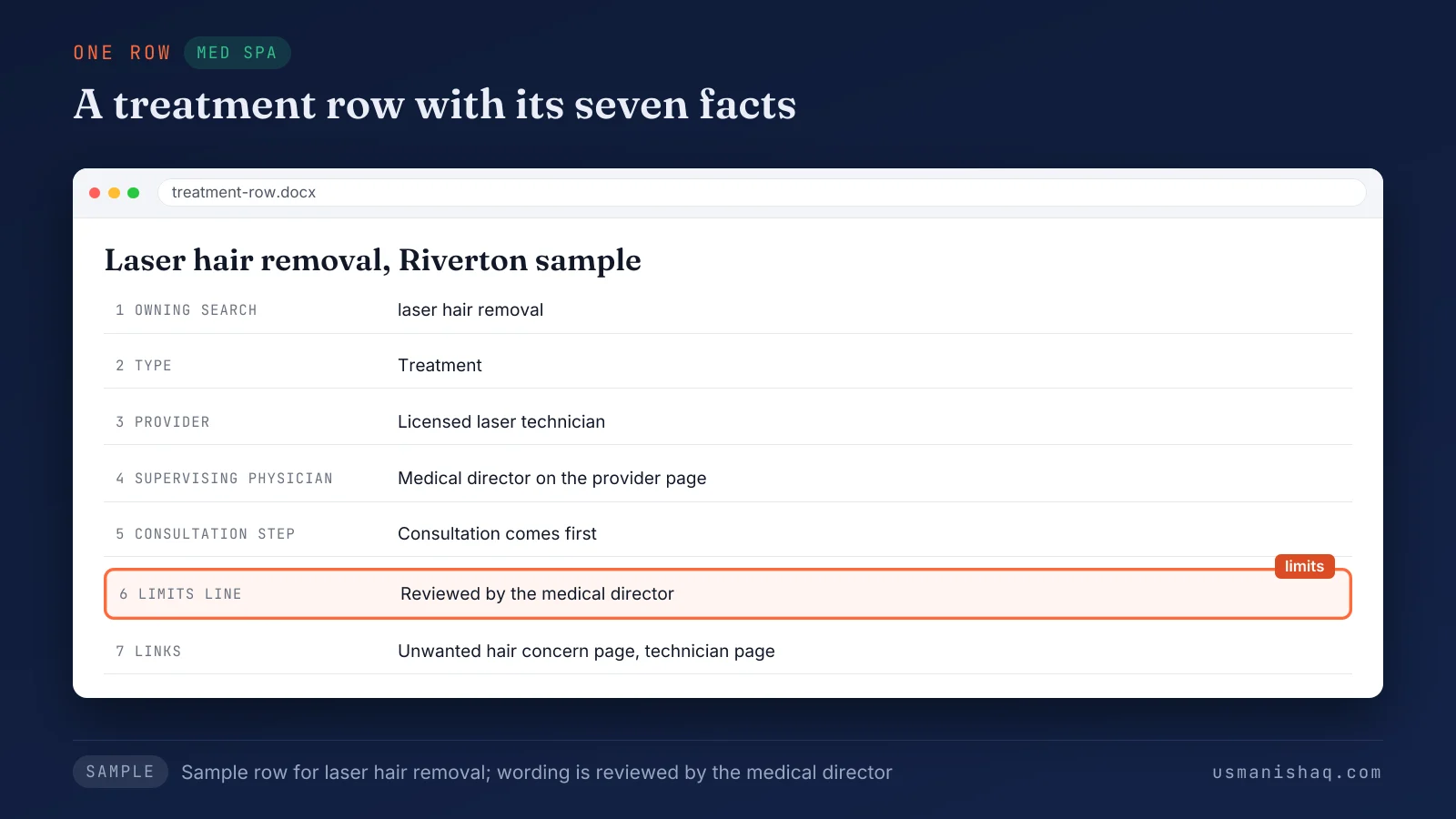
A single med spa treatment row carries seven facts, and the page is written only after all seven are filled.
Take laser hair removal at the Riverton sample spa. The owning search is "laser hair removal". The type is treatment and the provider is a licensed laser technician. Above that person sits the medical director named on the provider page.
The fifth fact is the consultation step. The page says a consultation comes first and that the provider decides what suits the customer. The sixth is the limits line the medical director reviewed. The seventh is the link list, which points to the unwanted hair concern page and to the technician's provider page.
Now count what the visitor sees. They read what the treatment is, who does it and what happens first. They read no promise. That is the point.
The page can still be warm and plain. You describe the visit in the order a customer lives it. Arrival, consultation, the treatment room and the first follow-up call.
How you know a med spa page works
A med spa page works when it brings consultation bookings, and you read that from your booking tool, not from rankings alone.
Count consultations per page. Treatment pages should bring bookings. Concern pages should bring clicks to treatment pages. Provider pages should bring bookings for a named person.
A page with impressions and no bookings needs a clearer answer, not another page beside it. Review the counts each month beside the grid.
Location pages and booking
A med spa with one location needs one location page, and a med spa with several needs one page per site.
Each location page holds the address, the hours, the providers on site and the treatments offered there. Say the Riverton spa opens a second room in Springfield. That page lists the laser technician who works there and only the treatments that room offers.
Booking stays on every page as a link, not a page of its own. Keep the booking tool's service names identical to your treatment page titles, so a visitor sees the same words twice.
The Semantic SEO Architecture plan with a provider grid sets this build list for your spa before anyone writes a word.
Prices, device brands and aftercare
Three questions follow the grid, and they are about prices, device brands and aftercare.
Should a med spa website show prices?
Yes, a page can show a price range or a starting point where one exists. Add a line that the consultation sets the final plan.
A dental practice has the same question. The topical map for a dental clinic website answers it with a cost page and a consultation step.
Should I create pages for each device or product brand?
Create a brand page only when customers search the brand name and your provider uses it.
Otherwise the brand sits as a line on the treatment page. A page for a device you retire next year is a page you must redirect.
Where does aftercare go?
Aftercare goes in a question page that the treatment page links to, written by the provider.
The provider writes it because the wording is clinical. Links between the treatment page and the aftercare page follow internal linking between related pages.
The med spa map on one line
A med spa map gives each treatment, concern and provider one page. Each page stays inside the limits your medical director sets.
Build the provider and treatment grid first, then the treatment pages, then the concern pages that point to them. Leave every medical claim to the people licensed to make it. The map only decides which pages exist and who stands behind each one.