
Compound SEO is search work whose results keep growing after the work stops, and it applies to some pages only.
Compound SEO is a practitioner phrase, and I could not find it in Google's SEO starter guide. I use it for one question that owners ask me in plain words. If you stop paying for SEO, what keeps working and what quietly stops?
It depends on the page. A page that answers a stable question can keep earning for a long time. A page that states prices, rules or opening hours starts to slide the day those facts change.
What is compound SEO?
Compound SEO is the part of search results that keeps earning on earlier work, such as ranking pages and matching names.
Borrowed from finance, the word suggests interest. You do the work once and some of it pays again each month without a new invoice.
That picture is only half right. Nothing in search stays fixed. Rivals publish, facts change and search engines update. A page that held a year ago is not guaranteed to hold next year.
Ahrefs's guide to continuous SEO says SEO cannot be switched on and off like a tap, as paid ads can be. I read that as a warning against the idea that all of it compounds.
What keeps growing after the work stops?
Little keeps growing after the work stops, but a page on a stable question with facts that stay true keeps earning.
Here are the assets that tend to hold, in the order I check them.
- A service page on a question that does not change, such as how a repair is done.
- Pages whose facts are stable, so nothing on them goes false.
- Names and addresses spelled the same on every page and listing.
- Internal links already in place between related pages.
- Links from other sites that were earned and still stand.
None of these grows on its own after you stop. They tend to keep their position for as long as nothing around them moves. The word "grow" is the owner's hope, and "hold" is what I can support.
I have no measured decay rate, and none of the sources I read gives one. Treat any promised timeline as unverified.
What stops when the work stops?
What stops when the work stops is new coverage, new links, fresh facts and the review that catches stale pages.
Most of a site's assets fall into one of three groups, and only one group keeps working unaided.
| Asset | Group | Why |
|---|---|---|
| Service page on a stable question | Holds | Nothing on it goes false |
| Page with prices, rules or hours | Slides | Facts change, so the page goes wrong |
| Page on a topic rivals keep improving | Slides | Rivals pass it as it stands still |
| New town and service pages | Stops | Nobody writes them |
| New links from other sites | Stops | They come from new work |
| Answers checked in AI tools | Stops | Nobody checks, so errors stay |
| Monthly report reading | Stops | Problems go unseen |
Six of the seven rows slide or stop even if every old page stays online. The site looks the same and the gap to its rivals widens.
The page ledger test, step by step
The page ledger test tags each page as holds, slides or stops and gives it a date for its next look.
I run it on the pages that bring calls, not on the whole site. Plan about an hour for twenty pages.
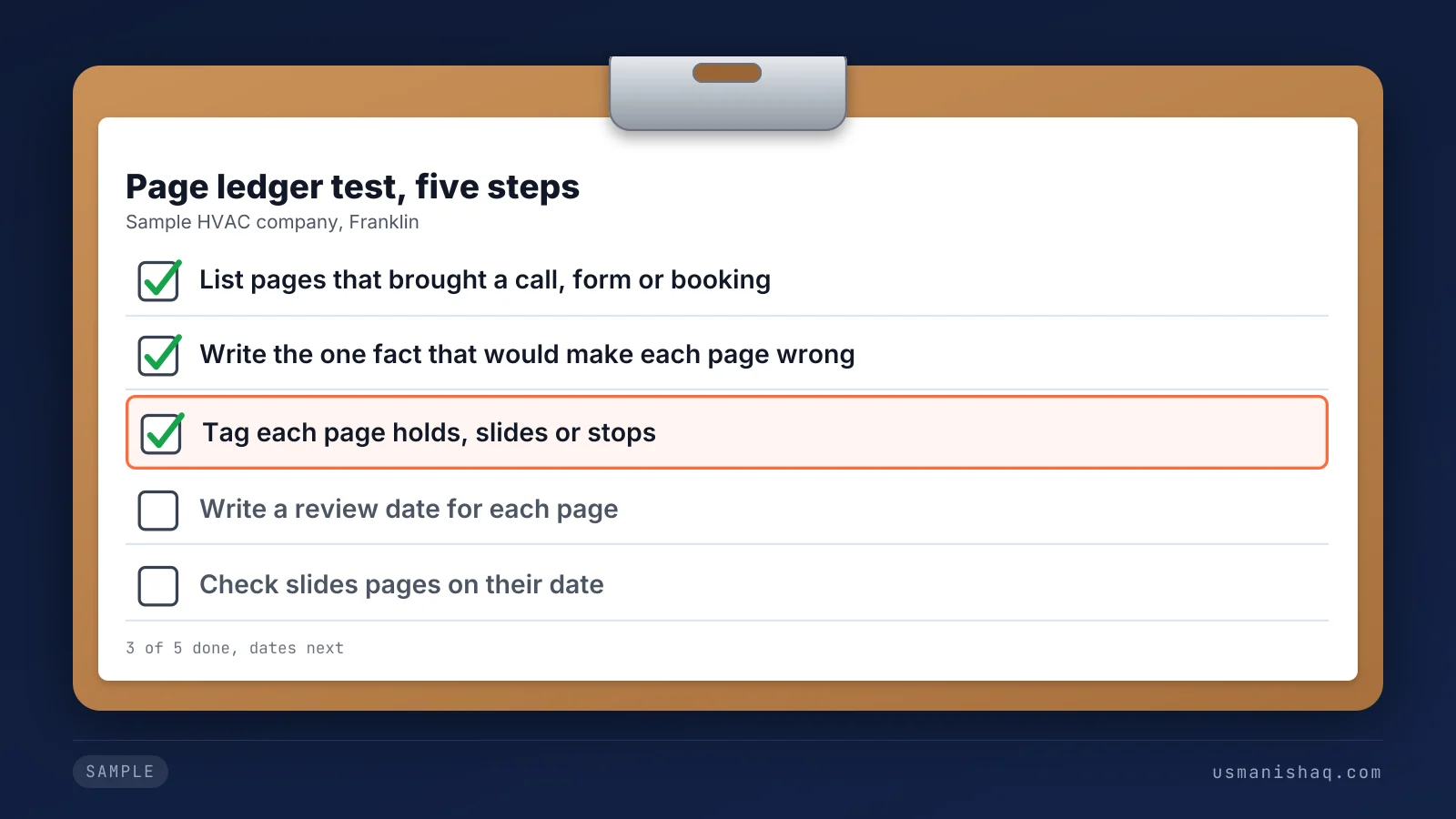
- List the pages that brought a call, a form or a booking in the last six months.
- For each page, write the one fact that would make it wrong, such as a price, a rule or a phone number.
- Tag a page holds if no such fact exists, slides if one does and stops if it needs new work.
- Write a review date, shorter for slides pages and longer for holds pages.
- Check each slides page on its date and change the fact if it moved.
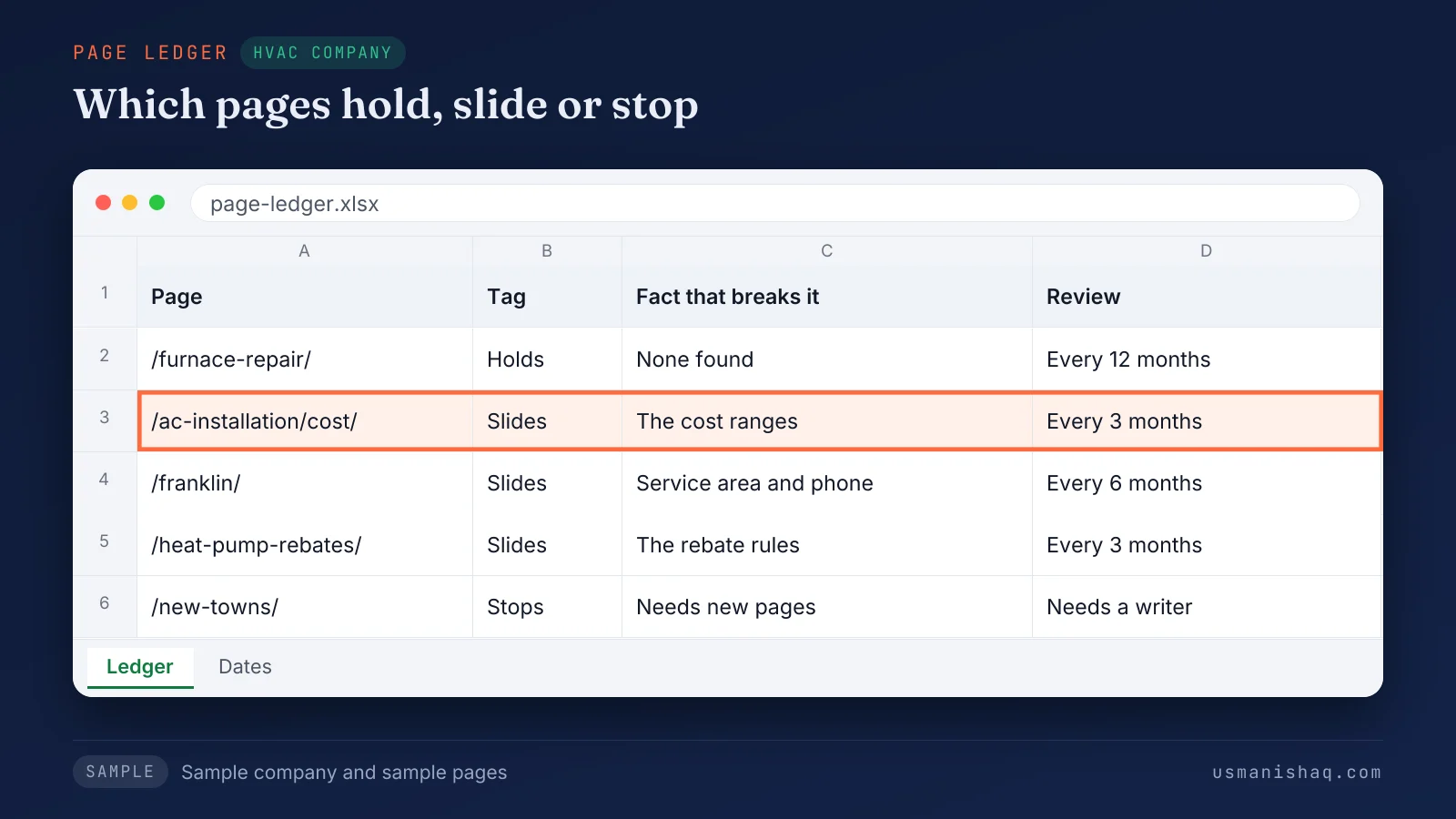
The sample below is an HVAC company in Franklin. The pages and tags are invented to show how the ledger reads.
| Page | Tag | Fact that breaks it | Review |
|---|---|---|---|
| /furnace-repair/ | Holds | None found | Every 12 months |
| /ac-installation/cost/ | Slides | The cost ranges | Every 3 months |
| /franklin/ | Slides | Service area and phone | Every 6 months |
| /heat-pump-rebates/ | Slides | The rebate rules | Every 3 months |
| /new-towns/ | Stops | Needs new pages | Needs a writer |
One limit applies. It tags pages by what could go wrong in their own facts, and it cannot predict what rivals will publish next quarter. A holds page can still lose ground to a better page, so check its search performance as well as its facts.
If the site was never planned page by page, a Semantic SEO Architecture page plan shows which pages are worth tagging.
What the timing evidence says
The timing evidence says results take weeks to months to show, and only your own data shows how fast they fade.
Google's SEO starter guide says changes can take effect in a few hours or several months. It suggests waiting a few weeks before judging an effect. That covers the way up. It says nothing about the way down.
What you can measure is your own site. Note the date work stopped. Then compare clicks per page in Search Console, three months before against three months after, and look at which tags lost.
What owners ask about stopping and restarting
Owners ask if they can pause, how often to refresh old pages and how to see which pages still earn.
Can I stop paying for SEO once the pages are live?
You can stop, and the holds pages will probably keep earning while the slides and stops pages lose ground.
Whether stopping is sensible depends on what the work brought in. Whether SEO is still worth it for a small business sorts that out by type of search.
How often should old pages be updated?
Old pages should be updated when their breaking fact changes, and checked on the review date in the ledger.
A calendar of "every month" wastes time on holds pages. If you wonder how many new posts the site needs, how many blog posts a small business needs shows the count.
Where can I see which pages still earn?
Search Console shows clicks and impressions per page, and that is where each tag gets checked.
Step-by-step reading is laid out in how to read an SEO report.
Compound SEO in short
Compound SEO is real for pages that answer stable questions and false for pages whose facts change.
Tag each page holds, slides or stops and give it a review date. Expect the site to hold only where the ledger says it should.