
Blog posts for a small business are counted from its topical map, question by question, as a post or another page. The count equals one post per customer question that earns its own page, so no fixed number applies.
A topical map is the plan of every service, town and customer question a website covers. Semantic SEO builds that plan so search engines understand which page owns each answer.
The posts are counted in five steps, and the result is a list of named question pages. Each post should go live when its answer is ready, whatever frequency studies or monthly quotas suggest.
More posts are added when a small business gains a service, a town or a customer question, even without a blog section. Posts written to a quota cause three problems, checked in the SEO quote, in old posts and against the map.
What decides how many blog posts a small business needs?
Blog posts for a small business are counted from its topical map, question by question, as a post or another page.
A blog post, in map terms, is a question page. Question pages sit in the outer section of the map and link to the service pages that sell.
Each customer question gets one owner. Some questions earn a page of their own, and that page is the blog post. Most questions belong on a page the business already needs.
Semantic SEO applies that sorting question by question, so search engines understand which page answers what. The first job is knowing which questions earn a post.
Which customer questions earn a blog post of their own?
A customer question earns its own blog post when customers search it and no service, town or price page answers it.
The tests a customer question passes before it earns a blog post are listed below:
- Demand: customers type the question into Google, ask it on calls or send it by email.
- Different thing: the question names a fault, a choice or a comparison that no other page owns.
- Different results: Google shows different pages for the question than for the service page's search.
- Pattern: the question repeats across the trade, such as "why is my water heater making a popping noise".
The four tests are a planning method used in semantic SEO, not a rule Google publishes. A plumbing search such as "pex vs copper repipe" passes all four and earns a question page.
The question "what happens on repipe day" fails the different-thing test. The answer stays a section of the repiping page. Questions that fail the tests still need a home, and that home is usually a service page.
Which questions belong on a service page instead of a blog post?
Most customer questions belong on a service, price, town or booking page instead of a blog post.
The owners that answer a customer question instead of a blog post are listed below:
- Price page: cost questions, such as "how much does a new AC unit cost".
- Town page: area questions, such as "do you service Lakeside".
- Service page section: steps and inclusions, such as "what does a furnace tune-up include".
- Booking page section: financing, free estimates and opening hours.
The answer stays on the site in every case. Only the separate URL goes, and semantic SEO keeps the question with the page that sells the job.
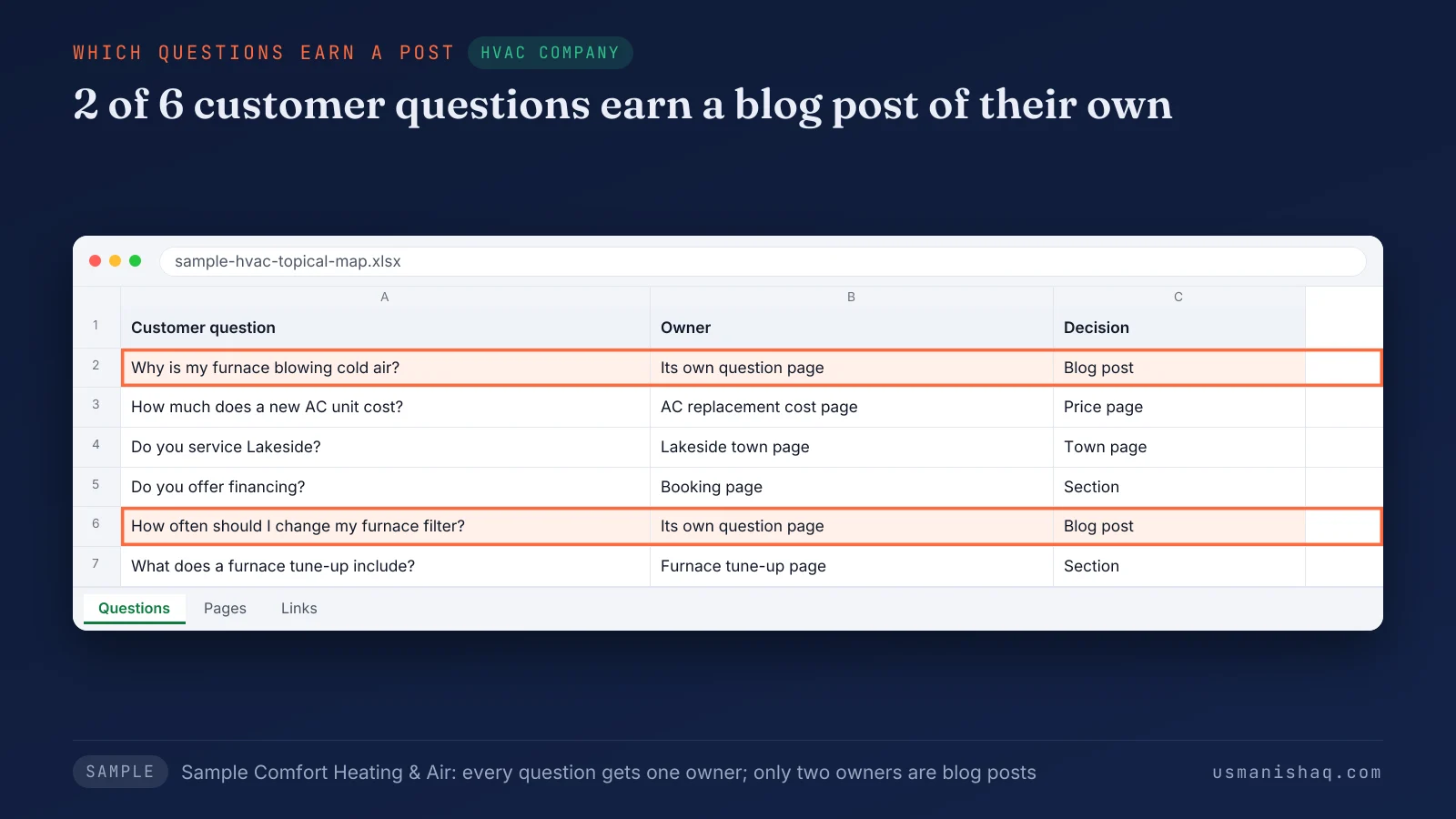
The sample HVAC map below sorts six customer questions. Two earn a blog post: why a furnace blows cold air and how often to change a furnace filter. The other four go to a price page, a town page and two page sections.
Counting every question for a whole business takes a short procedure.
How does a small business count the blog posts it needs?
Blog posts for a small business are counted in five steps, and the result is a list of named question pages.
The steps that count the blog posts a small business needs are listed below:
- List every service the business sells and every town it serves.
- Collect customer questions from calls, emails, reviews, Google Business Profile questions and Google Search Console queries.
- Give each question one owner: a page, a section of a page or a sentence.
- Count the questions that earned a page and are not service, price or town pages.
- Subtract the questions that a live post already answers.
The number left is the blog post count. Semantic SEO keeps that count tied to real searches, so every post has a job before anyone writes it.
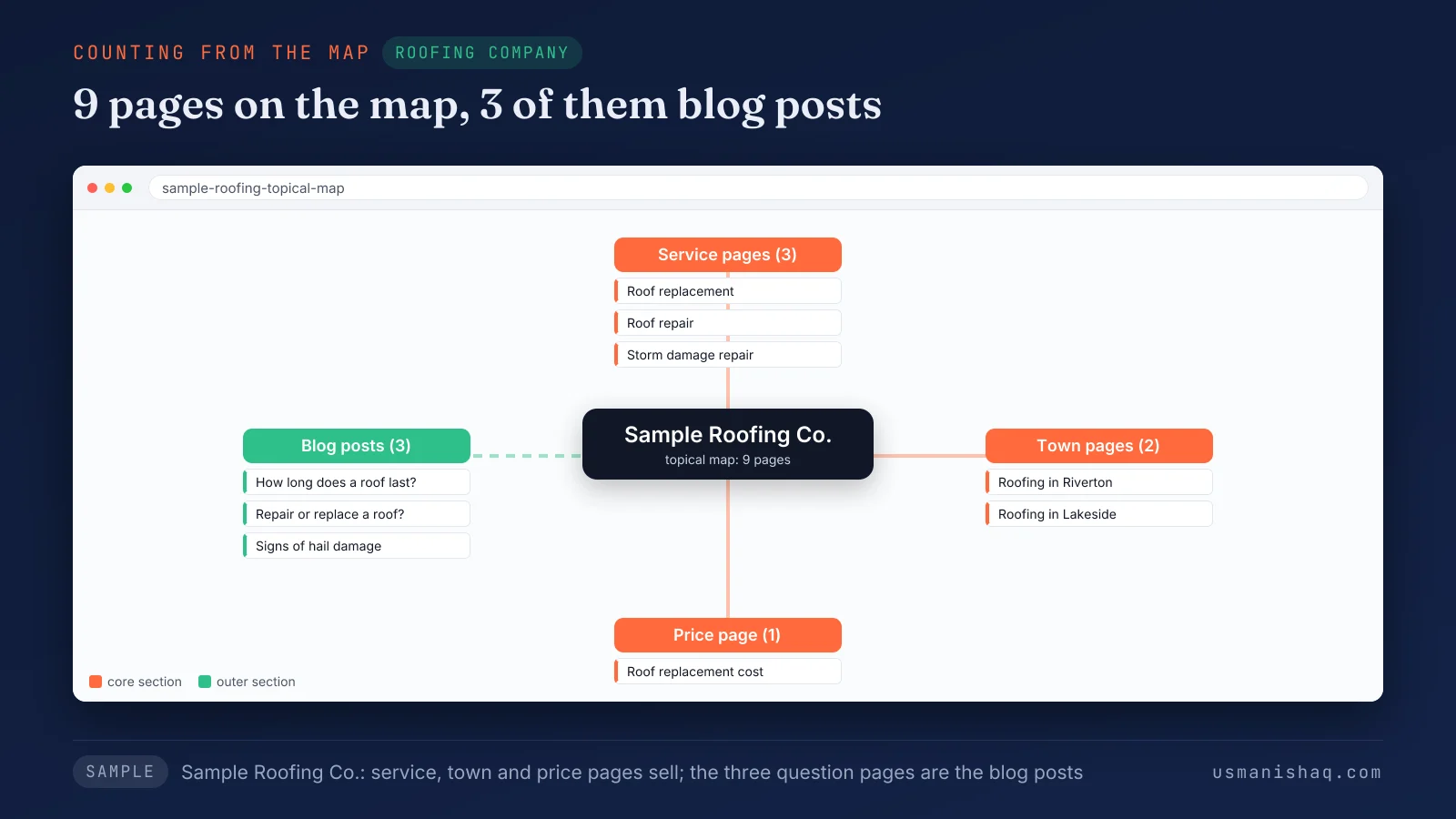
The sample roofing map below holds nine pages. Three are service pages, two are town pages and one is a price page. The other three are blog posts: how long a roof lasts, repair or replace a roof, and signs of hail damage.
The same count drives the Semantic Content Production workflow: one brief per map row, then one written page per brief. Real maps give a sense of the size of that list.
How many blog posts does a trade business end up with?
A trade business ends up with one blog post per question page, and the maps on this site hold two and four.
The repiping map for one plumbing service in two towns lists six pages. Two of them are question pages: PEX vs copper repipe, and signs you need a repipe.
The full plumbing company map lists 14 pages, and four of them are question pages. No benchmark for trade businesses turned up in the research for this page, so none is given here.
I count posts from the map before I count weeks. Semantic SEO treats the post count as an output of the map, never as an input. The next question owners ask is how often those posts go live.
How often should a small business publish blog posts?
Blog posts for a small business should go live when each answer is ready, whatever frequency studies or monthly quotas suggest.
John Mueller of Google posted on Twitter on 17 March 2021. The post read: "Google doesn't count your blog posts." Mueller added that quality matters more than quantity.
Mueller made the same point on 6 March 2018: a site is not a machine that publishes at a fixed rate.
Google Search Central's guide on creating helpful, people-first content lists a warning sign. The sign is producing lots of content on many topics in the hope that some of it ranks.
A steady rhythm still suits a busy owner. One finished post per map row, then the next row, is a rhythm most owners can keep. Semantic SEO sets the order of the rows, and the studies on frequency deserve a careful read.
What do blog posting frequency studies show?
Blog posting frequency studies show faster growth on higher-frequency blogs, and the recent study behind that claim measured B2B SaaS websites.
Stratabeat summarised its 2025 B2B SaaS SEO Performance Report in a post by Tom Shapiro dated 18 March 2025. Websites in the study that posted nine or more times a month grew monthly organic traffic by 20.1%.
The growth rate was 3.6 times that of sites posting one to four times a month. Higher frequency can lift traffic for software companies, according to that report.
The same report states that frequency alone was not enough. Top performers paired it with original research, custom graphics and internal linking.
A plumber or an HVAC company is not a B2B SaaS website, so the figures do not transfer. No dated frequency study of trade or service businesses turned up in the research.
A widely repeated HubSpot lead figure carries no date in any source read, so the figure is left out. Semantic SEO reads a study's sample before its number.
Is one blog post a month enough for a small business?
Yes, one blog post a month is enough for a small business when each post answers a customer question from its map.
Publishing more often does not make a site rank faster, since Google does not count blog posts.
When does a small business need more blog posts?
Blog posts are added when a small business gains a service, a town or a customer question, even without a blog section.
The events that add blog posts to a small business map are listed below:
- A new service, which brings its own customer questions about faults and choices.
- A new town, where a local question such as permit rules earns a post only when customers search it.
- A question that repeats on calls, in emails or in reviews.
- A Search Console query with impressions and no page that owns it.
- A seasonal question that returns each year, such as spring AC tune-ups or frozen pipes in winter.
A calendar date is not on the list. Semantic SEO adds the row to the map first, then the post follows.
Does a small business need a blog at all?
No, a small business does not need a section named blog; it needs pages for the questions its customers search.
Question pages sit under /blog, /guides or a resources folder, and the folder name changes nothing. Each question page links to the service page it supports.
What goes wrong when a small business blogs to a quota?
Blog posts written to a quota cause three problems, checked in the SEO quote, in old posts and against the map.
The problems that quota blog posts cause for a small business are listed below:
- Posts that answer no customer search, such as holiday greetings or general tips.
- Posts that compete with a service page for the same search, such as a post on one service in one town.
- Posts outside the services the business sells, which pull the site away from its trade.
Google's guide Creating helpful, reliable, people-first content lists content made in volume on many topics as a warning sign. Semantic SEO avoids all three problems by giving each post a map row before a date.
Two posts that answer one search split it, and the tests for which query earns a page decide which one keeps it.
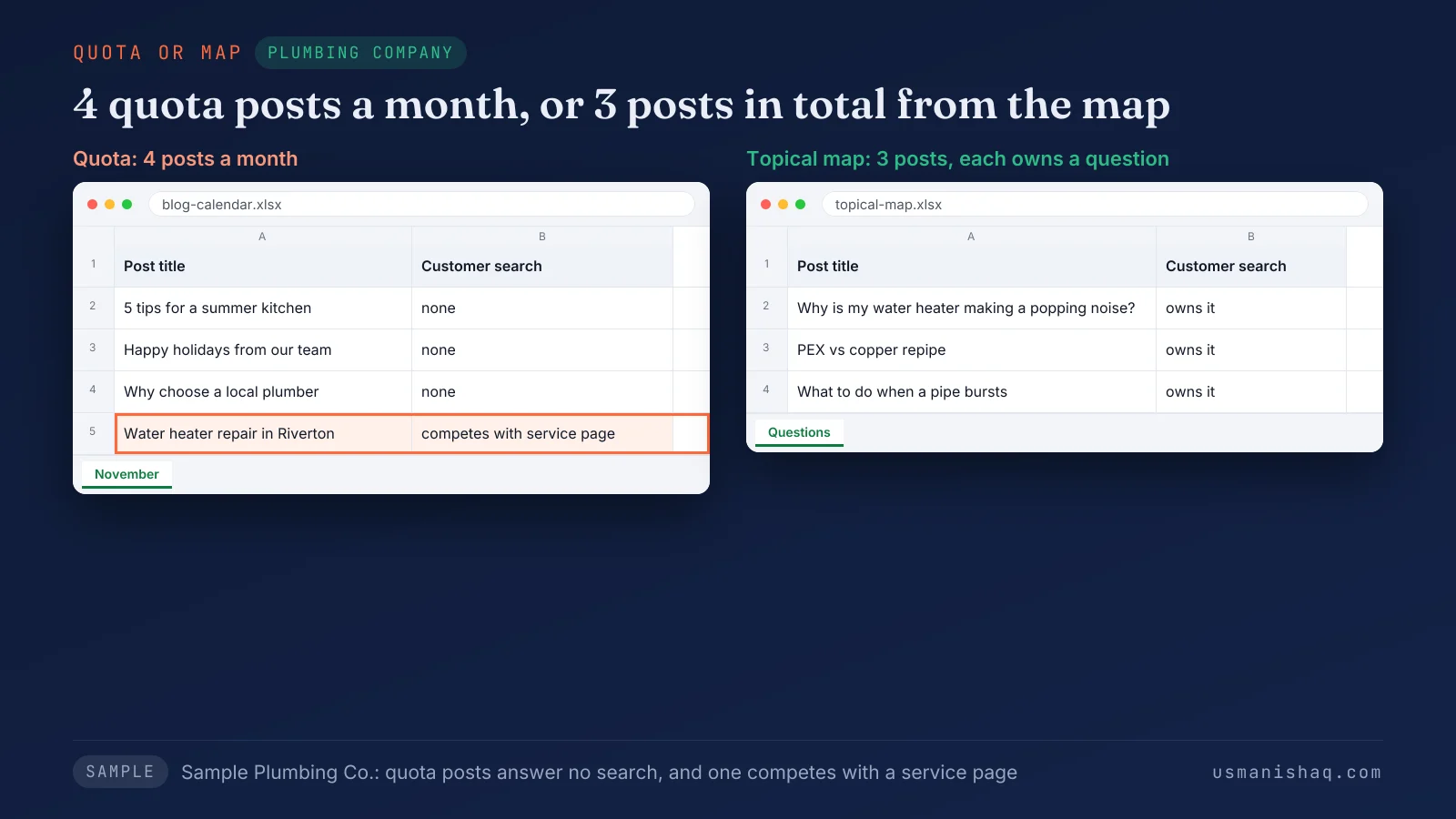
The sample plumbing calendar below holds four posts in one month. Three answer no customer search, and one, water heater repair in Riverton, competes with a service page. The map list holds three posts in total, and each owns one question.
How should an owner read blog posts in an SEO quote?
An owner should read blog posts in an SEO quote as named customer questions, not as a monthly count.
Each post in the quote should name the map row it answers. A line such as "4 blog posts a month" with no named question buys volume, not answers.
The other lines of the quote follow the same logic, and the steps to judge a monthly SEO retainer quote cover them.
What happens to blog posts a business already has?
Blog posts a business already has get one decision each: keep, merge into a stronger page or remove with a redirect.
A post that competes with a service page merges into that page. A post that answers no customer search is removed or rewritten for a map question.
The decisions come from a page-by-page check, and how a semantic content audit runs shows the order of that check.
Where does the list of customer questions come from?
The list of customer questions comes from the business's topical map, the plan that gives every service, town and question one owner.
The topical map as used here comes from the semantic SEO framework of Koray Tuğberk Gübür. The framework is a method of work, not a statement by Google.
The columns, the steps and the checks are set out in what goes into a topical map for a business website.
A full trade example, with its four question pages, is the topical map for a plumbing company website.
Questions owners ask about blog posts
Blog posts raise three more owner questions: the count before launch, the count before traffic and the length of each post.
How many blog posts does a new website need before launch?
A new website needs no blog posts before launch, because service, town and price pages come first. Question pages follow in the order the topical map sets, which is how semantic SEO sequences a new site.
How many blog posts does it take to get traffic?
No number of blog posts brings traffic on its own, because traffic comes from posts that answer questions customers search.
How long should a blog post be for SEO?
A blog post should be as long as its customer question needs, because extra words do not make a page better. John Mueller of Google made the same point about pages and words in March 2021.
The number of blog posts a small business needs
Blog posts a small business needs are counted from its topical map, one for each customer question that earns a page.
No weekly or monthly quota sets the number. Each post goes live when its answer is ready.
New rows arrive with new services, towns and questions. Semantic SEO keeps the count tied to what customers search.