

A service page should have an FAQ section only for the questions its other sections cannot hold. Each answer needs to be short and real.
Plenty of service pages carry an FAQ because a plugin added one. Eight questions, each answered in a vague sentence, sitting under the contact form. A buyer has little reason to read them.
Google has also stopped showing FAQ rich results. That removes the old reason for adding one to every page.
Should a service page have an FAQ section?
Yes, a service page should have an FAQ section when buyers ask questions that the page's own sections do not answer.
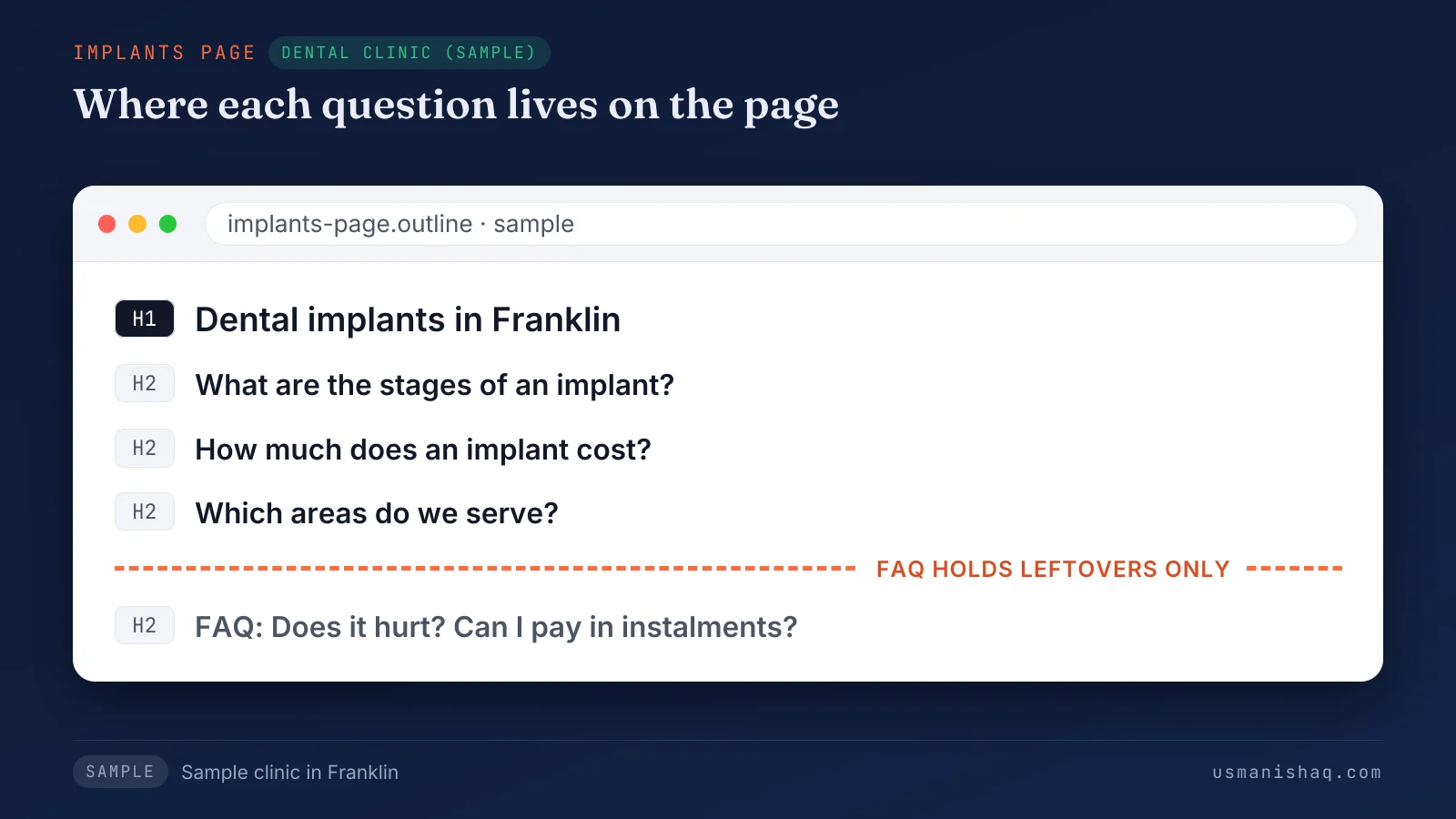
Take a dental clinic's implants page. Sections cover the procedure, the stages, the cost range and the areas served. A buyer still asks whether the treatment hurts, and whether the clinic offers a payment plan. Those questions fit nowhere in the sections, so they go in an FAQ.
If every question fits under an existing heading, no FAQ is needed. The answer belongs in the section, where it reads as part of the page.
I treat the FAQ as a catch-all for leftovers. It is not a place to repeat the page in question form.
What changed when Google retired FAQ rich results?
Google no longer shows FAQ rich results, so an FAQ section no longer earns extra space on the results page.
Google's own announcement in August 2023 said FAQ rich results would show only for well-known, authoritative government and health websites. For all other sites, the rich result was no longer shown regularly.
Google's Search Central changelog then records that the FAQ rich result would no longer appear in Google Search starting 7 May 2026. Its documentation for the feature has since been removed.
So the reason to write an FAQ has changed. It is no longer a way to take more room in the results. It is a way to answer a buyer who is still deciding.
If your pages already carry an FAQ, do not delete it in a panic. Read each question against the tests below and keep the ones that pass. A buyer still reads them, and that was always the main point. Keep the page address the same, so nobody loses a link.
You can read both notices on Google's pages, the 2023 announcement and the Search Central changelog.
Which questions belong in the FAQ?
A question belongs in the FAQ when no section can hold its answer. It also needs buyers who ask it before they call, and an answer that stays stable.
I run three tests, in order. They are my own working habit, not a Google rule.
- Section test. Can the answer sit under an existing heading? If yes, move it there.
- Call test. Do buyers ask it before they call? Check your own call notes and emails.
- Stability test. Will the answer be true next year? A changing price should not live in an FAQ.
Finding the questions takes about ten minutes. Open your last twenty emails and call notes about the service. Tally each question you see. Any question asked by two or more people goes on the list. Questions you only imagine stay off it.
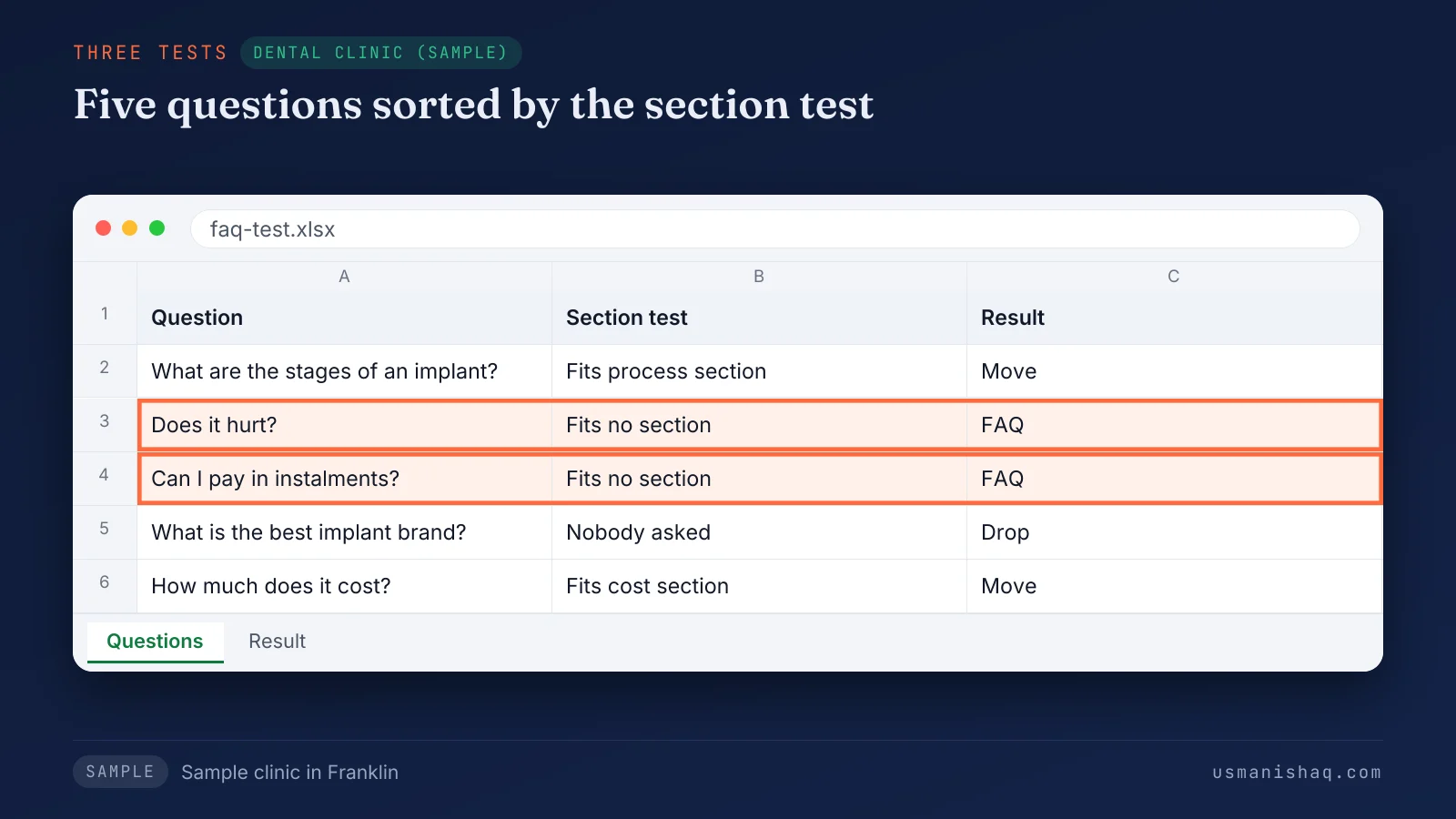
The table shows the tests run on the implants page for a clinic in Franklin. The clinic is a sample.
| Question | Section test | Call test | Result |
|---|---|---|---|
| What are the stages of an implant? | Fits the process section | Yes | Move to the process section |
| Does it hurt? | Fits no section | Yes | FAQ |
| Can I pay in instalments? | Fits no section | Yes | FAQ |
| What is the best implant brand? | Fits no section | No, nobody asked | Drop |
| How much does it cost? | Fits the cost section | Yes | Move to the cost section |
Two of five questions stay. The others move up or go. A long FAQ can mean the sections are thin. Say a law firm lists twelve questions on a family law page. Nine of them are really section topics, such as fees, timing and what to bring. Pull those up, give each a heading and the page gets fuller, while the FAQ shrinks to the three oddities.
Writing each FAQ answer
Writing each FAQ answer means opening with a direct answer in one or two sentences, naming the service and stopping.
Write the answer so it makes sense alone. A buyer may land on one line from a search and never see the rest of the page.
Say "Most tank water heaters are replaced in one visit." Do not say "It depends on many factors." If it does depend on something, name it, and say what you do about it.
Here is a plumber's version of the same fix. Before, the answer read "Our team will assess your needs and advise accordingly." After, it reads "A tank water heater is usually replaced in one visit, and we haul the old tank away the same day." The second answer names the job, the time and what happens to the old unit. A buyer can act on it.
Use the buyer's words for the question. Take them from calls, emails and chat logs, since your own phrasing rarely matches. Skip questions about your company's policies and keep each one about the service on the page.
Keep each answer under about sixty words if you can. Long ones belong in a section, with a heading of their own. If an answer needs a table, it was never an FAQ question.
Place the FAQ below the main content and above the final call to action. Buyers who need it will scroll to find it, and the others will not feel slowed down.
Planning the FAQ with the page
An FAQ section is written once the page's main sections exist. The questions that remain are the ones those sections left open.
That order matters in planning. A writer who starts with the FAQ ends up with eight questions and a thin page, because the FAQ becomes the page. Starting with the sections shows which questions are truly left over. I write the page, run the three tests on the questions buyers sent in, and add the survivors last. On a typical service page that is a handful, and some pages need none. Semantic Content Production for service page questions writes the sections from facts first and then adds only the questions that are left.
FAQ sections, schema and AI answers
An FAQ section no longer needs FAQ schema to be useful, and it does not guarantee a place in AI answers.
FAQ schema on a service page
A service page does not need FAQ schema, because Google no longer shows the rich result.
You may leave existing markup in place. I have not seen a Google notice that asks for existing markup to be removed. Add no new markup in the hope of a result that no longer exists.
Does an FAQ help a service page appear in AI answers?
An FAQ may help a service page appear in AI answers when each answer stands alone, but no tested rule says so.
Self-contained passages are easier for any system to lift. Nothing documented ties an FAQ block to being cited. I explain how to write each passage so it makes sense alone in making each answer stand alone on a service page.
How many questions an FAQ holds
An FAQ holds as many questions as pass the three tests, and for most service pages that is a small handful.
No number is documented. In my audit of a store's product FAQs, each question was checked for real demand before it stayed. I wrote it up as an FAQ audit of a skincare store.
The parts of a service page that rank and bring calls cover the rest of what the page holds.
FAQ sections on service pages in short
A service page needs an FAQ section for the few questions its sections cannot hold. Run the section, call and stability tests on each. Anything that fails goes into a section or out of the page.