
You find a schema consultant by looking in three places, testing their markup with free tools and handing over a one-page brief.
Schema markup is code that labels the facts on a page, such as your business name, address and services. In my view most owners need it done once and kept accurate, not a long contract.
The hard part is telling a person who writes valid code from a person who gets the facts right. The first kind looks good in a portfolio, which is why a portfolio is not enough.
Where do you find a schema consultant?
You find a schema consultant in three places, which are your own web people, SEO consultants and open marketplaces.
Start with the person who built or maintains your site. A web developer often adds markup in the same visit, and your site's theme or plugin may already output some.
Next come SEO consultants. A consultant who plans your pages can write markup that matches them, so the facts stay consistent. Technical SEO and Schema deliverables show what that work looks like when it is scoped as a service.
Last are marketplaces and directories. Upwork lists freelancers who offer schema markup, and 50Pros lists agencies. Everything on those pages is the seller's own claim, so check it before you act on it.
| Where | What you see | What to check |
|---|---|---|
| Your web developer | Existing markup in your page source | Does it match the text on the page? |
| An SEO consultant | Page plans and samples | Which pages get markup, and why? |
| A marketplace gig | Ratings and a price | Whether any past work is live on a URL |
| A directory of agencies | Reviews and case studies | Whether the work was for your kind of business |
One owner on a local search forum asked for someone who knew SEO, not just JSON-LD. That is the right instinct. Code is the easy half, and knowing which facts belong on which page is the other half.
Be careful with roundup articles. One list of schema companies that I read ranks the publisher's own firm first. Schema App's page on hiring versus doing it in house was written by a schema software vendor. Both are useful reading and neither is neutral.
What a schema consultant should show you before you hire
A schema consultant should show live pages with their markup, a passing test result and where each fact came from.
Ask for three things.
- Two URLs where they added markup, ideally for a business like yours.
- The result of Google's Rich Results Test for each URL.
- A sentence on where each fact in the markup was taken from.
Google's documentation recommends JSON-LD where your setup allows it. It names the Rich Results Test as a way to validate markup. It also says that supplying fewer but complete and accurate properties matters more than many incomplete ones. A consultant who adds every property they know has not read that page.
The Schema Markup Validator at validator.schema.org is a second free tool. Run both and ask about any difference.
How to test a schema consultant in thirty minutes
You test a schema consultant by checking that every value in their sample markup also appears as readable text on the page.
You need a laptop and the consultant's two sample URLs.
- Paste the URL into the Rich Results Test and note any errors or warnings.
- Paste the same URL into the Schema Markup Validator.
- View the page source and find the block that starts with a script tag of type application/ld+json.
- Pick five values, such as phone number, address and opening hours.
- Find each value in the visible page text, then compare it with your Google Business Profile.
Step five is there because it catches the failure that code checks miss. A page can pass every test and still list a phone number nobody answers.
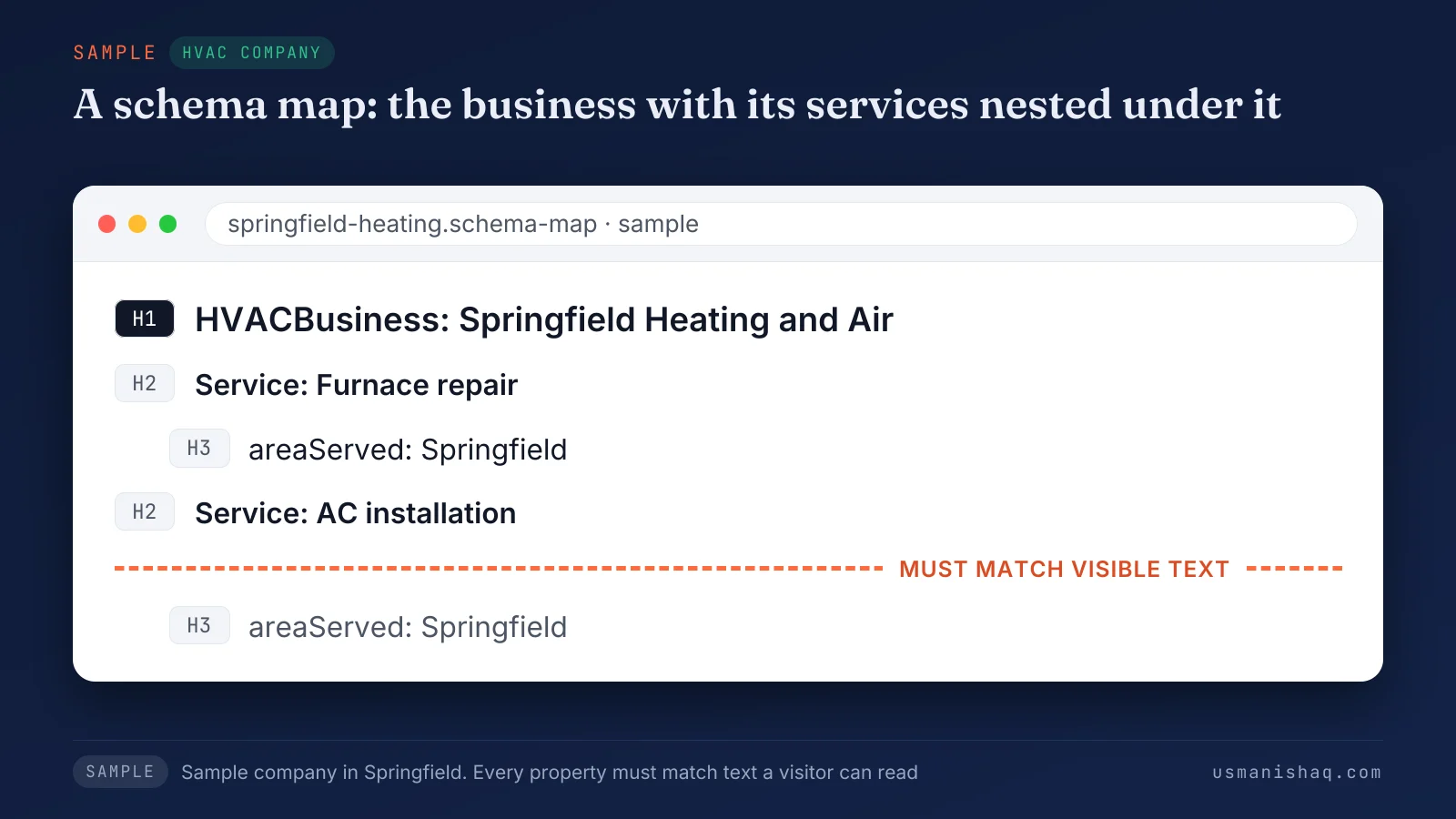
A pass looks like this. For a sample HVAC company in Springfield, the markup names the business type, lists two services and gives one area served. All five spot-checked values match the visible text and the profile.
A fail has one mismatch. The page says "Open Saturday" and the markup says closed. Ask the consultant to explain it. A good answer is "the template pulled an old value, and here is the fix".
What a schema brief contains
A schema brief names the pages, the facts, their sources, who adds the code and how you will check it.
Keep it to one page. Five headings are enough.
| Heading | What you write |
|---|---|
| Pages | Home, each service page, contact page |
| Facts | Name, address, phone, hours, services, areas served |
| Source of truth | Your Google Business Profile, or a fact sheet you supply |
| Who deploys | The consultant, or your developer from their file |
| Check | Rich Results Test on each URL, then a recheck in 30 days |
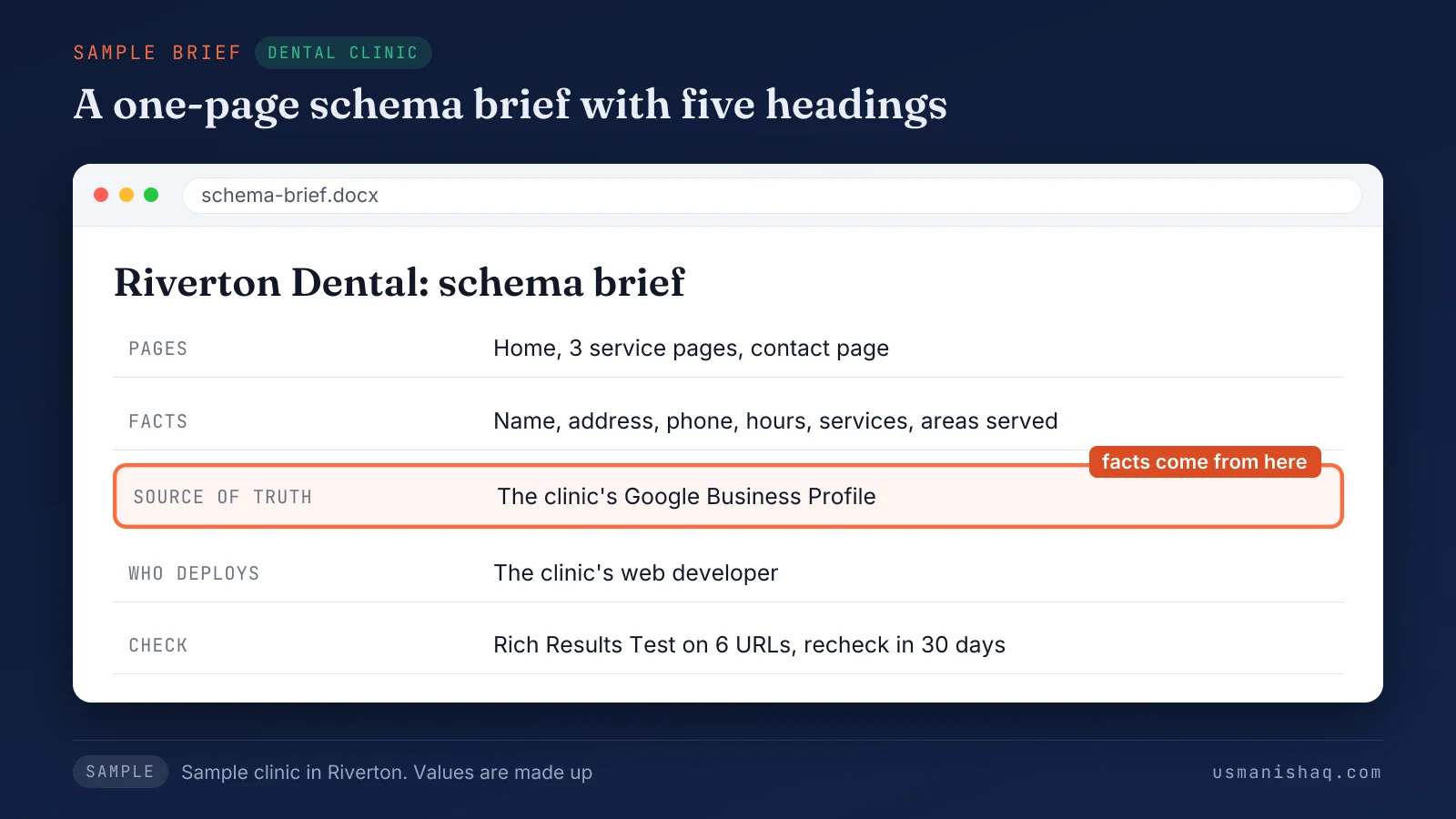
Take a sample dental clinic in Riverton. Pages are the home page, three service pages and the contact page. The source of truth is the clinic's profile, and the developer deploys. The check is a pass on six URLs and a second look after a month.
Write one more line, which is what the consultant must not do. For example, "Do not add review ratings to markup unless the reviews are on the page."
I leave guarantees out of the brief. Markup helps systems read the page, and Google says structured data makes a page eligible for some displays. It does not promise one.
What do owners ask before they hire a schema consultant?
Owners ask whether schema gets them cited by AI, whether a plugin is enough and what to read next.
Does schema markup get my business cited in AI answers?
No, schema markup is not a lever for AI citations, and Google lists no additional requirements for its AI features.
Google's page on AI features says there are no additional requirements to appear in AI Overviews or AI Mode. Markup still helps with accuracy. If an assistant has your hours wrong, fix the facts on your own pages and listings first. The steps are in wrong business facts in AI answers.
Plugin or consultant for a simple site
A plugin is enough for a simple site if its output matches your text, and many towns or services need a consultant.
Run the same five-value test on the plugin's output. If it passes, you may not need anyone. If the plugin repeats one address on every town page, you need a person who plans the facts.
Choosing between two consultants who both pass
Choose the consultant whose sample pages resemble your business and whose answers about sources are plain.
A short paid trial settles a tie, and the post on a paid trial of an SEO consultant shows how. Before the first call, send them what they need, listed in what to send before the first call.
How to find a schema consultant, short answer
Look first at the people already on your site, then at SEO consultants, then at marketplaces. Ask for two live URLs and run the Rich Results Test, the Schema Markup Validator and a five-value comparison against your profile. Give the person you pick a one-page brief.